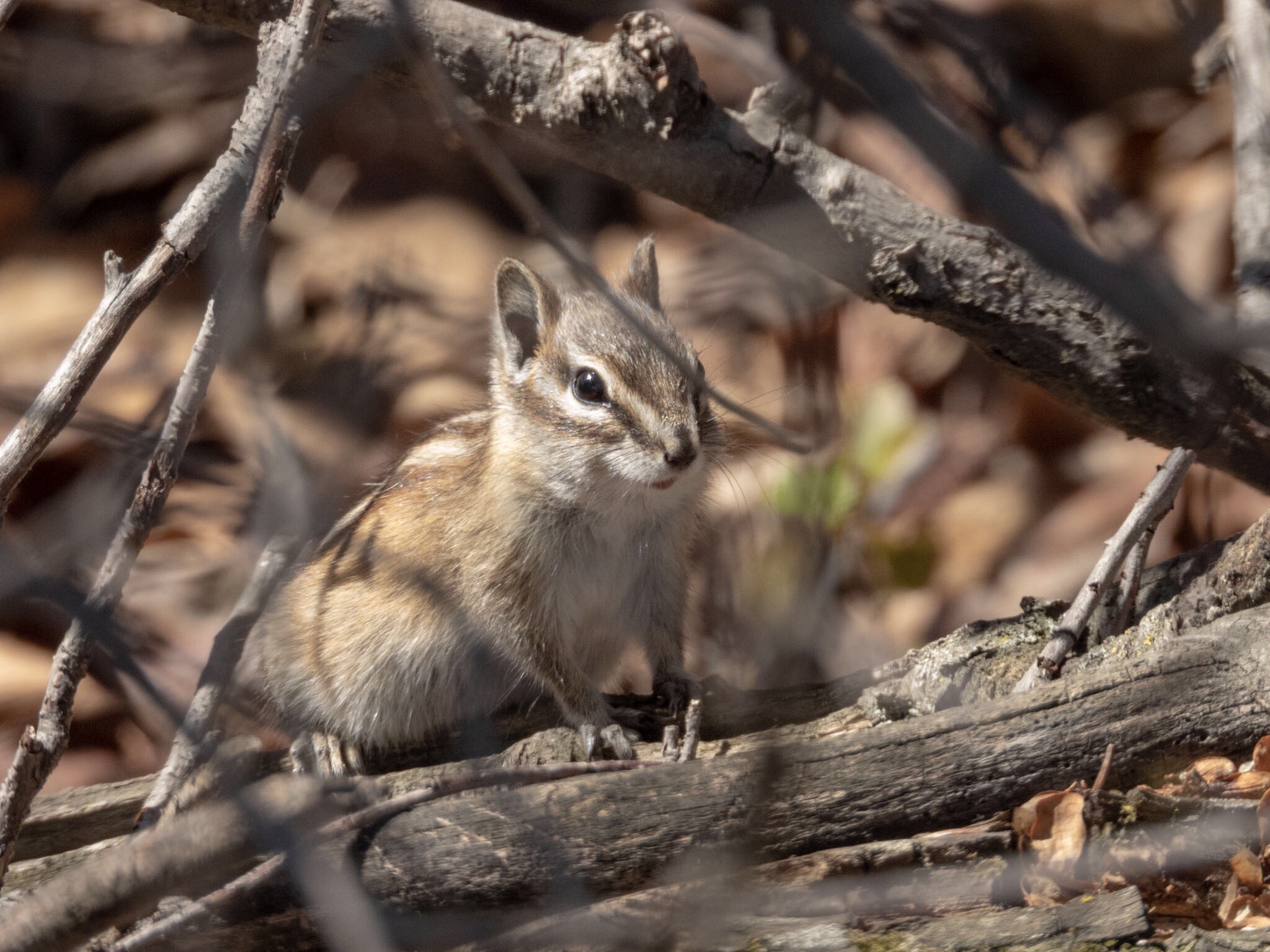
Last Sunday I went on my first bike field trip down to the Whitemud Ravine and through the river valley. It takes a bit of practice to bike, and, at the same time, be ready to bird and take pictures. Where do your keep your binoculars, camera and notebook while biking? You want this gear to be accessible yet out of your way while biking. Hanging the binoculars and camera around your neck does not work so well when on a bike. Still working on the logistics of that, but I am looking forward to doing more bike birding, or nature biking during the summer. The first critter I encountered when I arrived at the ravine was this diminutive Least Chipmunk (Neotamias minimus) scampering through the understory. He was bit apprehensive of the large critter staring at him and making weird noise (that would be me) yet too curious to just run away without checking out what the commotion was about. The Least Chipmunk is the smallest species of chipmunk and the most widespread in North America. These chipmunks are diurnal (primarily active during the daytime), which is probably a good idea considering the nearby Great Horned Owl family.
Nikon P1000, 1000mm @ 35mm, 1/500s, f/5.6, ISO 250. Postprocessed and cropped in Lightroom.
May the curiosity be with you. This is from “The Birds are Calling” blog (www.thebirdsarecalling.com). Copyright Mario Pineda.
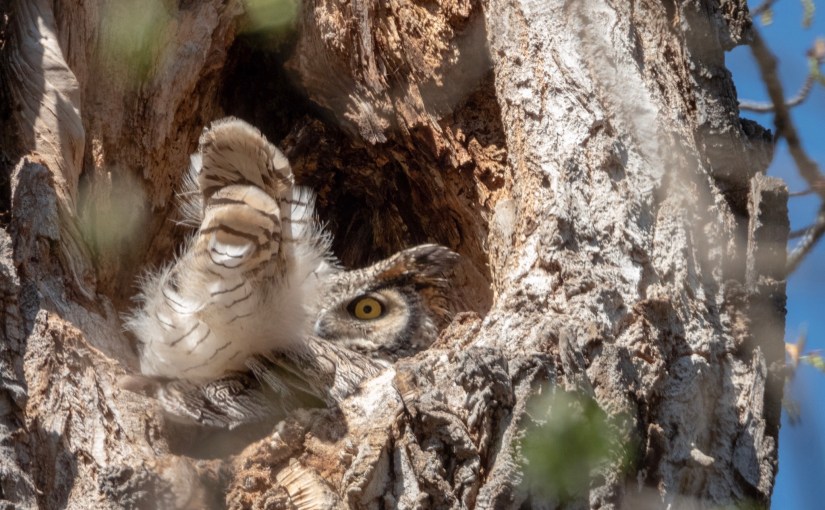
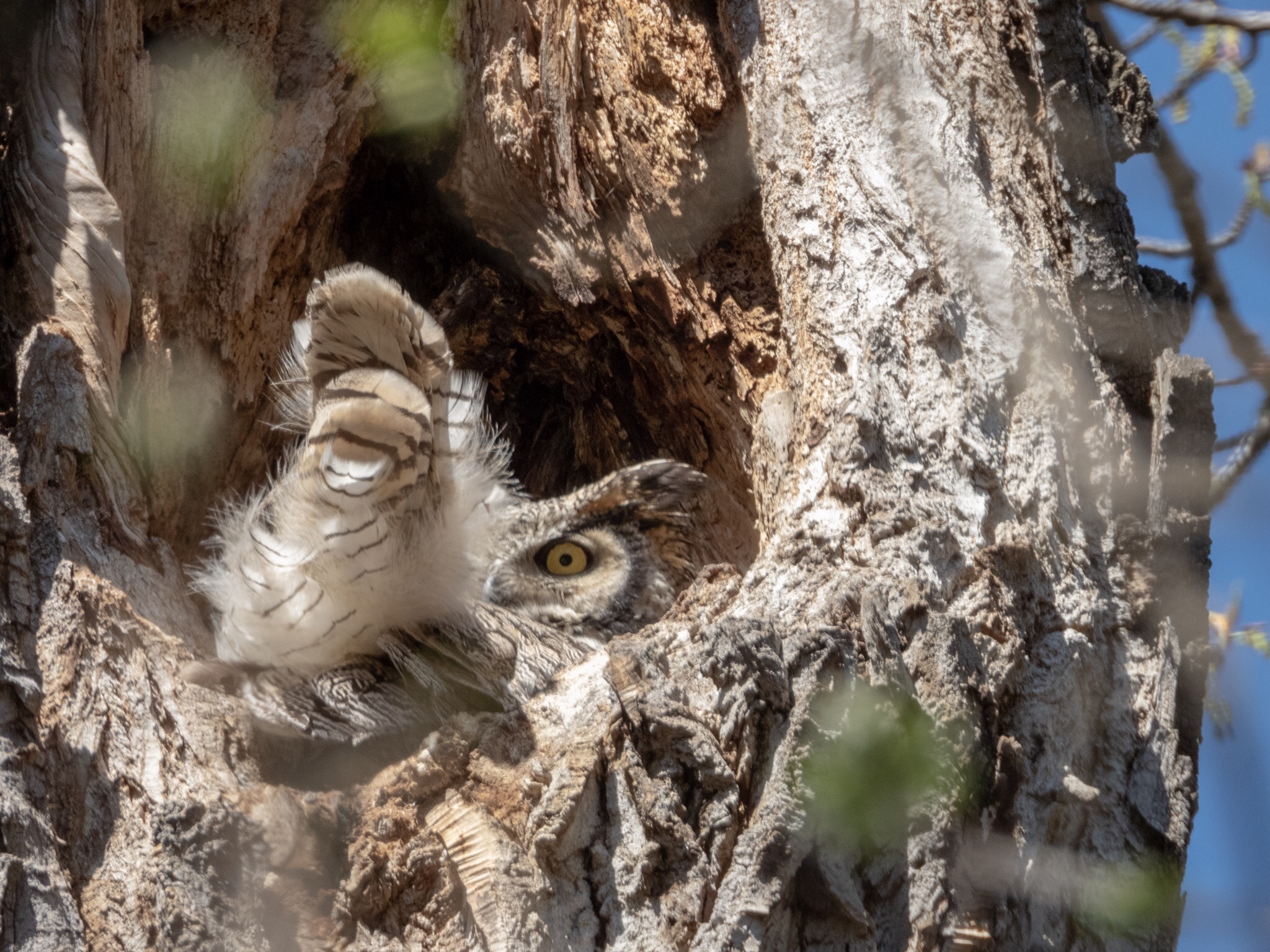
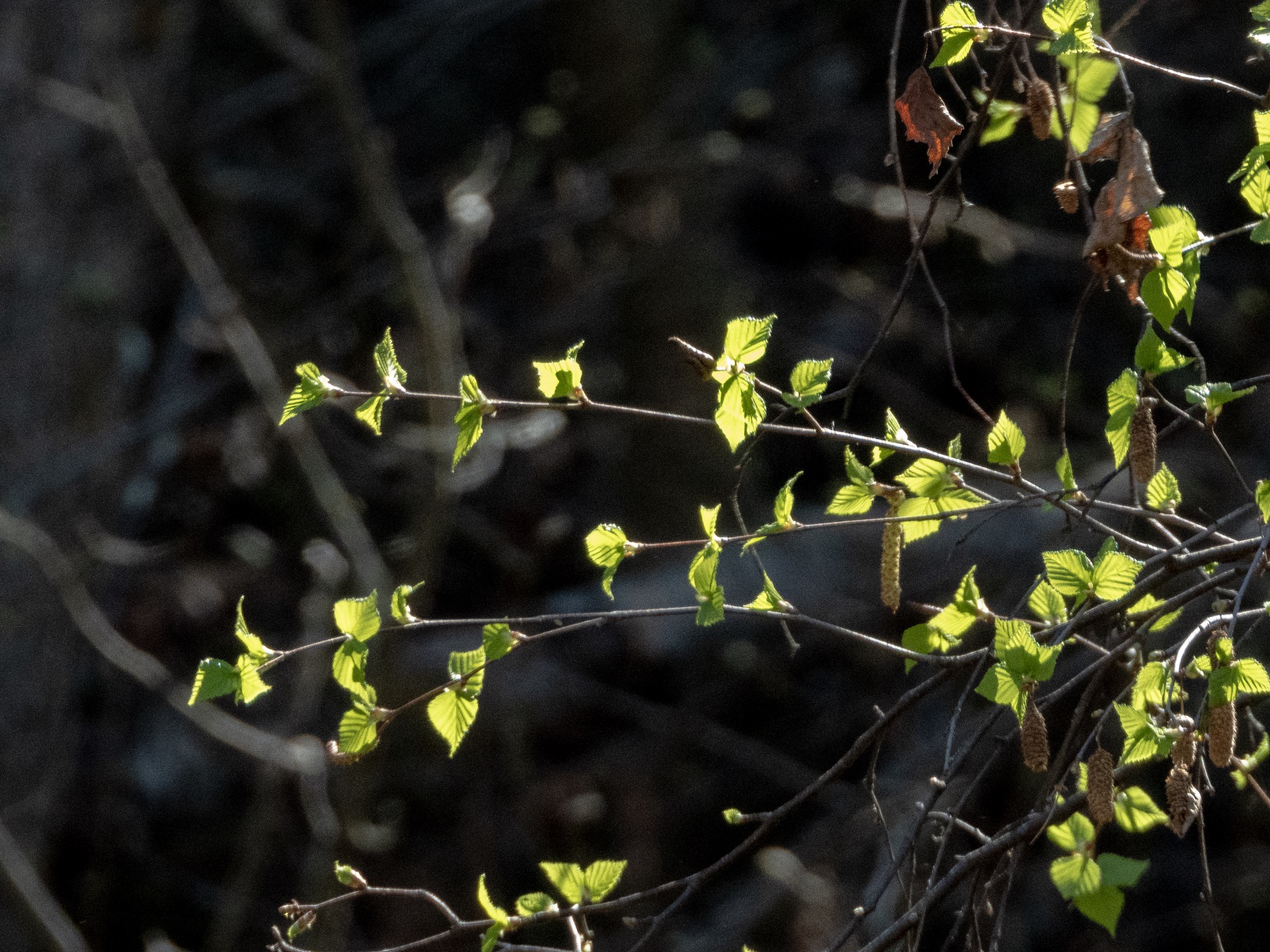
The female Great Horned Owl down at the Whitemud Ravine has now been holed up in her tree for 2 months (that’s 60 days folks). There is reliable intelligence (i.e. picture evidence) showing that her eggs now have hatched and that she has at least two adorable fuzzy chicks. I went down to check out the new family on Mother’s Day (last Sunday). It was a beautiful and sunny spring day and lots of people were out on the trails. The trail was busy with adults and kids walking and biking, dogs taking their owners for a walk and the occasional mandatory fitness buffs. I was surprised to find no other birders or photographers were at the nest site. Mom owl was in her nest, with her tail feathers sticking out. Dad owl was nowhere to be seen but the occasional hooting from inside the forest provided reassurance that he was around. I set up my gear and got to try out my new ultra-portable tripod, the JOBY GorillaPod 3K Video PRO with the Nikon P1000. As my mode of transport was my bike I did not want to pack the full sized tripod. The GorrillaPod performed commendable and had no trouble managing the hefty P1000. Of course a lone photographer with a camera pointed skyward attracts attention and it was not long before I had quite a gathering of spectators squinting against the bright sky trying to figure out what I was photographing. Everyone gets super happy and impressed when they are told about the nest with Great Horned Owl mom and her chicks. Owl mom seemed to be sleeping until an overly excited dog came running down the trail, barking and yapping like its life depended on it. Immediately a big yellow eye appeared in the nest scanning the horizon watchfully. She owl did not move a feather but her ever watchful eye was keeping close tabs on our activities below. I did not see the chicks that day, but I spend a long time at the nest taking photos, watching for the dad (which I never spotted, only heard) and talking to people about the owl family. Today’s photo was shoot through the emerging foliage. Your can see a few fuzzy green blobs of leaves bursting out after a long winter.
Nikon P1000, 1000mm @ 35mm, 1/500s, f/5.6, ISO 200. Postprocessed and cropped in Lightroom.
May the curiosity be with you. This is from “The Birds are Calling” blog (www.thebirdsarecalling.com). Copyright Mario Pineda.
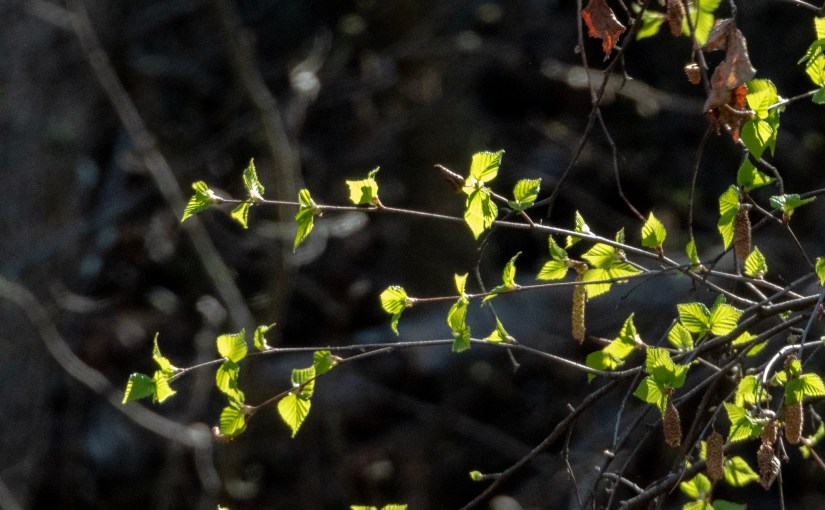
I have to admit there were days when I though this day would never come. The fact that the first day of spring technically was on March 20 almost seems like a cruel joke here in central Alberta. Its mid-May and it has not been until the last few days that we saw the first few green leaves bursting out. If white is the colour of winter, then the colour of budding foliage must be the colour of spring. This is not just any colour of green, it is a light, airy, fresh and rejuvenating color. Artist have a name for this particular hue of green – sap green. Some plain-air painters, in particular, prefer sap green for foliage because it is a warm, yellow green that mixes well for sunlight-infused trees.
Sun-infused objects make great subjects for photography. Today was a gorgeous sunny evening and it would have been criminal to spend it indoors. Said and done. After work I went out to Heritage Wetlands in Sherwood Park for some evening birding around the ponds. All in all, it was a great success with 23 species, including 4 lifers (indicated by *). I also managed to get a bunch of decent pictures of many of the species. After 6 weeks with the Nikon P1000 I am finally starting to feel that I am able to tame this beast of a camera.
Sherwood Park–Heritage Wetlands Park, Edmonton, Alberta, CA 13-May-2019 6:13 PM – 8:10 PM Protocol: Traveling 3.389 kilometer(s) 22 species (+1 other taxa)
Canada Goose (Branta canadensis) 2 American Wigeon (Mareca americana) 2 Mallard (Anas platyrhynchos) 10 Redhead (Aythya americana) 4 Ruddy Duck (Oxyura jamaicensis) 10 Red-necked Grebe (Podiceps grisegena) 3 American Coot (Fulica americana) 4 gull sp. (Larinae sp.) 1 Common Tern (Sterna hirundo) 5 * American White Pelican (Pelecanus erythrorhynchos) 2 Northern Flicker (Colaptes auratus) 2 Eastern Phoebe (Sayornis phoebe) 1 American Crow (Corvus brachyrhynchos) 3 Common Raven (Corvus corax) 2 Purple Martin (Progne subis) 4 * Tree Swallow (Tachycineta bicolor) 4 Black-capped Chickadee (Poecile atricapillus) 2 American Robin (Turdus migratorius) 3 White-crowned Sparrow (Zonotrichia leucophrys) 1 * Song Sparrow (Melospiza melodia) 1 Red-winged Blackbird (Agelaius phoeniceus) 30 Common Grackle (Quiscalus quiscula) 1 * House Sparrow (Passer domesticus) 3
Nikon P1000, 868mm @ 35mm, 1/500s, f/5.6, ISO 360. Postprocessed and cropped in Lightroom.
May the curiosity be with you. This is from “The Birds are Calling” blog (www.thebirdsarecalling.com). Copyright Mario Pineda.
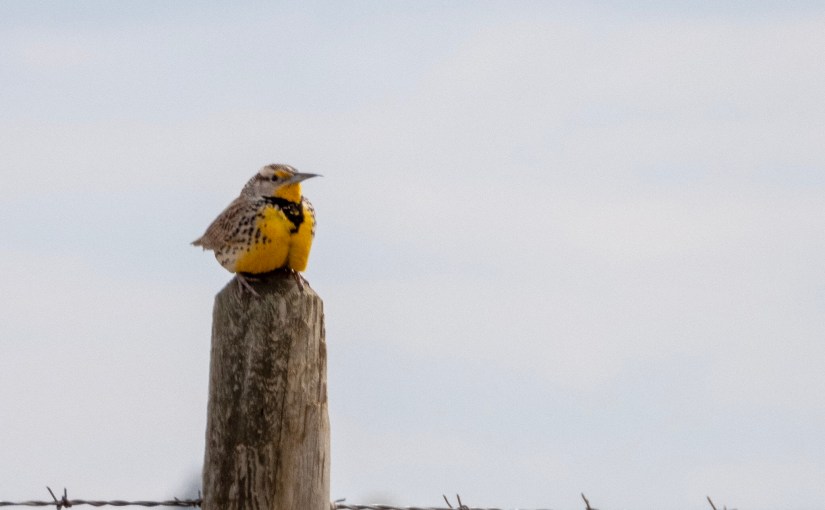
Meadowlarks are handsome and eye-catching birds that are common in grassland and farmland. The male has a predisposition to perch on fence posts and sing his heart out. Our first meadowlark was the Long-tailed Meadowlark (Leistes loyca) in the province of Araucania in southern Chile two days after Christmas last year. We found it sitting on a fence post by a grassy field overlooking Lago Budi while it was serenading. Fast forward 4 months and 11000km to the North on a dusty country road in the outskirts of Camrose. Its the Global Big Day of Birding and we are travelling in a convoy with the birding contingent of the Edmonton Nature Club. On a fence post along a stubble field next to a Hutterite colony (you can see the dark outline of the colony buildings in the background) we spot our second meadowlark species, the Western Meadowlark (Sturnella neglecta). Both species have the characteristic pointy bills and exhibit exactly the same behaviour; weakness to perch on fence posts and the typical meadowlark singing posture where they point their head upwards as they vocalize. Meadowlarks can be found in the Americas and interestingly all the North American species (2-3 species, depending on how you are counting) are yellow breasted while all the South American species (5 species) are red breasted.
Nikon P1000, 868mm @ 35mm, 1/800s, f/5.6, ISO 100. Postprocessed and cropped in Lightroom.
May the curiosity be with you. This is from “The Birds are Calling” blog (www.thebirdsarecalling.com). Copyright Mario Pineda.
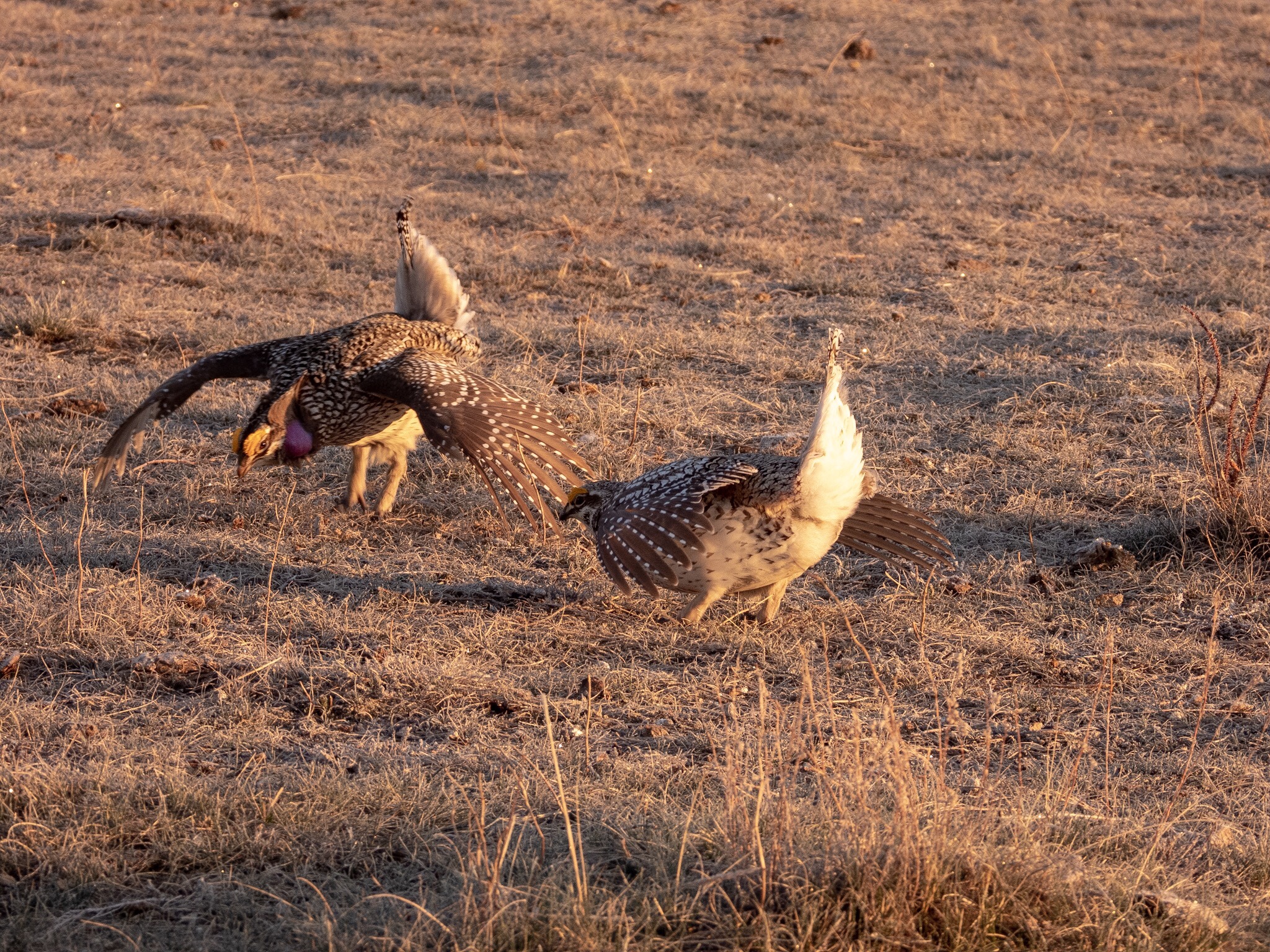
After my latest post on the Sharp-tailed Grouse Lek tour my better half and biggest fan pointed out that the word “lek” looks like the Swedish word “lek” which means “to play”. Yes, she is fluent in Swedish and that is only one of her many amazing qualities.
A bit of research reveals that indeed she is right. The word was introduced from Swedish into the English language by the Welch-born amateur naturalist Llewelyn Lloyd who spend a few decades in Sweden studying and writing about all manners of natural history, in particularly ornithology. It appears that the Swedish word lek first appeared in his 1867 book The game birds and wild fowl of Sweden and Norway. Getting your hands on this book in the olden days would have been a royal pain in the tail feathers, but these days it turns out that the entire book has been digitized and made available for free online. In Chapter 2 the breeding behaviour of the Capercaillie, which belongs to the same family as the Sharp-tailed Grouse (Phasianidae), are discussed and this is the first time the Swedish term lek-ställe is introduced. Loyd defines lek-ställe (play place)as the “locality where affairs matrimonial are carried on”. In the same paragraph he also introduces the term lek-tid (play time) as the “pairing season”. It appears that over the years lek-ställe has been shortened to simply lek.
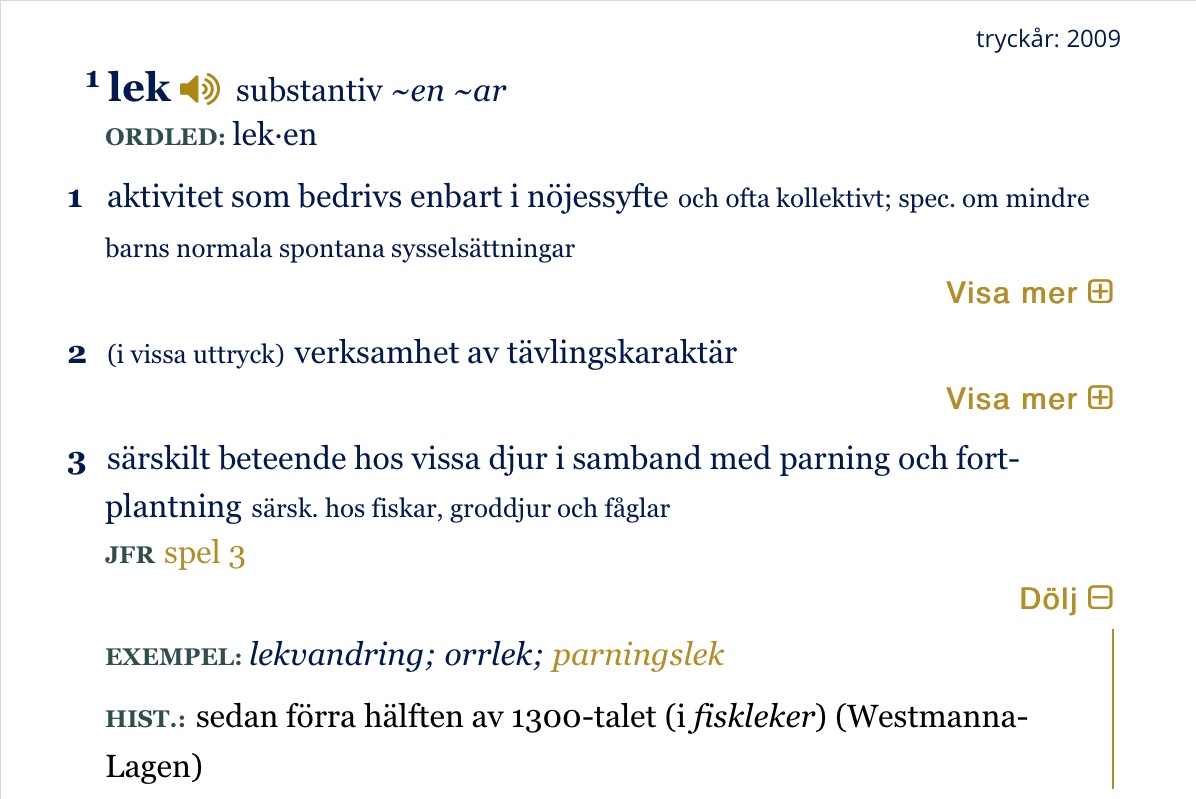
The question is how did the Swedish word “to play” (as in child play) end up going from “child play” to “adult play”? According to Svenska Akademiens Ordlista, which is the undisputed authoritative and comprehensive Swedish language dictionary (analogous to what the Oxford English Dictionary is to the English language) the word lek means:
What was that? You don’t speak Swedish? Well, I feel sorry for you, but ok, in English then: 1) activity that is conducted solely for pleasurable purposes (particularly child’s play), 2) activities of a competitive nature, 3) particular behavior in some animals in conjunction with mating and reproduction, e.g. in fish, amphibians and birds (since 1300 century). I was not aware of that last significance of the word in Swedish, then again the last time I use this word in a Swedish context was probably when I was wee tyke (or possibly when my tyke was wee), so there you have it.
On a different note, lek is not the only Swedish word that made it into Lewelyn Loyd’s book. He quite merrily mixes Swedish (and Norwegian) terms into the narration pretty haphazardly. For example: Troll-Foglar, kasse, nät, förtrollning, hällristningar, barrskogar, flytta, förflytta sig, spel etc. (It is left as an exercise for the reader to figure out what these words mean) The unofficial linguistic term for the habit of mixing English and Swedish in the same sentence is Swenglish and it is commonly but typically unbeknownst practiced in North American IKEA stores.
When I was a tyke we always asked our friends “Vill du leka?” (Do you want to play?) and in my youthful innocence I was never aware of any other meaning of the word. Thanks to our experience with the Sharp-tailed Grouse our Swedish and English vocabularies have become enriched. Now I can use the word again, this time with my better half…, Vill du leka ikväll?
Nikon P1000, 235mm @ 35mm, 1/250s, f/4.5, ISO 200. Postprocessed in Lightroom.
May the curiosity be with you. This is from “The Birds are Calling” blog (www.thebirdsarecalling.com). Copyright Mario Pineda.
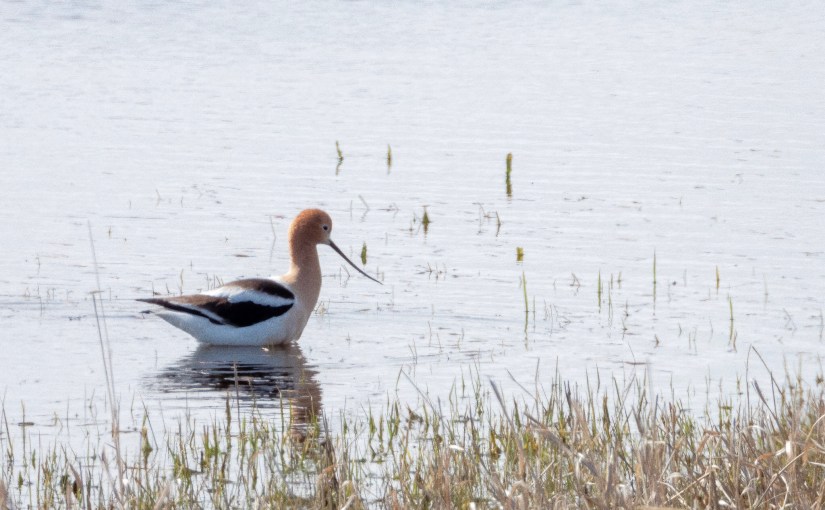
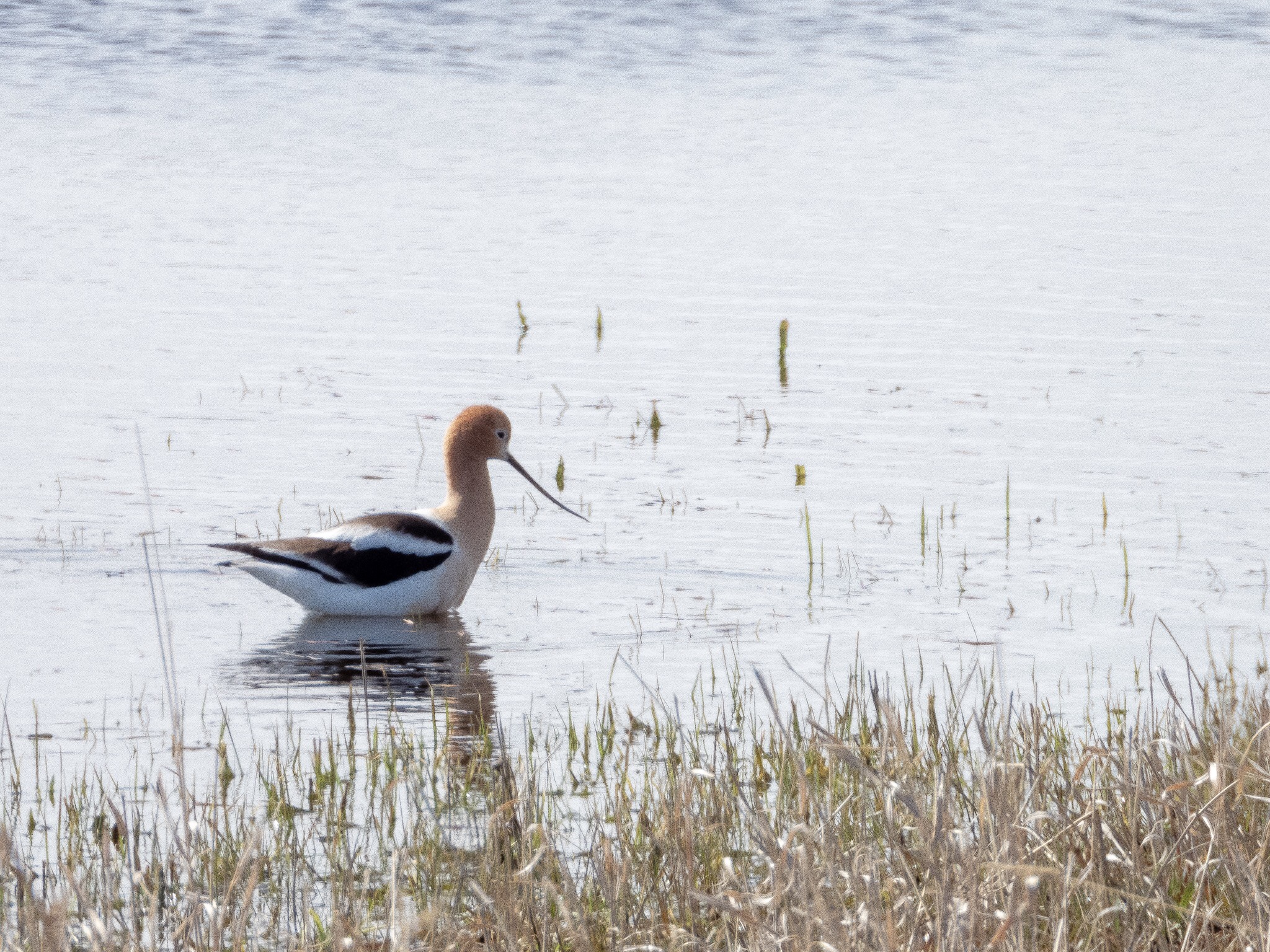
One of the stops during our Big Day tour of central Alberta with Edmonton Nature Club was Lyseng Reservoir. This 564-acre site is located approximately 60 km southwest of Edmonton and consists of upland, riparian and wetland habitat. During our Big Day tour we drove along the southern edge of the reservoir, stopping repeatedly as more and more birds appeared. The place was just bursting at the seams with birds. In less than 40 minutes we observed 28 different species, many of which were shore birds (all new to us), but also a handful of raptors (including a Great Horned Owl), a gaggle of different geese species and other miscellaneous goodies. One of our lifers here was the funky looking American Avocet (Recurvirostra americana, Life: #133, AB Big Year: #83) which has the notable distinction of being my first bird ever with an upturned bill. A number of these were wading along the shallow shoreline looking for a morsel to eat. Looking at the recorded observations at eBird reveals that central Alberta is the Northern margin of its distribution. This is a story that seems to be repeating itself. In yesterday’s post a similar eBird analysis revealed that Alberta is at the western margin of the Eastern Phoebe’s distribution (at least in Canada, it seems to go more westward further south). It may be that latitudinally (central) Alberta is the northern margin for many southern species with the American Avocet being one example, perhaps because of the long and cold winters. Longitudinally Alberta appears to be at the western margin of species such as the Eastern Phoebe, perhaps because of the Rocky Mountains are a physical barrier. This is all just a theory though and I have not googled it or consulted any experts. If I am right, however, remember “that is my theory, that is to say, which is mine,… is mine.” (To paraphrase Miss Anne Elk from the Monty Python sketch on Anne Elk’s Theory on Brontosauruses).
Nikon P1000, 806mm @ 35mm, 1/500s, f/5.6, ISO 110. Postprocessed and cropped in Lightroom.
May the curiosity be with you. This is from “The Birds are Calling” blog (www.thebirdsarecalling.com). Copyright Mario Pineda.
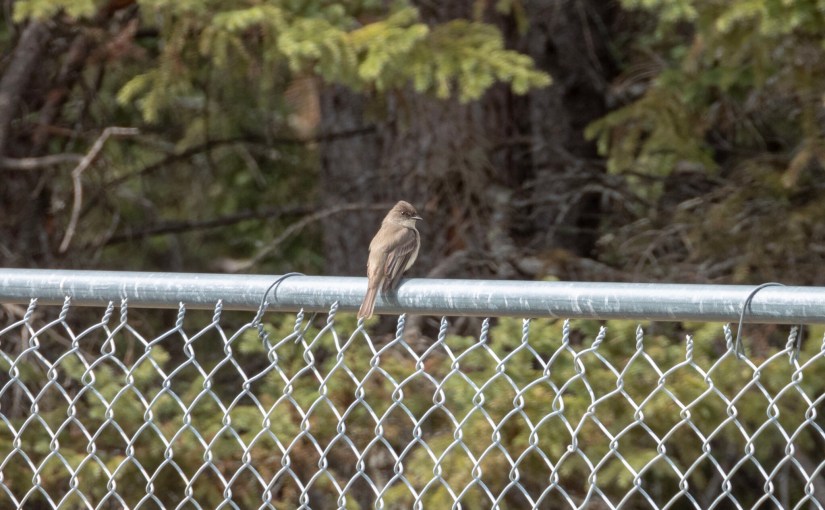
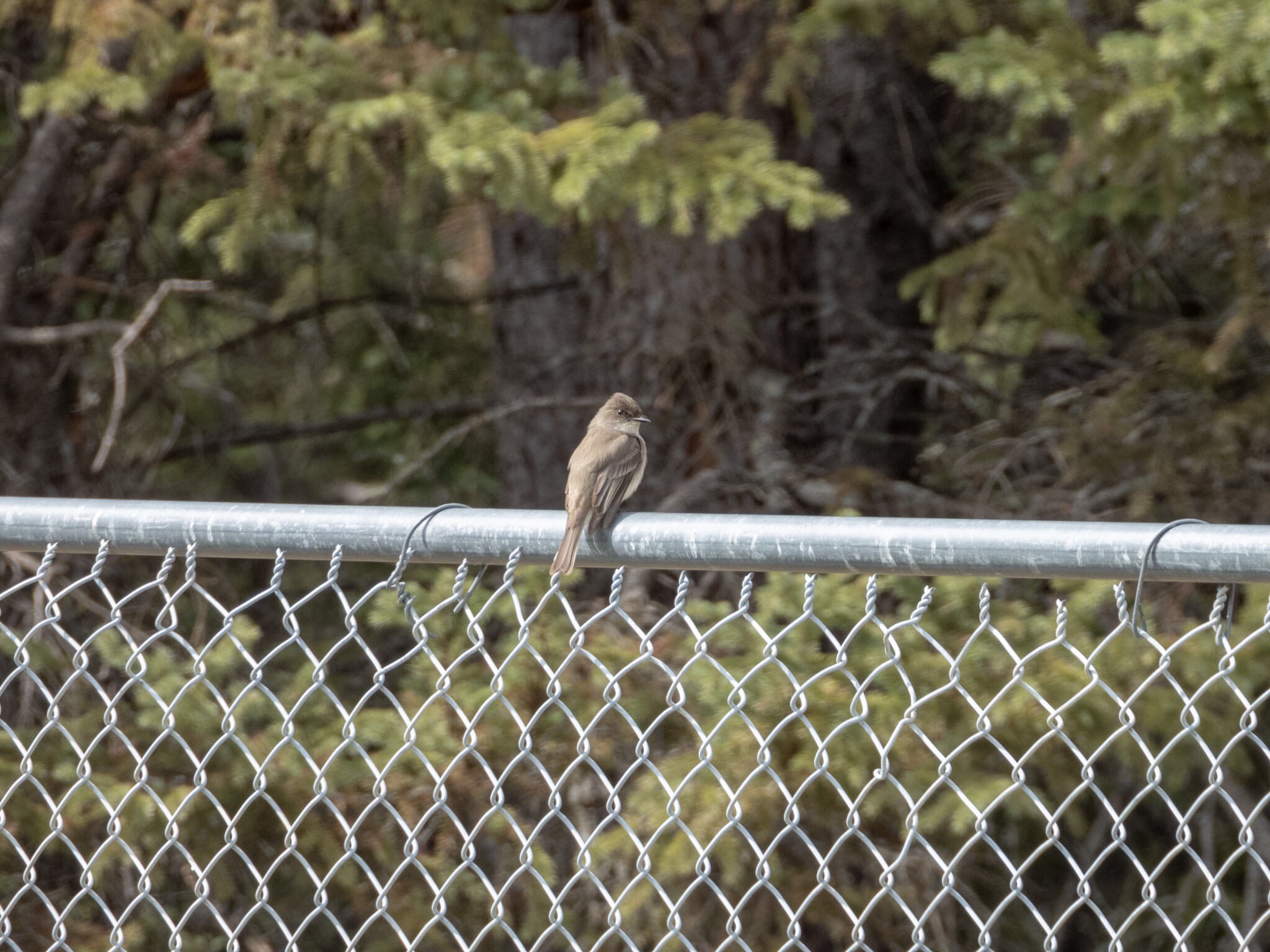
It was not until I saw my first Eastern Phoebe (Sayornis phoebe) that I even knew there was bird with this name. In my “pre-Phoebe” days Phoebe was a synonym for Lisa Kudrow in the sitcom Friends. The Eastern Phoebe is an unassuming small songbird, and if it would not have been hanging out on a fence I would likely have completely missed it. I managed to snap a picture of it before it flew of into the shrubbery. One can clearly see distinct “peaked head” which is due to the bird rising its feathers on top of its head. Based on submitted observations to eBird the Eastern Phoebe is at the eastern margin of its range here in Alberta, with the main part of its distribution being in central and eastern parts of the continent. We saw this bird at the tail end of our central Alberta tour with the Edmonton Nature Club during Global Big Day of Birding on May 4. The phoebe was the first bird we saw as soon as we pulled into the parking lot at Big Knife Provincial Park. It became bird #146 on our life list and #97 on our AB Big Year list.
Nikon P1000, 1100mm @ 35mm, 1/500s, f/5.6, ISO 125Same picture, just postprocessed and cropped in Lightroom
May the curiosity be with you. This is from “The Birds are Calling” blog (www.thebirdsarecalling.com). Copyright Mario Pineda.
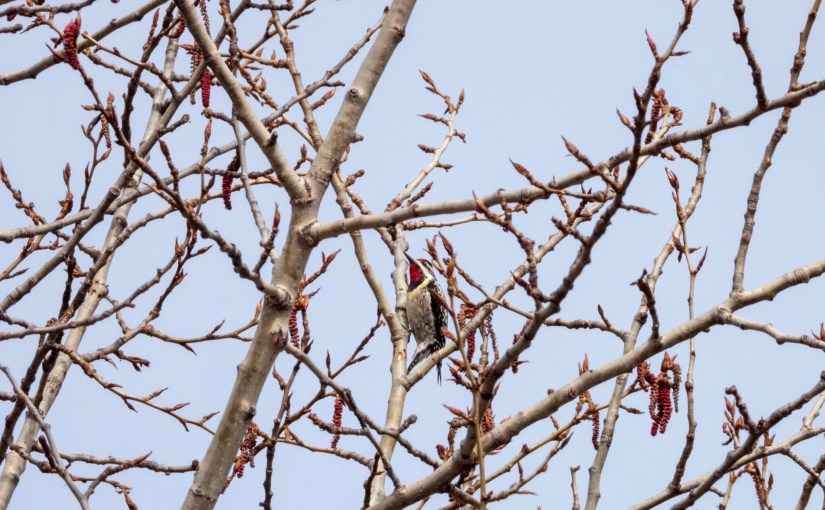
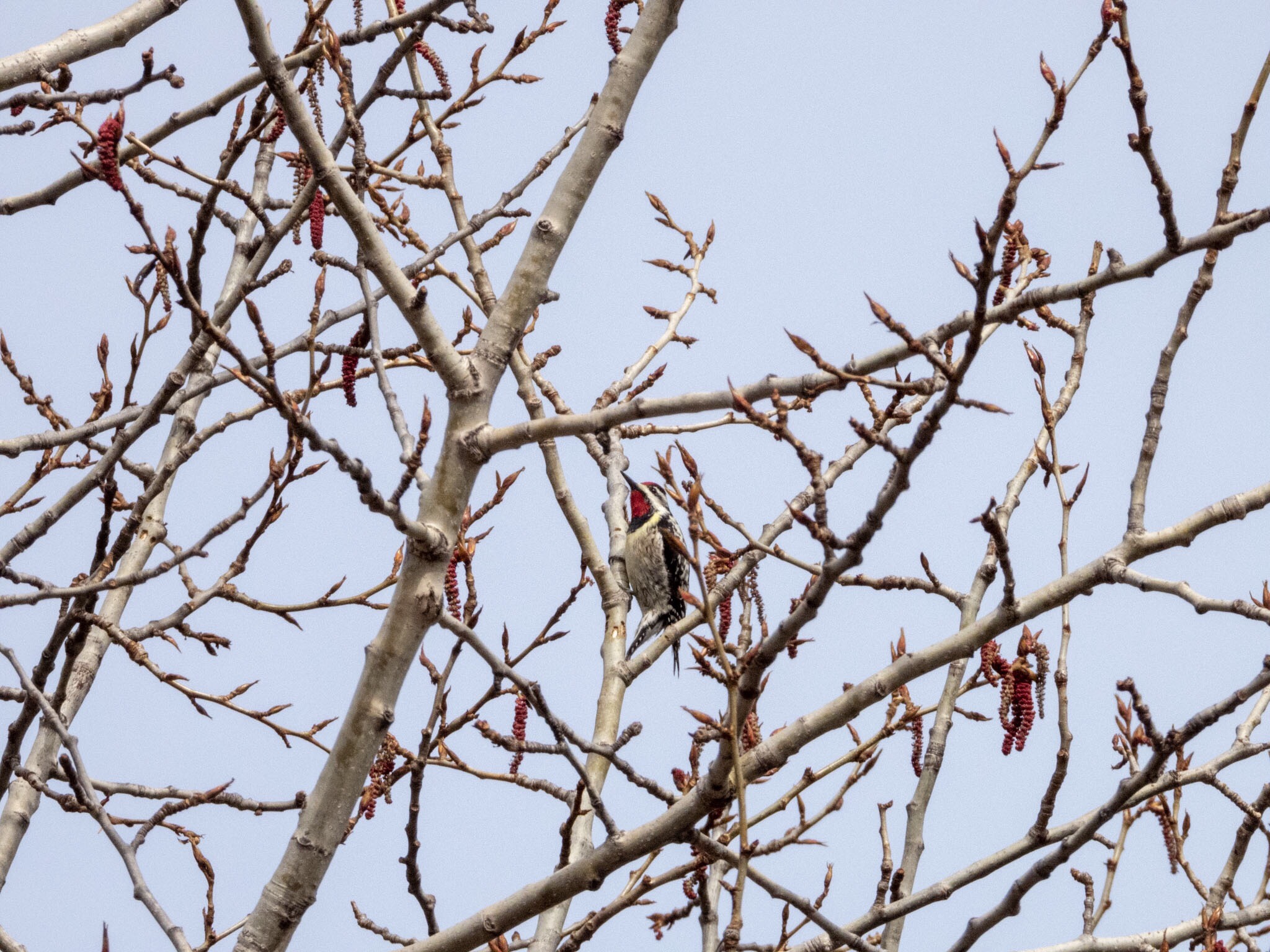
Our last stop of the day during our Big Day of Birding tour with the Edmonton Nature Club was Big Knife Provincial Park about 2 hours drive south east of Edmonton. The whole gang went for a walk through the forest, which was a nice change as we had spent most of the day doing in the car. This small provincial park straddles the Big Knife Creek, named after a fight to the death between “Knife”, a member of the Blackfoot tribe, and “Big Man” of the Cree tribe. I have not been able to find out why there were fighting, but clearly it must have been something of great importance. During our nature walk we found 15 species of birds, including a bunch of firsts (first of the year and first in our life); including the Great Blue Heron (Ardea herodias), Broad-winged Hawk (Buteo platypterus), Eastern Phoebe (Sayornis phoebe), and the diminutive Golden-crowned Kinglet (Regulus satrapa). As we were leaving we came across a Yellow-bellied Sapsucker (Sphyrapicus varius, Life: #145 , AB Big Year: #96) hard at work drilling sap wells high up in a lattice of branches. Unlike other woodpeckers, Sapsuckers do not look for insects to eat in dead trees. Instead they make, and maintain, sap wells and use the sap as their main food source, just like humans utilize the sap from maple trees for maple syrup. These sap wells must be continuously maintained so that the sap continues to flow. It had a rather scruffy appearance, like someone that just rolled out of bed in the morning after a few days without showering. I have been told, however, that that’s how sapsuckers roll it.
Nikon P1000, XXXmm equivalent, 1/Xs, f/X, ISO XXX
May the curiosity be with you. This is from “The Birds are Calling” blog (www.thebirdsarecalling.com). Copyright Mario Pineda.
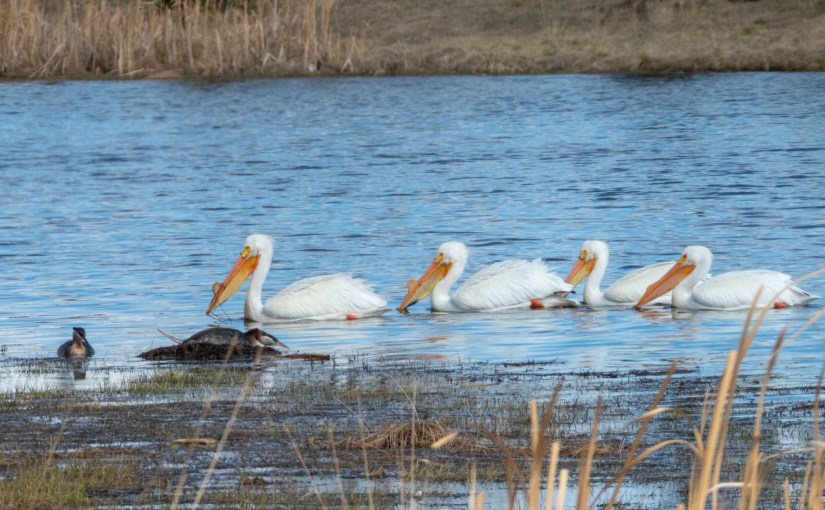
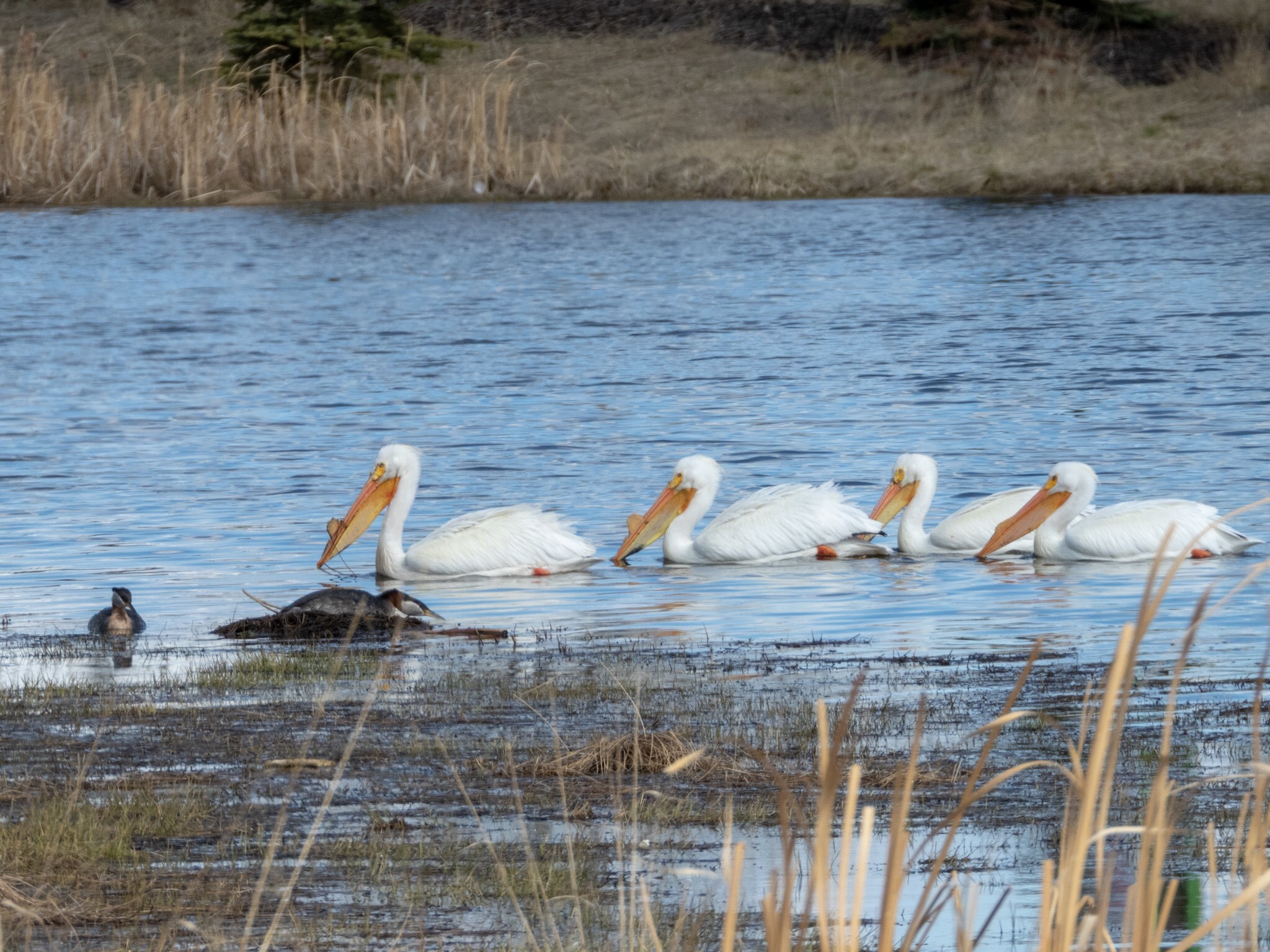
I do not know much about the birding scene in the Calgary area yet, but judging from the birding-related Facebook feeds that I am following, Calgary seems to have a thriving birding scene with several hotspots that look really awesome, e.g. Inglewood Bird Sanctuary and Frank Lake. As Calgary is roughly 300 km south of Edmonton northward migrants tend to arrive there a few weeks earlier than in the capital. Over the last few months I noticed that Calgary acts as a birding early warning system, preparing us Edmonton birders for things coming our way. One of the migrants that arrived in Calgary over a month ago were the American White Pelicans (Pelecanus erythrorhynchos). I have been looking forward to seeing this magnificent bird ever since I saw the first reported sightings of them in the Calgary area. They arrived here in the Edmonton a few weeks ago. Unfortunately, perhaps due to sloppiness on my behalf or just being a noob, I have been missing them on several occasions. The latest missed opportunity was a week ago at Heritage Wetlands Park, where, after several, hours of birding I came up empty handed on the pelican front. Once I came home and checked eBird, however, someone had reported seeing pelicans at that location the very same day. As I was bemoaning my lack of pelican luck, a fellow birder suggested that I check out Emerald Pond, a small pond behind Lowe’s in Sherwood Park. On our way back from our Big Weekend a few days ago we decided to make a stop at this pond. Sure enough, as we were parking a bird the size of a small airplane swooped down over the car and went in for a water landing on the pond. Once we sneaked our way down to the water’s edge we found four adult pelicans chugging along in the water. All four pelicans had horn like projections growing on their upper bills, indicating that they are breeding adults. They went along the shore of the pond, stopping to and from and fishing up aquatic vegetation. It looked like they were eating the aquatic plants growing along the reeds in the pond. While pelicans are omnivores I have not been able to find any information suggesting that they eat plants (but they seem to be happy to devour anything that has scales, fur or feathers, including pigeons and the odd chihuahua).
Birding keeps throwing me for loops. You can drive for an hour or more to the perfect birding spot, only to not see any bird at all. Or you can go to a small pond behind a big box store surrounded by busy roadways only to find the most amazing diversity of birds. In the 20 minutes we spend at the pond we saw 10 different species. There were the usual suspects, e.g. Canada Geese, Mallards, Ring-billed Gull, Franklin’s Gull. As we were about to leave a Common Golden eye came along, followed by a pair of Red-necked Grebes. When we were about to leave (second attempt) a squeaking Killdeer landed in the reeds and, out of nowhere, two Double-crested Cormorants came in for landing scaring the living bejeezus out of the merganser. On our drive home we were discussing what else we could have seen if we had stayed longer. We will definitely be back to this unassuming pond behind Lowe’s.
It was only as I was writing this post that I noticed that there are a pair of Red-necked Grebes next to the pelicans. One of the grebes looks like it is sitting on a mound. I am curious if this could be a nest. Yet another reason to head back sooner rather.
Nikon P1000, 605mm equivalent, 1/800s, f/5, ISO 100
May the curiosity be with you. This is from “The Birds are Calling” blog (www.thebirdsarecalling.com). Copyright Mario Pineda.
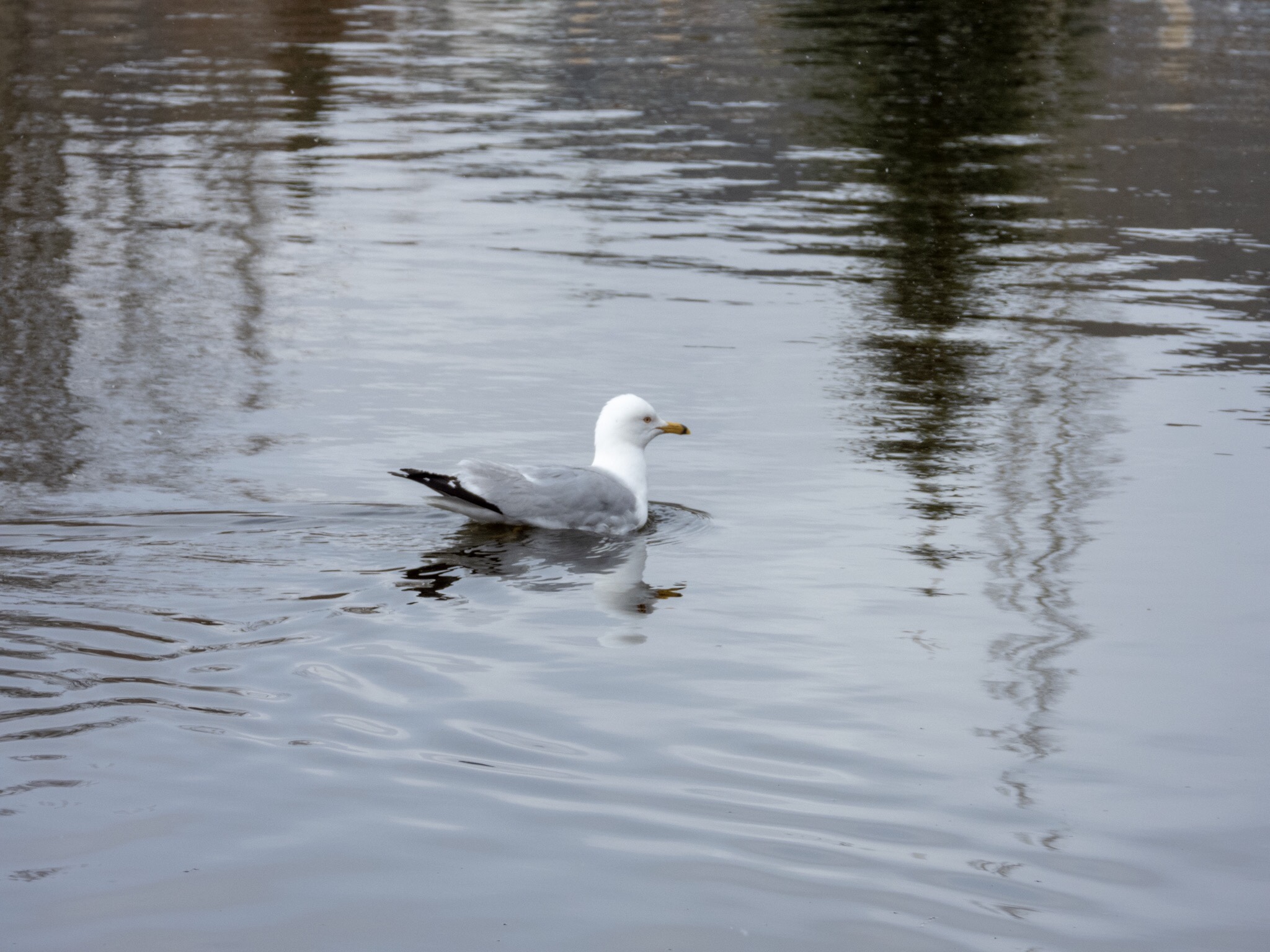
The Ring-billed Gull is perhaps the most ubiquitous gull in these neck of the woods (Alberta, Canada and North America). Sometimes it gets a bad rap as it tends to hang out where people either have food (Granville Island outdoor plaza in Vancouver comes to mind) or where we dispose of our trash (think landfills). It has no problems stealing your hotdog if you are inattentive to your hotdog. These gulls are intelligent, highly social and opportunistic. Any animal with these traits is bound to be successful and deserves our respect and admiration. They are also quite beautiful if you just take your time to look at them. This handsome fella was swimming around in Heritage Wetlands Park in Sherwood Park the other day.
Nikon P1000, 235mm equivalent, 1/800s, f/4.5, ISO 100
May the curiosity be with you. This is from “The Birds are Calling” blog (www.thebirdsarecalling.com). Copyright Mario Pineda.