Project 366 – Post No. 217 – Meandering creek

What is Project 366? Read more here!

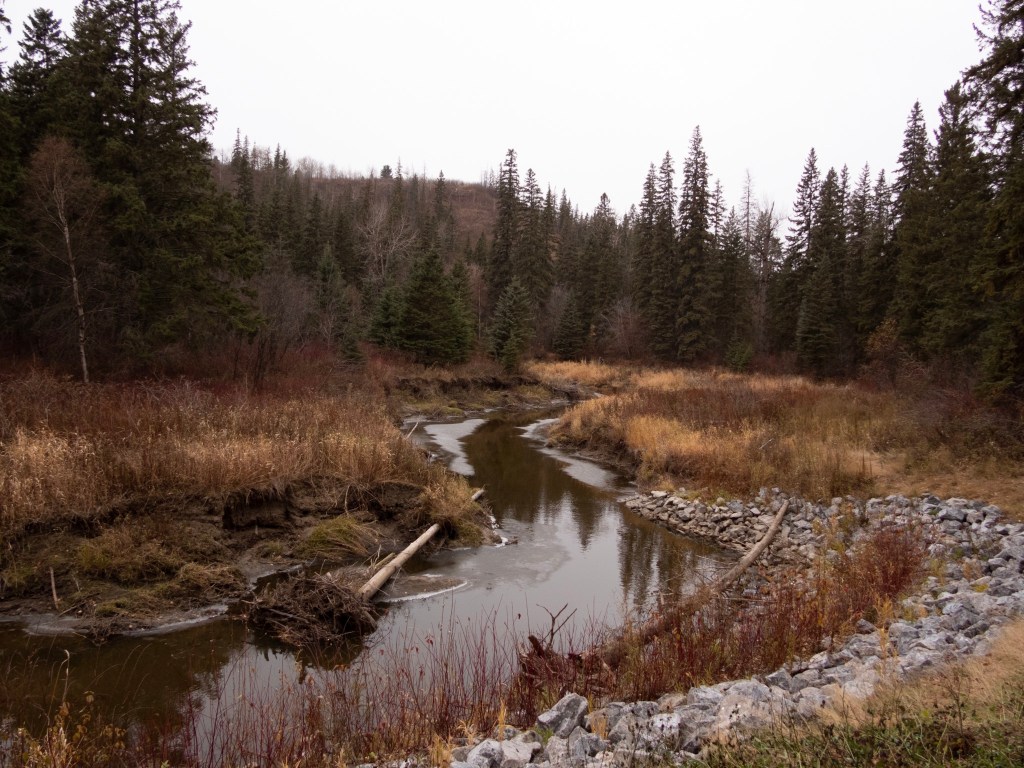
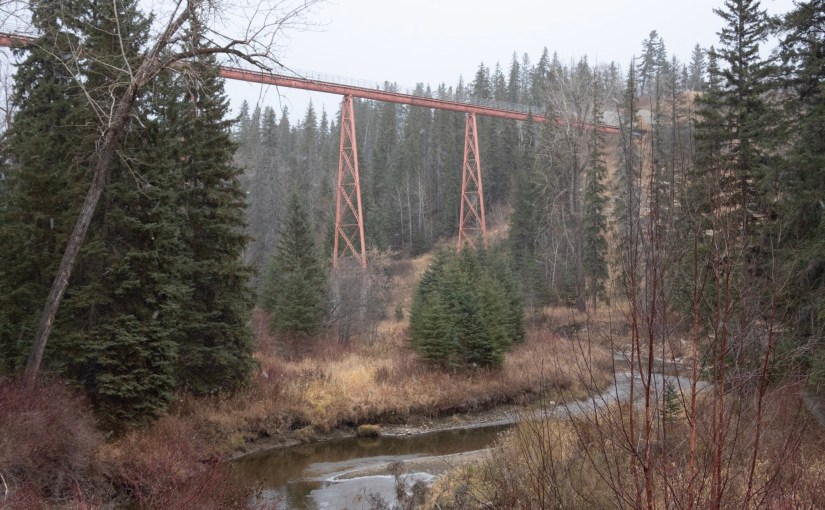
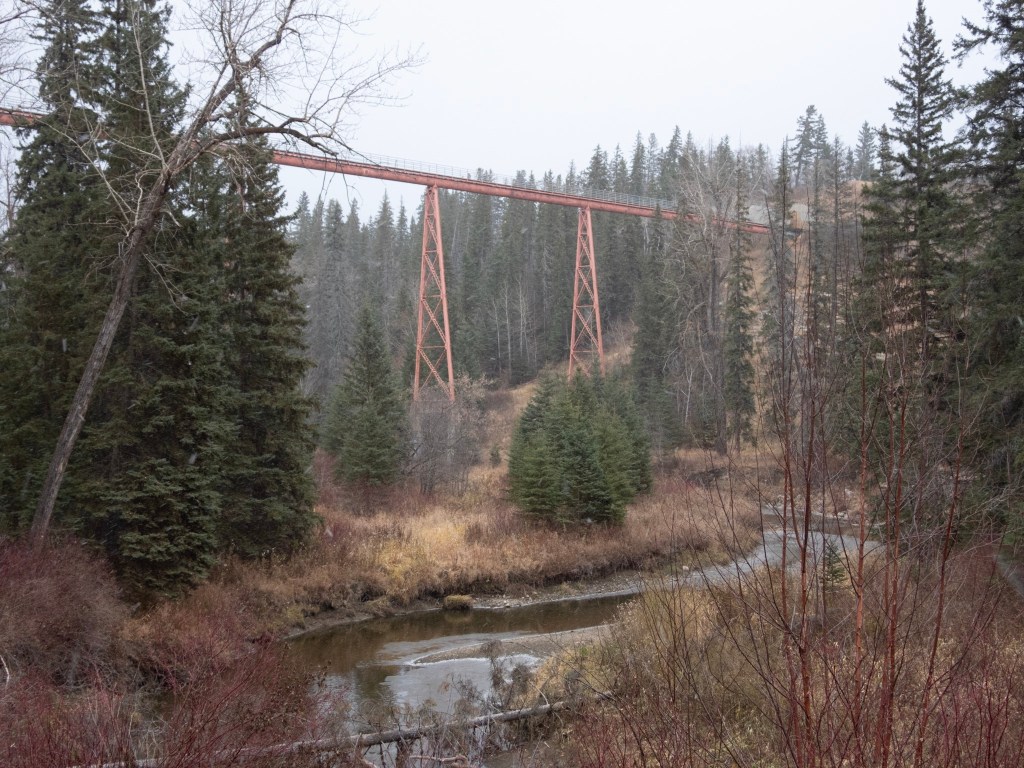
A meandering creek (or river) is a a creek characterized by a series of regular sinuous curves, bends, loops, turns or windings in the watercourse. A meander is produced by the river as it erodes the sediments of an outer (or concave) bank and deposits this and other sediments downstream on an inner (or convex) bank. The concave side of a meander is often referred to as a cut bank and the convex side as a point bank. Over time the result is the formation of a meandering course as the channel migrates back and fort across the direction of the floodplain. There is a whole lot of physics and math behind the formation, dynamics, size and shape of the meanders. The Whitemud Creek is meandering its way through the Whitemud Ravine and the erosion that takes place during this process is very noticeable on a seasonal basis. Particularly the cut banks seem to be advancing at a very fast pace with lots of trees succumbing and falling into the river as sections of the bank collapse into the creek. I am sure the busy work of beavers – i.e. removing trees – accelerates this erosion process. We humans are not, however, idle. In an effort to control the erosion and the ever-shifting course of the creek large swats of cut banks are covered in rocks, mesh and planted with fast growing plants. In today’s picture you can see a cut bank covered in sizable rocks in an effort to reduce the erosion and stabilize the bank. It seems, however, that most of these efforts only postpone the inevitable and it seems to be a loosing battle. The combined force of the beavers and the flow of the water is mighty.
May the curiosity be with you. This is from “The Birds are Calling” blog (www.thebirdsarecalling.com). Copyright Mario Pineda.

Project 366 – Post No. 216 – More beaver dams

What is Project 366? Read more here!

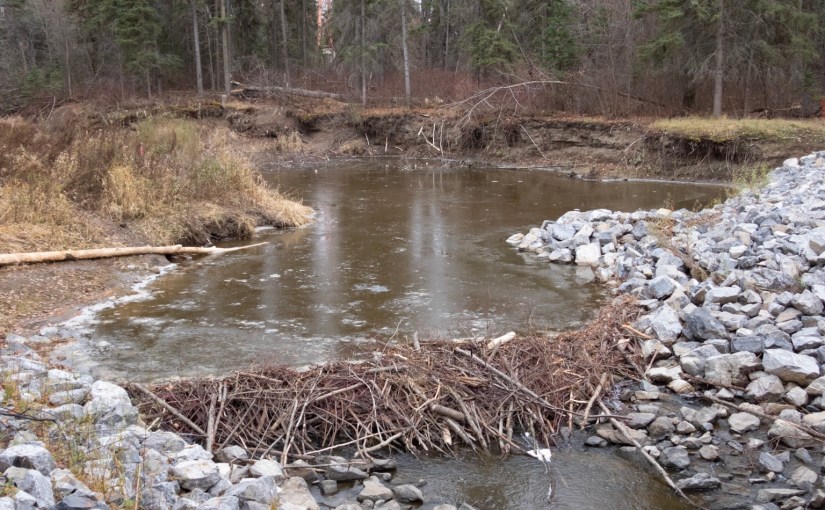
So I found another beaver dam down at the Whitemud Creek. That makes it two dams that have sprung up in the last month. This one is tucked away in a secluded part of the creek and is smaller than the first one. It is large enough though to dam up the water upstream, allowing only a small stream to flow over the crest. It is made up of smaller branches and twigs, but is remarkably efficient in blocking the flow of the water. It is difficult to imagine how one would successfully build a dam made up of branches in a flowing creek. There clearly must be some beaver science going on here. When people refer to beavers as engineers, they go that part right.

May the curiosity be with you. This is from “The Birds are Calling” blog (www.thebirdsarecalling.com). Copyright Mario Pineda.
Project 366 – Post No. 215 – Amiskwaciy Waskahikan

What is Project 366? Read more here!

The traditional name of Edmonton is Amiskwaciy Waskahikan, meaning Beaver Hills House. This place was the traditional meeting ground for many indigenous communities, including the Cree, Saulteaux, Nakota Sioux, Blackfoot and the Métis Peoples. Once one becomes more familiar with the natural history of Edmonton and its surrounding area, the choice of the name Beaver Hills House by the indigenous communities becomes apparent. Beaver houses, or lodges, are never far away. Every lake and pond outside of Edmonton seems to have at least one beaver lodge built in it. The Whitemud Creek is different tough. While there are certainly beavers in the creek, there are no beaver dams or lodges, or at least I have not been able to find them. I always though that one reason for this would be that it is a creek where the water is in constant motion. That is until I found beaver dams and lodges in a remote location of the North Saskatchewan river. So much for that theory. After spending lots of time at the creek it has become evident that the quaint creek is a battle ground between industrious beavers and equally industrious humans. The beavers are trying to go about their lives, which obviously includes a domicile, food and raising a family, while the humans are doing everything they can to maintain the ravine as a safe recreational area. Much could be said about the back and forth battle between the beavers and humans (see for example yesterday’s post), but it is now becoming evident that the Whitemud Creek beavers do indeed build dams, and quite possible lodges as well, but the humans are removing them. The other day I came across a sizable dam entirely obstructing the creek that must have been erected over the last few weeks. It will be interesting to see how long it will take before the crews move in and remove it. I will be doing more regular visits to the creek to monitor the situation.

May the curiosity be with you. This is from “The Birds are Calling” blog (www.thebirdsarecalling.com). Copyright Mario Pineda.

Project 366 – Post No. 214 – Owls vs beavers

What is Project 366? Read more here!

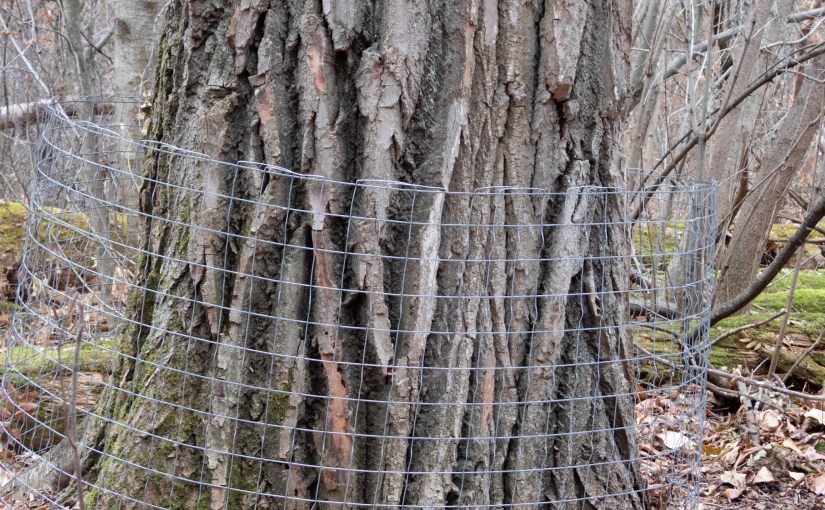
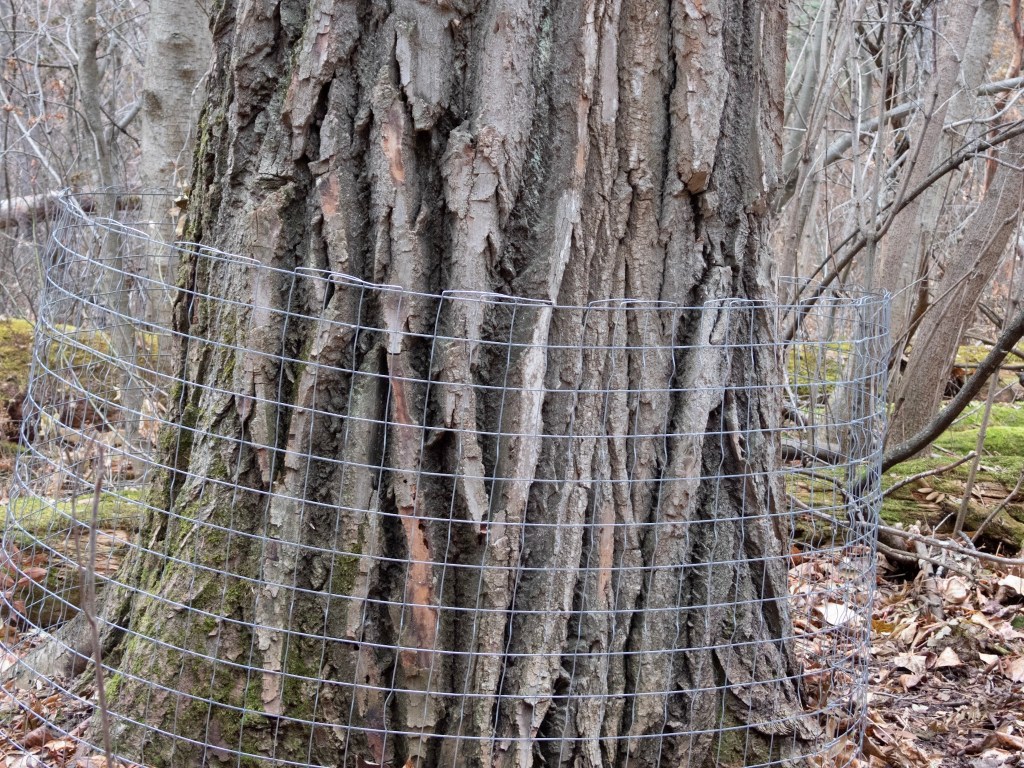
There is a rather unique tree down in the Whitemud Ravine. It is large and tall and half way up its trunk there is a l large cavity that has been used as a nesting cavity by Great Horned Owls for a number of years, most recently last spring. The other day I noticed that the base of the trunk had been wrapped in wired mesh. With the beavers coming back with a vengeance over the last few weeks it is hardly surprising that the city has tried to protect the tree. The City of Edmonton’s official policy on reducing beaver damage is to protect “high value trees” using metal mesh around the base of the trunk. As this is the only know Great Horned Owl nest it this part of the ravine this is definitely a high-value tree (see post 32). At this time of the year, the owls are nowhere to be see. One can only hope that the will be back next spring with a new batch of adorable owlets.

May the curiosity be with you. This is from “The Birds are Calling” blog (www.thebirdsarecalling.com). Copyright Mario Pineda.
Project 366 – Post No. 213 – The beavers are back

What is Project 366? Read more here!

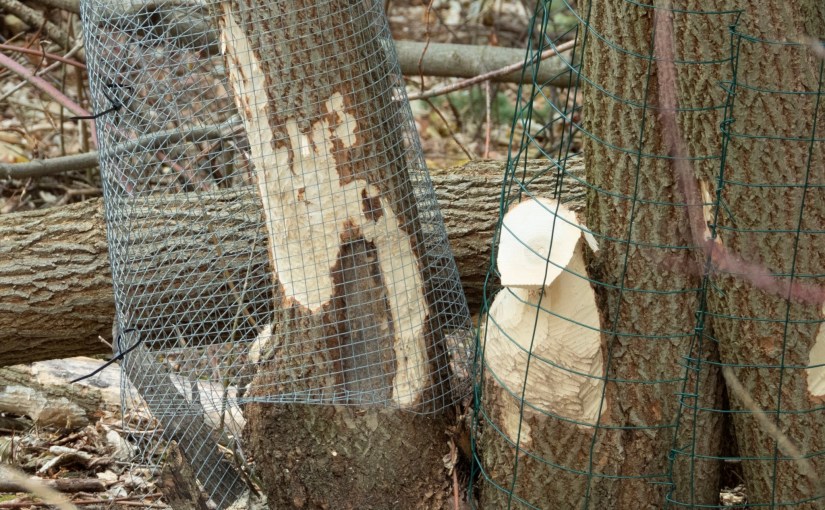
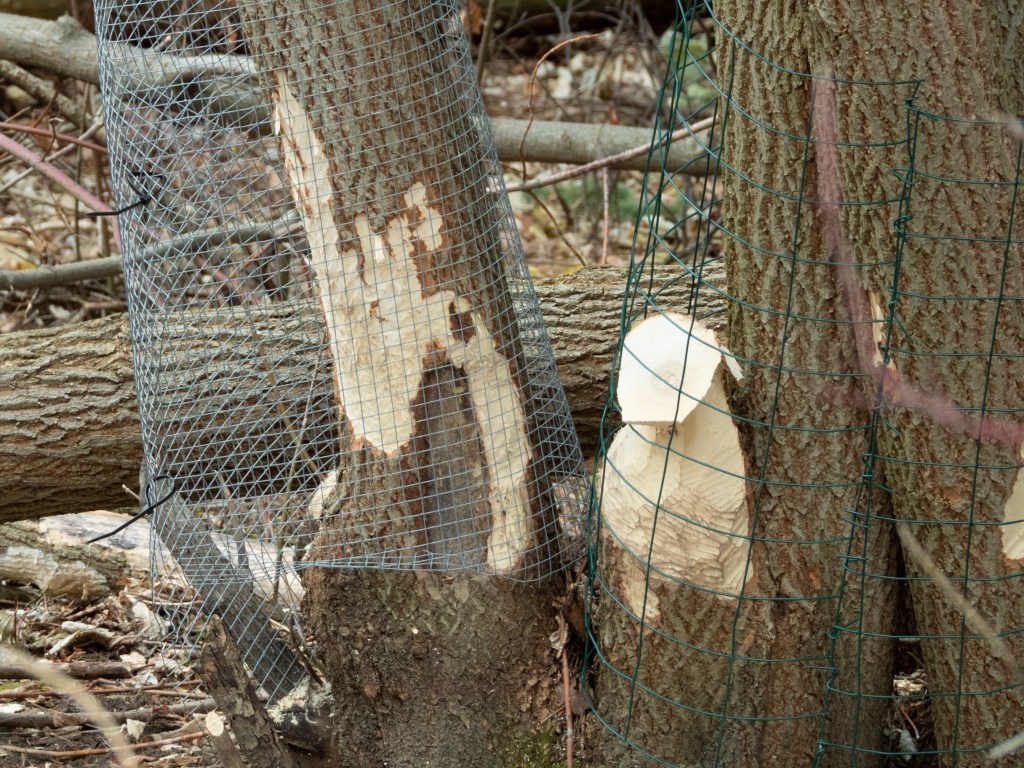
I assume it was bound to happen. Just like the Terminator said “I will be back”, so did the beavers. It appears that over the last month or so an army of beavers have invaded the Whitemud Creek. They have left their telltale signs all along the creek, with downed trees, chewed branches and debarked trunks. It is quite obvious that they mean business. Even trunks that have been covered in metal wire mesh – a way to deter beavers from damaging high valued trees – have not been spared. I am not entirely sure how they get to the trunk if there is a metal mesh in the way, but I guess if you are an uber-ambitious beaver you could either try to go under or over the mesh with a bit of acrobatic maneuvering…, or through the mesh if you are patient. Expect more beaver action picture over the next few days. I have not yet actually spotted a beaver, but I imagine that it only a matter of time.

May the curiosity be with you. This is from “The Birds are Calling” blog (www.thebirdsarecalling.com). Copyright Mario Pineda.
Project 366 – Post No. 212 – First “snow storm”

What is Project 366? Read more here!

It was a dull grey and windy afternoon. The thermometer read -2C, but with the wind chill it was more like -9C. It was certainly not ideal weather for birding, but I decided to brave the elements and head down to the Whitemud Creek. It had not been there for several weeks so you never know what you find after such a hiatus. By the time I go to the creek the snow had started to fall and it was swirling around in the wind. I would say that this qualified as the first “snow storm: of the season, but compared to what is to come it was pretty tame…, like a warm up to the real deal. I tried to capture the “storm” in a picture, but it turned out very anticlimactic and line would have to squint pretty hard to imagine any snow falling just by looking at the picture. While snow and sub-zero temperatures in October may sound extreme to non-Albertan’s, we are actually doing pretty good this season. Last year we had our first snow in September and quite often the end of October is already locked down in deep freeze in these neck of the woods. Other than the snow and some unusual beaver activity, as I predicted, most birds were in hiding. The notable exception, as always, were the Black-capped Chickadees that were our in full force and did not seem to mind the weather at all.

May the curiosity be with you. This is from “The Birds are Calling” blog (www.thebirdsarecalling.com). Copyright Mario Pineda.
Project 366 – Post No. 211 – In the Third Quarter

What is Project 366? Read more here!

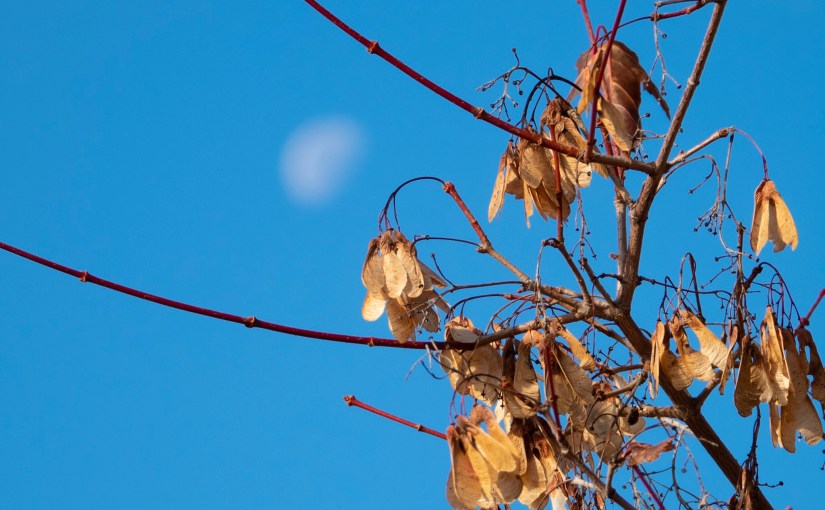
Reports came in today from the National Weather Service in Duluth (Minnesota) of weather radars that were lit up with what appeared to be storm systems moving in. It turned out that it was not a storm at all, just an estimated 900000 ducks on their way to who know where? Perhaps they were on their way to their overwintering grounds en masse. Today’s picture was taken a few days ago, so while the moon was in its Third Quarter then, today it is Waning Crescent. All these clear days with early morning moons and birds migrating make you wonder if birds use the moon to either time migrations and/or for navigation. It has been know for a long time that birds use specific start constellation during, such as the Polaris star, as well as the sun to navigate during their migrations. I have not been able to find any information about the role of the moon in bird migrations. Yes, today’s picture is almost identical to the picture in Post 208…, except that that the focus differs…, so, very similar, yet different focal points.

May the curiosity be with you. This is from “The Birds are Calling” blog (www.thebirdsarecalling.com). Copyright Mario Pineda.
Project 366 – Post No. 210 – Frozen reeds

What is Project 366? Read more here!

The shores of the Heritage Wetland Park in Sherwood Park are covered in dense reeds, making access to the lakes difficult. There are a few locations, however, where it appears that the reeds have been removed on purpose. Perhaps these are access locations for boats, although I have never seen any boats on the lakes and, other than for a kayak or canoe, the lakes (more like ponds) are likely too small for any more substantial vessels. In this picture one can see a thin layer of morning ice between the reeds. The ice did not last long as the sun warmed up the day the ice disintegrated.

May the curiosity be with you. This is from “The Birds are Calling” blog (www.thebirdsarecalling.com). Copyright Mario Pineda.
Project 366 – Post No. 209 – Frozen in time

What is Project 366? Read more here!

the

The winged fruits of a maple tree are unmistakable. Maple belongs to the Acer family and although it is commonly viewed as an iconic Canadian species (just look at our flag or maple syrup) the majority (about two thirds) of the 128 maple species are found in Asia. In Canada, ten species of maple can be found growing natively, perhaps the most famous one being the sugar maple, which is the species occurring on the Canadian flag and used for maple syrup. The botanical name for the helicopter seeds is samara.

May the curiosity be with you. This is from “The Birds are Calling” blog (www.thebirdsarecalling.com). Copyright Mario Pineda.
Project 366 – Post No. 208 – Maple in repose

What is Project 366? Read more here!

the

The winged fruits of a maple tree are unmistakable. Maple belongs to the Acer family and although it is commonly viewed as an iconic Canadian species (just look at our flag or maple syrup) the majority (about two thirds) of the 128 maple species are found in Asia. In Canada, ten species of maple can be found growing natively, perhaps the most famous one being the sugar maple, which is the species occurring on the Canadian flag and used for maple syrup. The botanical name for the helicopter seeds is samara.

May the curiosity be with you. This is from “The Birds are Calling” blog (www.thebirdsarecalling.com). Copyright Mario Pineda.