Project 366 – Post No. 302 – Great Horned Owl basking in the winter sun

What is Project 366? Read more here.

On this sunny mild winters day we came across one of the Whitemud Ravine Great Horned Owls perching in a tree overlooking the creek. It was soaking up the suns rays and seemed fast asleep. I cannot blame it. After the last few weeks of bitterly cold weather the -10 C day must have felt nice and balmy. According to eBird the last time a Great Horned Owl was observed in the ravine was in October last year. Has the owl been there the whole time, but just not seen? Has it been somewhere else and only recently returned to this location? Is it alone, or does it have a mate? The owl we saw was close to a tree where a pair of Great Horned Owls raised a pair of owlets last spring. Is this one of those owls and is it back for another breading season? So many questions and no answers. I will be keeping a close eye on the owls in the ravine and hopefully we will see another season of successful owlets born and raised in our very own backyard ravine.

May the curiosity be with you. This is from “The Birds are Calling” blog (www.thebirdsarecalling.com). Copyright Mario Pineda.
Project 366 – Post No. 301 – Pileated Woodpecker

What is Project 366? Read more here.

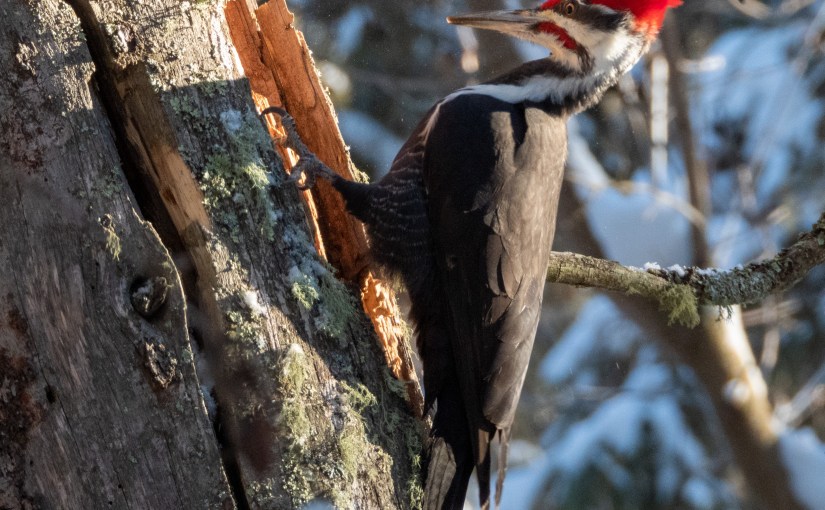
Loud banging noises were coming from the forest. It sounded like someone was hitting a tree trunk as hard as they could with a baseball bat. I knew right away what was making the noise and it certainly was not a human. As incredulous as I was I realized that the only creature capable of making such loud banging noises was a Pileated Woodpecker. I have seen and heard many Pileated Woodpeckers and I know they can be quite energetic when they go to town on a tree. I had never, however, heard one making a noise this loud. It was easy to spot the culprit. There it was, sitting on a decaying tree trunk, illuminated by the sun working on the tree like there was no tomorrow. Large chunks of the tree were flying all around it as it was digging its way into the core of the trunk. The speed at which a Pileated Woodpecker can hammer its way through a tree is truly a sight to behold. There are plenty of dead trees in the Whitmud Ravine with large cavities in them that are the work of Pileated Woodpeckers. Based on the size of some of the cavities it is only natural to come to the conclusion that it must have taken quite some time for a woodpecker to hollow it out. Once you have seen a Pileated Woodpecker in full action one realizes that it would only take a matter of minutes to hollow out one of those cavernous cavities. The efficiency of Pileated Woodpeckers makes them the industrial version of a regular woodpecker. They are truly a force to be reckoned with.

May the curiosity be with you. This is from “The Birds are Calling” blog (www.thebirdsarecalling.com). Copyright Mario Pineda.
Project 366 – Post No. 300 – Hairy woodpecker

What is Project 366? Read more here.

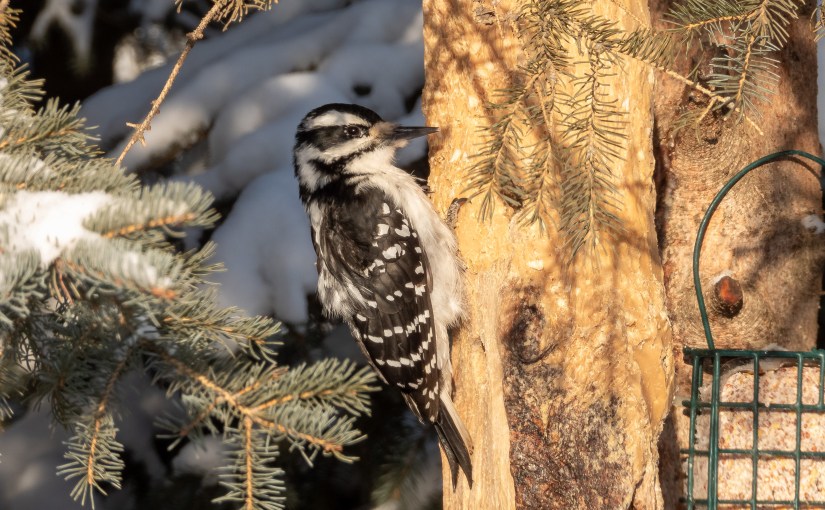
The last two post have featured a Downy Woodpeckers, first a female and then a male. There is, however, another woodpecker in town that looks nearly identical to the Downy Woodpecker. The Hairy Woodpecker is a tad larger than the Downy, with a distinctly longer bill. There are also some even more subtle differences in the black and white markings the the outer tail feathers of the two species. To make things even trickier, the two species can be found in the same habitat and often if one of them is around, the other one is not far away. Today’s picture is of a female Hairy Woodpecker. The telltale sign is the proportionately longer bill relative the head. My rule of thumb is that in Hairy Woodpeckers the length of the bill is more than half of the width of the head while in Downy Woodpeckers the bill is decidedly less than half the width of the head. As with most things in life, the more of the two species you see and compare the better one becomes at telling them apart.

May the curiosity be with you. This is from “The Birds are Calling” blog (www.thebirdsarecalling.com). Copyright Mario Pineda.

Project 366 – Post No. 299 – Male downy woodpecker

What is Project 366? Read more here.

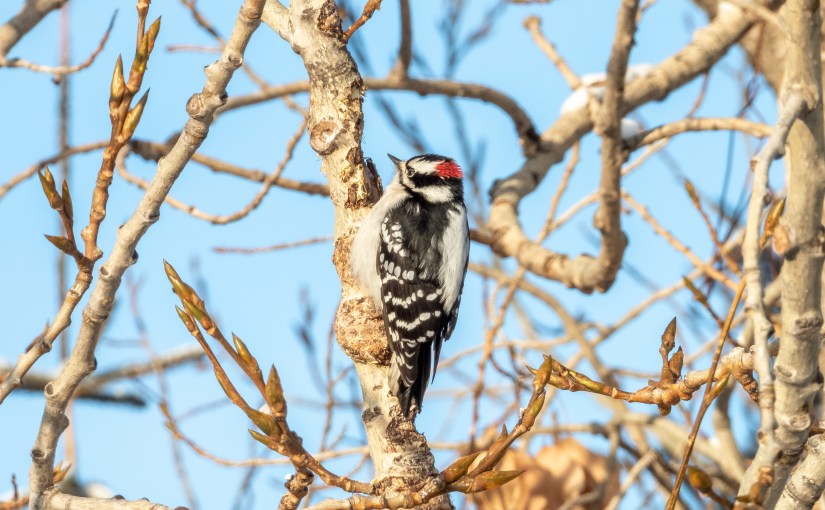
Yesterday’s post featured a female Downy Woodpecker. Today’s post is featuring a male Downy Woodpecker. If it would not be for the red patch on the neck of the male they would be indistinguishable. This male was just a few meters above the feeder where the female was feeding.

May the curiosity be with you. This is from “The Birds are Calling” blog (www.thebirdsarecalling.com). Copyright Mario Pineda.
Project 366 – Post No. 298 – Black, white and red?

What is Project 366? Read more here.

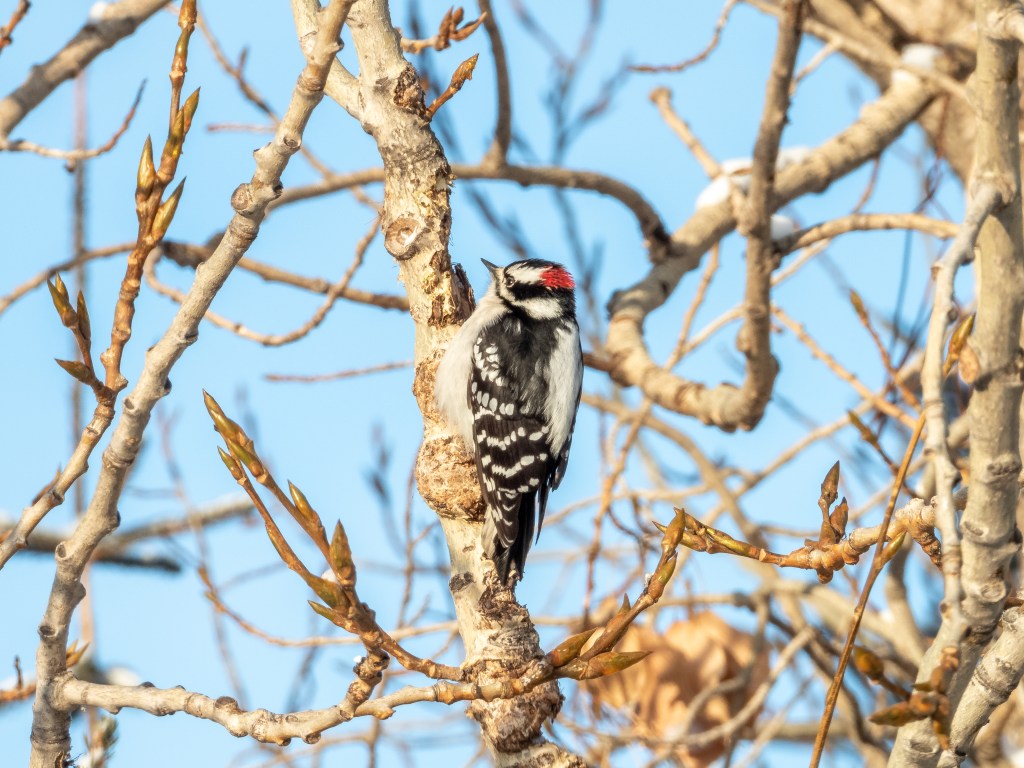
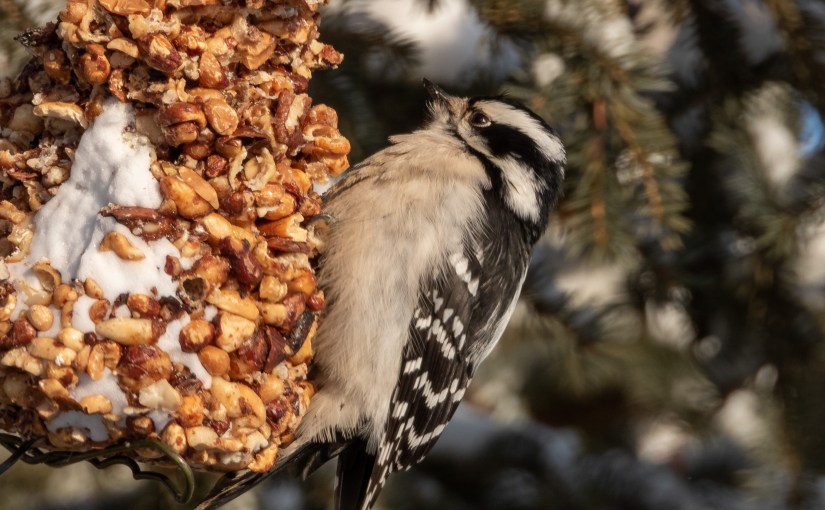
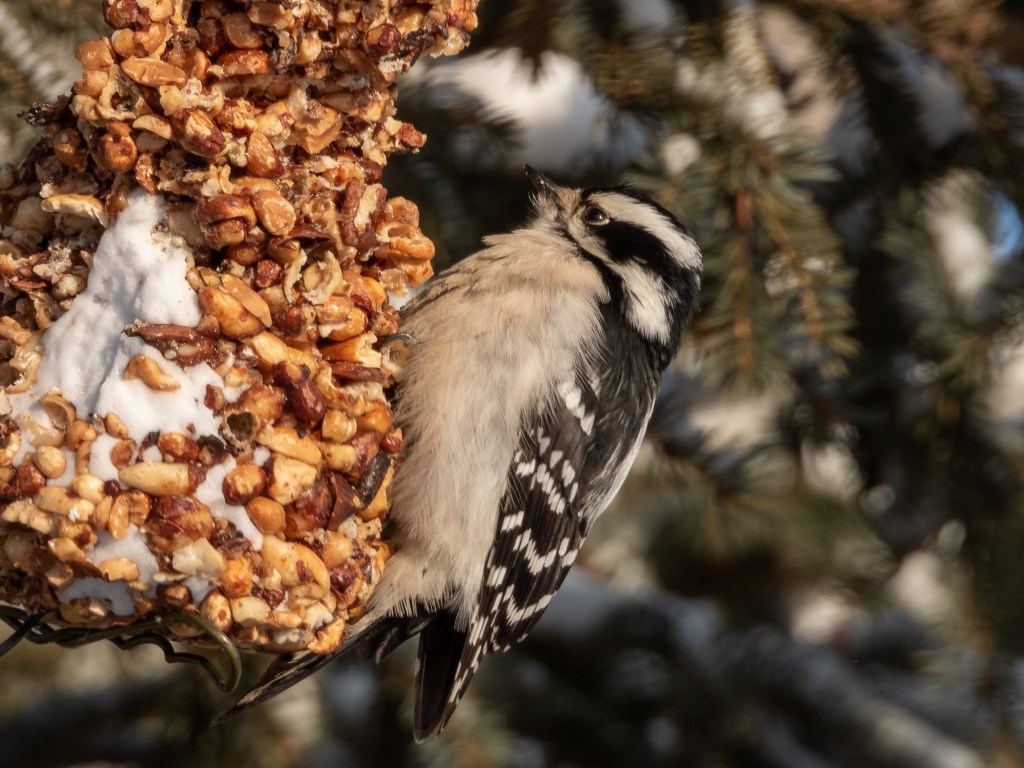
What is black, white, sometimes red and sits on tree trunks? Woodpeckers of course. It is a fascinating fact that many woodpeckers in the world seem to be black and white, with the males having red on their head. Case in point, our very own Downy Woodpecker vs Hairy Woodpecker vs. Pileated Woodpecker are all black and white with the males having red patches on their heads. The Black-backed Woodpecker is black and White, but with the males having yellow at the back of their head. As it turns out, both red and yellow plumage is caused by the same pigment (specifically carotenoids, which also create orange plumage). Northern Flickers also fit this pattern with black and white on their body and brown/orange on their body with red patches on their heads. As you move south through the american continent this color pattern repeats itself among the various woodpecker species one encounters, e.g. Cream-backed Woodpecker, Crimson-bellied Woodpecker, Crimson-crested Woodpecker, Guayaquil Woodpecker, and the Magellanic Woodpecker to mention just a few (but there are many more species fitting this pattern). There are several reasons for this color consistency in woodpeckers. A recent study found that habitat, climate and a shared evolutionary history are strong determinants of woodpecker plumage.

Female Downy Woodpecker going to town at one of the bird feeders in Hermitage Park on a bitterly cold January morning.

May the curiosity be with you. This is from “The Birds are Calling” blog (www.thebirdsarecalling.com). Copyright Mario Pineda.
Project 366 – Post No. 297 – Red-breasted Nuthatch at the bird feeder

What is Project 366? Read more here.

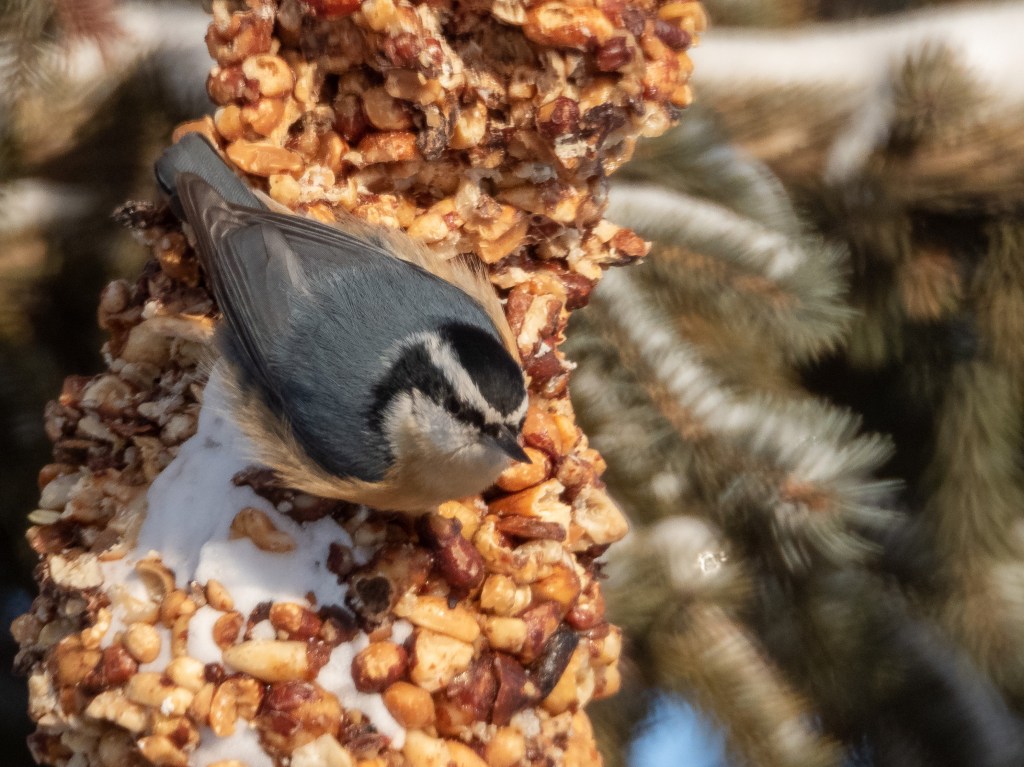
Red-breasted Nuthatches, just like their cousins the White-breasted Nuthatch are common, fleeting and assertive song birds. They know what they want and have no trouble elbowing their way to the food to get their fair share…, only to, moments later, vanish into the shrubbery again. A black stripe across their eyes reminiscent of a bandit mask only makes them appear more like a diminutive feathered vigilante refusing to get intimidated by more boisterous or larger birds.

May the curiosity be with you. This is from “The Birds are Calling” blog (www.thebirdsarecalling.com). Copyright Mario Pineda.
Project 366 – Post No. 296 – Black-capped Chickadees at the bird feeder

What is Project 366? Read more here.

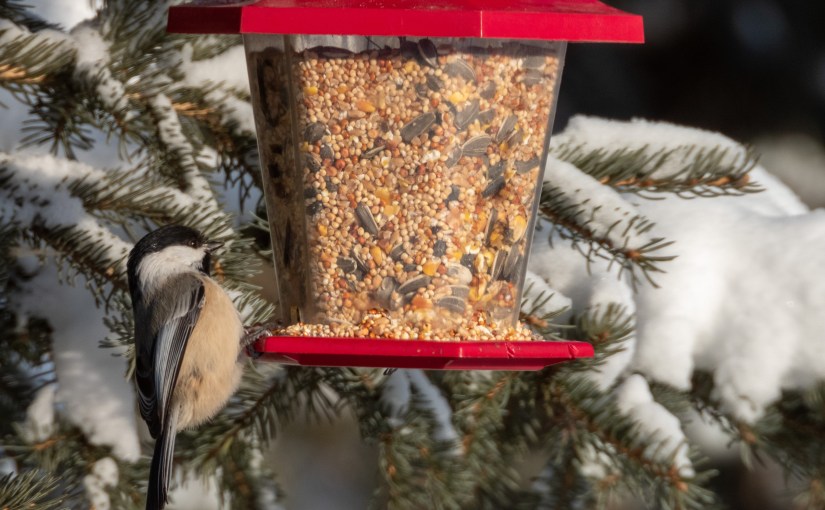
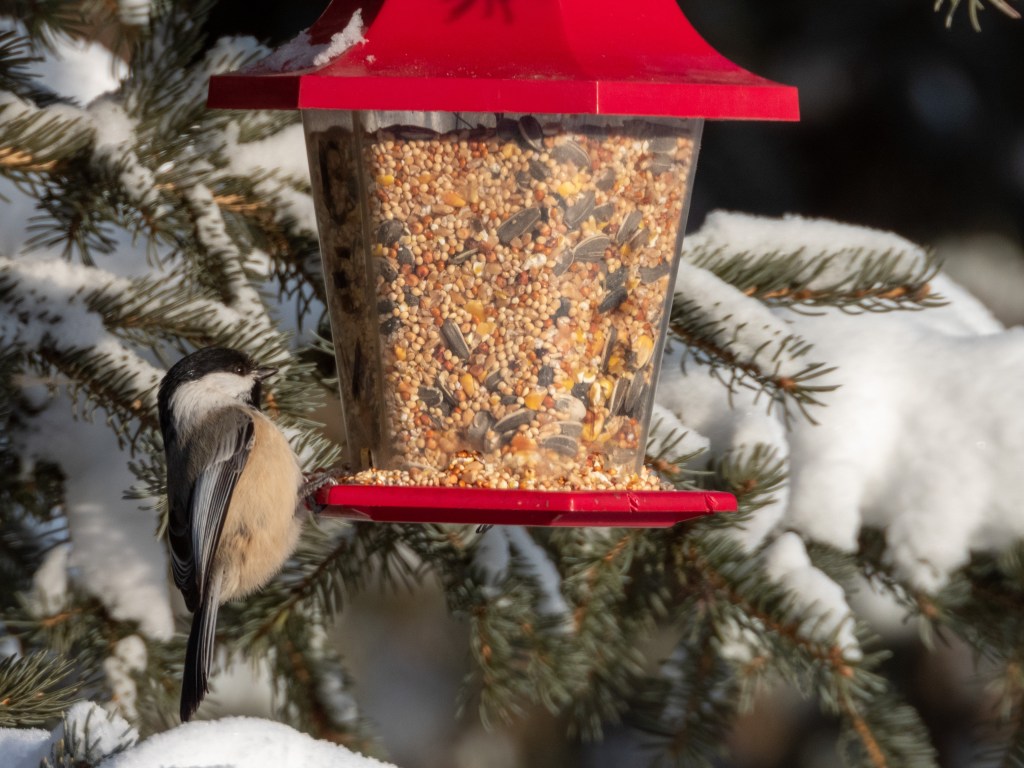
Today’s picture is of a fuzzy Black-capped Chickadee that is visiting one of the bird feeders in Hermitage Park. Any nature walk in these neck of the woods this time of the year (or any time of the year for that matter) will virtually guarantee the companionship of Black-capped Chickadees. There does not seem to be a temperature low enough to faze these diminutive birds. They always seem to be on the go and always looking for the next meal. This one has struck the mother lode.

May the curiosity be with you. This is from “The Birds are Calling” blog (www.thebirdsarecalling.com). Copyright Mario Pineda.
Project 366 – Post No. 295 – Dark-eyed Junco

What is Project 366? Read more here.

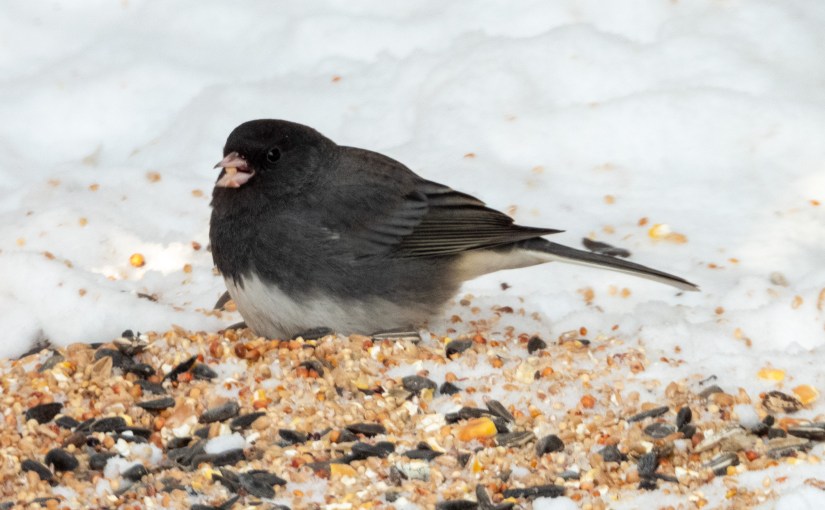
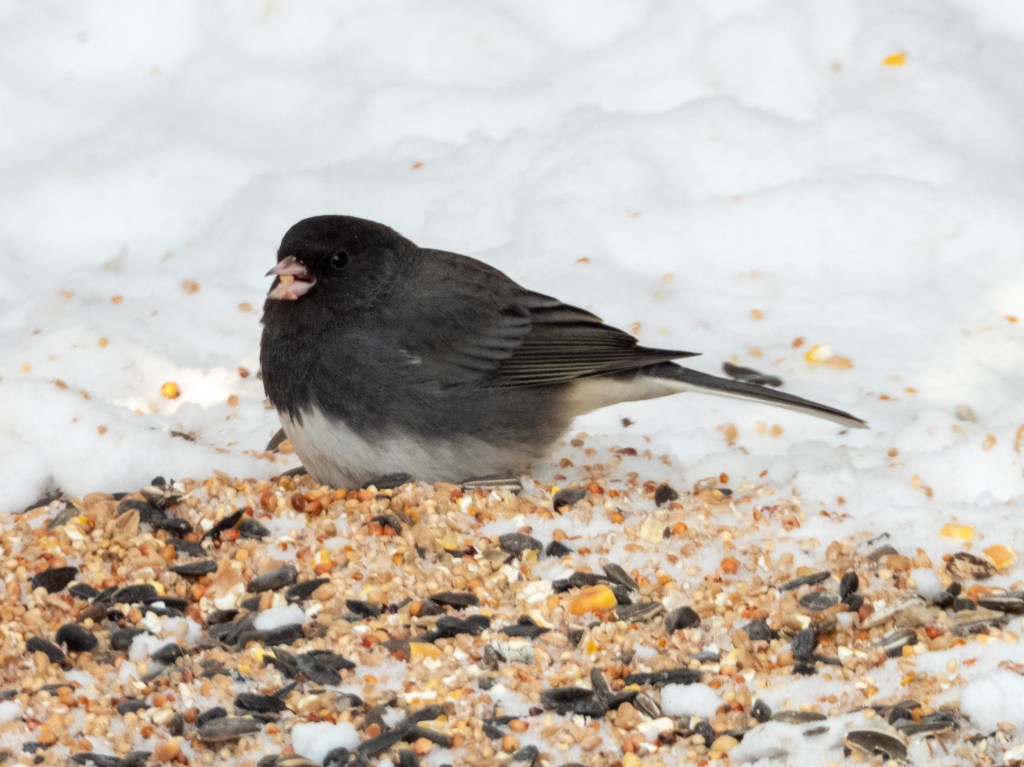
Dark-eyed Juncos are discrete little bird that like to “fly under the radar” by staying close to or on the ground. As I was watching the activity at the bird feeders with chickadees, nuthatches, downies and other winter birds quickly flitting in to pickup a morsel and then off again I failed to notice the more subtle activities going on on the ground. It took a while before I noticed the subtle scurrying of small dark colored birds on the ground. A closer look revealed the unmistakable dark hooded birds were Dark-eyed Juncos. Half a dozen or so of the juncos were scurrying around on the snow covered ground munching on all the seeds that had fallen down from the feeders.

May the curiosity be with you. This is from “The Birds are Calling” blog (www.thebirdsarecalling.com). Copyright Mario Pineda.

Project 366 – Post No. 294 – This is where to bird in -30 °C!

What is Project 366? Read more here.

So my prediction in yesterday’s post Where to bird in -30 °C? was correct. Offer food and the birds will come. Every winter the city sets up a large number of bird feeders in Hermitage Park and keeps them filled with an assortment of bird treats throughout the winter. The birds are well aware of this and the feeders are always busy. It was a beautiful sunny day today with the temperature hovering around -30 °C this morning. We arrived at the bird feeders around 10:30 am. There were no other people around, quite likely due to the bitter cold, but there was lots of avian action at the feeders. As the feeders are all clustered in a treed groove right off the parking lot we just pulled up the vehicle as close as possible and ended up doing some car birding. I am usually not a big fan of birding from the car, it seems like an oxymoron – you go birding to enjoy nature, yet you never leave the confines of the car. With the bone crushing cold, however, if seemed like a reasonable compromise. All in all we ended up seeing 8 species of birds, all of which were busy gorging themselves on sunflower seeds, nuts and suet.

Edmonton--Hermitage Park Bird Feeders, Edmonton, Alberta, CA
Jan 18, 2020 10:45 AM - 11:00 AM
Protocol: Stationary
Checklist Comments:     A sunny and clear but bitterly cold morning (-30C). No people around but lots of avian activity at the feeders.
8 species

Downy Woodpecker (Dryobates pubescens)  4
Hairy Woodpecker (Dryobates villosus)  1
Blue Jay (Cyanocitta cristata)  1
Black-billed Magpie (Pica hudsonia)  3
Black-capped Chickadee (Poecile atricapillus)  20
Red-breasted Nuthatch (Sitta canadensis)  3
White-breasted Nuthatch (Sitta carolinensis)  1
Dark-eyed Junco (Junco hyemalis)  5
A White-breasted Nuthatch enjoying the bird buffet on a cold winter’s morning at Hermitage Park.

May the curiosity be with you. This is from “The Birds are Calling” blog (www.thebirdsarecalling.com). Copyright Mario Pineda.
Project 366 – Post No. 293 – Where to bird in -30 °C?

What is Project 366? Read more here.

As the cold keeps its bitterly grip on all of Alberta I have not been able to do any birding at all for over a week now. Even if I would decide to brave the elements and go birding the question is where would I go. A quick glance at the last few weeks reports on eBird from the Edmonton area shows that the majority of hotpots have no sightings reported (no as in zero). One has to be careful when interpreting. No submitted sightings does not necessarily mean that the birds are not there, it could also mean that the birders are not there seeing the birds. It is likely a combination of both factors that result in the lack of observations. It;s too cold for birders to go birding and the birds, who are undeniably out there, are likely hiding and trying to stay warm. The only thing that might entice birds to be active in these low temperatures might be a food offering. In terms of birding this likely means that the best option to see birds would be at bird feeders. As it turns out the city has bird feeders set up every winter in Hermitage Park. Over the last few weeks 19 species of birds have been observed at the feeders here, a pretty good number for this time of year. We will see if I decide to challenge myself to venture our for some birding at the feeders this weekend.

May the curiosity be with you. This is from “The Birds are Calling” blog (www.thebirdsarecalling.com). Copyright Mario Pineda.