So it looks like spring is in the air. I would not dare to claim that spring has arrived. It’s in the air, like the smell of something yummy simmering and tempting us of greater things to come. The deep freeze has finally relented and we are back at more seasonal temperatures.
One of my recent “resolutions” is to get out into Nature more often. Now, “more often” is unacceptably vague. It’s like saying, “I will loose some weight”. Anyone into fitness and weight loss would tell you that “loosing some weight” just does not cut it. It needs to be specific. So, lets quantify what spending more time in Nature means to me. My aim is (currently) to head out into Nature at least twice a week, once during the work-week and a second time, for a longer outing, during the weekend. I have been doing well over the last few weeks, often going birding several times during the week and weekend. Undoubtedly the milder weather and the brighter evenings make it easier and more appealing to head out.
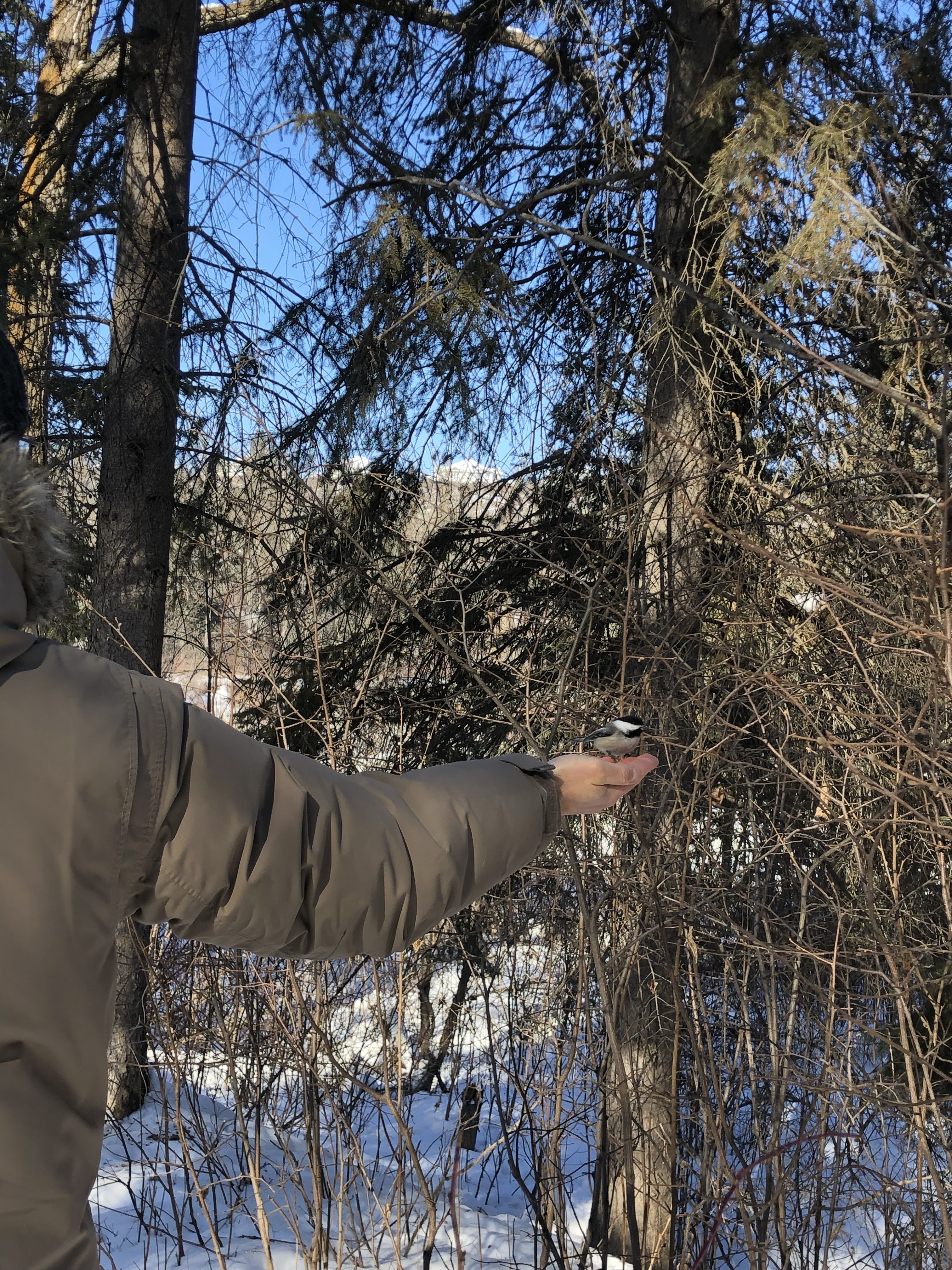
During a walk earlier this week at Whitemud Creek we tested our new camera, a Canon SX70 HS. My son managed to get a nice picture of a Black-capped Chickadee, something I found notoriously difficult as these tiny feathered bundles seem to be in constant motion. I did however manage to get a shot of a Southern Red-backed Vole peeking out of a tunnel in the snow trying to grab a sunflower seed. Southern Red-backed Voles are active throughout the winter and spend their time under the snow-pack in the subnivean zone. Here they enjoy protection from the elements and construct long tunnels as travel corridors. These forest dwelling voles are short-lived, with a maximum life-span of about one year, and depend on coniferous, deciduous and mixed forests.
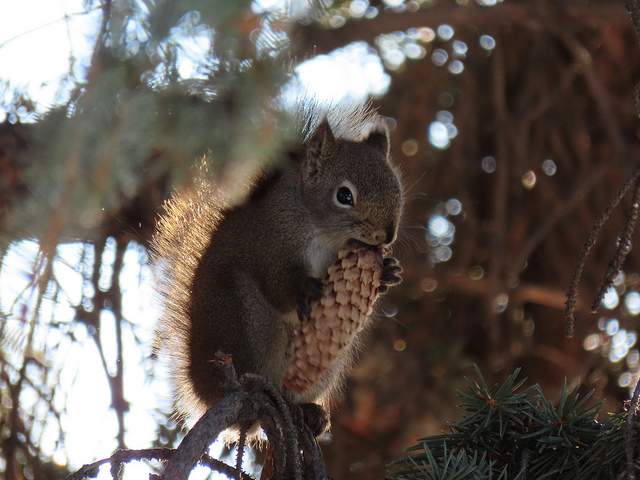
A Black-Capped Chickadee (Poecile atricapus) enjoying the spring in the air. Photo: Matias. Southern Red-backed Vole (Myodes gapperi) peaking out of its snow tunnel in search of a snowflower seed snack. Photo: Mario Pineda. Red Squirrel (Tamiasciurus hudsonicus) enjoying a snack. Photo: Matias.
May the curiosity be with you. This is from “The Birds are Calling” blog (www.thebirdsarecalling).
Today’s excursion, first one in March, happened to coincide with the World Wildlife Day (March 3). It was a beautiful sunny winter day with temperatures reaching a “balmy” -15 °C (-19 °C with the wind chill). Living in sub -30 °C range for a month changes one’s perspective on what constitutes cold weather. Anyone not having lived through these extreme temperatures for any length of time would likely and perhaps rightfully consider us a bit “nuts”. It is remarkable, however, that no matter how cold it gets, the birds are always out and active; with the exception of the owls, which just seem to “chill” (pun intended). Perhaps extremely low temperatures require birds to keep foraging in order to stay warm and to maintain their metabolism throughout the night.
Today we went for a 4 km walk along the Whitemud Creek Ravine (south of Snow Valley this time), our local winter bird hotspot. While we did not break any birding records it was well worth spending some time outside with the usual suspects; the Black-capped Chickadees demanding sunflower seeds, a Pileated Woodpecker going to town on an old tree, a very energetic Downy Woodpecker making a racket that seemed entirely disproportionate to its diminutive size, a Raven soaring silently overhead and a White-breasted Nuthatch snatching a sunflower seed before the chickadees found it. Lots of Red Squirrels were out as well looking for a morsel to eat.
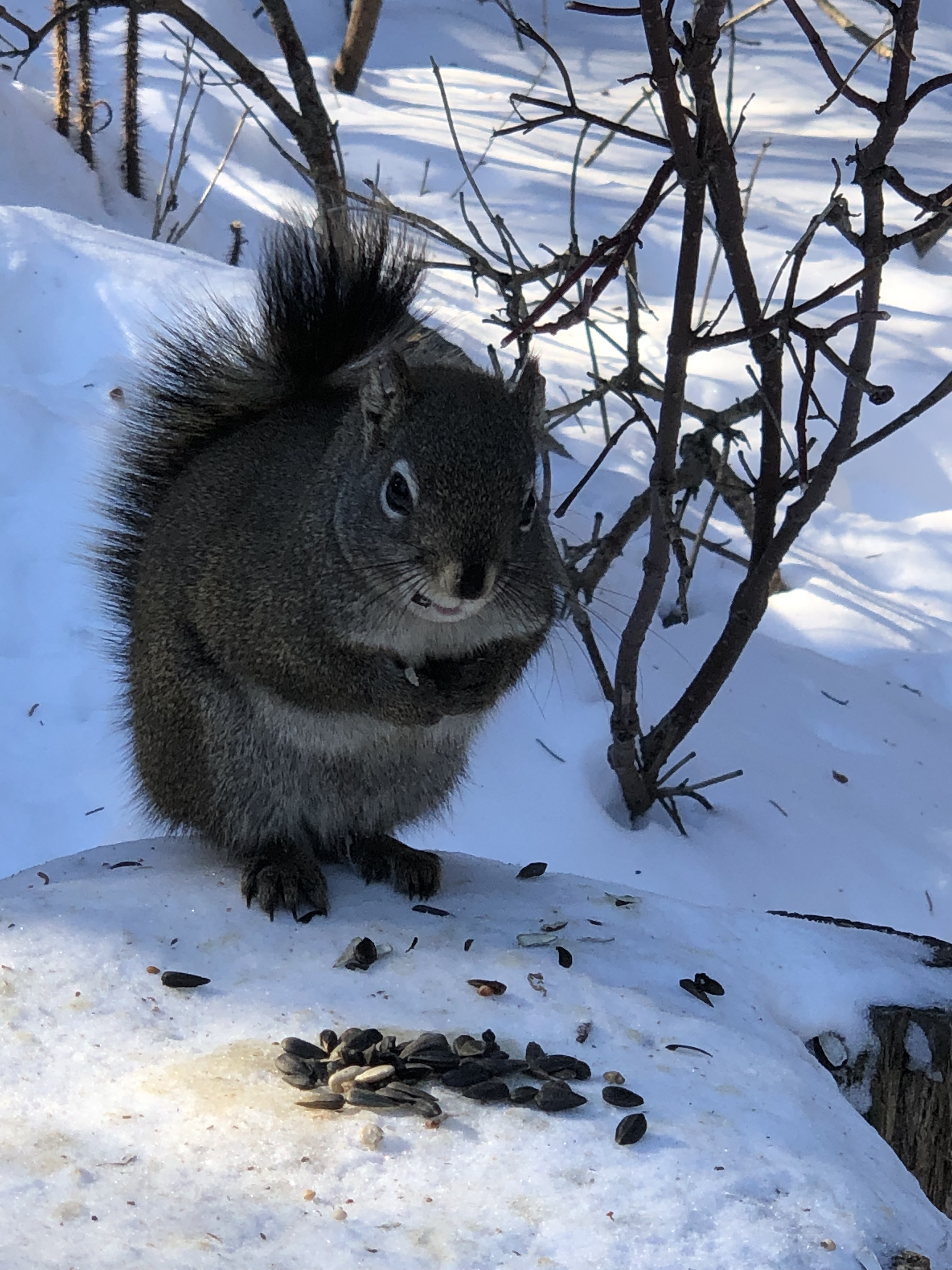
A Red Squirrel taking advantage of the sunflower handouts. Picture by Vero M. After accosting us for sunflower seeds, this Black-capped chickadee got its demands met. Picture by Vero M.
The eBird record for today’s excursion:
Edmonton--Whitemud Creek, S of Snowvalley, Edmonton, Alberta, CA 3-Mar-2019 12:04 PM - 1:33 PM Protocol: Traveling 3.976 kilometer(s) Comments: Beautiful sunny winter day, -15C (-19C with wind chill). 5 species
As of end of February we have seen 40 species of birds in Alberta. While the winter may be a slow time for birding, the final count for the greater Edmonton area winter bird count was finalised by the Edmonton Nature Club on March 1. Between December and February total of 91 species of birds were observed in a 160 km diameter circle centred on Edmonton (West/east boundaries are roughly Seba Beach and Ryley and the north/south boundaries are roughly Westlock and Wetaskiwin). This is the highest number of species observe since the count started 7 years ago. This year there were several notable additions (e.g. Eared Grebe, Great Blue Heron, Hermit Thrush and Brewer’s Blackbird). A total of 119 species were observed over the last 7 years. This just shows that, despite the long harsh winter, there is a remarkably large number of species present in and around Edmonton during this time of year.
Although we have had a somewhat slow start to our AB Big Year, most of these species will be present throughout the year giving us opportunities to bag them later. Some species, however, only occurs in the Edmonton area during the winter, for example Snowy Owls (which we did see a few weeks ago), Snow Bunting (not seen), Common Redpoll (seen), Hoary Redpoll (not seen), Pine Grosbeak (not seen), Brown Creeper (seen) and Northern Shrike (not seen) just to mention a few. Since we are “lucky enough” to have winter weather for more-or-less half the year (Oct to March on a typical year), we still have a few weeks to track down these winter visitors.
Number of check lists reporting Snowy Owl sightings in the Edmonton area over the last five years by time of year clearly showing that Snowy Owl sightings only occur between November and March.
I find myself still thinking of the poor Great Blue Heron that was found in Hermitage Park at the beginning of February (during the extreme cold spell). There was a discussion thread on the Edmonton Nature Club’s bulletin board that tracked the heron’s deteriorating condition and then it just vanished. It appears that this individual was at the wrong place at the wrong time of the year and it is unlikely this story had a happy ending. While many species seem to do well in our harsh winter environment, there is a fine line between survival and death when environmental conditions are at their extreme.
Here is the complete list by Edmonton Nature Club of species seen during the winter count 2018/19 in the greater Edmonton area:
Trumpeter Swan
Tundra Swan
Great Blue Heron
Red-necked Grebe
Western Grebe
Horned Grebe
Eared Grebe
Canada Goose
Mallard
Gadwall
Northern Pintail
American Wigeon
Green-winged Teal
Canvasback
Redhead
Ring-necked Duck
Greater Scaup
Lesser Scaup
Common Goldeneye
Barrows Goldeneye
Bufflehead
Hooded Merganser
Common Merganser
Red-breasted Merganser
Ruddy Duck
Sharp-shinned Hawk
Cooper’s Hawk
Northern Goshawk
Rough-legged Hawk
Golden Eagle
Bald Eagle
Merlin
Prairie Falcon
Gyrfalcon
Peregrine Falcon
Gray Partridge
Ring-necked Pheasant
Ruffed Grouse
American Coot
Eurasian-Collared Dove
Rock Pigeon
Great Horned Owl
Snowy Owl
Great Gray Owl
Barred Owl
Northern Saw-whet Owl
Northern Hawk Owl
Downy Woodpecker
Hairy Woodpecker
American Three-toed Woodpecker
Black-backed Woodpecker
Northern Flicker
Pileated Woodpecker
Northern Shrike
Blue Jay
Canada Jay
Black-billed Magpie
Common Raven
American Crow
Black-capped Chickadee
Boreal Chickadee
Red-breasted Nuthatch
White-breasted Nuthatch
Brown Creeper
Golden-crowned Kinglet
Townsend’s Solitaire
Hermit Thrush
Varied Thrush
American Robin
European Starling
Bohemian Waxwing
Cedar Waxwing
Yellow-rumped Warbler
Northern Cardinal
American Tree Sparrow
White-throated Sparrow
Song Sparrow
Dark-eyed Junco
Snow Bunting
Common Grackle
Evening Grosbeak
Pine Grosbeak
Brewer’s Blackbird
House Finch
Red Crossbill
White-winged Crossbill
Common Redpoll
Hoary Redpoll
Pine Siskin
American Goldfinch
House Sparrow
May the curiosity be with you. This is from “The Birds are Calling” blog (www.thebirdsarecalling).
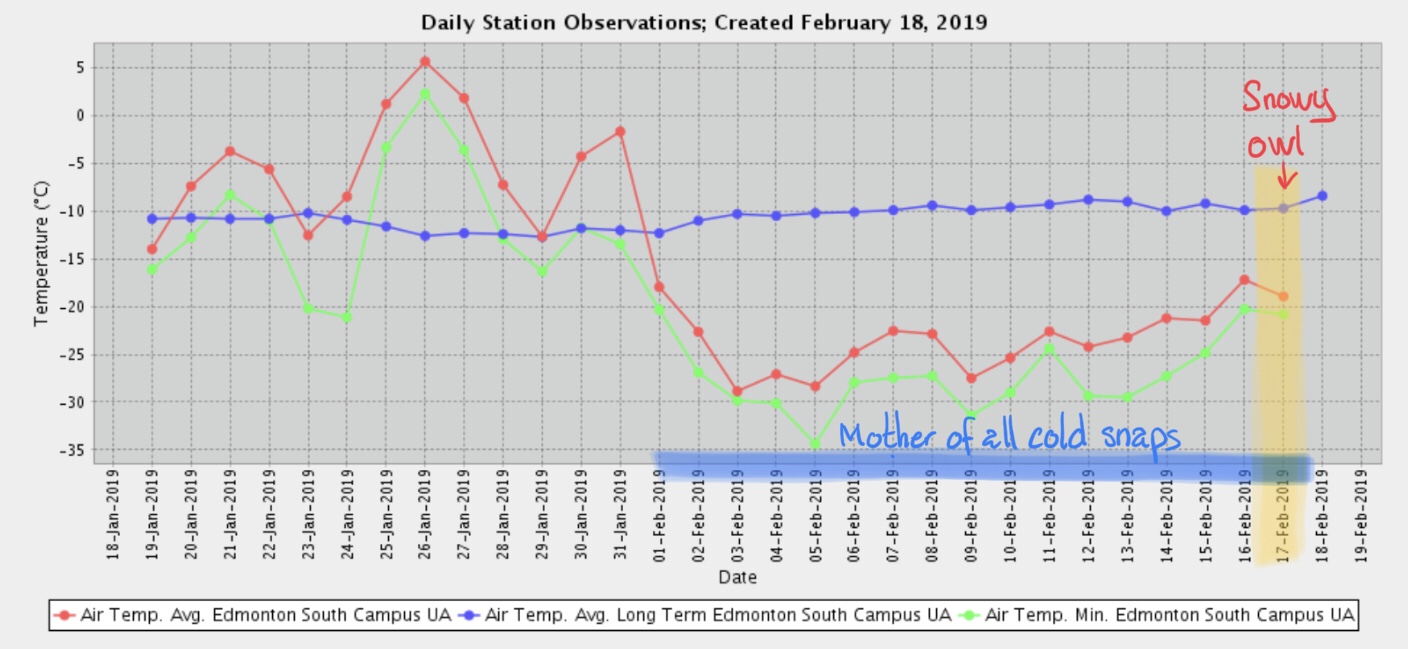
This year’s Family Day weekend coincided with the Great Backyard Bird Count so obviously this called for heading out into the wild for some birding with family and friends. For the past three weeks, however, Alberta has been under, what appears to be, an unbreakable cold spell. The normal seasonal temperature this time of year in Edmonton is around -10 °C, but all through February temperatures have hovered around -30 °C…, and that is without taking the windchill into account. With the windchill, night temperatures have dropped down to between -30 °C to -40 °C. Needless to say, birding has been put on the back burner during this cold spell.
The current cold snap is almost in on its third week. The wind chills often push the temperature down another 10 °C to 15 °C.
After three weeks of increasing cabin fever, it was decided, it was time to brave the deep freeze and head out in the frozen wilds. We ended up doing two excursions over the weekend, one to Ray Gibbon Drive in St. Albert in search of our first Snowy Owl and a second to the Whitemud Creek for some general winter bird awesomeness.
Ray Gibbon Drive is a major thoroughfare with lots of traffic and I would have never expected for such a large owl to be hanging out in plain daylight in such a busy and mundane location. We had, however, received reliable intel from a fellow birder that Snowy Owls can often be seen perching on the light and utility poles along the road. So it was with anticipation and mounting excitement we headed north to Ray Gibbon Drive on Sunday. The heavy traffic and the lack of shoulders do not allow a car to stop so our strategy was simple. Drive as slowly as possible, but not so slow that drivers behind us would lose their cool (which would be indicated by honking and visible fists in our rear mirrors)…, while systematically scanning the roadside for owls. We figured that at a slow enough speed and with three pairs of eyeballs it would be difficult for an owl to go unnoticed. If we did not spot an owl on the first pass, we would drive to the end of the road, turn around and do another pass…, and repeat as long as necessary. As it turned out, luck was on our side. On our first pass, we spotted a large “poofy” organic-looking mass on the cross arm of a wooden utility pole. We decided to try to get a better view, so we pulled off the main road, parked at a gravel road and ventured into the Grey Nuns Spruce Woodlot. The good news is that after a bit of a hike we were able to get a clear view of the owl from a distance. The not so good news is that the cold got the better of us and we had to cut the birding short and as we do not have a camera yet we were not able to get a picture of the owl. The specimen was a large white snowy owl that looked completely at ease on its perch, despite the heavy traffic close by.
This sighting is special for us. Not only is it a lifer for all three of us but it is also our very first owl! One cannot help but be in awe of such a magnificent bird on a blisteringly cold winter day such as this, particularly when you consider that they migrate south to Edmonton to overwinter.
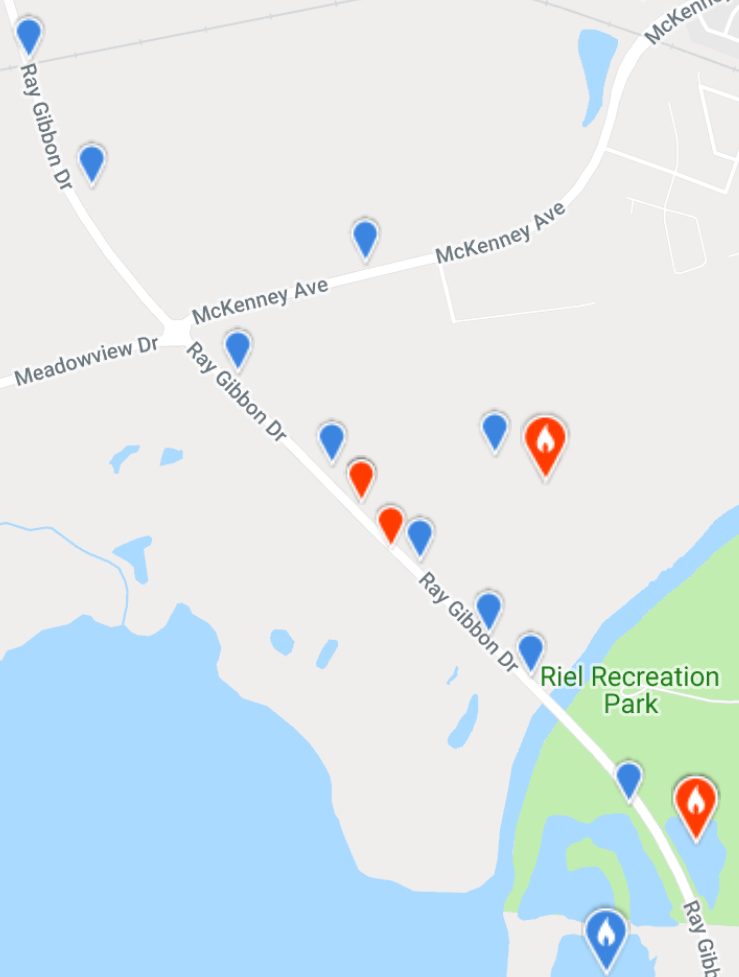
Reported Snowy Owl sightings along Ray Gibbon Dr between December 2018 and February 2019. Yup – the owls are definitely there!
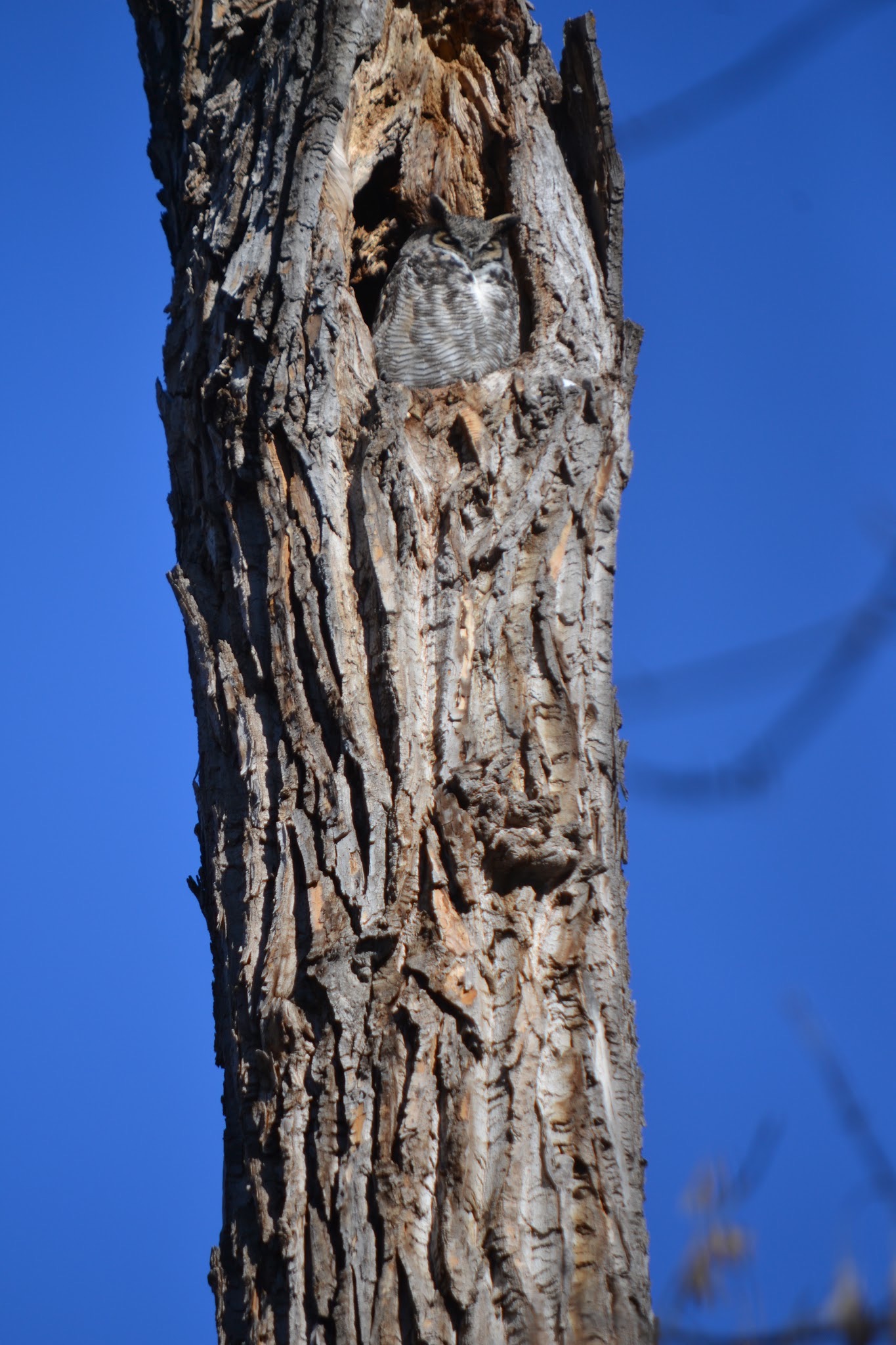
The following day we ventured to Whitemud Creek. Over 150 species of birds have been identified along this creek, making it somewhat of a birding hotspot due to the riparian habitat and abundance of old growth forest with dead standing trees. Despite the biting cold we saw all the regular inhabitants of the area, from the bold and chatty Black-capped Chickadees demanding sunflower seeds, the odd White-breasted Nuthatch to a timid Downy Woodpecker and a splendid Pileated Woodpecker that could not care less about us ogling him as he was working away on a tree stump with such ferocity woodchips were whirling around him like there was no tomorrow. The highlight, however, was undoubtedly the Great Horned Owl pair we found, with the female snuggled up in a large cavity in a dead tree and the male hiding among the low-level branches of a nearby spruce tree. The pair, silent and perfectly camouflaged blended in with the bark of the trees. How did we find them? We just followed the throng of primates carrying cameras with large telephoto lenses. It turns out that the owl pair is a bit of celebrity for people that regularly visit the creek.
Female Great Horned Owl in her abode. Image: Patricia S. Male Great Horned Owl, presumably the partner of the female in a nearby tree. Image: Patricia S.
All in all, the weekend’s birding did not become memorable for the sheer number of species but rather for the two iconic and majestic owls that both were lifers as well as our first two owl species. With the addition of these two owls, our Alberta Big Year tally is now at 40 species. Here is the full tally of our sightings for these two days.
St. Albert--Ray Gibbon (Riel East Pond), Edmonton, Alberta, CA
Feb 17, 2019 4:48 PM - 5:33 PM
Protocol: Stationary
1 species

Snowy Owl (Bubo scandiacus)  1     Large individual sitting on top of a wooden power post with feathers fluffed and just chilling. Beautiful sunny day, -17C, slight breeze and -24C with the windchill.
Edmonton--Whitemud Park, Edmonton, Alberta, CA Feb 18, 2019 1:00 PM - 2:30 PM Protocol: Traveling 3.0 kilometer(s) Comments: Beautiful sunny winter day, -14C (-20C with windchill). 7 species