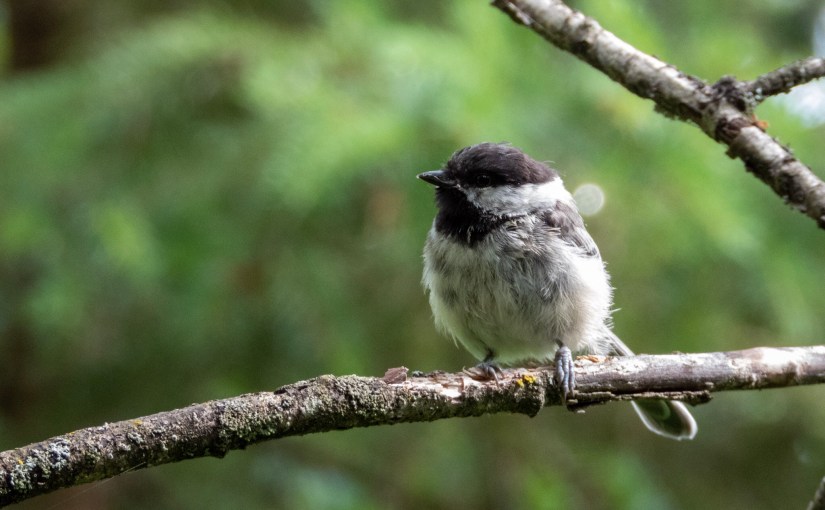
Came across the unusually fuzzy looking Black-capped Chickadee at the MacTaggard Sanctuary the other day. This chickadee looked bedraggled and mottled , like it was having a bad hair feather day. I have my suspicions that’s perhaps it could bear a juvenile, but I have not been able to find any conclusive information supporting my theory. During the winter the chickadees were very abundant and as soon as one would arrive at the trail, the chickadees would greet you, probably hoping for a treat. During the summer the situation is quite different. While one can hear their song in the forest they keep to them selves and rarely accost unsuspecting humans. This disheveled looking chickadee, however, came down to check me out. It did not stray long. Once it was clear that I was not offering any treats it took off and vanished in the shrubbery again.
Fuzzy Black-capped Chickadee (Poecile atricapillus) at the MacTaggard Sanctuary, Edmonton. July 7, 2019. Nikon P1000, 504mm @ 35mm, 1/160s, f/5, ISO 400
May the curiosity be with you. This is from “The Birds are Calling” blog (www.thebirdsarecalling.com). Copyright Mario Pineda.
If your look around the forest after a rain, you might notice that some leaves shed the water readily and appear dry while on other leaves the water pools in droplets. Leaves are covered in a waxy cuticle and the structure and chemistry of the cuticle determines how water on its surface behaves. The stronger the water is repelled from the surface of the leave the larger and more dome shaped the water droplets on the leaves are. It is the cohesive intermolecular forces between the water molecules (specifically the hydrogen bonds between water molecules) that result in surface tension That ultimately form the spherical shape. There is probably a lot more that could be said about this phenomenon but suffice to say that is quite photogenic.
Water droplets on a Prickly Wild Rose (Rosa acicularis) at the MacTaggard Sanctuary, Edmonton. July 7, 2019. Nikon P1000, 134mm @ 35mm, 1/200s, f/4, ISO 100
May the curiosity be with you. This is from “The Birds are Calling” blog (www.thebirdsarecalling.com). Copyright Mario Pineda.
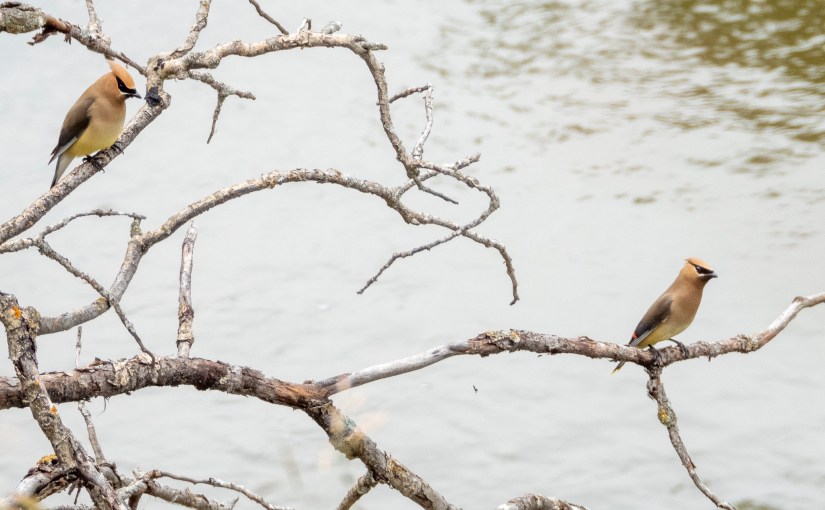
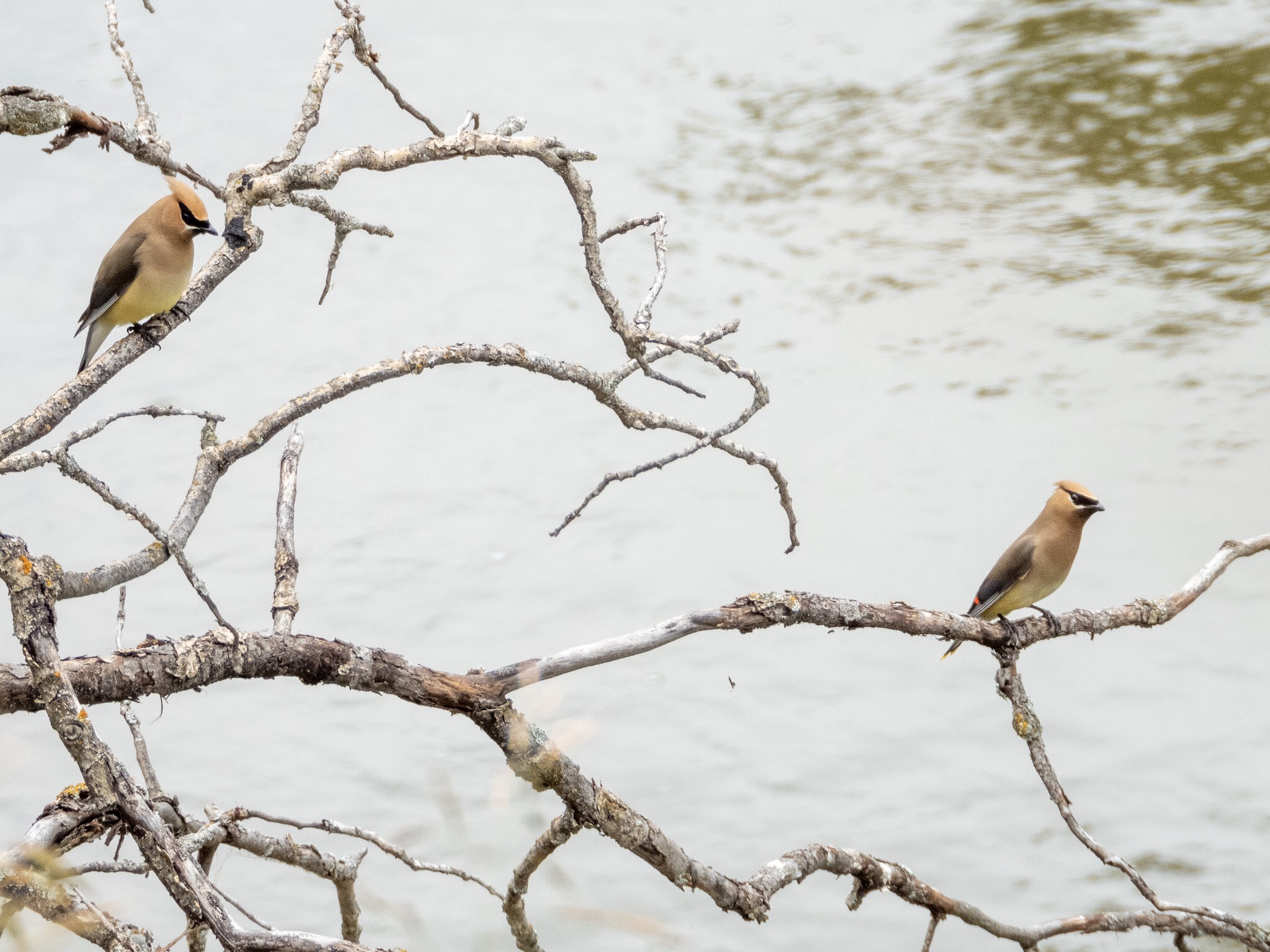
I had dropped off my teen at practice, there was a break in the never ending rain and I had 90 minutes to myself. Dark clouds loomed at the horizon so there was no time to waste. I raced as fast as it was legal to the nearest birding spot, which happened to be the MacTaggard Sanctuary. The MacTaggard sancturary straddles the Whitemud Creek south of 23rd avenue. I have been here once before, about three weeks ago at which point I was almost eaten alive by the mosquitoes. (See Post No. 078) With the copious amounts of rain we have received over the last few weeks the mosquito situation has not improved. With the trail covered in mud and mushrooms sprouting all around in the soggy leaf litter I set out with my sights set on the oxbow lake situated in sanctuary (See Post No. 075 for an explanation of what an oxbow lake is). I never made it to the lake. First I got sidetracked by a fleeting glimpse of an American Goldfinch. I spend some time trying to get a better look at it but to no avail. Then I spotted a Pileated Woodpecker perched high up on a dead tree. As I was watching it another one landed on the same tree. You simply do not walk away from a duet of Pileated Woodpeckers, so I spend quite some time checking out these cool fellas. They were flying too and fro between trees and seemed to have a jolly good time together. Once I decided to move on something in the corner of my eye caught my attention as I hiked over a bluff overlooking the creek. I stopped and scanned the creek and the dense riparian vegetation below me. It took a while, but then I saw them. Five magnificent and regal Cedar Waxwings were playing hide and seek in the thick riparian vegetation with an occasional foray out into the open over the creek. Cedar Waxwings have been on my birding wanna-see list ever since the beginning of the year. Way back on March 29 my very first Project 366 post was about Bohemian Waxwings (See Post No. 001). I ended seeing lots of Bohemian Waxwings along the Whitemud Creek as the winter petered out. The almost identical Cedar Waxwings, however, evaded me.., until today. The two species look almost identical and the physical differences between them are subtle. While Bohemian Waxwings are bigger and chunkier than Cedar Waxwings, for the uninitiated noob (like me) that does not really help. The key distinguishing feature for me was the orange under-tail of the Bohemian Waxwings versus the white under-tail of Cedar Waxwings. Today’s Cedar Waxwings brings my AB Big Year total to 115 and my Life list to 163. The last month has been a bit of a dry spell in terms of spotting new species as the birding has been a bit of hiatus in favour of a focus on bison. Hopefully the Cedar Waxwings are a sign of being back in the swing of things.
Cedar Waxwings (Bombycilla cedrorum) at the MacTaggard Sanctuary, Edmonton. July 7, 2019. Nikon P1000, 538mm @ 35mm, 1/250s, f/5, ISO 125
May the curiosity be with you. This is from “The Birds are Calling” blog (www.thebirdsarecalling.com). Copyright Mario Pineda.
Instead of a nature walk we went on a bike ride today in the Edmonton River Valley. Although no birding was part of the plan I did pack my binoculars and camera in the paniers, just in case we would bump into anything interesting. Sure enough, as we were approaching Quesnell Bridge I spotted these large white birds in the water along the opposite shore. There were not too many options as to what it could be. Five Americans White Pelicans were frolicking in the murky waters of the river. As we were crossing the bridge we got a closer look and I managed to take a few pictures from my high vantage point. This is the first time I have seen pelicans in the river and I guess, for a water bird, the river is probably as good of a place to hang out as any other body of water. Right along the shore where the pelicans were there were some people fishing. Perhaps the fishermen and the pelicans chosen the same location because it is a good fishing spot.
American White Pelicans by the Quesnell Bridge in the North Saskatchewan River in Edmonton. July 6, 2019. Nikon P1000, 1008mm @ 35mm, 1/500s, f/5.6, ISO 220
May the curiosity be with you. This is from “The Birds are Calling” blog (www.thebirdsarecalling.com). Copyright Mario Pineda.
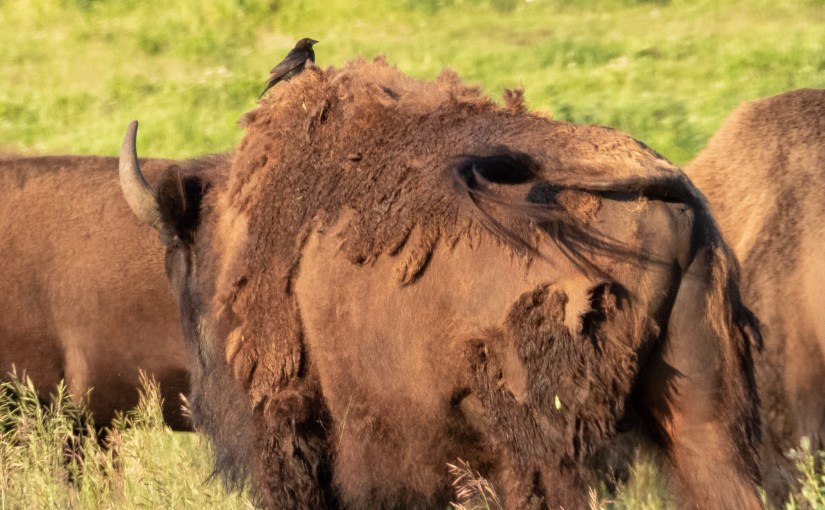
Intermingled with the massive bison were these small brown birds that were mostly hiding in the tall grass and occasionally emerging and landing on the back of a bison before diving down into the grass again. These were Brown-headed Cowbirds (Molothrus ater), a species commonly associated with grazing animals. The tend to look for insects and seeds to eat on the ground stirred up by the larger animal. Before European settlement, the Brown-headed Cowbird followed bison herds across the plains. Because of their nomadic lifestyle they engage in brood parasitism laying their eggs in the nest of unsuspecting birds of other species. These days the species is commonly seen around domesticated livestock and at suburban bird feeders. At Elk Island, however, they still live their traditional lifestyle in close association with bison herds.
Brown-headed Cowbird (Molothrus ater) going for a ride on a Plains Bison at the Bison Loop at Elk Island National Park. June 30, 2019. Nikon P1000, 756mm @ 35mm, 1/500s, f/5.6, ISO 280
May the curiosity be with you. This is from “The Birds are Calling” blog (www.thebirdsarecalling.com). Copyright Mario Pineda.
While most of the bison on the meadow were pretty chilled and seemed to just enjoy the sunny morning a few of the males had other things in mind. These two males were ogling and sizing each other up. Just as it looked like they were about to walk away, they turns around and crashed their heads together. Their horns locked together and a twisting wrestling match ensued were the two bulls trekked to outmaneuver each other. This went on for a while when suddenly one of the bison lost his footing and crashed down on his side. He was back on his feat at once and they were back in staring competition mode. Bison bulls engage in head butting battles fort mating privileges. I am not sure when the mating season for the bison in Elk Island starts, but these males might be getting ready for it.
Male Plains Bison head butting at the Bison Loop at Elk Island National Park. June 30, 2019. Nikon P1000, 605mm @ 35mm, 1/250s, f/5, ISO 100
May the curiosity be with you. This is from “The Birds are Calling” blog (www.thebirdsarecalling.com). Copyright Mario Pineda.
Among the hundreds of bison covering the meadow I found this one calf that decided to take a snooze in the sunshine. It did not have a care in the world and was clearly oblivious to my presence. An adult bison walked by and deposited a bison sized turd a few feet from it’s head, but little bison baby just kept snoozing on. With coyotes, bears, vehicles and pooping bison around you think this youngster would be a tad more wary, but I guess if your mom is a half a tonne (500 kg = 1100 lbs) lady capable of running as fast as a horse, anyone even thinking of messing around with her precious baby would soon regret it and would probably not live to tell the tale. Since the bison were introduced at Elk Island National Park in 1907, over 100 generations of have been born and raised in the park. This calf was in the northern par of the park which means it is a Plains Bison. In the southern part of the park the Wood Bison live. It would be interesting to see some of their calves. Would they look different? That sounds like an exciting field trip; tracking down some Wood Bison calves.
Plains Bison calf having a snooze at the Bison Loop at Elk Island National Park. June 30, 2019. Nikon P1000, 806mm @ 35mm, 1/500s, f/5.6, ISO 100
May the curiosity be with you. This is from “The Birds are Calling” blog (www.thebirdsarecalling.com). Copyright Mario Pineda.
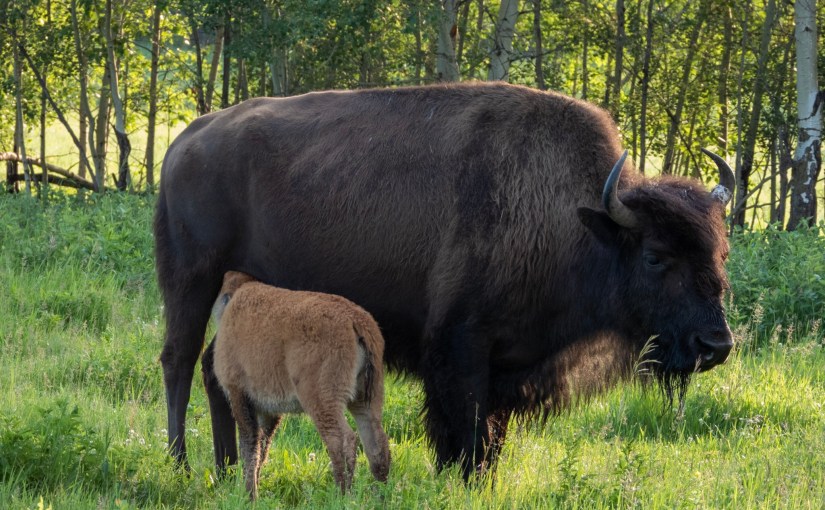
At the edge of a grove, away from the melee, a lonely bison mom and her calf were having a moment. The reddish brown calf was quite assertive, pushing its head into the mom’s groin, clearly letting her know what it wanted. I was probably not more than 25 meters from them, stuck in a bison traffic jam in the Bison Loop at Elk Island National Park. Mom and calf seemed not to mind my presence at all. I opened the sunroof of the truck and climbed out with my camera. This vantage point gave me an unobstructed view of the surroundings. As I was observing mom and calf I was surprised when I realize that the cow had horns, something I had assumed only male bison would have. It turns out that the physical differences that distinguish males (bulls) from females (cows) are quite subtle so determining a bison’s sex is not entirely trivial. Clearly the presence of horns cannot be used to tell males and females apart. Although a cow’s horns are slightly more curved and slender than a bull’s, one would likely have to be quite experienced to be able to pick up on this. Obviously a bison feeding a calf is one sure-way of positively identifying a female.
Mom and her calf at the Bison Loop at Elk Island National Park. June 30, 2019. Nikon P1000, 258mm @ 35mm, 1/125s, f/4.5, ISO 280
May the curiosity be with you. This is from “The Birds are Calling” blog (www.thebirdsarecalling.com). Copyright Mario Pineda.
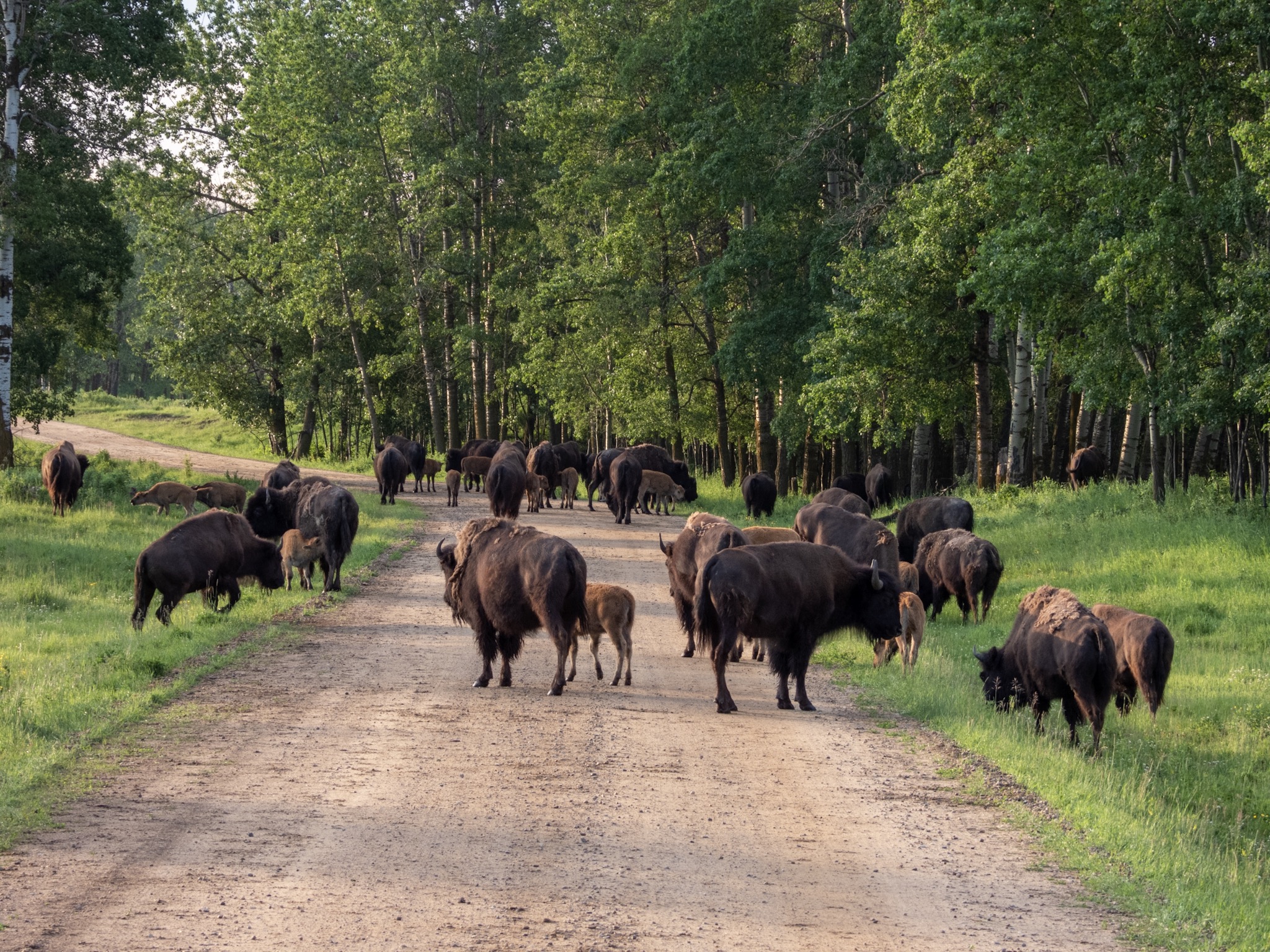
So here is another bison post as promised yesterday. This was the view as I entered the Bison Loop at Elk Island National Park yesterday morning at 6 am. Those bison were in no hurry anywhere and took their sweet time. They were mainly just standing around, occasionally a few of them decided to lie down in the grass or on the dirt road. I was slowly inching my way along in my vehicle. Mostly I was standing still waiting for a few of the bison to lumber on. A few times I got too close and I got some dirty bison looks thrown my way. Clearly the message was, this is our turf and here we are the traffic.
Today is July 1 and other than it being Canada Day it also marks the half way point of my Alberta Big Year. 178 day down and 178 days left to go. My current tally is 114 species seen in Alberta since 00:01 January 1 this year. According to eBird 404 species of birds have been reported in Alberta since the beginning of times (or at least since the beginning of the eBird record). Looking at the species reported this year only, the number is 317. Clearly I have long ways to go to reach the stratosphere of birding in Alberta. I am hoping to boost this number by going to some targeted hotspots beyond Edmonton during the summer, e.g. Frank Lake and Inglewood Bird Sanctuary, both these locations are located in and around Calgary. Other than this, my bread and butter will be my two main field locations, the Whitemud Creek and Elk Island National Park. With 153 species recorded at Whitemud Creek and 243 species reported at Elk Island there are plenty more treasures waiting to be found.
Bison traffic jam at the Bison Loop at Elk Island National Park. June 30, 2019. Nikon P1000, 157mm @ 35mm, 1/100s, f/4, ISO 100
May the curiosity be with you. This is from “The Birds are Calling” blog (www.thebirdsarecalling.com). Copyright Mario Pineda.
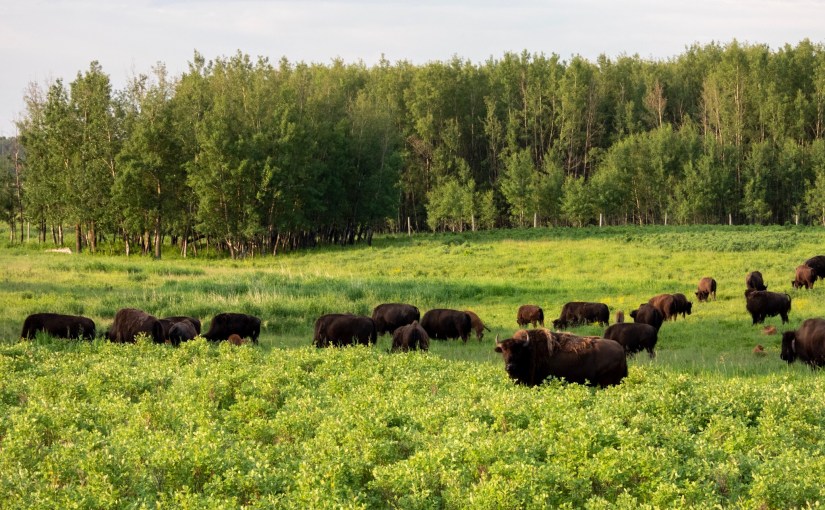
‘Twas the morning before Canada Day, when all through the park not a human was stirring, only the bison. Well, it’s not that time of year yet (as a matter of fact, today is day 178 so we are exactly halfway there), but it sure felt like that time of year this morning. At 6 am I rolled into Elk Island National Park and as the Bison Loop emerged around a curve in the road, for a second, I though I was dreaming. The field surrounding the Bison Loop and Mud Lake was filled with bison. There must have been several hundreds of them. Adults, awkward and mangy looking teens and milk chocolate coloured calves dotted the grassy field, more bison were hiding in the tree groves, bison were blocking the road and the Bison Loop gravel road was a veritable traffic jam of bison. One of the collective nouns for bison is an obstinacy of bison (the other ones are a heard of bison, a gang of bison and a troop of bison). The term seems quite fitting to such a massive animal that clearly has the attitude that they can do whatever they want. If they decide to cross the road and stand in front of your vehicle, they will do just that. As I approached the Bison Loop I thought to myself, “if I drive into the loop, I will be stuck for who knows how long”. This is one traffic jam I would love to be in. Said and done, I drove into the loop and was soon surrounded by bison and stuck in my first bison traffic jam. A few hours later I emerged on the other side of the loop with tones of picture and unforgettable memories. It was almost as if I had travelled a few hundred years back in time to the heydays of the bison when an obstinacy of bison roamed the grasslands as far as they eye could see. Much more could be said about this experience, and I will say more…, expect the next few days to have a bison theme. Tomorrow is Canada Day and the plans are to spend the day in the great canadian outdoors at Elk Island with family and friends and, hopefully, another obstinacy of bison.
An obstinacy of Plains Bison (Bison bison bison) at Elk Island National Park. June 30, 2019. Nikon P1000, 157mm @ 35mm, 1/125s, f/4, ISO 100
May the curiosity be with you. This is from “The Birds are Calling” blog (www.thebirdsarecalling.com). Copyright Mario Pineda.