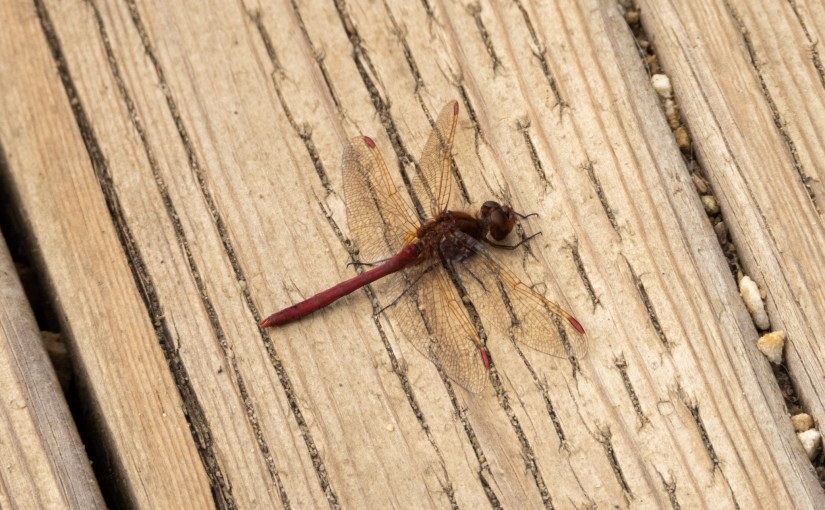
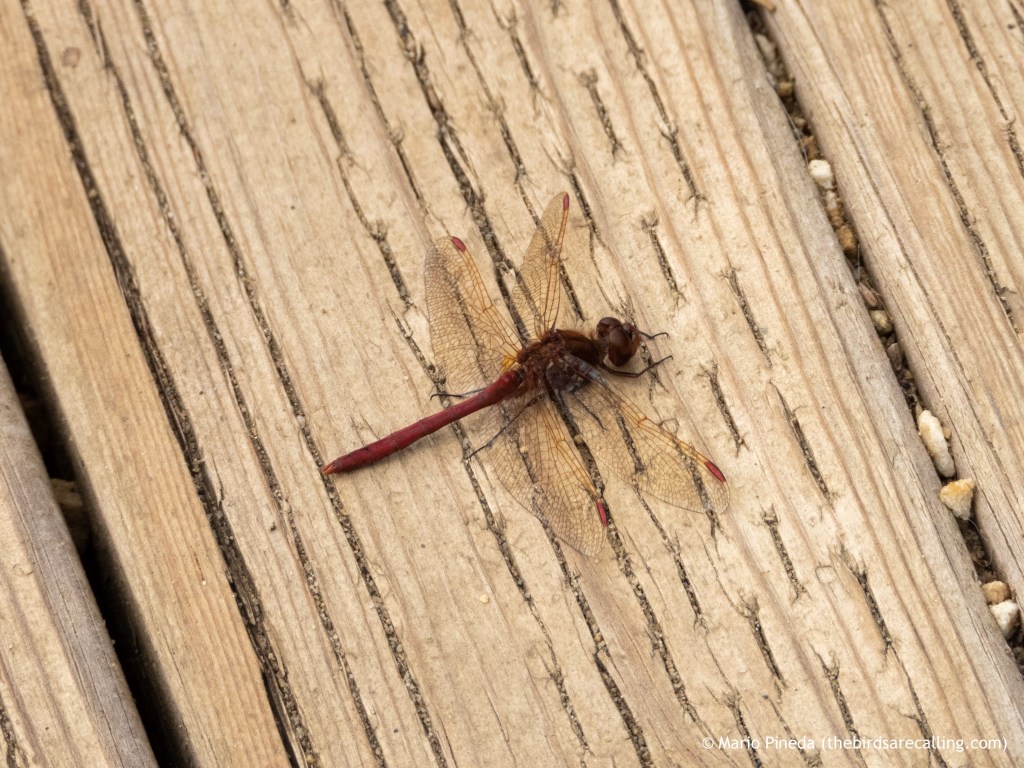
Its name must have been Danger. Meadow “Danger” Hawk. How else could one explain it deciding to land and chill out on the wooden boardwalk that goes around the Heritage Wetland Park. It seemed to be a rather inopportune location for a rest. With kids and dogs running along the boardwalk, cyclists zooming by and the odd birder not paying attention where they step as they scan the skies for exciting finds. This birder did spot the Meadow Hawk, however. I quietly suck up to it to see how close I could get before it got spooked. I was only about a meter right above it snapping pictures when it decided that it had had enough and took off.
Meadow hawk at Heritage Wetlands Park. September 21, 2019. Nikon P1000, 605mm @ 35mm, 1/320, f/5, ISO 100
May the curiosity be with you. This is from “The Birds are Calling” blog (www.thebirdsarecalling.com). Copyright Mario Pineda.
The world is changed; I can feel it in the water, I can feel it in the earth, I can smell it in the air
Lady Galadriel’s prologue in the Fellowship of the Ring
It does not just feel like fall anymore. As of today, the fall is here. As the seasons are changing and nature is readying itself for another winter there are larger and more sinister changes at work. The climate of the entire planet is undergoing massive changes at a scale never seen before. Global emissions are reaching record levels every year and show not sign of relenting. The last four years have been the hottest on record, winter temperatures in the Arctic are rising at an unprecedented rate and extreme weather events are increasingly more extreme and more common. The impacts of climate change are being felt everywhere and are having real consequences on human life. This week the UN Climate Action Summit is taking place and there is a sense of urgency never before seen, particularly among youth that are participating in the summit demanding immediate and forceful action from the leaders of the world. While we all have the possibility to do our share in reducing our impact on the natural world it is easy to feel helpless and insignificant in the large scope of things. What difference will it make if limit my driving when Alberta alone emits close to 300 megatonnes of carbon dioxide annually, the province with the highest greenhouse gas emissions in Canada, and rising? Obviously, in light of this, for the individual person, it is not about making a dent in the emissions, but to take a stand and to show that enough is enough. For anyone to take a stand the requirement is that one has the basic knowledge of the impact humans have on the planet and the role we play in the changing climate. One would think that this would be the easy part, educating people and spreading awareness, but alas it appears that this is the biggest hurdle of them all. Misinformation, denialism and good old stupidity is preventing us to make any headway towards stopping and solving the degradation of our environment. For every little step of progress humanity seems to take two steps back. Just a few local example, we are still talking about building oil pipelines and we are still talking about extracting billion of barrels of oil from the oil sands. It is difficult to watch this rhetoric unfold and turn a blind eye, particularly if you do have a voice. I might not be world leader, an activist or a celebrity but I am a parent and a teacher which means I do have a voice and I do have an opportunity to contribute to educating the next generation of leaders and decision-makers.
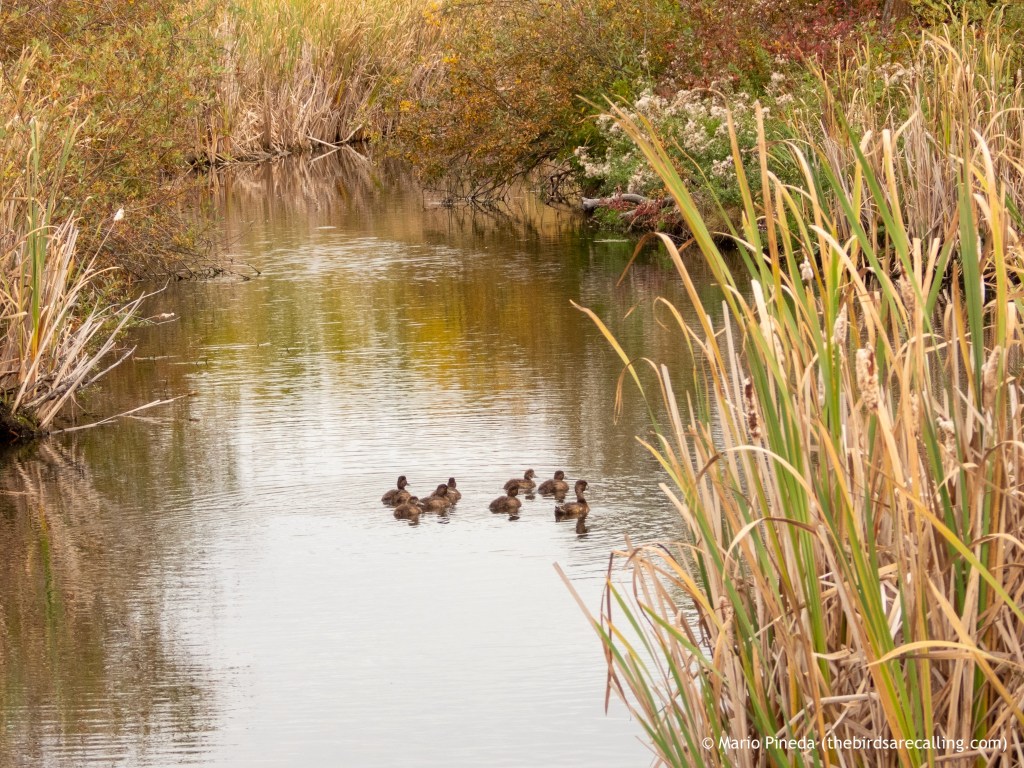
Common Goldeneyes (Bucephalus clangula) at Heritage Wetlands Park. September 21, 2019. Nikon P1000, 134mm @ 35mm, 1/200, f/4, ISO 100
May the curiosity be with you. This is from “The Birds are Calling” blog (www.thebirdsarecalling.com). Copyright Mario Pineda.
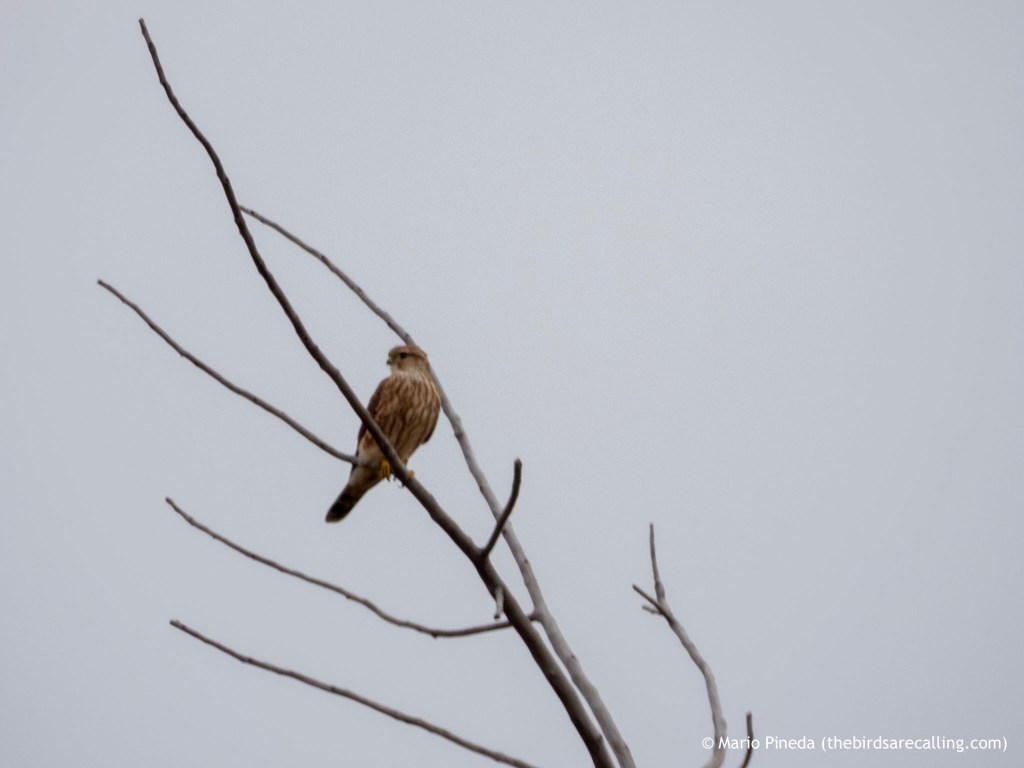
Last time I saw a Merlin was in Camrose during the AB Big Day even on May 4, so when I spotted one perched high up on a dead branch above the Heritage Wetland Park ponds it was a nice treat. It did not stay put for long. After a few minutes it took off, circled the tree tops, scared the bejesus out of a flock of crows and landed high up in another tree. A Pileated Woodpecker caught the Merlin’s attention. It took off again, this time aiming directly for the woodpecker. An adult Pileated Woodpecker is far too big for a Merlin to take down, but I guess it found the woodpecker irritating and scared it into flight. For a few seconds the two were circling each other in the air before each one landed on a new tree. I guess they realized that none of them was really going to scare the other one away so they just accepted each other’s differences. This is the closest I have ever seen a Merlin, but I still had to zoom in all the way to over 1600 mm to get close enough for a positive identification. The picture quality is certainly not stellar but it serves its purpose as far as identification goes. It was not until I came home and was able to cross-reference my picture against field guides that I was 100% sure that it was a Merlin. The Nikon P1000 is a bit of a double edged sword. On one hand, at 1600 mm zoom very few camera setups would be able to get this close, and those that would would be far more unwieldy and expensive. On the other hand, while the 1600 mm is about half of P1000 optical zoom capabilities, the image quality will suffer at this focal length, specially if the camera is hand held.
Merlin (Tamiasciurus hudsonicus) at Whitemud Ravine. September 15, 2019. Nikon P1000, 1613mm @ 35mm, 1/500, f/6.3, ISO 160
May the curiosity be with you. This is from “The Birds are Calling” blog (www.thebirdsarecalling.com). Copyright Mario Pineda.
The Heritage Wetlands is noticeably absent of bird life this time of year as most birds have already left for their southerly overwintering grounds. Today was my lucky day, however. A lonesome Belted Kingfisher was putting in substantial effort looking for its next meal. It was so focused on looking for fish that it did not notice me sneaking up on it as it was perched on the handrail of a wooden boardwalk. Its Lifer #165 and my 116th species on my AB Big Year list. There are 114 species of kingfishers worldwide, but the Belted Kingfisher is the only species found in North America. It is a top predator in both lakes and and along the coast. They can be found in Alberta between April and end of October and spend the winter south of Canada in the United Stated, the Caribbean and throughout Central America. They are funky looking birds with a shaggy crest and a big bill. It was an unexpected find and I spend a long time observing it as it was fishing for its next meal.
May the curiosity be with you. This is from “The Birds are Calling” blog (www.thebirdsarecalling.com). Copyright Mario Pineda.
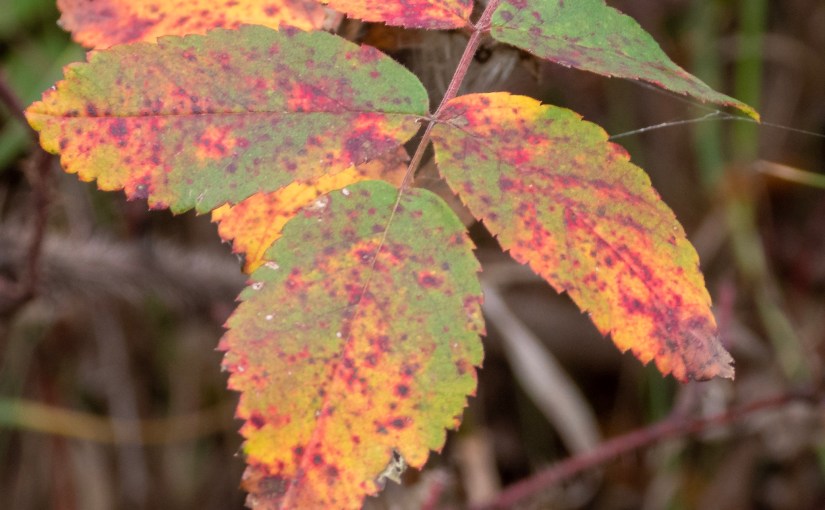
The fall colors are now coming in with full force. Officially the first day of fall in the Northern Hemisphere is on Monday September 23, in three days. So the timing of the changing colors of the leaves is pretty good. Last year we were hit with the first snow on the last day of summer. There is currently no snow in the forecast, but things are definitely cooling so anything is possible I assume. The bird diversity has decline noticeably. The ponds and lakes are eerily empty and one can start feeling the fall in the air. It is a bit melancholic that what once was is not gone and we are standing at the door step of a long dark and cold winter. On a more cheerful note, winter will bring with it new denizens of the frozen wilds. The snowy owls, the Bohemian Waxwings, Redpolls, and Pine Siskins.
May the curiosity be with you. This is from “The Birds are Calling” blog (www.thebirdsarecalling.com). Copyright Mario Pineda.
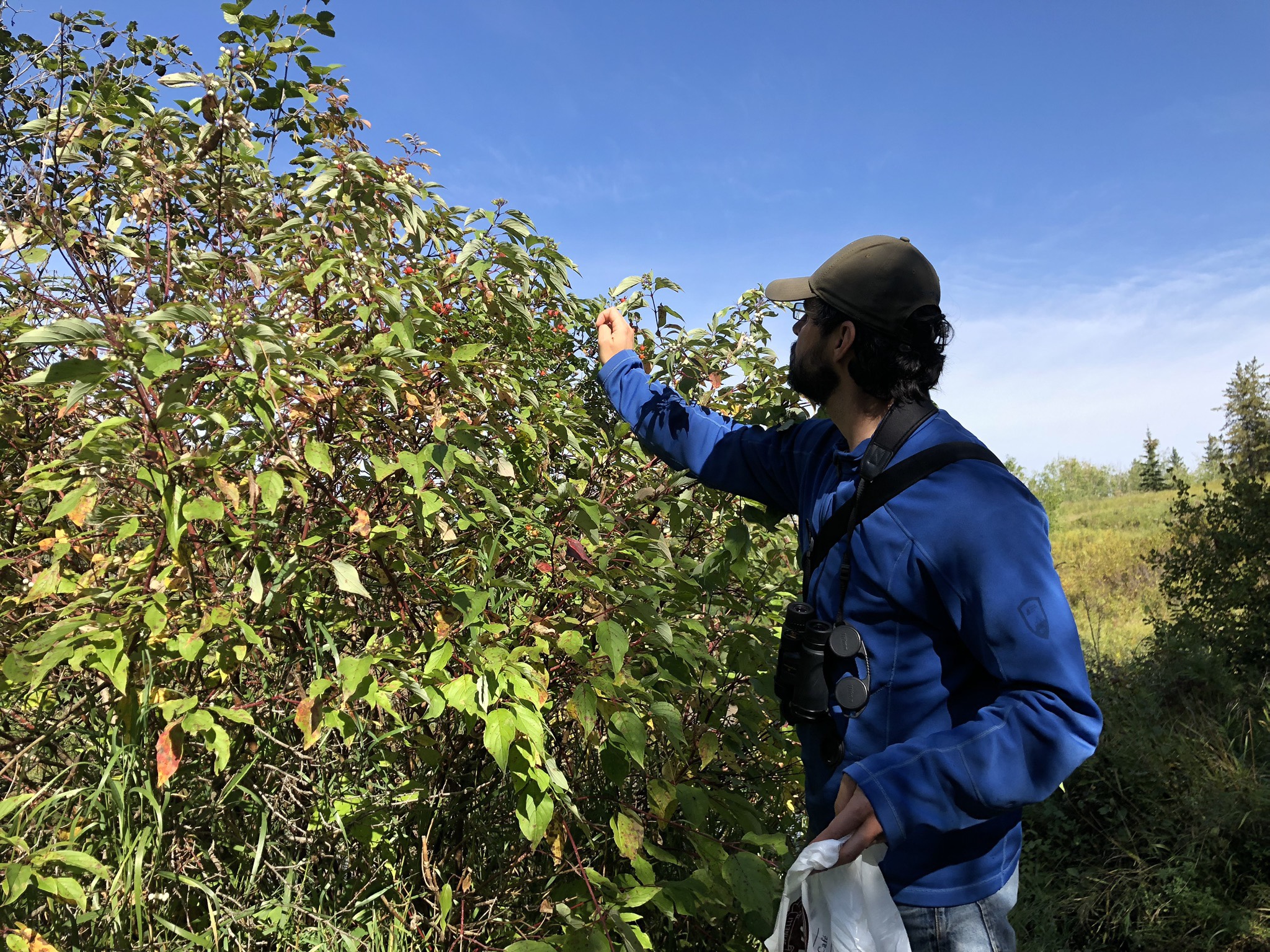
Lots of people harvest what nature has to offer, most often in the form of hunting or fishing. I have, however, not encountered many people that harvest wild plants or parts of wild plants. Recently we met a gentleman down by the creek that was harvesting Chokeberry for himself and his family. He told us that people these days, specially in the cities, do not harvest wild plants, berries, fruit or mushrooms. So we thought, let’s try something new and the other day we went out down to the creek to harvest some rose hips. I am well-familiar with rose hips as it is commonly consumed in Europe, where I grew up. I have never, however, harvested my own rose hips so this was a new experience for me. Rose hips felt like a safe choice as there is nothing else around that could me mistaken for rose hips. Berries can be trickier and mushrooms are definitely beyond my comfort zone at this point.
May the curiosity be with you. This is from “The Birds are Calling” blog (www.thebirdsarecalling.com). Copyright Mario Pineda.
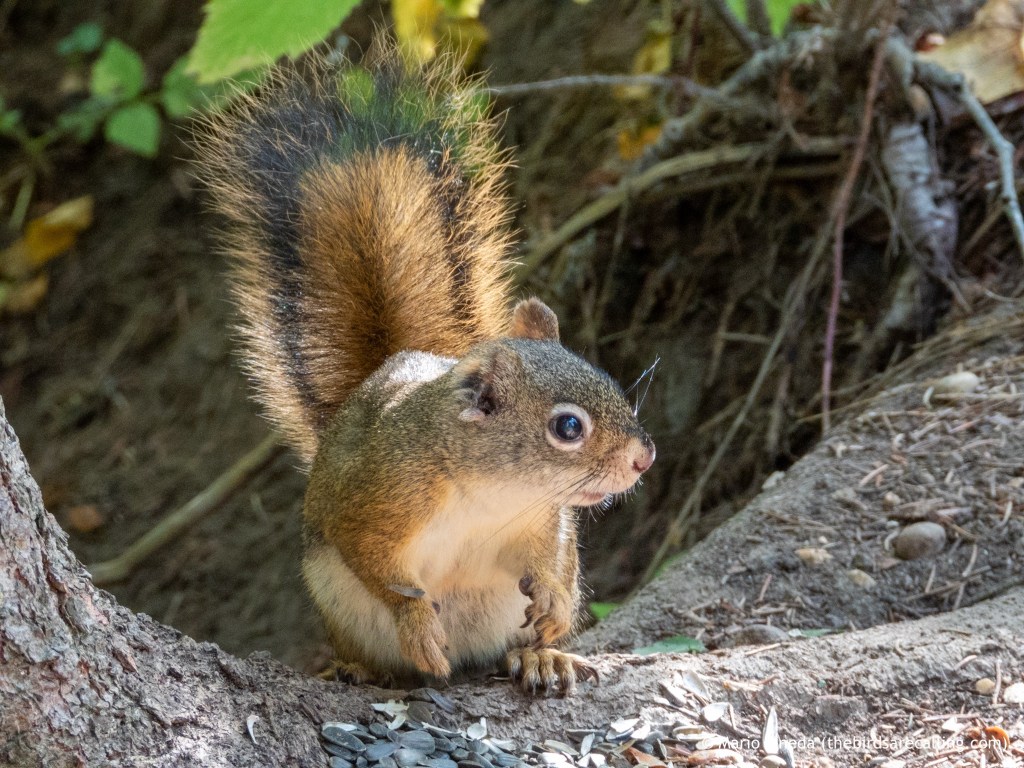
The American Red Squirrel loves to munch on seeds, particularly sunflower seeds when these are provided by their human subjects. Sunflower seeds do not occur naturally in the Whitemud Ravine but people distribute sunflower seeds by the bags along the trails so there is always plenty to go around. A diet that predominantly is based on seeds is sometimes referred to as seed predation or granivory. The Red Squirrels are opportunistic and will incorporate a range of food items into their diet such as fruit , berries and fungi. This fella that we encountered along the trail was to busy munching on sunflower seeds to really care about our presence. The light in the picture allows one to clearly see the typical dark band across the bushy tail.
Red Squirrel (Tamiasciurus hudsonicus) at Whitemud Ravine. September 15, 2019. Nikon P1000, 470mm @ 35mm, 1/60, f/5, ISO 800
May the curiosity be with you. This is from “The Birds are Calling” blog (www.thebirdsarecalling.com). Copyright Mario Pineda.
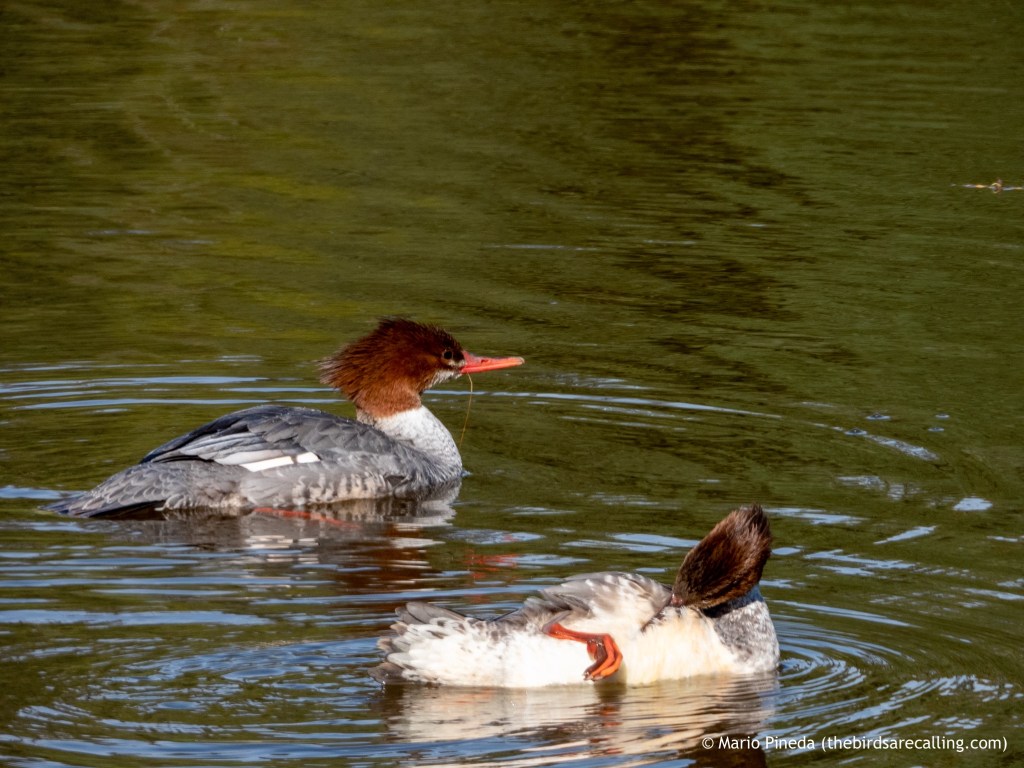
Over the summer the Whitemud Creek has been quiet when it comes to waterfowl. Maybe it is the constant strong current but it seems that most water fowl prefer more still water for their day to day business. The other day, however, as we were down buy the creek harvesting rose hips we came across half a dozen Common Mergansers hanging out on the banks for the creek. I am not sure what brought them there, but it was a welcomed sight. After a while sitting on the shoreline they went into the creek and started going back and forth, sort-of aimlessly. As mergansers migrate south in the fall, one possibility is that they are starting to get together to prepare for their migration to their overwintering habitats.
Common Mergansers (Mergus merganser) at Whitemud Creek. September 15, 2019. Nikon P1000,935mm @ 35mm, 1/500, f/5.6, ISO 140
May the curiosity be with you. This is from “The Birds are Calling” blog (www.thebirdsarecalling.com). Copyright Mario Pineda.
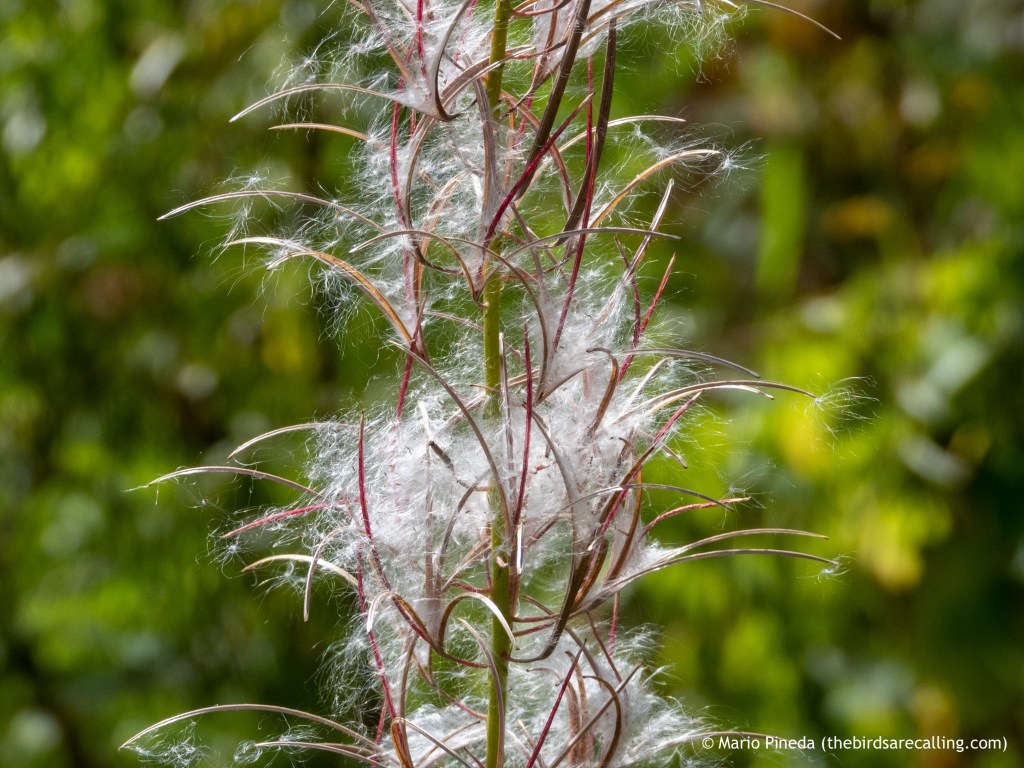
The Fireweed (Chamaenerion angustifolium) have matured and the flowers have have turned into long thin stalked brown seed pods that have splitting at the tip. The two half’s of the seed pod then curl backwards and releasing numerous small seeds that have long white hairs attached to catch the wind. When all the pods have opened the top of the plant looks like a fuzzy mess. A single fireweed can produce up to 80000 seeds. The fuzz was used by native peoples as fibre for weaving and for padding. For example, Salish people wove fireweed with the down of mountain goat wool for making blankets. The seed are also an excellent fire starter.
Fireweed seed fuzz at Whitemud Ravine. September 15, 2019. Nikon P1000, 347mm @ 35mm, 1/1000, f/4.5, ISO 100
May the curiosity be with you. This is from “The Birds are Calling” blog (www.thebirdsarecalling.com). Copyright Mario Pineda.
It was a beautiful sunny Sunday morning and we had made our way to Whitemud Ravine south of Snow Valley to Look for some rose hips. I was not sure about the timing as some online resources claim one should wait with harvesting rose hips until after the first frost as they are supposedly sweeter that way. They appear ripe, however, with some of them starting to turn to soft and mush so we decided to try out both versions; harvest some before the first frost and then compare these to rose hips harvested after the first frost. There is certainly no shortage of rose hips along the trails so I think there will be plenty left to harvest later in the season. We ended up with about two cups of rose hips. We washed them, pinched off the old rose petals and now have them out to dry. Once they have dried up a bit we will try making rose hip tea.
Rose Hip bounty at Whitemud Ravine. September 15, 2019. Nikon P1000, 67 84mm @ 35mm, 1/800, f/3.5, ISO 100
May the curiosity be with you. This is from “The Birds are Calling” blog (www.thebirdsarecalling.com). Copyright Mario Pineda.