Project 366 – Post No. 032 – Great Horned Owl family update

What is Project 366? Read more here!

The secret is out, someone saw one of the Great Horned Owl chicks peaking out of the nest the other day. I am obviously talking about Edmonton’s own celebrity owl family down in the Whitemud Ravine. Last time I was down there, four days ago, mom owl was still in her cavity. I did not see any chicks but mom was peaking out of the nest and she seemed to be “higher up” in the nest, perhaps indicating that there are growing chicks below her. While this is exciting news, I am a bit concerned about the well-being of this celebrity family. Just like any celebrity family, they are under close scrutiny of the public with eager paparazzi nature photographers and birders watching their every move. There always seems to be photographers at the nest. To anyone regularly trafficking the trail it would be completely obvious that there is something interesting hiding in the trees. So far, everyone seems to be mindful and considerate of the feathered family, but it only takes one bad apple to cause irreparable harm. There are good reasons why eBird does not allow the publication of the exact location of owl nests. Owls are vulnerable to disturbances not just from humans but also from other birds. For example, owls are commonly harassed by other birds. If other birds, such as crows, ravens and other raptors, get alerted to the presence of the owls they could start harassing them or even prey on the young. Perhaps one could view all the nature loving photographers and birders as standing on guard around the family, making sure they are not bothered by anyone with ill intentions. I know that I will be back at the nest, carefully and mindfully observing the family from a distance.

Nikon P1000, 1210mm equivalent, 1/200s, f/5.6, ISO 400

May the curiosity be with you. This is from “The Birds are Calling” blog (www.thebirdsarecalling.com). Copyright Mario Pineda.

Project 366 – Post No. 030 – Deadeye Robin

What is Project 366? Read more here!

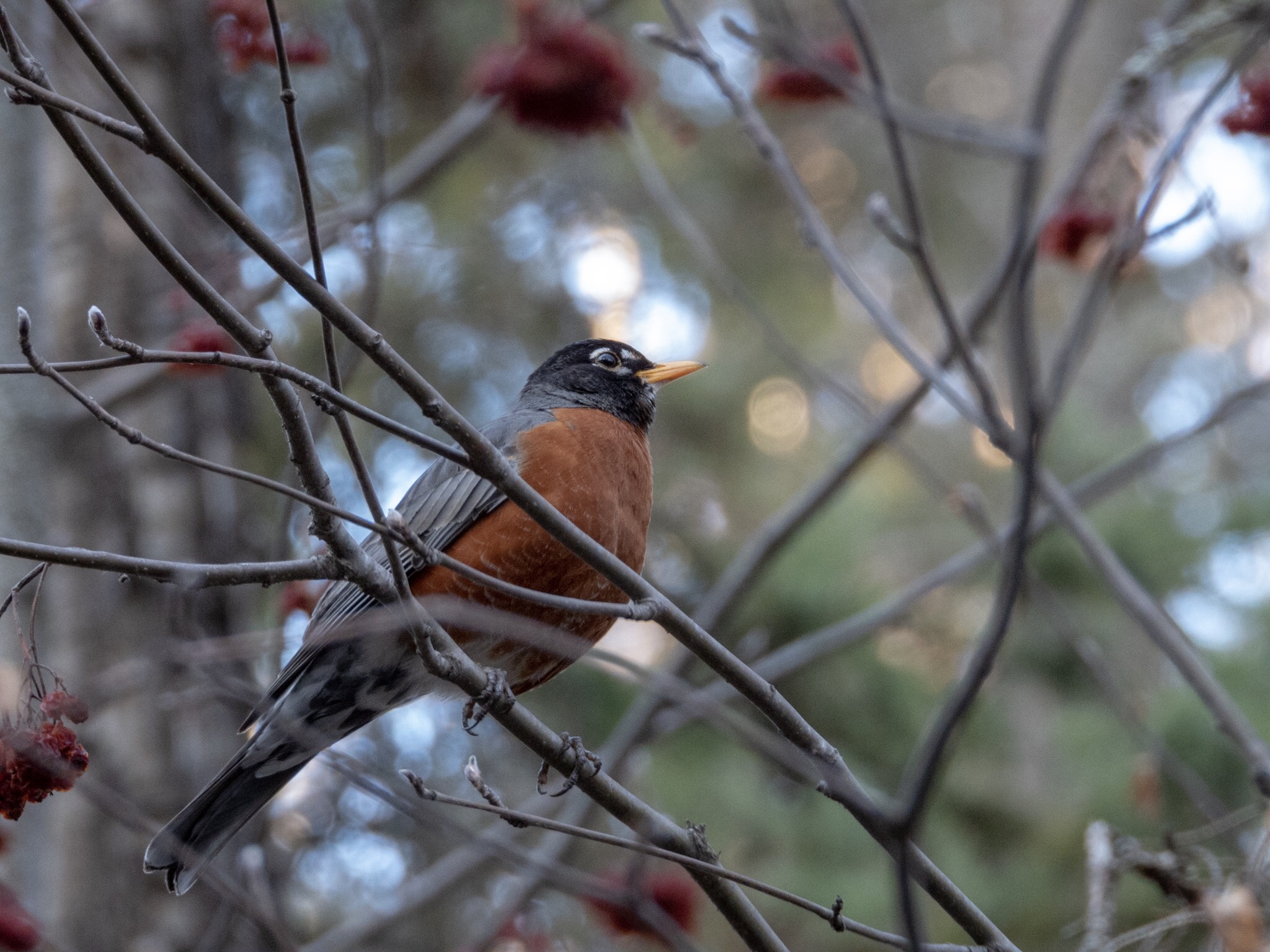
I had been bushwhacking along the trails and through the brush at the Whitemud Creek for a few hours and the sun was getting low in the sky. I had just finished checking part of the trail where Pileated Woodpeckers often hang out (with no luck). As I started heading back a quick bout of chirping in the shrubbery along the trail caught my attention. The twilight made it tricky to find the culprit, but there it was – an American Robin sitting in a Mountain Ash just minding its own business. Initially I did not reach for my camera as I already have plenty of pictures of robins and it was getting too dark to take pictures anyway. The robin was, however, sitting completely still, almost like it was posing for me so I figured that I could at least try to get a picture of it. While I did have the camera on a monopod I figured that the chances of the pictures turning our would be quite slim. It was getting dark and there was jumble of twigs and branches between me and the robin. I doubted the camera would be able to focus properly through the shrubbery in the low light. To my surprise the camera nailed the focus immediately. At 1/60s (which is a really long exposure at 705mm zoom) and ISO 500 (which is a sure recipe for grainy images lacking detail) the exposure settings were a bit challenging to say the least. I ended up only taking a few pictures. When I inspected the images back at the car I was astonished. Every single image was razor sharp (by P1000 standards), the exposure was spot on and the the bokeh was awesome. The P1000 really throws me for loops at times. Only a few days earlier I had been shooting Ospreys in transmission towers under, what would be considered, ideal conditions (a backdrop of a bright blue sky, no interfering shrubbery, etc.). Despite this, I had great difficulty coaxing the camera into focusing properly (both with auto focus and manual focus) and the pictures came out unacceptably soft. For a brief moment the robin made me feel like a deadeye, but the truth is that I am still not able to wrap my head around why the camera struggled with the osprey in what should have been ideal conditions but nailed the robin in the twilight.

On a side note. This post is #30 of my Project 366. One month down, eleven to go. Congratulations to…, me! Keep up the great work. 😁

Nikon P1000, 705mm equivalent, 1/60s, f/5, ISO 500

May the curiosity be with you. This is from “The Birds are Calling” blog (www.thebirdsarecalling.com). Copyright Mario Pineda.

Project 366 – Post No. 020 – Tracks in the Sand

What is Project 366? Read more here!

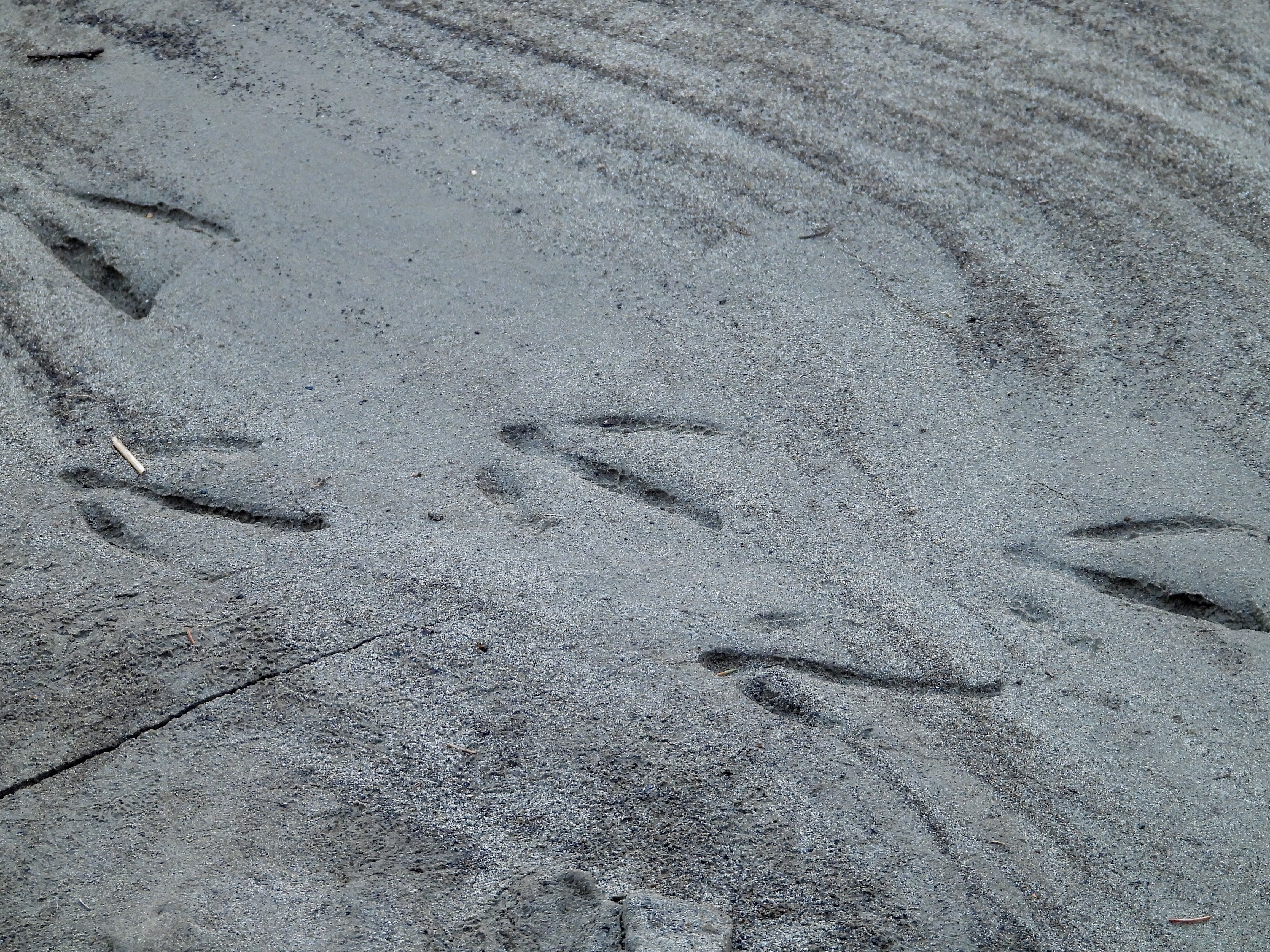
The water level at out local creek in the Whitemud Ravine was high for most of March due to the snow melt. Now that the snow is gone the water has receded substantially leaving areas along the bank, that previously were submerged, exposed. We came across the following tracks on a recently exposed sand bank along the shore. Due to recent erosion when the water level had been high we were unable to actually get down on the sand bank to have a closer look at the tracks. The tracks were large, though, and were leading from the water’s edge. The only two possibilities in terms of who could have made them are either a beaver or a musk rat. The tracks were far too big for a muskrat and they were missing the markings caused by the tell-tale muskrat tail, which leaves a beaver as the only plausible candidate. As we were pondering these questions guess who emerges out of the water? No one other than a beaver him/her self. As the beaver slowly waddled up on the bank it left exactly the same tracks behind it. I almost wish the same thing would happen everything you find animal tracks in the wild. After spotting animal tracks, you take your best shot at identifying them and then comes the “answer key” walking along leaving exactly the same tracks.

May the curiosity be with you. This is from “The Birds are Calling” blog (www.thebirdsarecalling.com). Copyright Mario Pineda.
Project 366 – Post No. 017 – Compton tortoiseshell

What is Project 366? Read more here!

Encountered the first butterfly of the year down at the Whitemud Ravine yesterday. Actually, I saw quite few of these little guys. These are Compton tortoiseshell butterflies (Nymphalis vaualbum) and is usually one of the earliest butterflies to be seen in the spring. This species is circumpolar around the Northern Hemisphere and, hence, is found across Canada south of the tundra. Nature is slowly waking up after a long winter but this far north everything is happening much later compared to locations further south south. We still have to see any signs of greenery. Any day now I hope. Things are likely to pickup speed during the last two weeks of April.

May the curiosity be with you. This is from “The Birds are Calling” blog (www.thebirdsarecalling.com). Copyright Mario Pineda.

Project 366 – Post No. 016 – Downy Woodpecker

What is Project 366? Read more here!

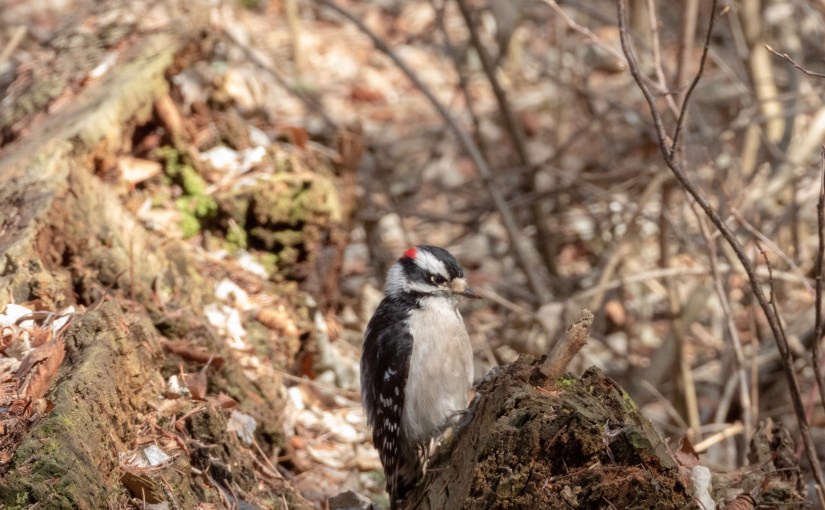
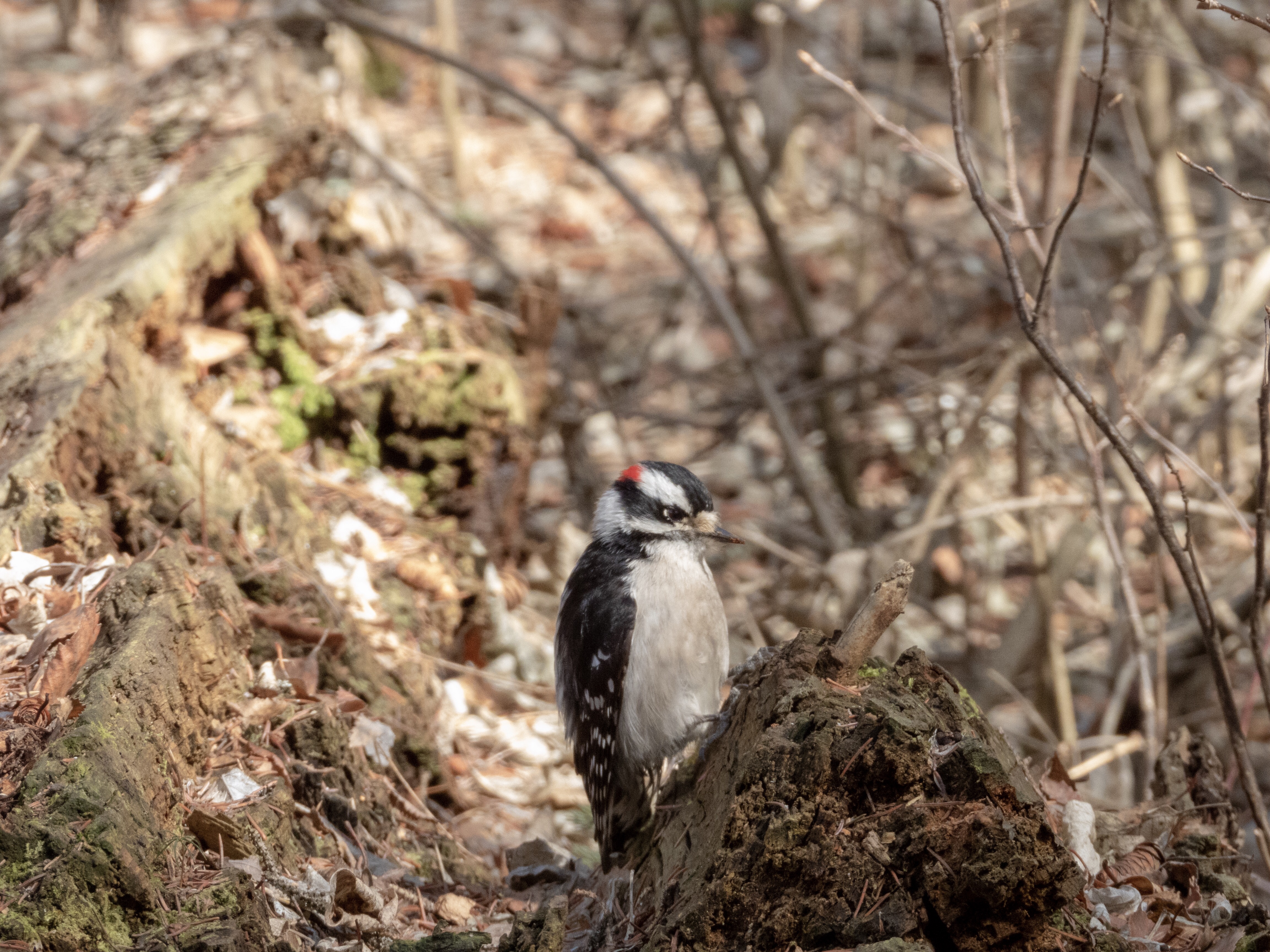
The Downy Woodpecker is the smallest North American Woodpecker and quite likely also the cutest. The Downy Woodpecker holds a special significance to me as it is the first species that I identified for my 2019 Alberta Big Year. Today I found this little guy (the red patch indicates it is a male) down on the forest floor spending a long time going through all the nooks and crannies of an old log looking for anything to eat. Downy Woodpeckers are not shy and often come to suets in the winter. Today I realized, however, that they are tricky to photograph as they tend to be quite energetic and move around a lot. One of the first identification challenges I encountered when In started birding was to tell downies apart from their larger lookalike, the Hairy Woodpecker. Other that a slight size difference, with the Hairy being a tad larger, all other distinguishing characters are very subtle. The breakthrough for me came when I visited Beaverhill Bird Observatory in December and encountered both species at the bird feeder at the same time. Ever since that day I have had no troubles distinguishing between the two. The next few bird species that I would benefit from having next to each other to get that light bulb moment would be a Canadas Goose vs. a Cackling Goose and a Bohemian Waxwing vs. a Cedar Waxwing.

May the curiosity be with you. This is from “The Birds are Calling” blog (www.thebirdsarecalling.com). Copyright Mario Pineda.

Project 366 – Post No. 015 – Beaver Muzzle Wrestling

What is Project 366? Read more here!

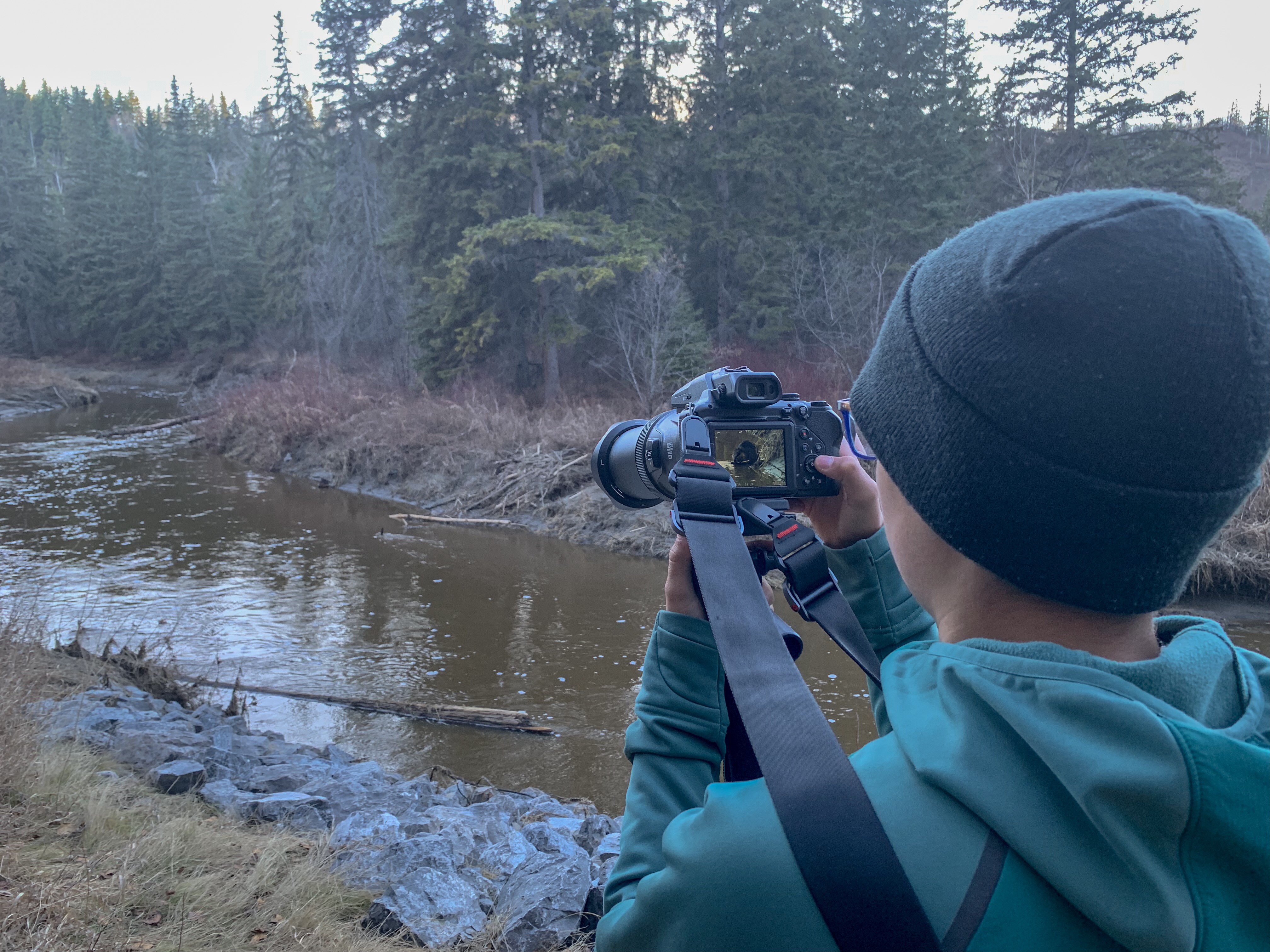
Monday after school we grabbed a quick snack, out gear and headed right down to the Whitemud Ravine. After a weekend of birding out of town we were antsy to check in on our Great-horned Owl couple. The female is in a large tree cavity sitting on eggs while the male is always on guard in a nearby tree. The eggs are predicted to hatch any day now. Well, they were still there. Nothing new and no indications that the eggs have hatched. Other than mom and pops owl, there was not much bird action along the creek. The lack of birds was, however, more than made up by beaver action. There were beavers everywhere. Swimming in the creek, sitting on the banks and waddling along the shore. We stopped counting at ten beavers and instead focused on trying to shoot pictures instead. Unfortunately it was an overcast day and the sun was getting low so our bridge camera had trouble with the low light. The photos turned out blurry no matter how we sliced it. Either the shutter speed was to slow or the ISO was to high. Even without the pictures though it was quite a show. Some of the beavers were “muzzle wrestling”, they swam up towards each other, their muzzles side by side and then they pushed each other around in the water. The interaction was not overly aggressive so I am not sure if these were hostile or friendly encounters. On our way back to the car we managed to track down a rumoured porcupine sitting high in a pine tree. We have heard stories of this fella from other birders but we have never managed to track him/her down…, until today. Clearly the porcupine did not want to be disturbed so we took a few grainy pictures of his spiky derrière and called it a day.

May the curiosity be with you. This is from “The Birds are Calling” blog (www.thebirdsarecalling.com). Copyright Mario Pineda.
Project 366 – Post No. 013 – Bison at Sunrise at Elk Island National Park

What is Project 366? Read more here!

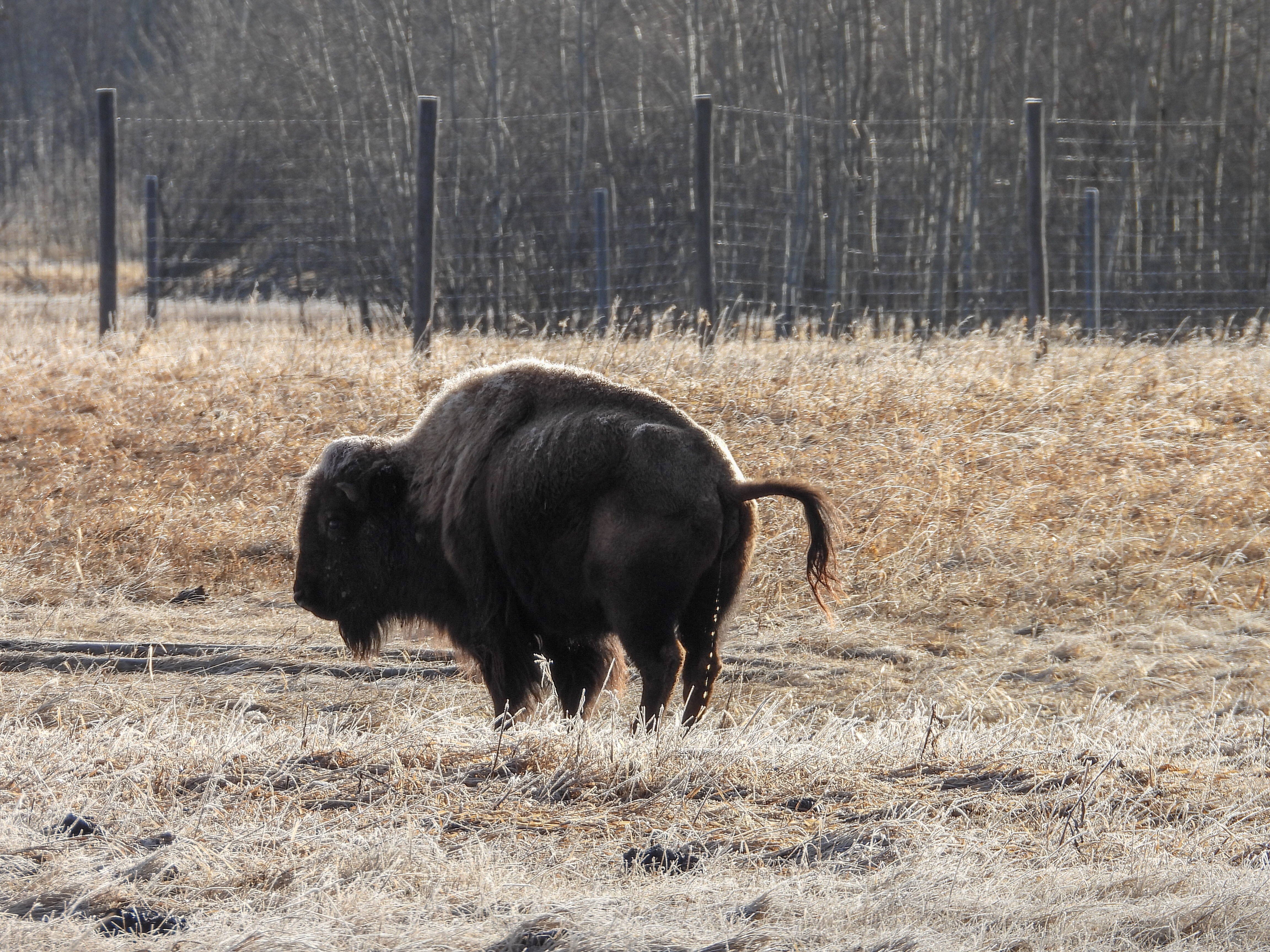
The sun was rising over the highway as I was heading east on my way to an early morning excursion at Elk Island National Park. As far as national parks go, Elk Island National Park is the smallest national park in Canada. It is unique, however, in that it is the home to the highest density of ungulates in Canada. Perhaps the most famous residents are the Plains Bison (in the northern part of the park) and the Wood Bison (in the southern half of the park). While this park never seems to get very busy, getting there early on a Sunday morning guarantees that one will have the whole place to oneself. Other than a very energetic Pileated Woodpecker going to town on a wooden power pole, the ravens, Black-capped Chickadees, Canada Geese and starlings were out. The pothole lakes in the park were still largely frozen over while most lakes outside the park seem to have open water by now. The Canada Geese were, however, patiently biding their time, hanging out on the frozen lakes waiting to get their feet wet. I found a dozen Plains Bison just chilling in the sunrise, including the female on the picture that unabashed relieved herself right in front of me. On this particular morning, the males were more into doing number twos.

May the curiosity be with you. This is from “The Birds are Calling” blog (www.thebirdsarecalling.com). Copyright Mario Pineda.
Project 366 – Post No. 010 – Great Horned Owl on Eggs

What is Project 366? Read more here!

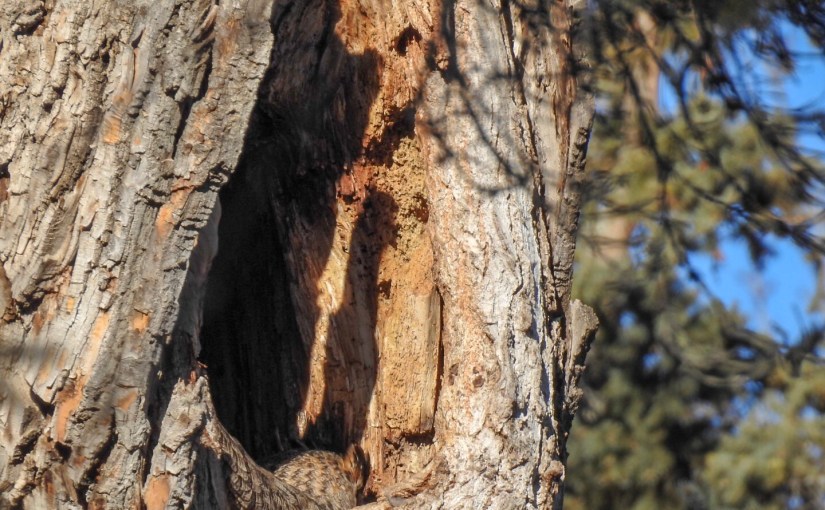
The female Great Horned Owl in Whitemud Ravine is on her 29’th day sitting the eggs. We have been down checking in on her several times a week in the last little while and she is always in her nest. The male is always on guard in a nearby tree. In this picture you can see her feathery rear end and the back of her head with the two characteristic “horns”, which are actually tufts of feathers. The significance of the horns is not fully understood but it is believed they are used in social interactions. The owl couple is always very chilled when we are around (which is during the day) and one can always see Red Squirrels defiantly romping around in the understory right below the owls. I suspect the tables are turned once darkness falls. I have entertained the idea of heading down to the owls at night. The next full moon is on March 20. Let’s see if I can convince anyone else to joint me on a night time nature walk.

May the curiosity be with you. This is from “The Birds are Calling” blog (www.thebirdsarecalling). Copyright Mario Pineda.

Project 366 – Post No. 009 – The Photogenic Red Squirrel

What is Project 366? Read more here!

As we are trying to figure how to use our new camera for wildlife photography one of the main challenges always seems to be to try to get close enough to your subject. Well, that is not a problem with the local American Red Squirrel population. This picture was taken with our Nikon P900 at a focal length of 116 mm (650 mm at 35 mm equivalent) from only a few meters away. The little guy (or gal) was preoccupied gobbling down as many sunflower seed as possible and could not care less about us inching our way closer and closer while our camera was shooting away. In the Edmonton area we are still fortunate to have a thriving population of Red Squirrels, they are just as easily spotted in the local park or forest as in our neighbourhood backyards. They can be bold and brazen and very opportunistic. I have lost count of the number of squirrels I have had to evict from our house over the years,… that’s evicting from inside the house. While they might be cute one day and a brazen pest the next we are fortunate in Edmonton that the Eastern Gray Squirrel has not been introduced here. It is an introduced species in various locations in eastern North America, including in Vancouver and Calgary. In these cities it has become the predominant squirrel, essentially essentially replacing the native squirrels.

May the curiosity be with you. This is from “The Birds are Calling” blog (www.thebirdsarecalling). Copyright Mario Pineda.

Project 366 – Post No. 008 – Muskrat Spring Grooming

What is Project 366? Read more here!

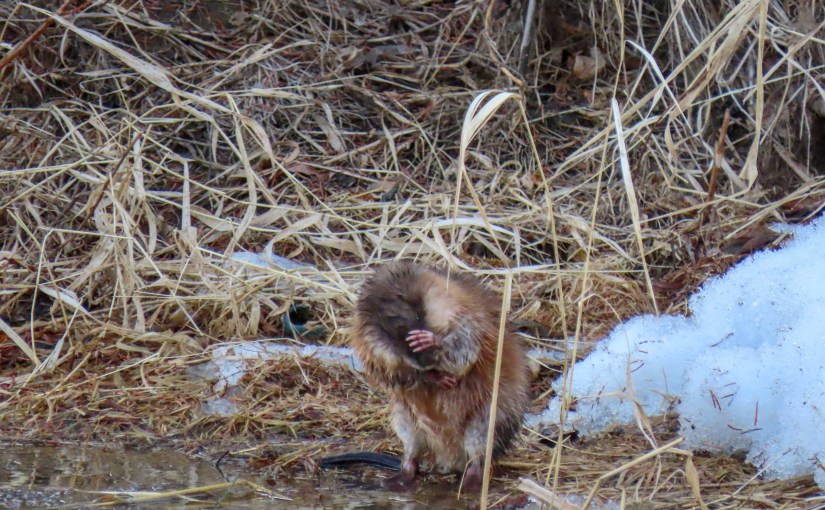
A few weeks ago, as the ice on the creek still was breaking up, we came across this fuzzy Muskrat sitting on a muddy back grooming himself. I imagine it must have just woken up from the long winter hibernation and was doing his “spring cleaning” of the fur. Muskrats are often found in association with beavers, and indeed, further down on the same muddy bank there were two adult beavers Also busy grooming themselves. While both Muskrats and beavers are rodents, they are not particularly closely related. Contrary to what the name suggests, Muskrats are not a species of rat. It’s closest relative are mice, voles and lemmings. It is basically a large field mouse adapted to an aquatic life. I was on the opposite side of the creek when I spotted it. Over the next few minutes I managed to slowly sneak through the vegetation until I was at the water’s edge right across from it, no more than 10 m away. While the both the Muskrat and the beavers must have known I was there, they completely ignored me and just minded their own business. While I have seen Muskrats before, this was the first time I have been able to study one this closely for an extended period.

May the curiosity be with you. This is from “The Birds are Calling” blog (www.thebirdsarecalling). Copyright Mario Pineda.