If your look around the forest after a rain, you might notice that some leaves shed the water readily and appear dry while on other leaves the water pools in droplets. Leaves are covered in a waxy cuticle and the structure and chemistry of the cuticle determines how water on its surface behaves. The stronger the water is repelled from the surface of the leave the larger and more dome shaped the water droplets on the leaves are. It is the cohesive intermolecular forces between the water molecules (specifically the hydrogen bonds between water molecules) that result in surface tension That ultimately form the spherical shape. There is probably a lot more that could be said about this phenomenon but suffice to say that is quite photogenic.
Water droplets on a Prickly Wild Rose (Rosa acicularis) at the MacTaggard Sanctuary, Edmonton. July 7, 2019. Nikon P1000, 134mm @ 35mm, 1/200s, f/4, ISO 100
May the curiosity be with you. This is from “The Birds are Calling” blog (www.thebirdsarecalling.com). Copyright Mario Pineda.
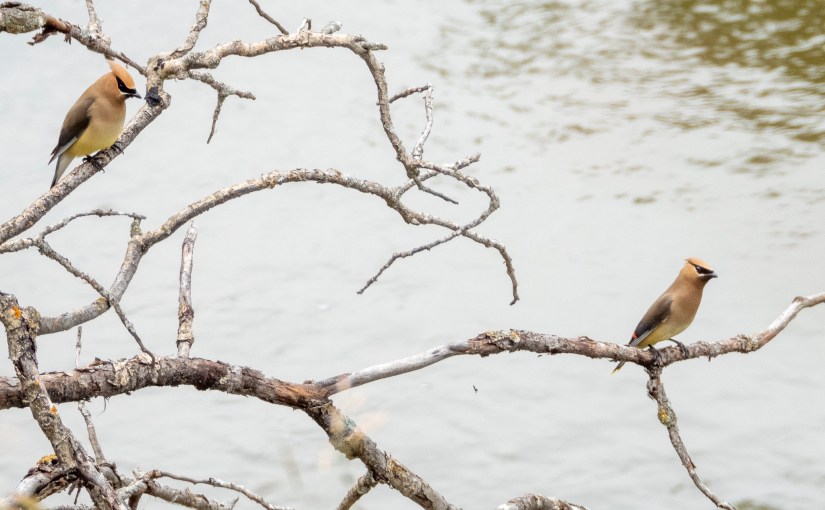
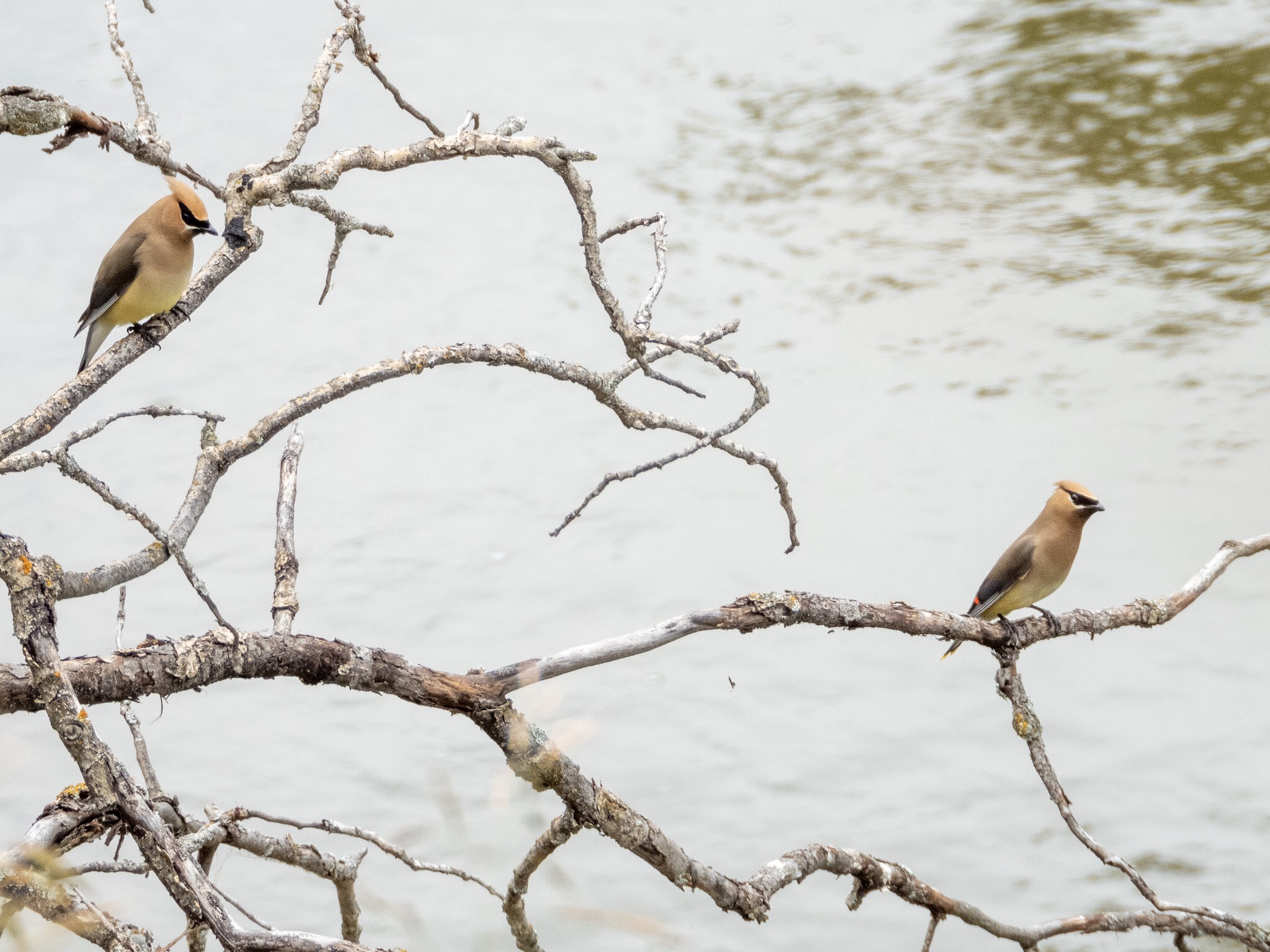
I had dropped off my teen at practice, there was a break in the never ending rain and I had 90 minutes to myself. Dark clouds loomed at the horizon so there was no time to waste. I raced as fast as it was legal to the nearest birding spot, which happened to be the MacTaggard Sanctuary. The MacTaggard sancturary straddles the Whitemud Creek south of 23rd avenue. I have been here once before, about three weeks ago at which point I was almost eaten alive by the mosquitoes. (See Post No. 078) With the copious amounts of rain we have received over the last few weeks the mosquito situation has not improved. With the trail covered in mud and mushrooms sprouting all around in the soggy leaf litter I set out with my sights set on the oxbow lake situated in sanctuary (See Post No. 075 for an explanation of what an oxbow lake is). I never made it to the lake. First I got sidetracked by a fleeting glimpse of an American Goldfinch. I spend some time trying to get a better look at it but to no avail. Then I spotted a Pileated Woodpecker perched high up on a dead tree. As I was watching it another one landed on the same tree. You simply do not walk away from a duet of Pileated Woodpeckers, so I spend quite some time checking out these cool fellas. They were flying too and fro between trees and seemed to have a jolly good time together. Once I decided to move on something in the corner of my eye caught my attention as I hiked over a bluff overlooking the creek. I stopped and scanned the creek and the dense riparian vegetation below me. It took a while, but then I saw them. Five magnificent and regal Cedar Waxwings were playing hide and seek in the thick riparian vegetation with an occasional foray out into the open over the creek. Cedar Waxwings have been on my birding wanna-see list ever since the beginning of the year. Way back on March 29 my very first Project 366 post was about Bohemian Waxwings (See Post No. 001). I ended seeing lots of Bohemian Waxwings along the Whitemud Creek as the winter petered out. The almost identical Cedar Waxwings, however, evaded me.., until today. The two species look almost identical and the physical differences between them are subtle. While Bohemian Waxwings are bigger and chunkier than Cedar Waxwings, for the uninitiated noob (like me) that does not really help. The key distinguishing feature for me was the orange under-tail of the Bohemian Waxwings versus the white under-tail of Cedar Waxwings. Today’s Cedar Waxwings brings my AB Big Year total to 115 and my Life list to 163. The last month has been a bit of a dry spell in terms of spotting new species as the birding has been a bit of hiatus in favour of a focus on bison. Hopefully the Cedar Waxwings are a sign of being back in the swing of things.
Cedar Waxwings (Bombycilla cedrorum) at the MacTaggard Sanctuary, Edmonton. July 7, 2019. Nikon P1000, 538mm @ 35mm, 1/250s, f/5, ISO 125
May the curiosity be with you. This is from “The Birds are Calling” blog (www.thebirdsarecalling.com). Copyright Mario Pineda.
Instead of a nature walk we went on a bike ride today in the Edmonton River Valley. Although no birding was part of the plan I did pack my binoculars and camera in the paniers, just in case we would bump into anything interesting. Sure enough, as we were approaching Quesnell Bridge I spotted these large white birds in the water along the opposite shore. There were not too many options as to what it could be. Five Americans White Pelicans were frolicking in the murky waters of the river. As we were crossing the bridge we got a closer look and I managed to take a few pictures from my high vantage point. This is the first time I have seen pelicans in the river and I guess, for a water bird, the river is probably as good of a place to hang out as any other body of water. Right along the shore where the pelicans were there were some people fishing. Perhaps the fishermen and the pelicans chosen the same location because it is a good fishing spot.
American White Pelicans by the Quesnell Bridge in the North Saskatchewan River in Edmonton. July 6, 2019. Nikon P1000, 1008mm @ 35mm, 1/500s, f/5.6, ISO 220
May the curiosity be with you. This is from “The Birds are Calling” blog (www.thebirdsarecalling.com). Copyright Mario Pineda.
I was standing at the edge of a small grassy patch by Lake Beaumaris. All around me there were a large number of Red-winged Blackbirds, Common Grackles and House Finches fluttering about in the shrubbery surround the lawn and on the lawn itself. None of the species were new, yet there was handful of odd looking individuals mixed in among all the usual suspects. They had the overall shape and color of a sparrow, except they were at least twice the size of any sparrow I know. Their beak, however, was decidedly non-sparrow-like. It had the distinct triangular shape of a blackbird…, yet there was not a speck of black on these individuals. I had my suspicions, but I was not sure and when I left I was still very much on the fence regarding the identification of these birds. I had lots of picture of them, so once I got home the research begun. After extensive online research and carefully study of Sibley I can only conclude that my suspicion was correct. These were female Red-winged Blackbirds. It is and odd phenomenon, male Red-winged Blackbirds are not only one of the easiest birds to identify both by look and sound, but also one of the most abundant species around ponds, wetland and marshes, yet paradoxically female Red-winged Blackbirds are nowhere to be seen. I had not put much thought into it previously, tacitly assuming that the females probably looked the same as a the male. I was, however wrong. While the females have a similar overall shape as the males, and their beak is certainly the same shape and size, not much else is similar. It is quite peculiar that while the male Red-winged Blackbirds were one of the first spring migrants I observed many months ago, and since then I have seen hundreds upon hundreds of them, it is only now that I came across the females. At this point I do not have the faintest idea of why the males are so abundant while the females are so rare. This will definatelly require more thinking and research to figure out what is going on.
Female Red-winged Blackbird (Agelaius phoeniceus) at Beaumaris Lake. June 21, 2019. Nikon P1000, 146mm @ 35mm, 1/250s, f/5, ISO 140
May the curiosity be with you. This is from “The Birds are Calling” blog (www.thebirdsarecalling.com). Copyright Mario Pineda.
It was a typical family scene that probably happens in bird families around the world every morning. While mom was looking after the kids, dad was busy looking for breakfast. The Red-necked Grebe family had two chicks, one of which was snoozing snug and cosy on mom’s back while the other one was floating nearby, also snoozing. Dad was nowhere to be seen. After about five minutes dad appears out of nowhere with a small fish in his beak. When realizing breakfast was incoming the chick floating on the water stirred, shook the sleep out of its eyes and raced towards the dad. The chick was rewarded with the fish. Dad took off right away and the chick swam back to mom and fell asleep again. This scene repeated itself several times over the next ten to fifteen minutes. The fish catching abilities of the dad were quite impressive. He returned with a new fish every few minutes. Most of the time the fish was small enough for the chick to eat it, but a few times he came back with impressively large fish that even he had trouble swallowing. He ended up having to let go of some of the fish as they were simply to large.
Red-necked Grebe (Podiceps grisegena) at Beaumaris Lake (Alberta, Canada) on June 21, 2019. Nikon P1000, 1008mm @ 35mm, 1/500s, f/5.6, ISO 125
May the curiosity be with you. This is from “The Birds are Calling” blog (www.thebirdsarecalling.com). Copyright Mario Pineda.
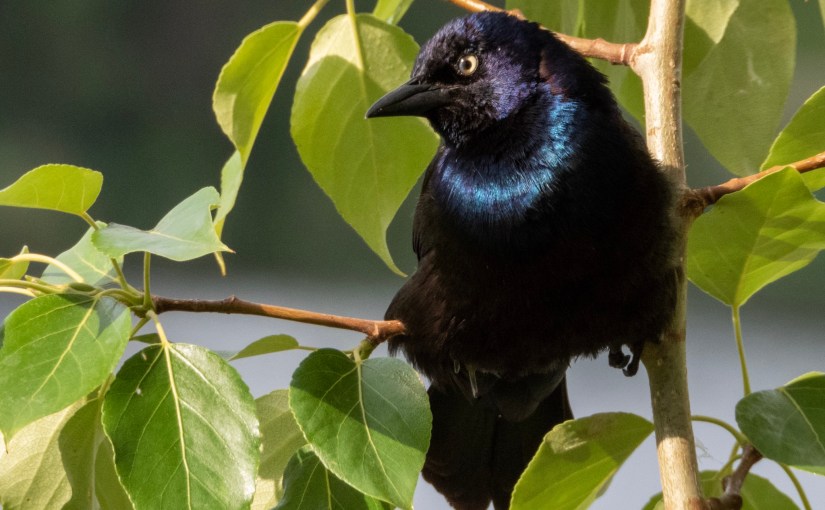
It was an overcast Friday morning. It had been raining non-stop all week and the last time I was able to go for birding was a week ago. Luck was, however, on my side this morning. As I was heading out to work there was a break in the rain and next thing I knew the morning meeting I was heading to was rescheduled. All of a sudden I had one hour of rain-free unscheduled time at my disposal. Without further ado I ran back in, grabbed my camera binoculars and set my heading dead north. I was heading to Beaumaris Lake, a birding location I have heard lots of excited birders rave about but not had an opportunity to visit yet. Beaumaris Lake is a 2.7 km loop around a lake that is situated in the neighbourhood of, you guessed it, Beaumaris in North Edmonton. Despite its location in the midst of the subdivision, surrounded by houses on all sides, the lake is a birding hotspot with 158 species recorded on eBird. I spend the next 45 minutes strolling around the lake (I did not make it all the way around, so I have a good reasons to come back to explore the rest of the lake). The Red-necked Grebes were out in full force with their chicks hanging out with mom while dad was busy catching fish. While the Red-necked Grebe family were the highlight of the day, I also got a nice close up look at a bunch of Common Grackles. While it was overcast and grey when I arrived, once I started photographing the birds a well-timed break in the cloud cover let the sun through. The Common Grackles suddenly went from looking black to stunning dark blue purple iridescent. My time was soon up and I had to head to work. It was a wonderful start to the day and I will definitely be back to spend some more quality time at the lake getting to know its feathery inhabitants.
Common Grackle at Beaumaris Lake (Alberta, Canada) on June 21, 2019. Nikon P1000, 756mm @ 35mm, 1/500 s, f/5.6, ISO 280
May the curiosity be with you. This is from “The Birds are Calling” blog (www.thebirdsarecalling.com). Copyright Mario Pineda.
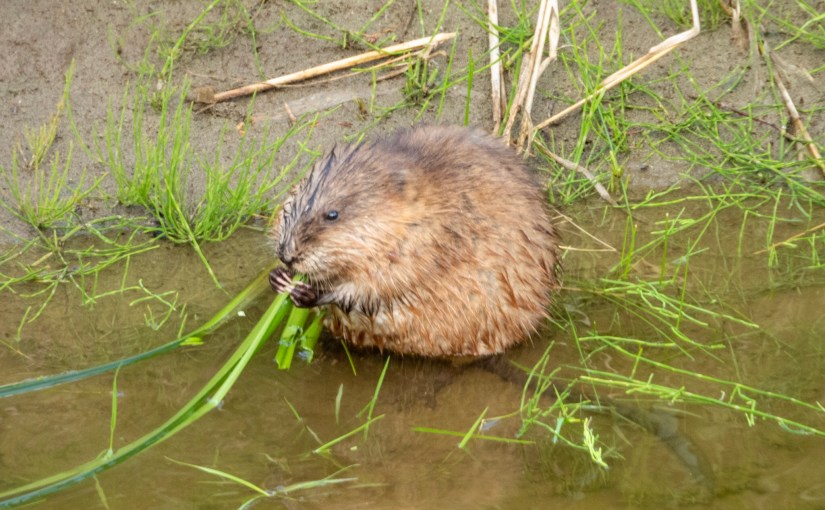
Another nature walk and another muskrat sitting in the bath going to town with its vegetables. It seems that every time I come across muskrats they seem to be eating. Maybe they are just more conspicuous when they are eating…, or maybe they are just always eating, just like human teenagers. I imagine one would have to chomp down quite a bit of vegetables to get your daily nutrient requirements. Just like me, muskrats are facultative herbivores which means that they prefer to eat plants but, if necessary, can also consume animal such as fish, frogs and insects. The other day as I was out by a lake with some young ones we spotted a muskrat swimming around and, too my surprise, not eating (but it was probably looking for food). When the kids saw it they immediately identified it as a beaver. To be entirely honest, the first time I saw a muskrat I also mistook it for a beaver. The muskrat is like the lesser known cousin of the superstar beaver in that everyone recognizes a beaver (even if they have never seen one) while few people recognizes the muskrat (even if you might be looking at one). Perhaps the easiest way to tell these semi-aquatic rodents apart, particularly if it is your first time seeing one, is the tail. Beaver with its tell-tale flat and paddle-shaped tail while the muskrat has a long, skinny tail with flat sides. If you can see the tail there really is no way of mis-identifying a muskrat for a beaver. In the picture below you can clearly see the long skinny tail of the muskrat. Once you become a more seasoned muskrat aficionado you realize that there are a few other distinguishing characteristics as well. Perhaps the most obvious difference (if you know about it) is the size difference. Beavers are huge weighing in at between 35 and 60 pounds while muskrats are puny in comparison topping out at about 4 pounds. Another difference is that with muskrats you can usually see its whole body when it is swimming while with beavers you typically only see their large wedge-shaped head. While I have not seen a beaver at the creek for a while the musk rats are out in full force.
Muskrat (Ondatra zibethicus) at Whitemud Creek (Alberta, Canada) on June 14, 2019. Nikon P1000, 1210mm @ 35mm, 1/160s, f/5.6, ISO 400
May the curiosity be with you. This is from “The Birds are Calling” blog (www.thebirdsarecalling.com). Copyright Mario Pineda.
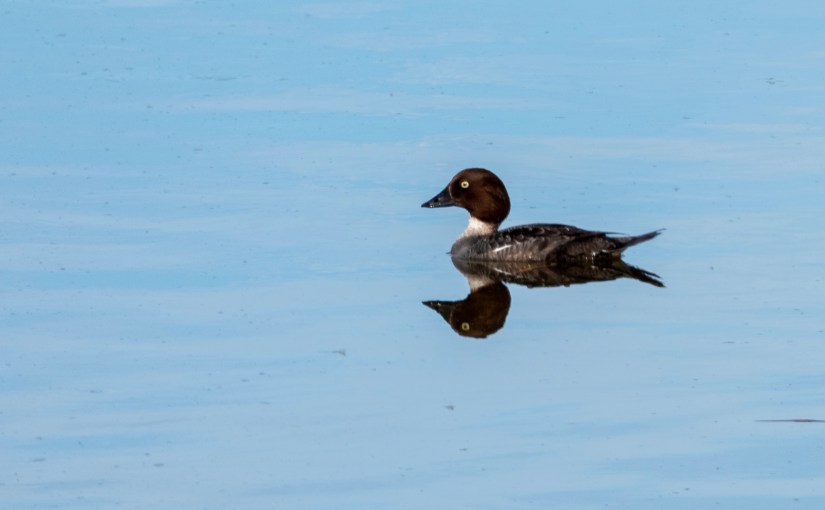
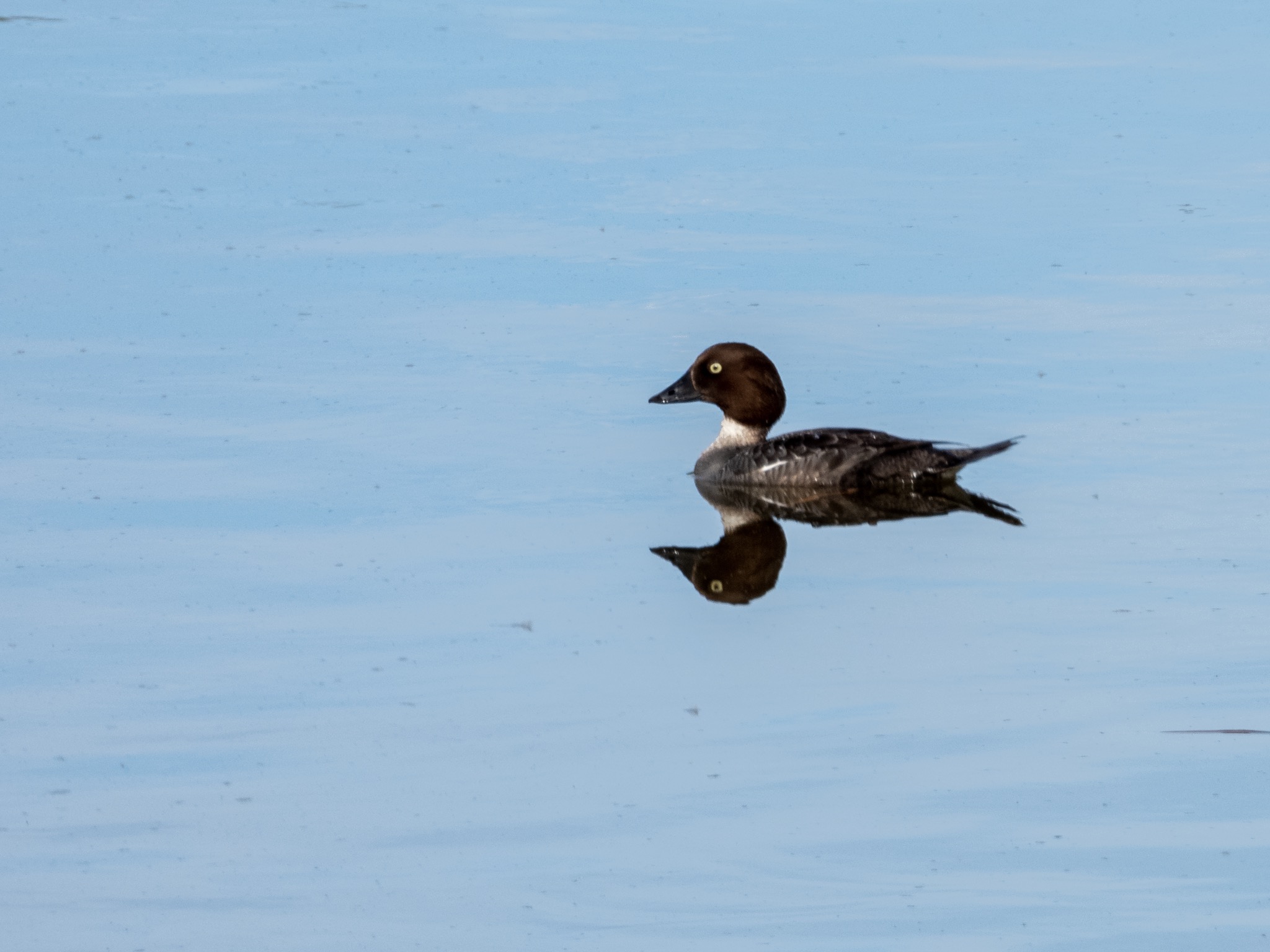
As I crossed the pedestrian bridge across the Whitemud Creek a lone female Common Goldeneye (Bucephalus clangula) was swimming around in the creek eyeing me curiously. Common Goldeneyes are medium-sized diving ducks where the females are brunettes with a piercing golden-yellow eye. There are two species of goldeneyes, the Common Goldeneye, which as the name suggests is more common, and, the more rare, Barrow’s Goldeneye. While the males of the two species are easy to tell apart, the females are more difficult to distinguish as they appear nearly identical. According to Sibley the Barrow’s Goldeneye female has a darker brown head than the Common Goldeneye which does not help me at all since I did not have the two species next to each other for comparison. Perhaps the best distinguishing characteristic between the females of the two species for someone like me that has only seen a handful of these species is the bill color. According to Sibley the female Barrow’s Goldeneye has a “usually mostly yellow” bill while the female of the Common Goldeneye has a “usually mostly black” bill. Looking at the picture I would say that her bill is definitely in the category “mostly black”; ergo, it is a Common Goldeneye.
Female Common Goldeneye (Bucephala clangula) at Whitemud Creek (Alberta, Canada) on June 14, 2019. Nikon P1000, 1109mm @ 35mm, 1/125s, f/8, ISO 100
May the curiosity be with you. This is from “The Birds are Calling” blog (www.thebirdsarecalling.com). Copyright Mario Pineda.
Yesterday I went for a nature walk to a part of the Whitemud Creek that is located south of the 23rd Avenue. I have not been to this location previously and I just happened to run some errands in this neighbourhood so I decided to “kill two birds with one stone” and squeeze in a short nature walk in-between errands. As it turns out this part of the creek flows through the Mactaggard Sanctuary, a 104 hectares nature sanctuary, part of which was donated to the University of Alberta in 1980 by Sandy A. Mactaggard, a developer and philanthropist. The sanctuary has a interesting history, which also explains why it is called a “sanctuary” and not a “park”. There is a video where the late Mr. Mactaggard tells the story behind the sanctuary. In short, the sanctuary used to be located outside of Edmonton when Sandy Mactaggard originally purchased the land for housing development, but only after promising the previous owner of the land that he will preserve it to benefit the citizens of Edmonton. The purpose was not to turn it into another park, but rather keep it pristine and let it remain the way it always had been. That is why it became a sanctuary. The trails along this part of the creek are more untamed and rough with less traffic.
I did not have much time for my nature walk so I had to move quick and as a result did not get much birding done. My main aim was to find a large oxbow lake situated in the sanctuary and do some preliminary scouting to figure out how to access the lake. Oxbow lakes are often enveloped in dense vegetation and can be difficult to find and access. The benefit of this is that many animals use these lakes for raising their young. I did not have any trouble finding the lake as the trail briefly passes right along side of it, but just as I suspected most of the lake is surrounded by dense vegetation. Accessing the more remote parts of the lake (the ones where the trail did not go) proved, however, to be even more difficult than I had anticipated as the entire outside rim of the lake is surrounded by a high and very steep bank (almost like an overgrown cliff) and there was not obvious way of accessing the shoreline. There is a trail, the Mactaggard sanctuary loop trail, that loops around the lake ascending the steep bank. Although this quick exploration gave me some ideas of how one might be able to access some of the more remote parts of the lake, I did not have time to look into the feasibility of any of these possibilites. That will have to be another excursion. On a different note, the mosquitos were voracious and I did not bring any repellent so, this is a reminder to myself not to forget the repellent next time.
Oxbow lake in Mactaggard Sanctuary along Whitemud Creek, Edmonton. June 13, 2019. Nikon P1000, 24mm @ 35mm, 1/800s, f/2.8, ISO 100
May the curiosity be with you. This is from “The Birds are Calling” blog (www.thebirdsarecalling.com). Copyright Mario Pineda.
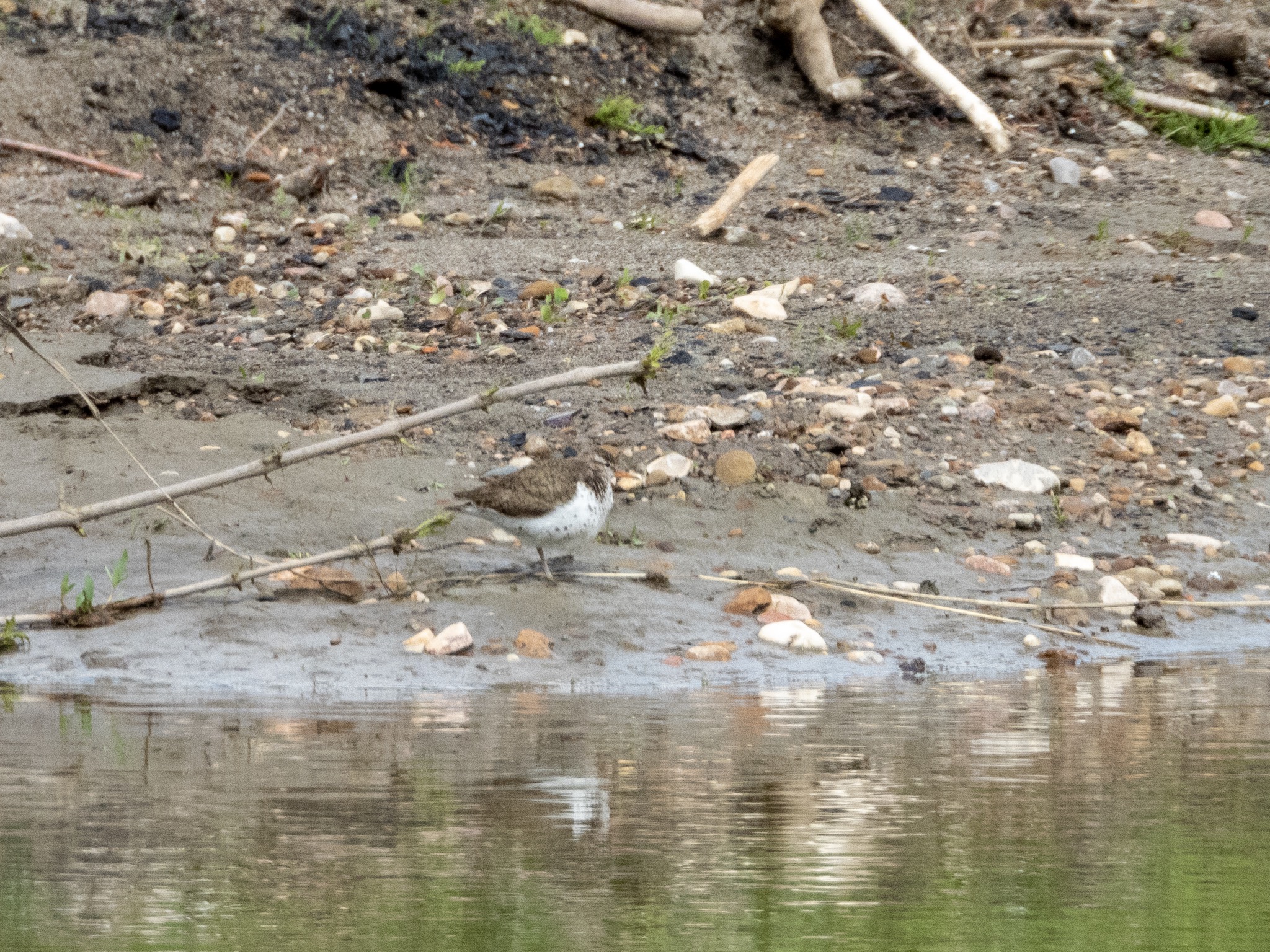
Something was definitely moving along the water’s edge, we just could not immediately focus in on it. It took us a while to adjust our eyes and calibrate our brain to pick up the small stealthy bird scurrying around on the sandy shore on the opposite side of the creek. It was a small shorebird with spotted underparts and sand brown upper parts. If it would not move around it would be nearly impossible to see against the sand and pebbles along the shoreline. I have not seen many shorebirds in my life and this one was definitely a new one. While it was working the shoreline for a morsel to eat its tail was continuously bobbing up and down. Ultimately, this is what gave it away…, it was a Spotted Sandpiper (Actitis macularius, Lifer #162, AB Big Year #114). The Spotted Sandpiper is a true American as it can be found from the Canadian high arctic during the boreal summer down to the shorelines of Chile during the austral summer.
Nikon P1000, 868mm @ 35mm, 1/500s, f/5.6, ISO 280
May the curiosity be with you. This is from “The Birds are Calling” blog (www.thebirdsarecalling.com). Copyright Mario Pineda.