Project 366 – Post No. 019 – The Elusive Snow Geese

What is Project 366? Read more here!

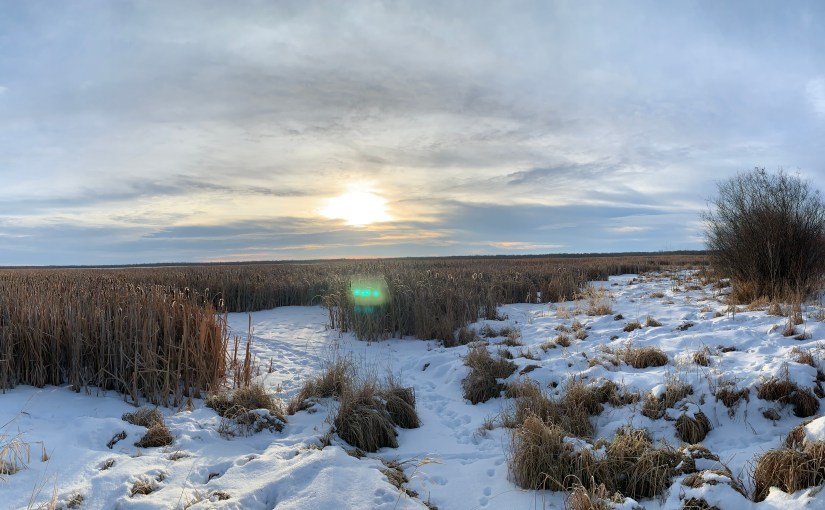
The last few weeks have been a time of searching, a time of planing, and a time of scheming. Our patience and resolve has been tested repeatedly. We have accumulated hundred kilometres on dusty country roads single-mindedly in pursuit of our goal. We have been searching for the elusive snow geese. Over the last few weeks flocks of thousands of snow geese have been observed in the shallow lakes around Beaverhill Natural Area East of Edmonton, and more geese are reported to arrive on a daily basis. This was obviously too much of a temptation for us, so we decided to track the geese down to experience one of nature’s truly incredible events. Much can be said about this adventure and there will be a separate blog post about this (scheduled for tomorrow night) but suffice to say after several excursion and following leads from expert birders the geese evaded us. Finally we gave up and deflated started heading home while pondering how tens-of-thousands of large birds can hide so effectively. We had just got on the highway outside of Tofield when suddenly, from the passenger seat, “Dad – stop, stop, stop!”. As I was on the highway there was obviously no stopping, but a turn of my head to check what my son was pointing at revealed a myriad a fluffy white birds sitting on a pond along the side of the highway. What happened then, all occurred every fast. As I desperately was scanning the road side for any possibility of getting of the highway I found a tiny dirt road. After a quick check in the rear mirrors, I stepped on the break and careened of the highway and onto the dirt road. As it turns out, the dirt road took us directly to the lake with the geese…, and there they were! Thousands up one thousand of white snow geese on the water as well as a cloud of geese spanning a large chunk of the horizon flying overhead. We knew we did not have much time. We quickly and stealthily snuck out of the car with our binoculars and camera ready. It only lasted seconds, but all of a sudden the geese on the lake all took off simultaneously. There were geese everywhere, all the geese became airborne in the span of a few seconds. As they gained altitude they joined the large flock flying overhead. We were floored. Later on, in the car on the way home, we were discussing how many geese we had seen. It was definitely in the tens-of-thousands, but was it 10000, 20000, or more? In the end we decided to record the “conservative” figure of 15000 individuals, but quite likely the actual number was higher. We did manage to snap a few pictures but none of them make justice to overwhelming scene of a mega-gaggle of snow geese.

May the curiosity be with you. This is from “The Birds are Calling” blog (www.thebirdsarecalling.com). Copyright Mario Pineda.

Project 366 – Post No. 018 – Barn Swallow Real Estate

What is Project 366? Read more here!

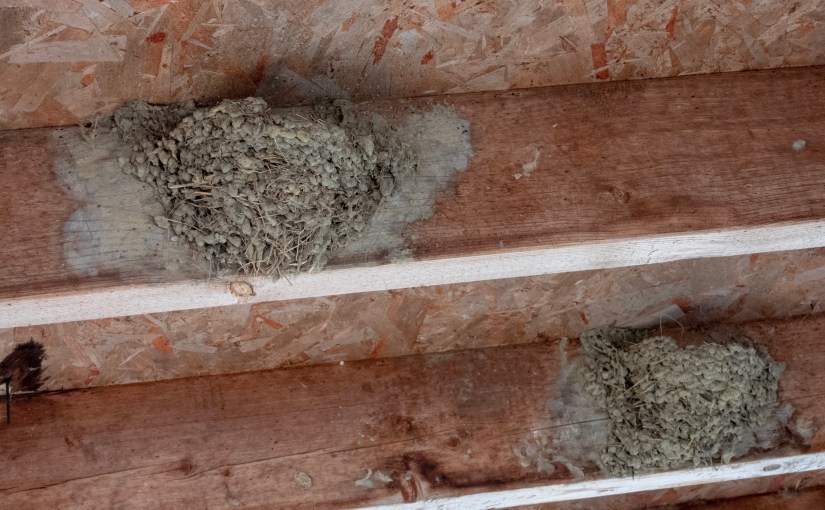
As you approach the trail head that takes you to the Beaverhill Bird Observatory a small side road takes you to Francis Point. We tried to find Francis Point in February when the snow still was deep, but were unable to find this inconspicuous side road. It was likely covered up with snow. It is about a 500 m walk through a forested patch to get to the Francis Point bird blind, an old wooden shed that looks like it is about to collapse any minute. From the blind you have an expansive and unobstructed view of a vast grassy field. I suspect that once upon a time, when the Beaverhill Lake was larger this field may have been under water. Over the last few decades, however, the lake has been shrinking and these days it is no longer visible from the blind. Along the rafters in the blind there are cup-shaped bird nest made out of mud. There are not many options in terms of who could have made them. It could be either swifts or swallows. As there are no swifts reported at this location that leaves us with the swallows. Three species of swallows have been reported here; the Tree Swallow (Tachycineta bicolor), Cliff Swallow (Petrochelidon pyrrhonota) and the Barn Swallow (Hirundo rustica). The tree swallow is out as it nests in natural cavities of standing dead trees, old woodpecker cavities or in nest boxes. Cliff Swallows build a nest out of mud that looks very similar to the nests in the blind. Cliff Swallow nests are different in that they are more covered and have small circular entrances. That leaves us with the barn swallow. A simple web search reveals that indeed the match is perfect. Barn Swallows typically nests inside accessible buildings such as barns and stables, or under bridges and wharves. They collect mud pellets and build neat cup-shaped nest attached to beam or other vertical projections. The inside of the nests is lined with grasses, feathers or other soft materials. It never crossed my mind to peek inside the nests, but next time we visit I will have a look. Judging from the eBird reports, the Barn Swallows do not return to Francis Point until May so we still have a few weeks to go before being able to acquaint with the inhabitants of the nests.

May the curiosity be with you. This is from “The Birds are Calling” blog (www.thebirdsarecalling.com). Copyright Mario Pineda.
Project 366 – Post No. 016 – Downy Woodpecker

What is Project 366? Read more here!

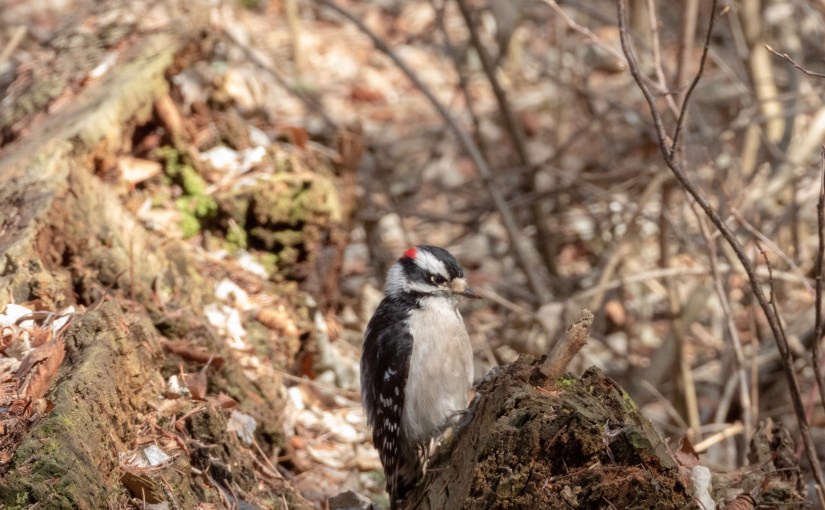
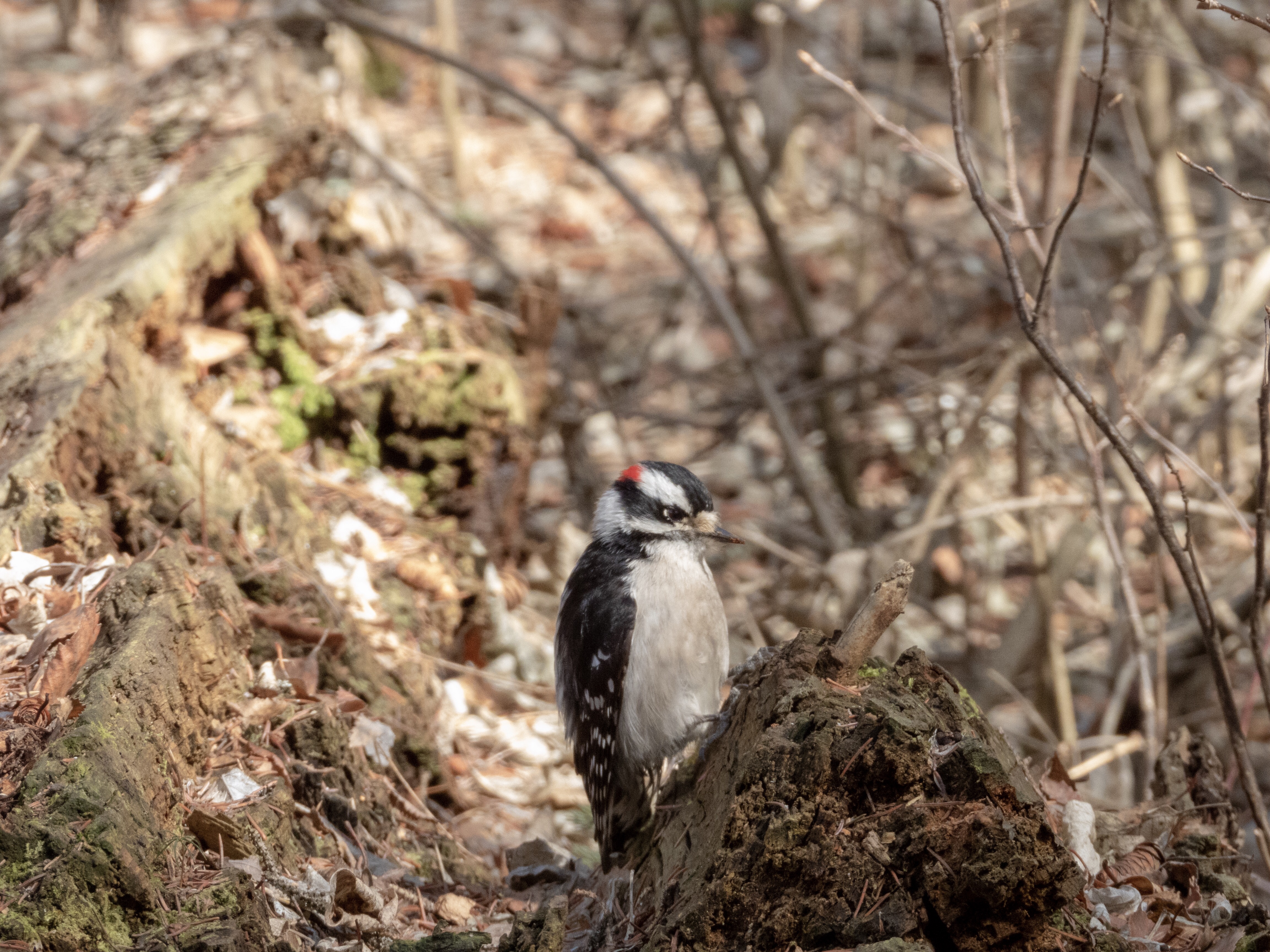
The Downy Woodpecker is the smallest North American Woodpecker and quite likely also the cutest. The Downy Woodpecker holds a special significance to me as it is the first species that I identified for my 2019 Alberta Big Year. Today I found this little guy (the red patch indicates it is a male) down on the forest floor spending a long time going through all the nooks and crannies of an old log looking for anything to eat. Downy Woodpeckers are not shy and often come to suets in the winter. Today I realized, however, that they are tricky to photograph as they tend to be quite energetic and move around a lot. One of the first identification challenges I encountered when In started birding was to tell downies apart from their larger lookalike, the Hairy Woodpecker. Other that a slight size difference, with the Hairy being a tad larger, all other distinguishing characters are very subtle. The breakthrough for me came when I visited Beaverhill Bird Observatory in December and encountered both species at the bird feeder at the same time. Ever since that day I have had no troubles distinguishing between the two. The next few bird species that I would benefit from having next to each other to get that light bulb moment would be a Canadas Goose vs. a Cackling Goose and a Bohemian Waxwing vs. a Cedar Waxwing.

May the curiosity be with you. This is from “The Birds are Calling” blog (www.thebirdsarecalling.com). Copyright Mario Pineda.

Project 366 – Post No. 015 – Beaver Muzzle Wrestling

What is Project 366? Read more here!

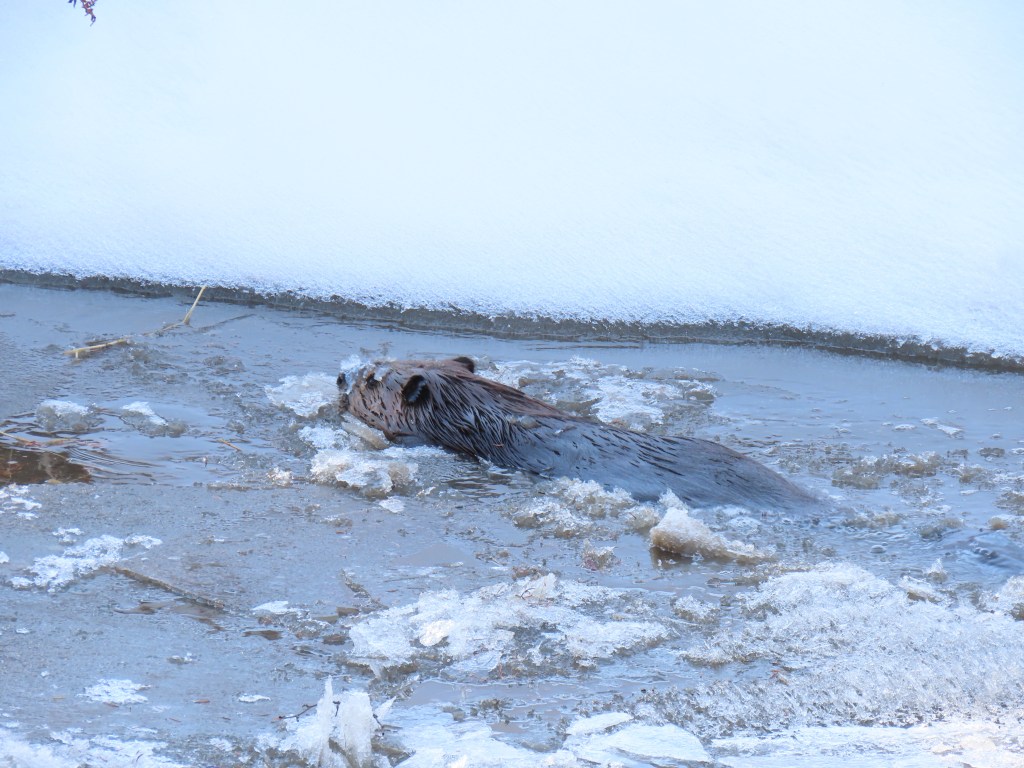
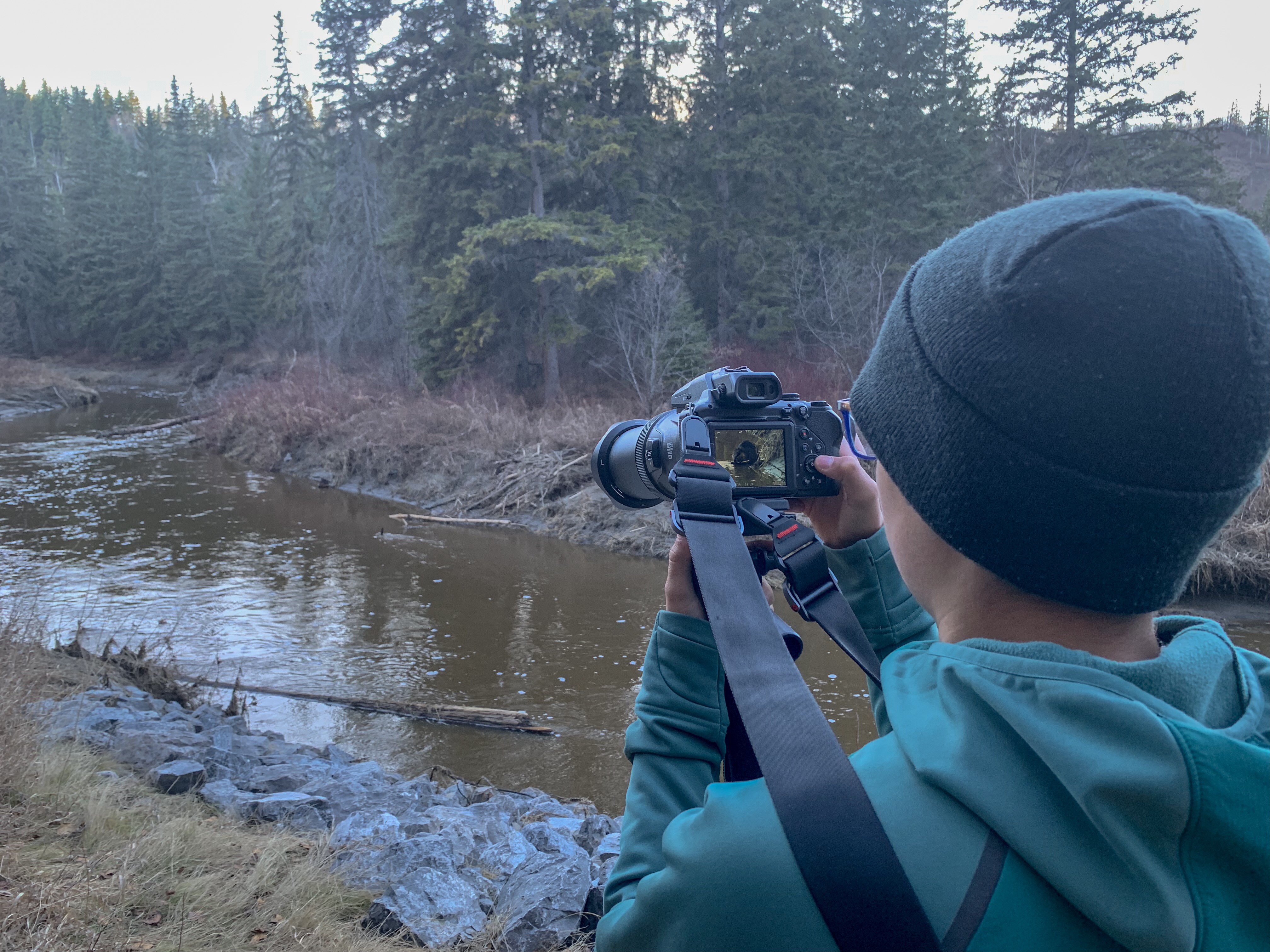
Monday after school we grabbed a quick snack, out gear and headed right down to the Whitemud Ravine. After a weekend of birding out of town we were antsy to check in on our Great-horned Owl couple. The female is in a large tree cavity sitting on eggs while the male is always on guard in a nearby tree. The eggs are predicted to hatch any day now. Well, they were still there. Nothing new and no indications that the eggs have hatched. Other than mom and pops owl, there was not much bird action along the creek. The lack of birds was, however, more than made up by beaver action. There were beavers everywhere. Swimming in the creek, sitting on the banks and waddling along the shore. We stopped counting at ten beavers and instead focused on trying to shoot pictures instead. Unfortunately it was an overcast day and the sun was getting low so our bridge camera had trouble with the low light. The photos turned out blurry no matter how we sliced it. Either the shutter speed was to slow or the ISO was to high. Even without the pictures though it was quite a show. Some of the beavers were “muzzle wrestling”, they swam up towards each other, their muzzles side by side and then they pushed each other around in the water. The interaction was not overly aggressive so I am not sure if these were hostile or friendly encounters. On our way back to the car we managed to track down a rumoured porcupine sitting high in a pine tree. We have heard stories of this fella from other birders but we have never managed to track him/her down…, until today. Clearly the porcupine did not want to be disturbed so we took a few grainy pictures of his spiky derrière and called it a day.

May the curiosity be with you. This is from “The Birds are Calling” blog (www.thebirdsarecalling.com). Copyright Mario Pineda.
Project 366 – Post No. 014 – Rough-legged Hawk

What is Project 366? Read more here!

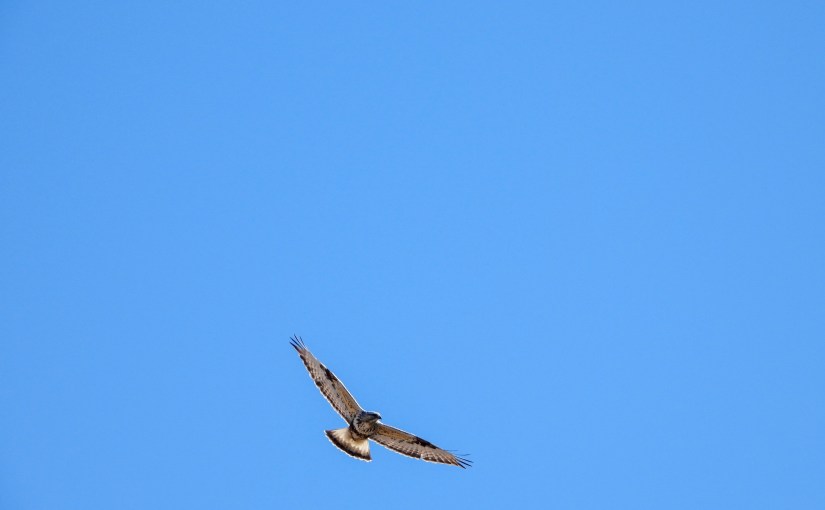
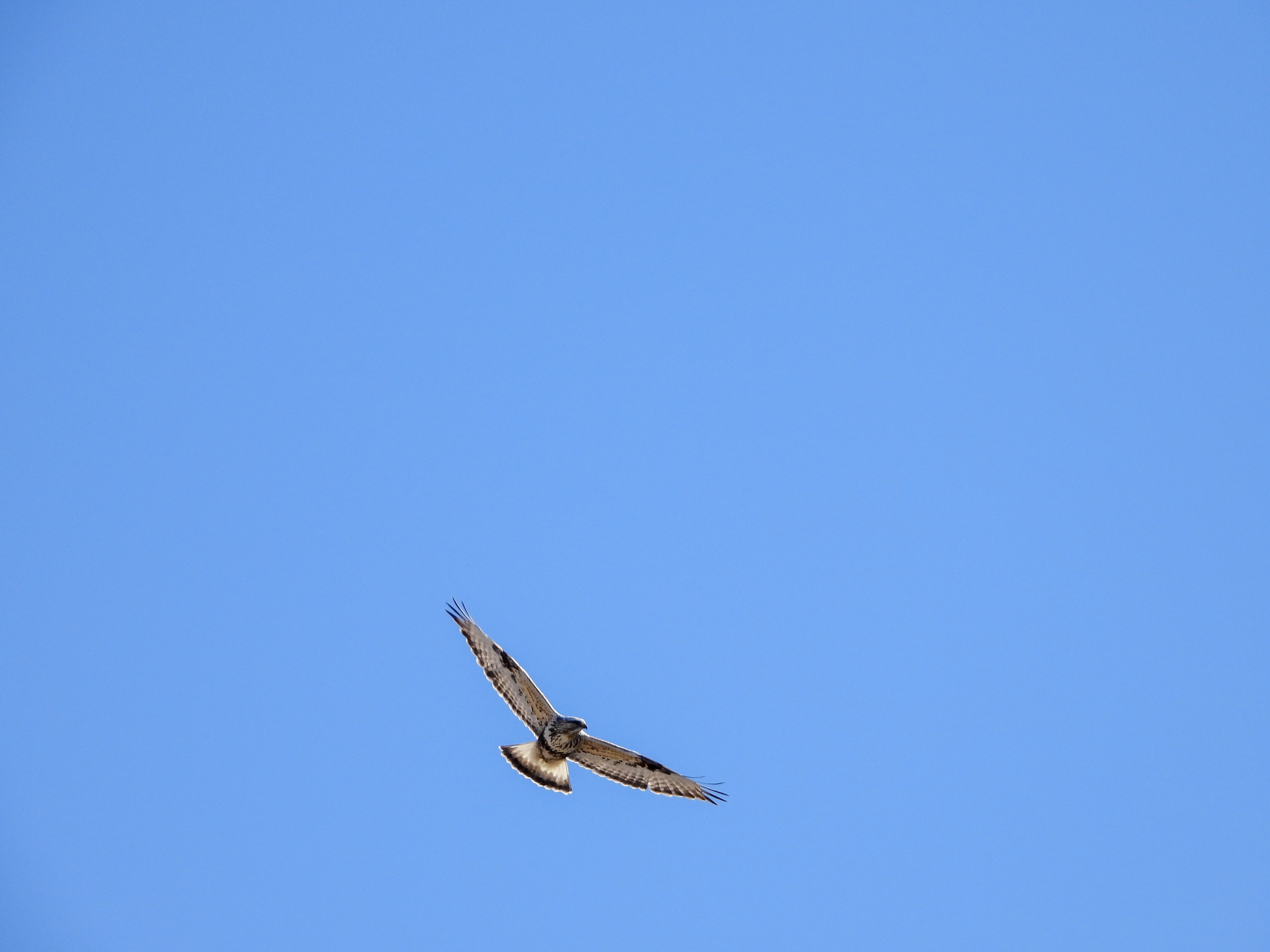
This time of year the area East of Beaverhill Natural Area is buzzing with returning migrants and where there is food, there are predators. I imagine the birds of prey must be busy hunting to recover from (or prepare for) their migration and get ready for breading season. This area has a rich diversity of birds, probably because of its vicinity to the Beaverhill Natural Area and the Beaverhill Lake, which is an important habitat for migrants and shorebirds in particular. We spend most of the last weekend in this area and were treated to an abundance of species, including a Snowy Owl and more Rough-legged Hawks that I can count. It was as if every tree along the road had a hawk in it. Many of them were soaring or hovering in the strong breeze over the vast open stubble fields. Occasionally one would focus in on a specific spot far out in a field, hover above it and then do a kamikaze-like dive towards the ground. Clearly they were in a hunting mode. We never saw one actually catch anything, so I am not sure what success rate is. I imagine, however, that with the snow gone and nothing growing on the fields yet, it must be a good set up for spotting any little rodent scurrying around on the ground. This was also an opportunity to test our new camera set up for some BIF (Birds In Flight) shooting. With a beautiful blue sky, no clouds in sight and the sun beaming down the conditions were perfect for some awesome photography. We did manage to get a few keepers, including the photo below of an adult light morph Rough-legged Hawk looking for his or her next meal. Apparently the “hockey pucks” on the wrists are typical identifies. During the summer Rough-legged Hawks breed in the arctic and during the winters they migrate to southern Canada and the USA.

May the curiosity be with you. This is from “The Birds are Calling” blog (www.thebirdsarecalling.com). Copyright Mario Pineda.
Project 366 – Post No. 012 – The Lonesome Snowy Owl

What is Project 366? Read more here!

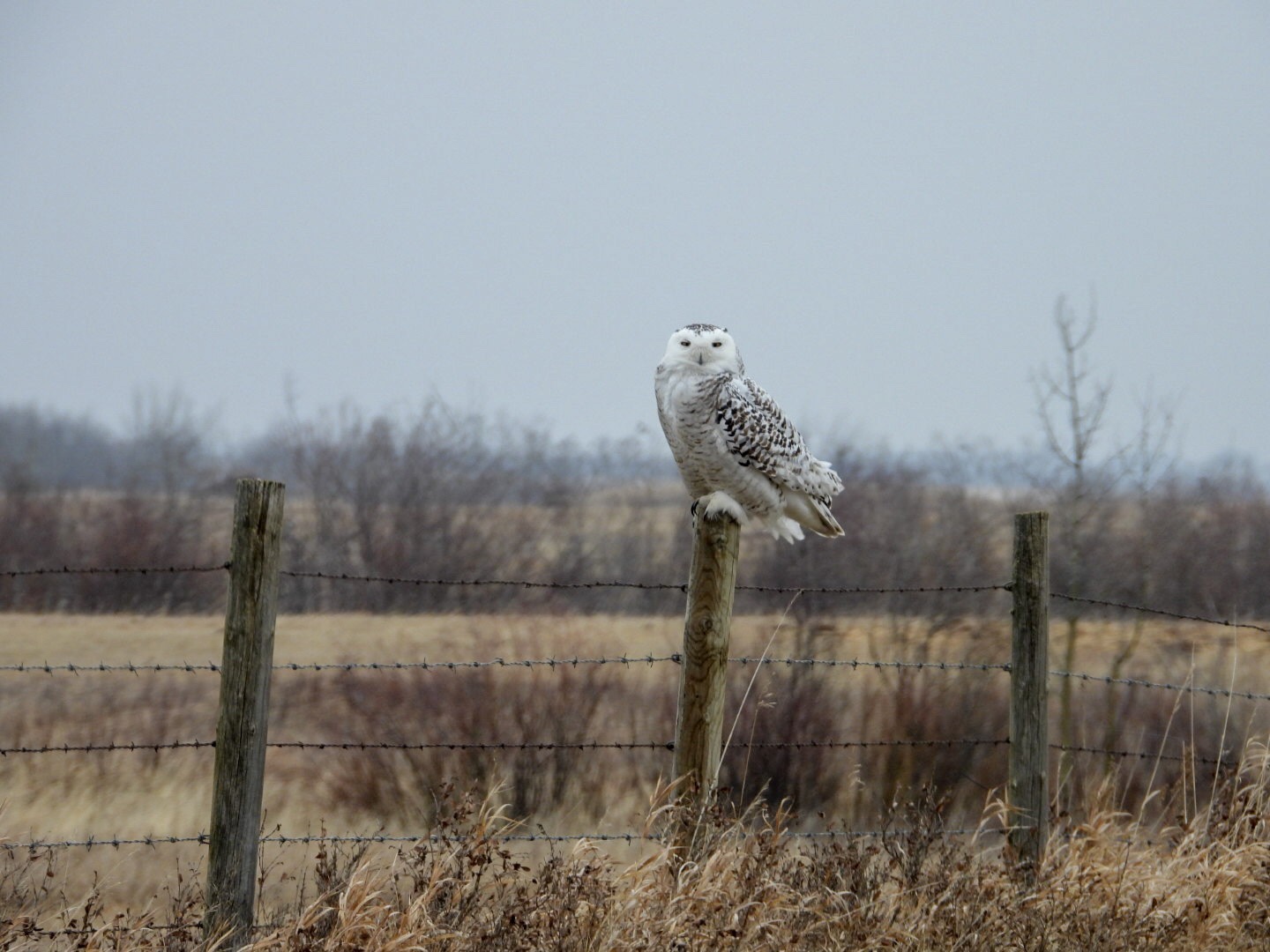
Snowy Owls spend the winters in Alberta only to return to the arctic in March and April. Last weekend (April 6) we were out by Beaverhills Lake Natural Area, crisscrossing the country roads looking for returning migrants. We were hoping for a diverse assortment of water fowl and crossing our fingers for the ephemeral Snow Goose. We had just checked out a waterlogged field where a large group of Snow Geese had been seen the previous day. Alas, they had moved on by the time we made it there. A bit bummed we rumbled on along the dusty gravel roads when, all of a sudden, in the distance I noticed a large “poofy” mass on top of a fence post along the road. Although I am an owl noob, I have seen enough owls this winter that I know to scan for “large poofy masses”. I though to myself, “that looks like an owl”, never actually seriously thinking it would be an owl. As we approached, I could not help myself from slowing down, just in case. Well, would you believe it. It was a lonesome and gorgeous Snowy Owl. The car came to a screeching halt. I yelled to my companions in the back seat: “OWL UP AHEAD”. Everyone dropped what they were doing. I have never seen a pair of teens becoming unglued from their cell phones so fast. We had barely come to a stop, the windows were already down, binoculars up and I threw myself out of the car with the camera ready to shoot. The owl could not care less. It sat there looking at us indifferently and eerily cool. This was an unexpected treat. While we did see a Snowy Owl a few months ago I had simply assumed that they had all left for their arctic summer. Checking eBird later that day, revealed that, indeed the only Snowy Owl sightings for the month of April in Alberta were right in the area were we were. As a matter of fact, the same day another reporting of a Snowy Owl was recorded just a few km away along the same range road. Could it be the same owl? It’s possible, or maybe there are more holding on to our Alberta spring. I assume this will be the last Snowy Owl for this winter. So long Snowy Owls. Bon voyage and see you next winter.

May the curiosity be with you. This is from “The Birds are Calling” blog (www.thebirdsarecalling.com). Copyright Mario Pineda.

Project 366 – Post No. 011 – Documenting Northern Pintails

What is Project 366? Read more here!

It is difficult to have the Monday blues when you got to spend the gorgeous spring weekend in the great outdoors. I did an early morning foray to Elk Island National Park to catch the bison at sunrise (I did not manage to convince anyone else to join me) and we went on two trips out to the area east of Beaverhill Natural Area in search of the elusive Snow Goose. The Snow Goose chase is a story in itself but it suffice to say that we ended up crisscrossing the Range Roads and Township Roads in the area. Virtually all the snow is gone by now and the majority of ponds and lakes are ice free. Many of the fields are inundated with shallow ponds, something the water fowl are taking full advantage of. We did not focus our attention on these birds (the Snow Geese were calling) but during a brief pit stop on a dusty and desolated Range Road I took the following picture of some water fowl enjoying the gorgeous spring day. While the image quality and composition is nothing to write home about it serves as a good example of the genre of documentary wildlife photography I am aiming for. While beautiful composition and top notch image quality always is a bonus my aim is to document an interesting species, behaviour or natural history artefact. Image quality and composition comes secondary. This image was taken at 210 mm focal length with a Nikon P1000 (that is 1512 mm in terms of 35 mm) and with ISO 250. I took the picture to help me id the two Northern Pintails (male is far left and the female is far right) hanging out with the Mallard couple. While we have seen the Northern Pintail previously (in the Keephills Cooling ponds a few months ago) last time they were, well, pinpricks on the distant horizon and we just had to trust pro-birders with high-magnification scopes for the identification. To date this is the clearest and closest view I have ever had of Northern Pintails, which is oddly satisfying. This is precisely the reason why we recently got a super-zoom bridge camera. So far it is serving its intended purpose. In the one week that we have used it, pictures from this camera has helped us to identify three different species, Northern Pintail, Rough-Legged Hawk and American Tree Sparrow (the last two being lifers).

May the curiosity be with you. This is from “The Birds are Calling” blog (www.thebirdsarecalling.com). Copyright Mario Pineda.
Project 366 – Post No. 010 – Great Horned Owl on Eggs

What is Project 366? Read more here!

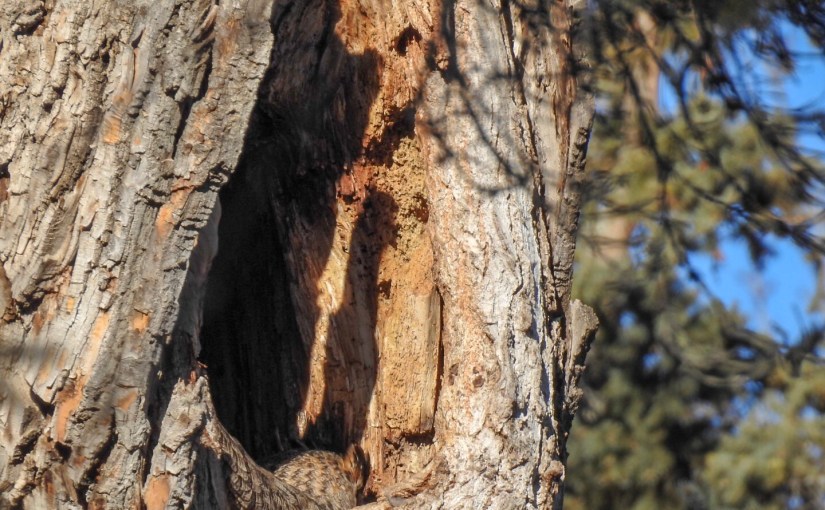
The female Great Horned Owl in Whitemud Ravine is on her 29’th day sitting the eggs. We have been down checking in on her several times a week in the last little while and she is always in her nest. The male is always on guard in a nearby tree. In this picture you can see her feathery rear end and the back of her head with the two characteristic “horns”, which are actually tufts of feathers. The significance of the horns is not fully understood but it is believed they are used in social interactions. The owl couple is always very chilled when we are around (which is during the day) and one can always see Red Squirrels defiantly romping around in the understory right below the owls. I suspect the tables are turned once darkness falls. I have entertained the idea of heading down to the owls at night. The next full moon is on March 20. Let’s see if I can convince anyone else to joint me on a night time nature walk.

May the curiosity be with you. This is from “The Birds are Calling” blog (www.thebirdsarecalling). Copyright Mario Pineda.

Project 366 – Post No. 007 – AB Big Year Bird #44

What is Project 366? Read more here!

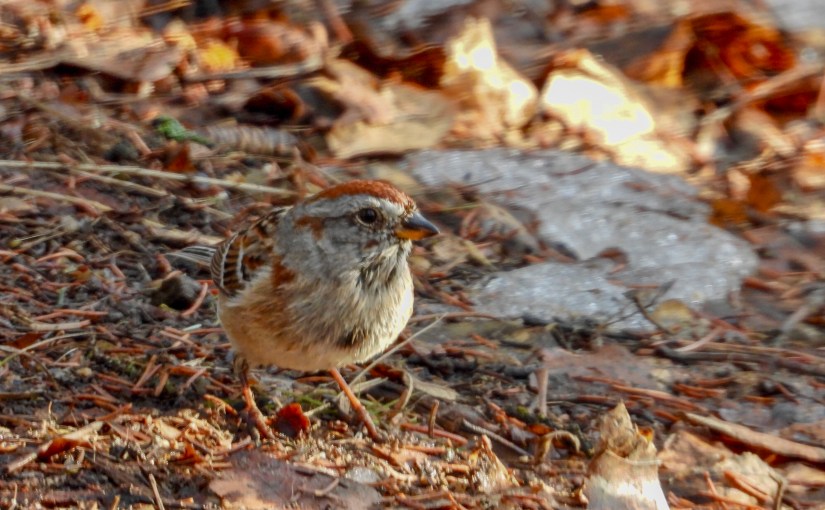
Yesterday my son and I went for a nature walk at the Whitemud Ravine. We quickly encountered the usual suspects. The Black-Capped Chickadees where out in full force as usual, Mr. and Ms. Mallard were swimming around in the swollen creek but got tired of the strong current and waddled up on a sand bank, a few Canada Geese flew noisily overhead, a lonely Downy Woodpecker made a brief appearance and a few dozen Bohemian Waxwings were gobbling down Mountain Ash berries, drinking water from puddles and eating snow. After a few hours, thinking we had seen it all for the day, we started heading back to the trail head. On our way back a subtle movement in the dense understory caught my eye. It was definitely a small bird. About the size of a chickadee, but the way it moved was different. We quickly focused in on the bird with our binoculars and camera. With a rufous coloured crest and a bi-coloured beak, it’s was definitely a new species. I managed to coax the camera into action and snapped a few pictures before a fitness buff came steaming down the trail and the bird took off. As we inspected the images and consulted Merlin Bird the verdict was unanimous. It was an American Tree Sparrow. A lifer for both of us and bird number 97 on our life list and number 44 on our AB Big Year list. It’s amazing how such small and and unassuming creature can make you so excited and happy. On our way back to the car my son and I talked about the significance of lifers and while it may be just another bird, it is also a once-in-a-lifetime experience that we can cherish for the rest of our life. Welcome to our life little American Tree Sparrow.

May the curiosity be with you. This is from “The Birds are Calling” blog (www.thebirdsarecalling). Copyright Mario Pineda.
Project 366 – Post No. 006 – Black-capped Chickadee

What is Project 366? Read more here!

This picture was taken by my son when he first put his hands on our new Canon PowerShot SX70 HS. He took this image in the low light conditions of the understory with full zoom at 1365 mm (35 mm equivalent) at ISO 800. I like how the picture shows the “fluffiness” of the Black-capped Chickadee, which helps to keep them warm in the winter. It also shows a rarely seen phenomenon…, a Black-capped Chickadee sitting still for more than a blink of an eye. These small nonmigratory songbirds seem to be in perpetual motion even during the coldest of winter days. We saw an abundance of Black-capped Chickadees flittering around in the understory during the recent February cold-spell even when temperatures dropped to below -40 °C. It is remarkable how well-adapted these birds are to our harsh climate. To conserve energy on cold nights, they have the ability to go into a state of torpor by lower their body temperature by as much as 10 to 12 °C (their normal body temperature is 42 °C). They may be small, but what they lack in size they make up for in sheer feistiness and awesome attitude. They are constant companions on our nature walk along the creek and are always checking if we bring any treats.

May the curiosity be with you. This is from “The Birds are Calling” blog (www.thebirdsarecalling). Copyright Mario Pineda.