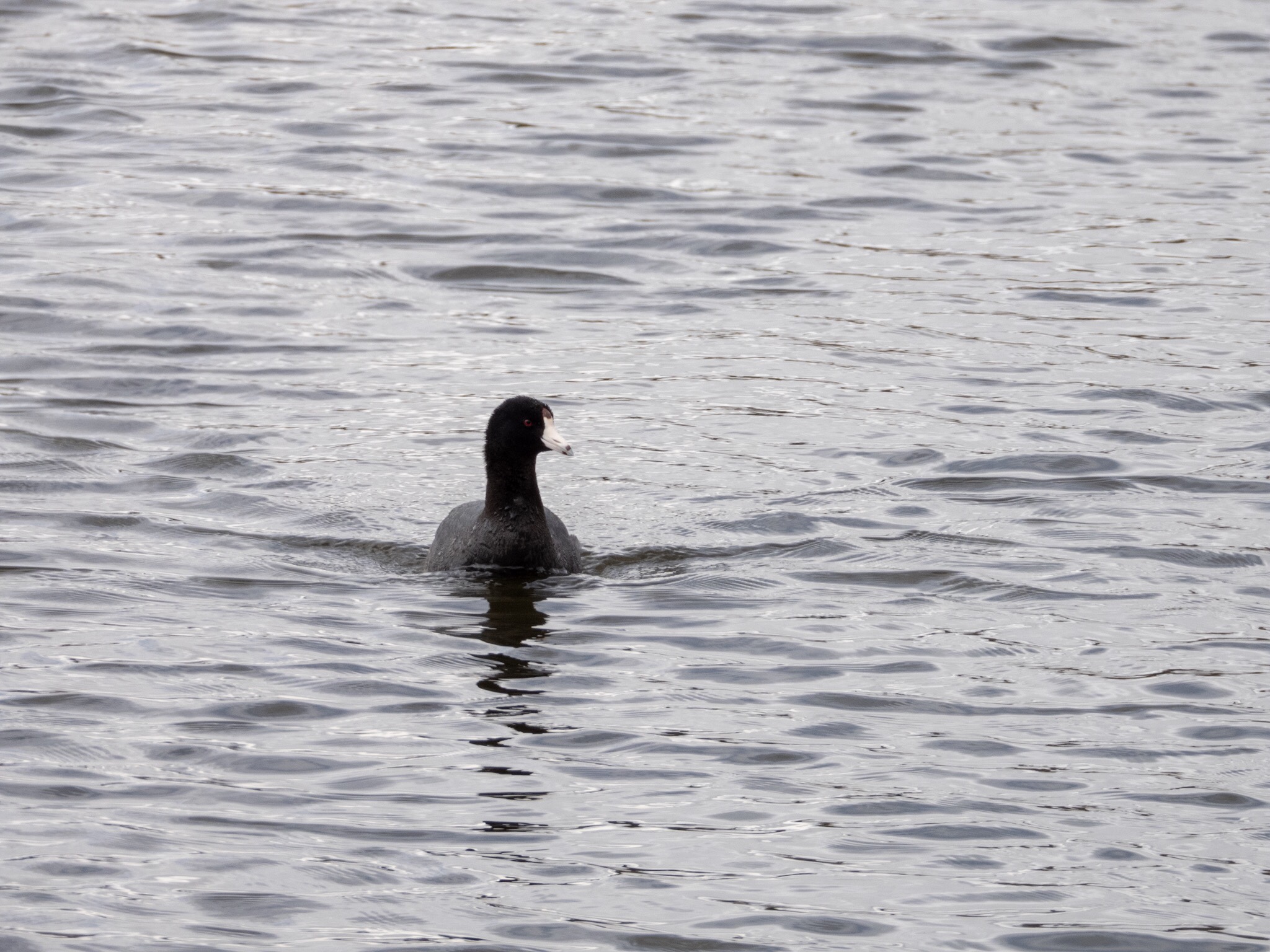
Coots are cute and unmistakable, resembling plump aquatic chickens. This might explain why they are called poule d’eau in some parts of the world (which translates to water hen). This fella was chugging along like a little tug boat on one of the ponds at Heritage Wetland Park in Sherwood Park. It’s an American Coot and it is the only coot species that occurs in North America. This was my third coot species, with the previous two being the Red-gartered Coot and White-winged Coot, both observed in southern Chile. There are ten species of coots in the world, of which six live in South America. The six South American coots tend to be distributed on the western side of the continent, down south along the eastern part of South America and across Patagonia. The one common locality where all the six South American coots co-occur is Chile. So as far as I am concerned, here is yet one more good reason to go back to South America and Chile in particular, to top up my coot list.
Nikon P1000, 470mm equivalent, 1/640s, f/5, ISO 100
May the curiosity be with you. This is from “The Birds are Calling” blog (www.thebirdsarecalling.com). Copyright Mario Pineda.
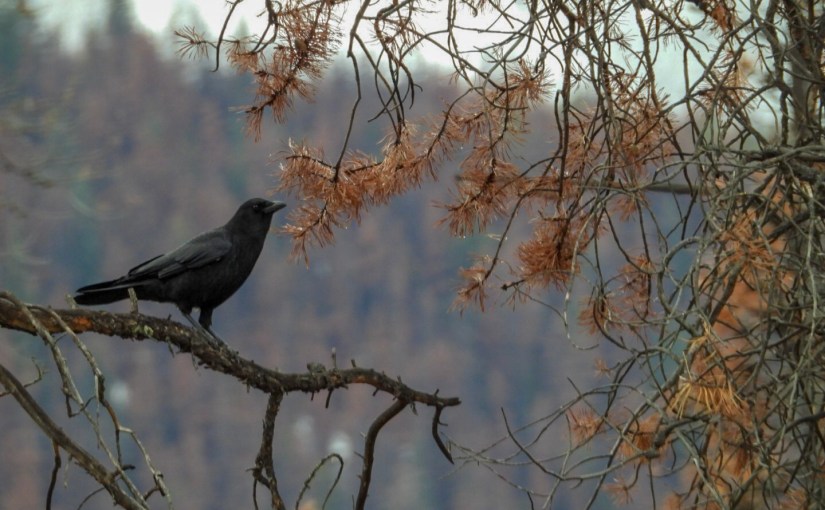
There are many cultural depictions of black birds, such as ravens and crows, that associate these birds with ill omen and death. Clearly these are figments of peoples’ imaginations. Black birds are highly intelligent, uber cool, and ecologically important as they are ubiquitous, globally distributed and take on the roles of predator, prey and scavenger, all in one. This picture from Jasper National Park is emblematic of some of those darker cultural depictions that these birds sometimes are associated with. At first glance there may not be any apparent death or ill omen here, but upon closer inspection, the rust coloured needles of the surrounding pine forest, tell a different story. These “red tops” have succumbed to the mountain pine beetle. Over the last several decades this beetle has ravaged the pine forests of British Columbia, and more recently it has spread into Alberta. The underlaying reasons for this multi-decade epidemic are complex and multifarious with books written about it. Without getting into details, the ultimate causes of this cataclysmic epidemic can all be attributed human arrogance, misguided policies, science illiteracy and greed.
Enough doom and gloom. Black birds are not always associated with ill omen and foreboding. In Native American culture the raven is viewed as a creature of metamorphosis, symbolizing change or transformation. I like to view this lone black bird as exactly that, a sign of the ongoing metamorphosis of the forests of western Canada. Right now it might be difficult to see beyond the destruction, but nature will prevail and out of the ashes of the red tops ecological succession will create new ecosystems and new opportunities that only time will tell. Personally, I am looking forward to the wild flowers that are expected to be one of the early colonizer.
As far as this one particular black bird hanging out in a forest of mountain pine beetle killed trees. The question is, is it a crow or a raven? As in American Crow vs. Common Raven. Typically the movement and vocalizations would give it away, but this fellow did neither. It just sat there. My first though was that the “curved bill” suggests it would be a raven. A consult with the folks at Edmonton Nature Club zeroed in on the overall shape and proportions being more consistent with a crow. In the end I am on the fence with this one.
Nikon P1000, 1100mm equivalent, 1/400s, f/5.6, ISO 400
May the curiosity be with you. This is from “The Birds are Calling” blog (www.thebirdsarecalling.com). Copyright Mario Pineda.
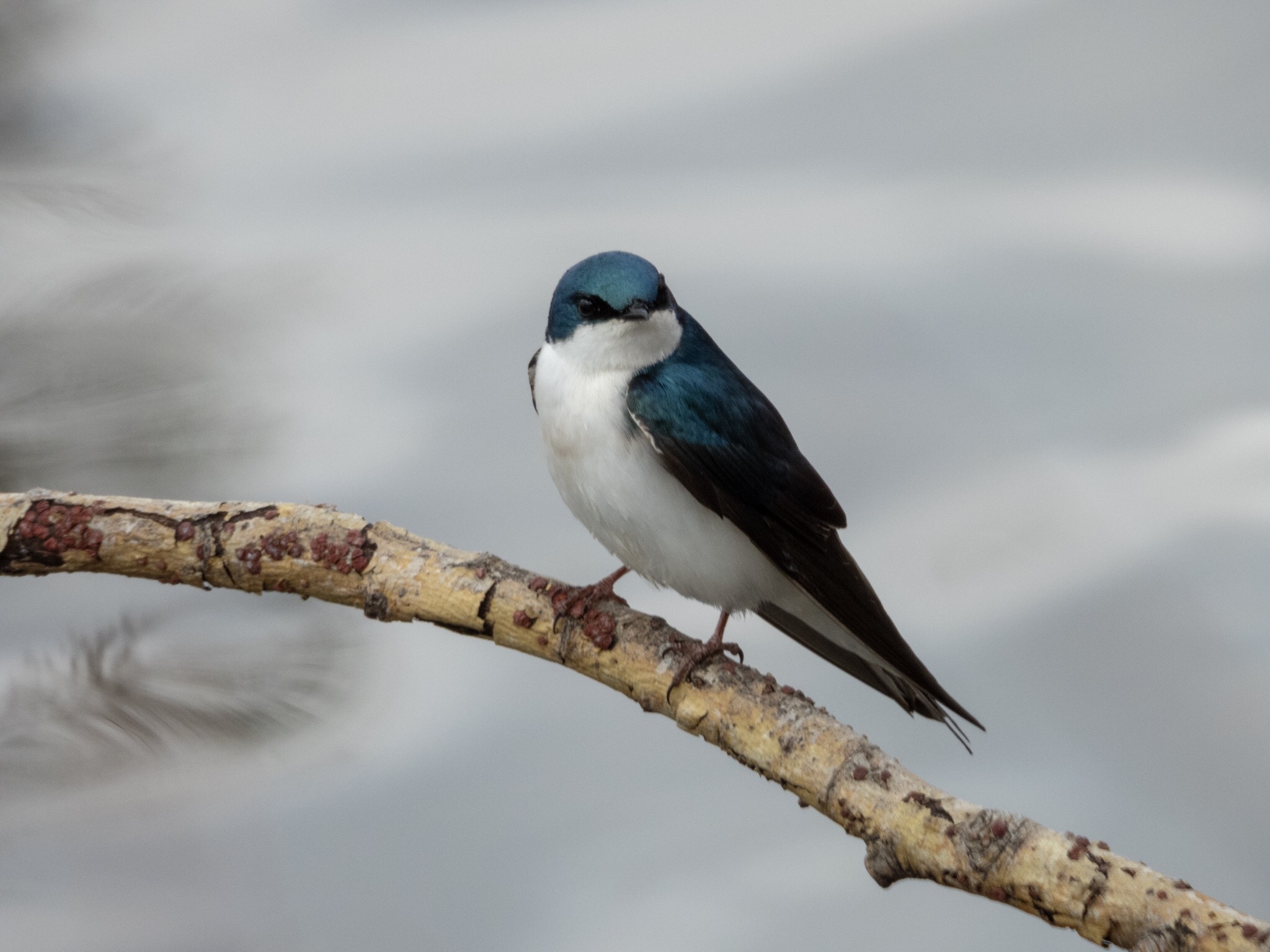
Swallows can be tricky to id and photograph. They are small, always seem to be airborne, skipping back and forth at breakneck speeds, never stopping and seemingly never landing. During a field trip in southern Chile in December I found these swallows flying around above a pasture. Despite visiting the same field almost every day over the next few weeks I never managed to catch one perching. As a result I never got a good look at one and, needless to say, I was not able to id or photograph them. Using the process of elimination all I was able to do was to narrow it down to two possible species, either the Chilean Swallow (Tachycineta leucopyga) or the Blue-and-white Swallow (Pygochelidon cyanoleuca). Of course, this left me very dissatisfied but they were simply too small, too fast and the morphological differences between the two species were too subtle for me to be able to pinpoint the species. Fast forward 5 months and I spot my first swallow of the year at Heritage Wetland Park in Sherwood Park. As it turns out, Canadian swallows behave the same way as Chilean swallows. Skipping back and forth at breakneck speeds, never stopping, never perching and never sitting still. Even with a new camera and more birding and photography experience there was just no way for me to catch up with them. As I was standing at the edge of the pond pondering my conundrum I suddenly spotted a lonesome swallow sitting on a dead branch that was jutting out over the water surface. It only sat there for a few seconds before taking flight again. Now I had a lead, I immediately trained my camera on that branch; pre-focusing and adjusting all the settings. I waited and I waited. I lost my concentration and focus several times but after what appeared to be an eternity, there it was, a very pretty Tree Swallow (Tachycineta bicolor, Lifer: #107, AB Big Year: #56). It landed at the exactly same spot as last time. I don’t know if it the same individual or a different one that just happened to land on the same place. I did not care, it was the closes look I have ever got of a swallow. The wait was worth it.
Nikon P1000, 1310mm equivalent, 1/500s, f/5.6, ISO 160
May the curiosity be with you. This is from “The Birds are Calling” blog (www.thebirdsarecalling.com). Copyright Mario Pineda.
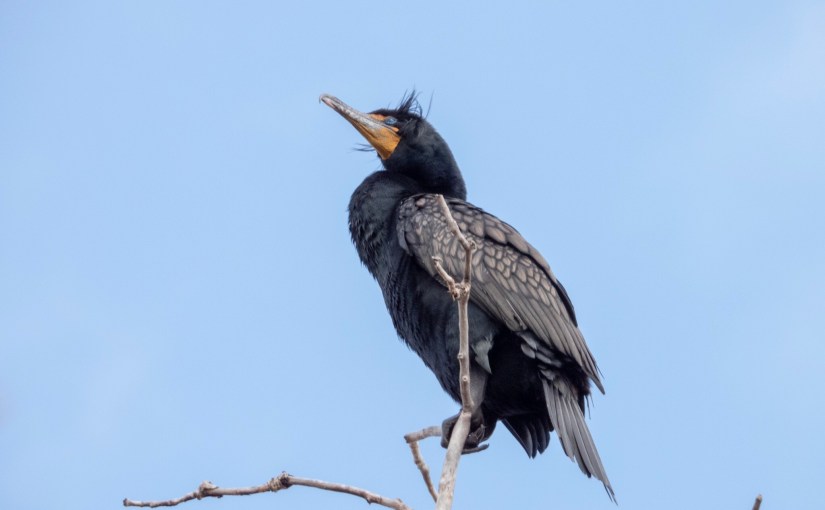
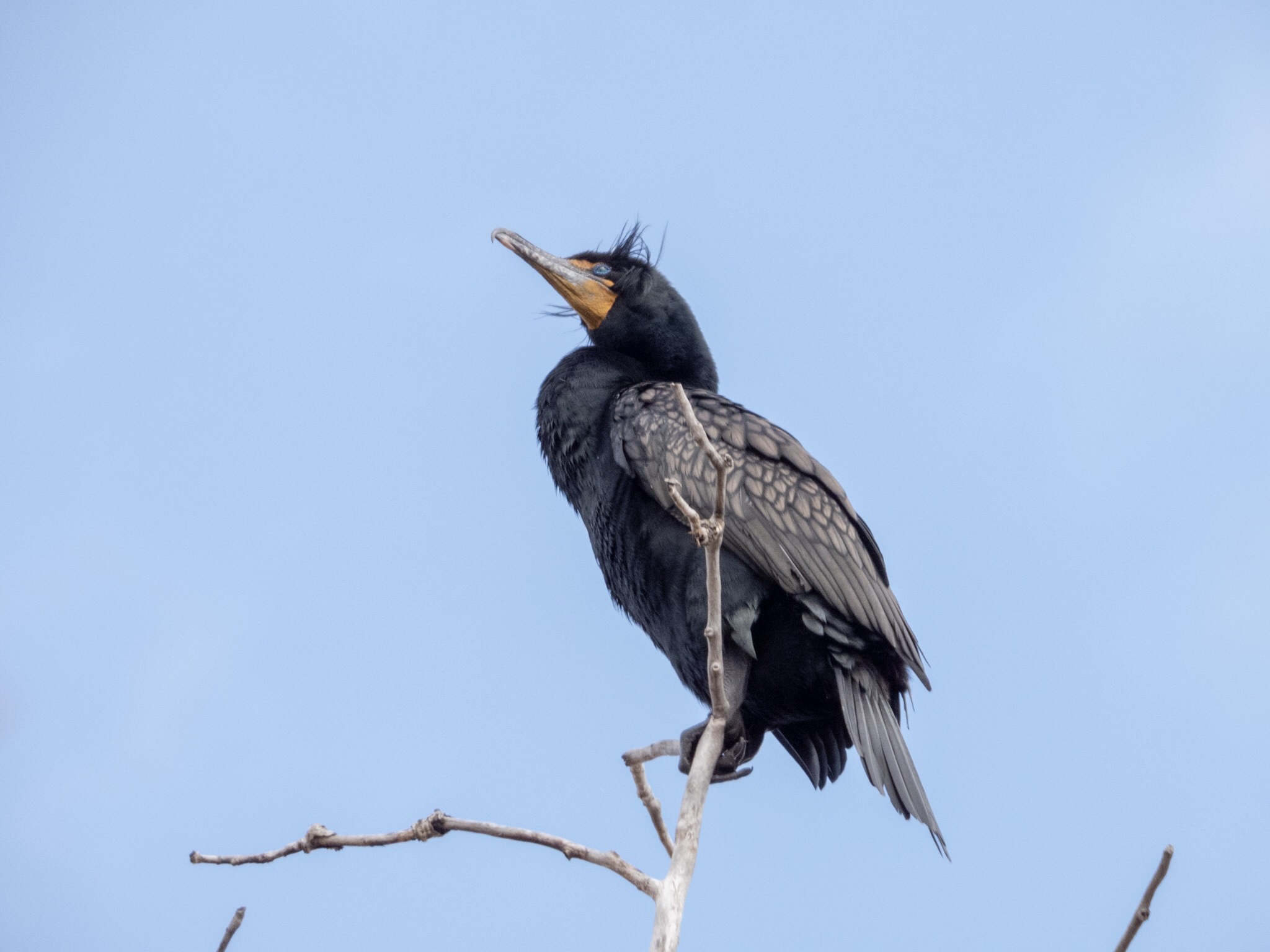
I came across a single Double-crested Cormorant at Heritage Wetlands Park in Sherwood Park a few days ago. Cormorants tend to hang out in colonies so this is likely an early bird. eBird records show that up to 16 cormorants were recorded at this location last summer (in May) and that they start arriving around mid-April and stay until the end of September. The Double-crested Cormorants appear black form a distance but upon closer inspection, particularly if the light is right, one can see a subtle beautiful pattern emerge on their wings. It almost looks painted. This particular individual, lets call him/her Early Bird, was perched at the very top of a tall tree, almost as he/she wanted to show everyone “Check me out, I got here first!”. One can also see that Early Bird has a bit of bad hair day, either that, or its a tad breezy way up there.
Nikon P1000, 935mm equivalent, 1/500s, f/5.6, ISO 320
May the curiosity be with you. This is from “The Birds are Calling” blog (www.thebirdsarecalling.com). Copyright Mario Pineda.
I recently ventured to Heritage Wetlands Park in Sherwood Park. This wetland is in a curious place, located smack dab in the middle of a sub-divisions in Sherwood Park where it is surrounded by residential properties to the North and South and bounded by Clover Bar Road to the East and Highway 21 to the West. The park consists of four small ponds with plenty of reeds along the shores. No matter where you go you are looking into someone living room and there is no escape from the noise of the busy roadways nearby. Despite what appears to be a less than ideal location the wetlands are bustling with bird life. During my two brief visits I saw 18 species of birds, six of which are lifers (Green-winged Teal, Double-crested Cormorant, Tree Swallow, Franklin’s Gull, Song sparrow, and Red-winged Blackbird). As I logged my observations on eBird later that afternoon I noticed several observations in the same location on the same day of American White Pelicans. A bit more research revealed that historically there is a group of 10 to 20 pelicans that hang out in the wetlands. With a wing span of up to 3 m, the second largest wingspan of any North American bird, after the Californian condor eBird describes it as “extremely large and conspicuous” . How I managed to miss spotting them beats me. I guess I have at least one good reason to go back “pelican hunting” as soon as it stops snowing (yes it is April 30 and it is snowing). Here are a few more really good reasons to go back (as soon as it stops snowing): Northern Shoveler, Barn Swallow, White-throated sparrow, Common Grackle, American Wigeon, Great Blue Heron, Cooper’s Hawk, Red-tailed Hawk, Purple Martin. All of these species were seen by others on the same day I was there and all of them would be lifers for me.
The charming fella on the picture is a Red-necked Grebe (Podiceps grisegena). A number of Red-necked Grebe pairs were cruising back and forth on the ponds. I imagine they might be having their nests in the reeds. This species is know for ferrying their young chicks around on their backs, so it might be worth keeping an eye out over the next while for some unbearable cuteness.
Nikon P1000, 756mm equivalent, 1/500s, f/5.6, ISO 110
May the curiosity be with you. This is from “The Birds are Calling” blog (www.thebirdsarecalling.com). Copyright Mario Pineda.
The secret is out, someone saw one of the Great Horned Owl chicks peaking out of the nest the other day. I am obviously talking about Edmonton’s own celebrity owl family down in the Whitemud Ravine. Last time I was down there, four days ago, mom owl was still in her cavity. I did not see any chicks but mom was peaking out of the nest and she seemed to be “higher up” in the nest, perhaps indicating that there are growing chicks below her. While this is exciting news, I am a bit concerned about the well-being of this celebrity family. Just like any celebrity family, they are under close scrutiny of the public with eager paparazzi nature photographers and birders watching their every move. There always seems to be photographers at the nest. To anyone regularly trafficking the trail it would be completely obvious that there is something interesting hiding in the trees. So far, everyone seems to be mindful and considerate of the feathered family, but it only takes one bad apple to cause irreparable harm. There are good reasons why eBird does not allow the publication of the exact location of owl nests. Owls are vulnerable to disturbances not just from humans but also from other birds. For example, owls are commonly harassed by other birds. If other birds, such as crows, ravens and other raptors, get alerted to the presence of the owls they could start harassing them or even prey on the young. Perhaps one could view all the nature loving photographers and birders as standing on guard around the family, making sure they are not bothered by anyone with ill intentions. I know that I will be back at the nest, carefully and mindfully observing the family from a distance.
Nikon P1000, 1210mm equivalent, 1/200s, f/5.6, ISO 400
May the curiosity be with you. This is from “The Birds are Calling” blog (www.thebirdsarecalling.com). Copyright Mario Pineda.
It was a cold and windy spring day. Heavy wet snow had blanketed Edmonton overnight. The good news was that there was no need to remove any of the snow as it was rapidly melting. The bad news was that it made the roads, sidewalks and trails a mess. A cold and windy breeze made things generally unpleasant and cold. Not ideal conditions to go birding, but (in theory) the birds are going to be there, rain or shine. Nevertheless, with the miserable conditions and only 30 minutes to spare I did not have high hopes as I hit the gravel trail at the Heritage Wetland Park in Sherwood Park. I could not have been more wrong. Despite the bone chilling strong breeze, within seconds I was greeted by the metallic clanking call of several Red-winged Blackbirds (Life List #105, AB Big Year #54). During the next 30 minutes I was barely able to put my notebook down, the birds were everywhere. Eleven species later I had also scored two more lifers; the Song Sparrow (Life List: #106, AB Big Year: #55) and Franklin’s Gull (Life List: #107, AB Big Year: #56). The Song Sparrow was quite a hoot. There it was sitting on an exposed branch violently swaying in the wind singing up a storm in the blustering breeze. You can see the ruffled feathers from the breeze on the back of his head as he is going to town. Not sure if he is telling other males to stay away or if he is trying to impress some lady friend, or both. Either way, in the breezy conditions his efforts seem futile and perilous, but what do I know about Song Sparrow logic.
The Song Sparrow brings to mind a scene from the 1995 movie Crimson Tide where Capt. Frank Ramsey (Gene Hackman) and Lt. Cmdr. Ron Hunter (Denzel Washington) on submarine USS Alabama get into an argument after Capt. Ramsey decides to run an emergency drill at the same time as there is a fire in the galley which ends up killing one sailor.
Capt. Ramsey: So, Mr. Hunter, do you think I was wrong to run that drill sing in the breeze? Hunter: Not necessarily, sir. Capt. Ramsey: Do you think I got that mansparrow killed? Hunter: No, sir. One thing had nothing to do with the other. It was an accident. Capt. Ramsey: Would you have run the drillbeen singing? Hunter: No, sir, I wouldn’t have. Capt. Ramsey: Why not? Hunter: The fire in the galley owl could have flared back up come back for seconds. I would have seen to it first, sir. Capt. Ramsey: I’m sure you would have. Me, on the other hand, I tend to think that that’s the best time to run a drill sing. Confusion onthe shipin the reeds is nothing to fear. It should be taken advantage of. Lest you forget, Mr. Hunter, we are a ship of war in breeding season, designed for battle to hook up with females and making baby birds. You don’t just fight battlesbreed when everything is hunky-dory. What’d you think, son? I was just some crazy old coot [sic]… putting everyone in harm’s way as I yelled “yee-haw”? Hunter: That was not my first thought, sir. But there’s no excuse. At the time I was fighting the fire in the galley the owl had Stan for lunch... I did not agree with your call, sir.
Nikon P1000, 935mm equivalent, 1/320s, f/5.6, ISO 400
May the curiosity be with you. This is from “The Birds are Calling” blog (www.thebirdsarecalling.com). Copyright Mario Pineda.
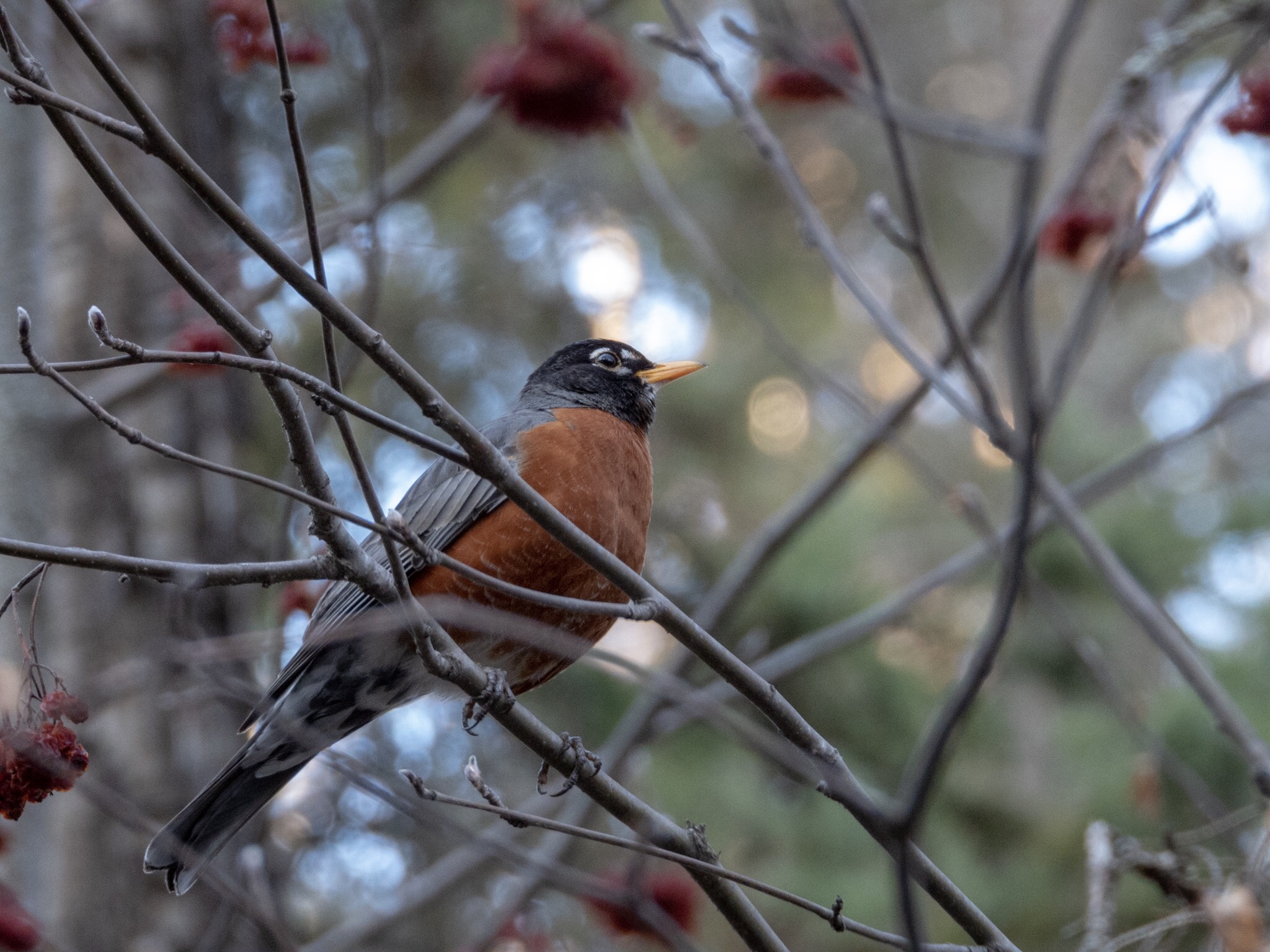
I had been bushwhacking along the trails and through the brush at the Whitemud Creek for a few hours and the sun was getting low in the sky. I had just finished checking part of the trail where Pileated Woodpeckers often hang out (with no luck). As I started heading back a quick bout of chirping in the shrubbery along the trail caught my attention. The twilight made it tricky to find the culprit, but there it was – an American Robin sitting in a Mountain Ash just minding its own business. Initially I did not reach for my camera as I already have plenty of pictures of robins and it was getting too dark to take pictures anyway. The robin was, however, sitting completely still, almost like it was posing for me so I figured that I could at least try to get a picture of it. While I did have the camera on a monopod I figured that the chances of the pictures turning our would be quite slim. It was getting dark and there was jumble of twigs and branches between me and the robin. I doubted the camera would be able to focus properly through the shrubbery in the low light. To my surprise the camera nailed the focus immediately. At 1/60s (which is a really long exposure at 705mm zoom) and ISO 500 (which is a sure recipe for grainy images lacking detail) the exposure settings were a bit challenging to say the least. I ended up only taking a few pictures. When I inspected the images back at the car I was astonished. Every single image was razor sharp (by P1000 standards), the exposure was spot on and the the bokeh was awesome. The P1000 really throws me for loops at times. Only a few days earlier I had been shooting Ospreys in transmission towers under, what would be considered, ideal conditions (a backdrop of a bright blue sky, no interfering shrubbery, etc.). Despite this, I had great difficulty coaxing the camera into focusing properly (both with auto focus and manual focus) and the pictures came out unacceptably soft. For a brief moment the robin made me feel like a deadeye, but the truth is that I am still not able to wrap my head around why the camera struggled with the osprey in what should have been ideal conditions but nailed the robin in the twilight.
On a side note. This post is #30 of my Project 366. One month down, eleven to go. Congratulations to…, me! Keep up the great work. 😁
Nikon P1000, 705mm equivalent, 1/60s, f/5, ISO 500
May the curiosity be with you. This is from “The Birds are Calling” blog (www.thebirdsarecalling.com). Copyright Mario Pineda.
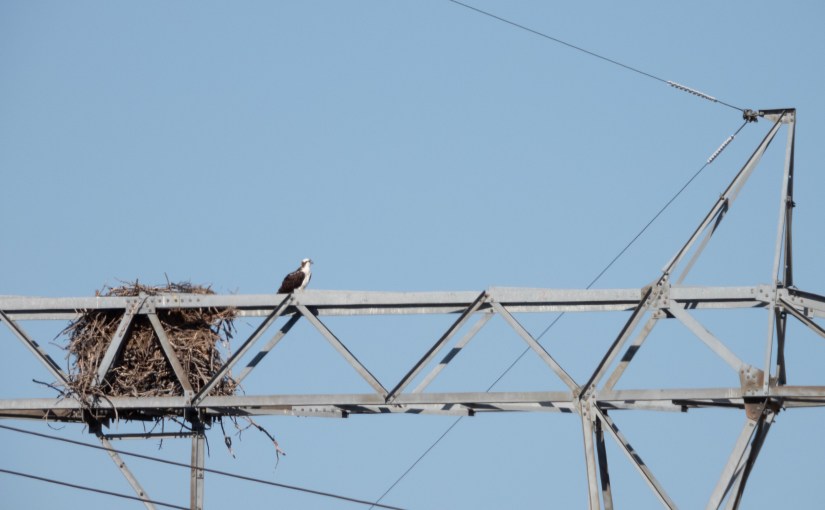
As you head out of Edmonton on the Yellowhead Highway eastbound towards the mountain parks you pass by the sleepy village of Wabamun, primarily know for being one of the gateways to fishing in Wabamun Lake. On the left hand side of the highway, right by the ramp for Wabamun there are power transmission towers rising high above the surrounding forests. Right on top of one of the towers embedded into the steel lattice there is a large messy-looking stick nest. I noticed the nest several month ago in the middle of the winter as we were heading out on one of our field trips to Jasper. The minute I saw it, it intrigued me. Who build the nest? Does it get occupied during the breeding season? By whom? How large is it? How long has it been there? It clearly is a large nest, but without a known point of reference it is quite difficult to estimate its size. I suspected that it was most likely a raptor nest. Digging around on eBird did not reveal anything as I was unable to find any reported observations at this location. The winter came and went, spring arrived and we went back and forth to Jasper several times. The nest remained perched on the transmission tower and my curiosity just grew but did not get satisfied…, until last weekend. As we were on our way back from Jasper and were approaching the tower I had a feeling, a hunch if you will, that something was about to happen. As I was the driver I decided to forgo the temptation to reach for the binoculars. Instead I asked the rest of the gang in the car to get the binoculars and get into standby mode. Of course they had no idea what I was talking about so they were a bit slow,… too slow. As we emerged from under an overpass, there it was, the transmission tower and on top of it, right by the nest, two large white and dark brown raptors with fuzzy unkept “hairdos”. Id’ing was a breeze – they were a pair of Ospreys (Pandion haliaetus), the iconic fish raptors. These magnificent birds of prey became number 104 of our World Life List and 53 on our AB Big Year list. As we were cruising along at highway speeds we had passed them in a blink of an eye. At the next exit we turned around and went back to get a closer look. As we were admiring Mr. and Ms. Osprey some of my questions got their answer but new questions arose as well. Apparently an adult Osprey is around to 60 cm (~24in) long. Using the individual in the picture as a referent suggests that the nest is between 3-4 Osprey units in diameter (i.e. 180cm-240cm, 72in-96in), a truly impressive size. Does this pair inhabit the same nest every year? Did they build it, or did they inherit it? Either way, as we parted ways (for this time) I wished the force to be with them in their truly electrifying abode.
Nikon P1000, 806mm equivalent, 1/800s, f/5.6, ISO 100
May the curiosity be with you. This is from “The Birds are Calling” blog (www.thebirdsarecalling.com). Copyright Mario Pineda.
The trail the Valley of Five Lakes in Jasper National Park meanders between and around…, you guessed it, five lakes. The Fifth Lake (that is actually it’s name) is different from the other four lakes in that it is emerald green this time of year. It is surrounded by lush spruce forests and at one end of it (NW side) there is a small wooden boat dock. The dock is the perfect spot for taking a break with a beautiful view of the lake and the surrounding mountains. Last time we were here there was a lonely Common Loon enjoying the spring sun. This iconic species came in as species 52 on the AB Big Year list and 103 on the Life List. As we were studying it through our binoculars I noticed how the loon would lay its head flat on the water surface moments before diving. I am not sure if I just have not noticed this behaviour previously or if this was a behaviour unique to this particular individual. I will definitely look for this next time I see a loon and hopefully get a video recording of it.
May the curiosity be with you. This is from “The Birds are Calling” blog (www.thebirdsarecalling.com). Copyright Mario Pineda.