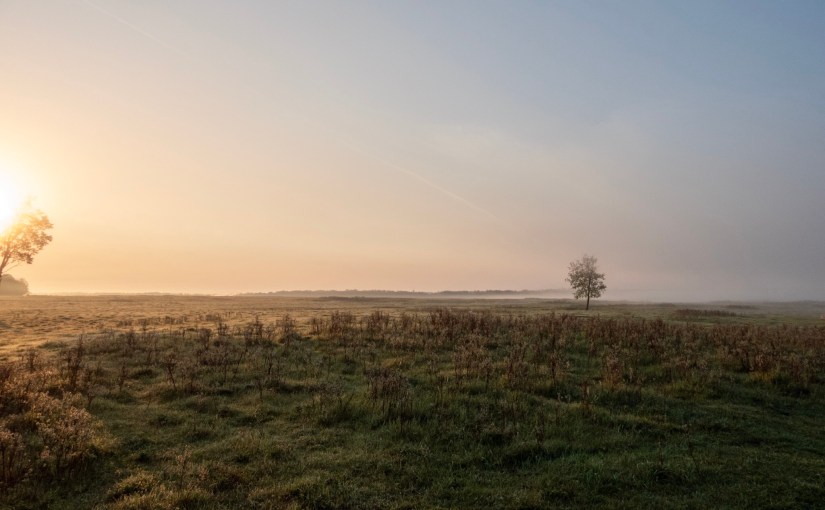
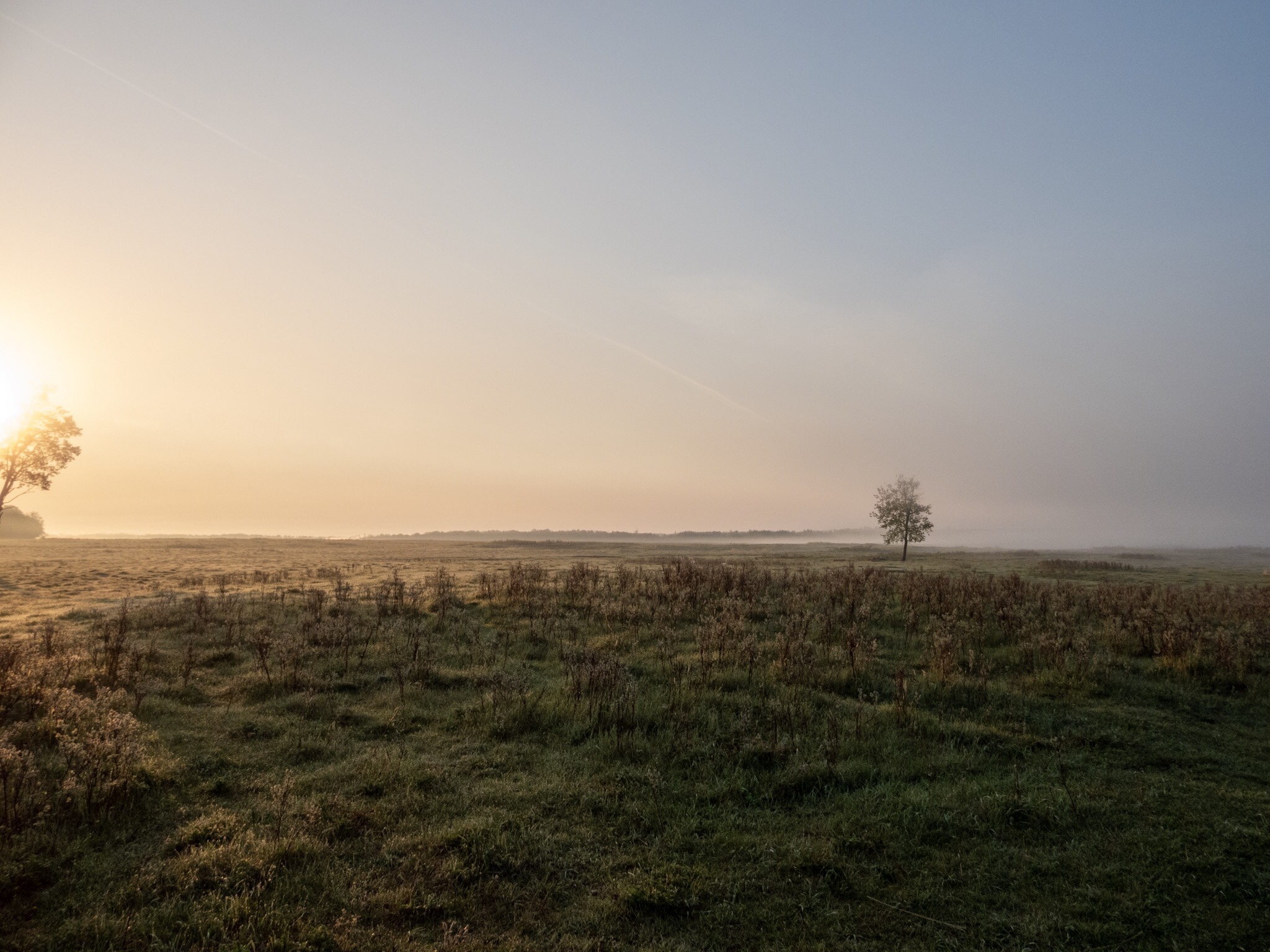
The alarm clock went off at 5am. Fifteen minutes later I was heading East on a quiet and empty Yellowhead Highway, into the sunrise and towards Elk Island. Nature walks at dawn is a meditative experience. The dawn of a new day, the absence of humans and human made noises washes away stress, sleepiness and rejuvenates the mind. The absence of human-made sounds is made up for by a cacophony of natural sounds, primarily birds. Dawn is the time of day that birds are by far the most active and vocal. As I was approaching the park thick impenetrable fog shrouded the landscape forcing me to, at times, slow down to walking speed on the highway. I have not seen fog this thick in many years. It was the proverbial pea soup with visibility diminished to only a few meters. Once I arrived at Elk Island heavy fog banks covered the open fields and ponds. Not ideal for viewing or photographing wildlife, but magical nevertheless and quite inducing for landscape photography. After a quick scan of the fog covered Bison Loop I settled in at the Mud Lake parking lot to brew myself a cup of coffee and wait for the fog to lift. I spend the next few hours hiking along ponds and wetlands around Tawayik Lake seeing lots of waterfowl and industrious beavers.
Nikon P1000,24mm @ 35mm, 1/1000s, f/2.8, ISO 100
May the curiosity be with you. This is from “The Birds are Calling” blog (www.thebirdsarecalling.com). Copyright Mario Pineda.
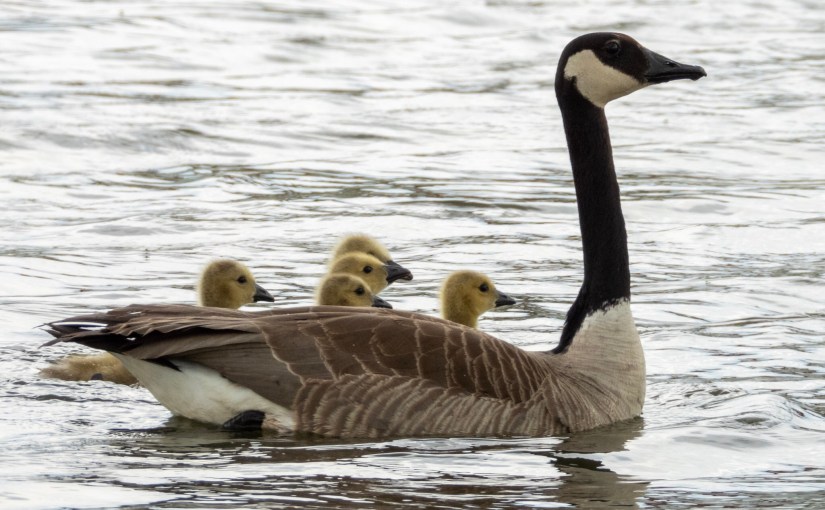
I was at the Emerald Pond in Sherwood Park looking for charismatic birds such as pelicans. The pelicans were a no show, but there was plenty of Canada geese in the tall grass surrounding the pond. I did not pay much attention to the geese and as I was walking along the shore they kept a close eye on me and slowly, almost reluctantly, moved out of my way as I was approaching. As I approached one goose that appeared alone I noticed something else moving around in the grass right beside the goose. They were goslings and this would explain the slighly odd behaviour of the adult geese. The adult was herding the goslings towards the water’s edge while keeping its head high and its gaze fixed on me. As I started to scrutinize the other geese around the pond, now that I knew what to look for, I saw they all had little ones. The yellow goslings were remarkable well-camouflaged in the tall grass and obediently followed their moms and dads into the water. Once in the water the families quickly crossed the pond and got out of the water on the other side. I imagine the goslings might be safer in the tall grass as they would be easy prey for an opportunistic raptor in the open water.
Nikon P1000, 437mm @ 35mm, 1/500s, f/5, ISO 100
May the curiosity be with you. This is from “The Birds are Calling” blog (www.thebirdsarecalling.com). Copyright Mario Pineda.
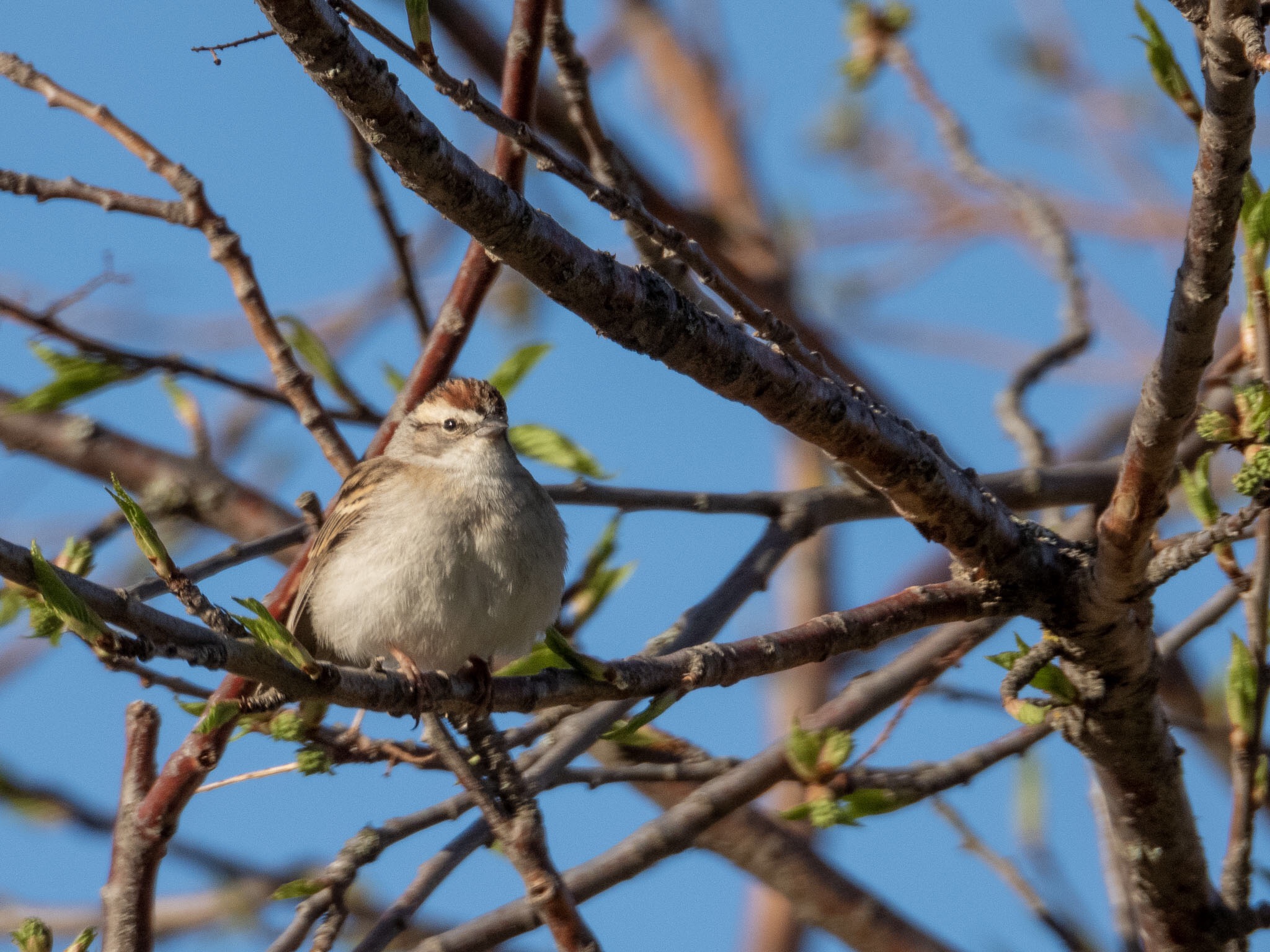
The Chipping Sparrow (Spizella passerina) became lifer #158 and AB Big Year #109. It was a special find as this was the first time I did not finds the bird, but rather the bird found me. I was at the parking lot of Snow Valley on a sunny morning trying to get a good view of a bird sitting at the very top of the tallest spruce tree around singing its heart out. Because of the position of the bird and the bright light it was difficult to get a good view of its colour. Based on the size and over all shape I suspected a Dark-eyed Junco. I decided to try to identify it by its song, so I pulled up its audio file in the Merlin App to compare with the actual song. Within seconds after pressing play half a dozen small birds swooped in around me. They landed just a few meters from me in the trees, on the park bench and on a trash can. The suspected junco…, well, it flew of, go figure. The closest bird was definitely a house finch with its reddish head and neck and shoulders. The others were house sparrow sized and shaped but with a rust cap and black eye liner. It was a band of Chipping Sparrows and they were very curious about the large non-junco making junco sounds. So I guess one could say the Chipping Sparrow find was serendipitous. Birding with the Edmonton Nature Club I have seen birders playback bird calls in an attempt to attracts birds or bring them closer in. If used judiciously this appears to be an efficient trick turn the tables and instead of trying to sneak closer to the birds convince the birds to come closer to you.
Nikon P1000, XXXmm @ 35mm, 1/Xs, f/X, ISO XXX.
May the curiosity be with you. This is from “The Birds are Calling” blog (www.thebirdsarecalling.com). Copyright Mario Pineda.
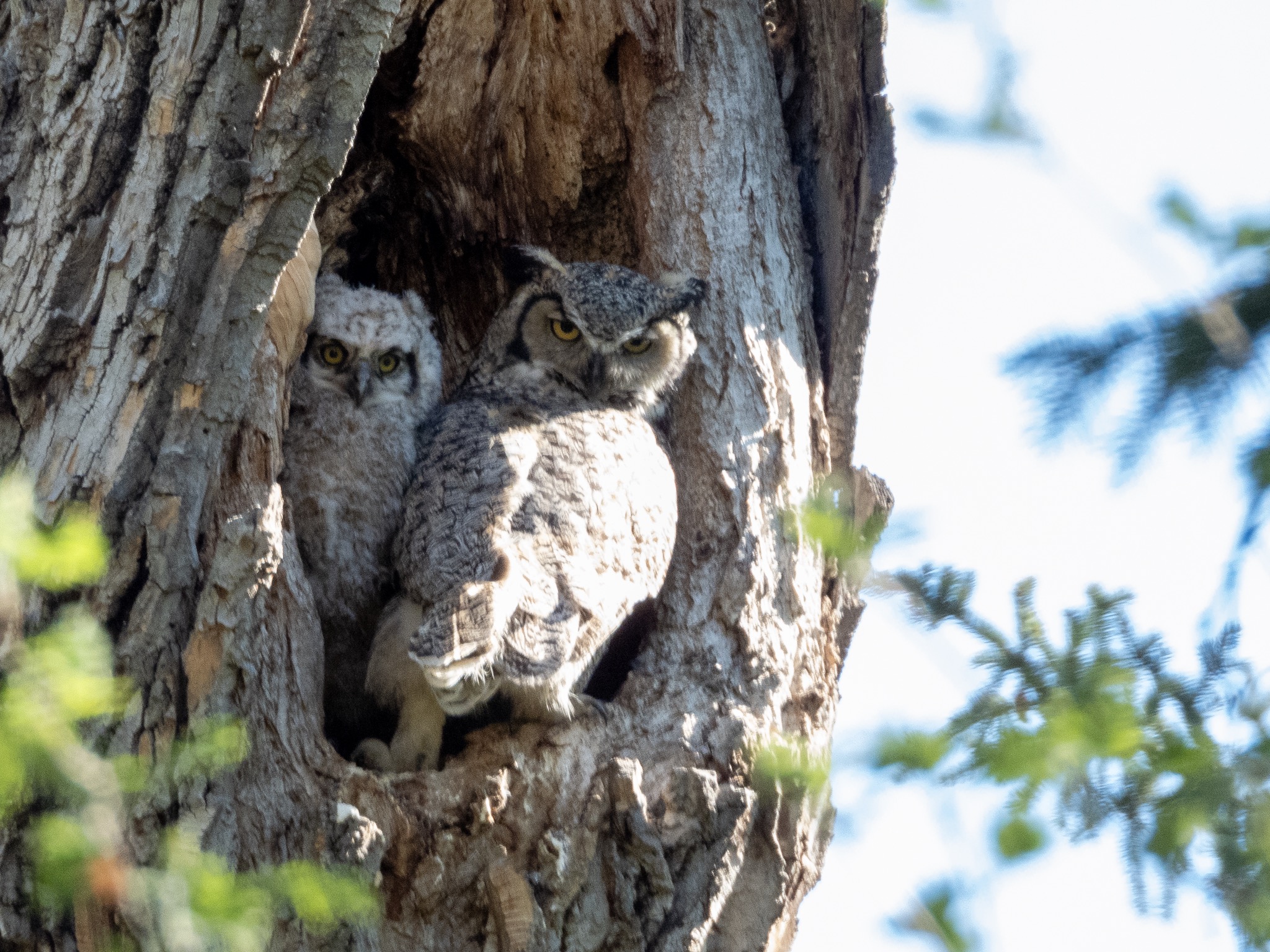
I had never been down to the Whitemud Ravine in the morning before. Last Tuesday I was off from work and woke up early to a beautiful sunny morning. It was the perfect morning for a nature walk down by the creek. Said and done, at 7 am I started out down at the Snow Valley parking lot. Right off the bat, the birding kicked in at full gear with a bunch of Chipping Sparrows (Spizella passerina) hanging out in the trees by the parking lot. These were lifers for me and by playing their call through the Merlin App I had them sitting all around me in the trees curiously eyeing me. I can just imagine what must have been going though their bird brains, “Is this an intruder?” or “Is this a potential mate?”. That was a great start to a morning of some awesome birding. Other than two lifers, the highlight was definitely the Great Horned Owlets that were hanging out in their cavity. They were about 3 weeks old and getting quite large. By owl standards they would probably be considered teenagers. They sure behaved like teenagers, curious, oblivious to the dangers of the outside world, not following their owl parent instructions etc. There they were, perching precariously at the edge of the nest and ogling passersby. The sudden croaking of ravens directed their attention skywards. I am not sure if they would be aware of the dangers the ravens pose, but their parents definitely are. Dad, sitting in a nearby tree, started hooting and right away mom was inbound. She landed at the edge of the cavity pushing her owlets inside. The owlets had none of it as they tried to get past mom to check out what the commotion was about. Although the mother barely fit in the nest she blocked the entrance pushing her owlets back into the nest as she intently eyed the skies for the ravens. I spend well over an hour at the nest, snapping pictures and shooting videos of the chicks.
Nikon P1000, 1108mm @ 35mm, 1/200s, f/5.6, ISO 400.
Below is a video clip (13:16 min) of the action at the nest. Mom arrives at 7:32 and the person you can hear talking and shooting pictures in the background is Wayne Oaks, the resident Whitemud Ravine birding afictionado.
All in all, it was an amazing and beautiful morning full of birds, two of which were lifers (Chipping Sparrow and the American Goldfinch). I could have continued but after 3.5 hrs and 6 km my stomach started to grumble so it was time for a second breakfast and more coffee. This experience has opened my eyes to the virtues of early morning birding. The weekend cannot arrive soon enough.
Here is the eBird summary of the morning.
Edmonton–Whitemud Park, Edmonton, Alberta, CA May 21, 2019 7:07 AM – 10:37 AM Protocol: Traveling 6.341 kilometer(s) 18 species
Canada Goose (Branta canadensis) 5 Mallard (Anas platyrhynchos) 12 Green-winged Teal (Anas crecca) 2 Common Goldeneye (Bucephala clangula) 3 Common Merganser (Mergus merganser) 5 Great Horned Owl (Bubo virginianus) 4 Downy Woodpecker (Dryobates pubescens) 1 Pileated Woodpecker (Dryocopus pileatus) 1 Sound only Common Raven (Corvus corax) 3 Black-capped Chickadee (Poecile atricapillus) 15 American Robin (Turdus migratorius) 4 House Finch (Haemorhous mexicanus) 1 American Goldfinch (Spinus tristis) 2 Chipping Sparrow (Spizella passerina) 3 Dark-eyed Junco (Junco hyemalis) 3 White-throated Sparrow (Zonotrichia albicollis) 1 Song Sparrow (Melospiza melodia) 2 Common Grackle (Quiscalus quiscula) 1
May the curiosity be with you. This is from “The Birds are Calling” blog (www.thebirdsarecalling.com). Copyright Mario Pineda.
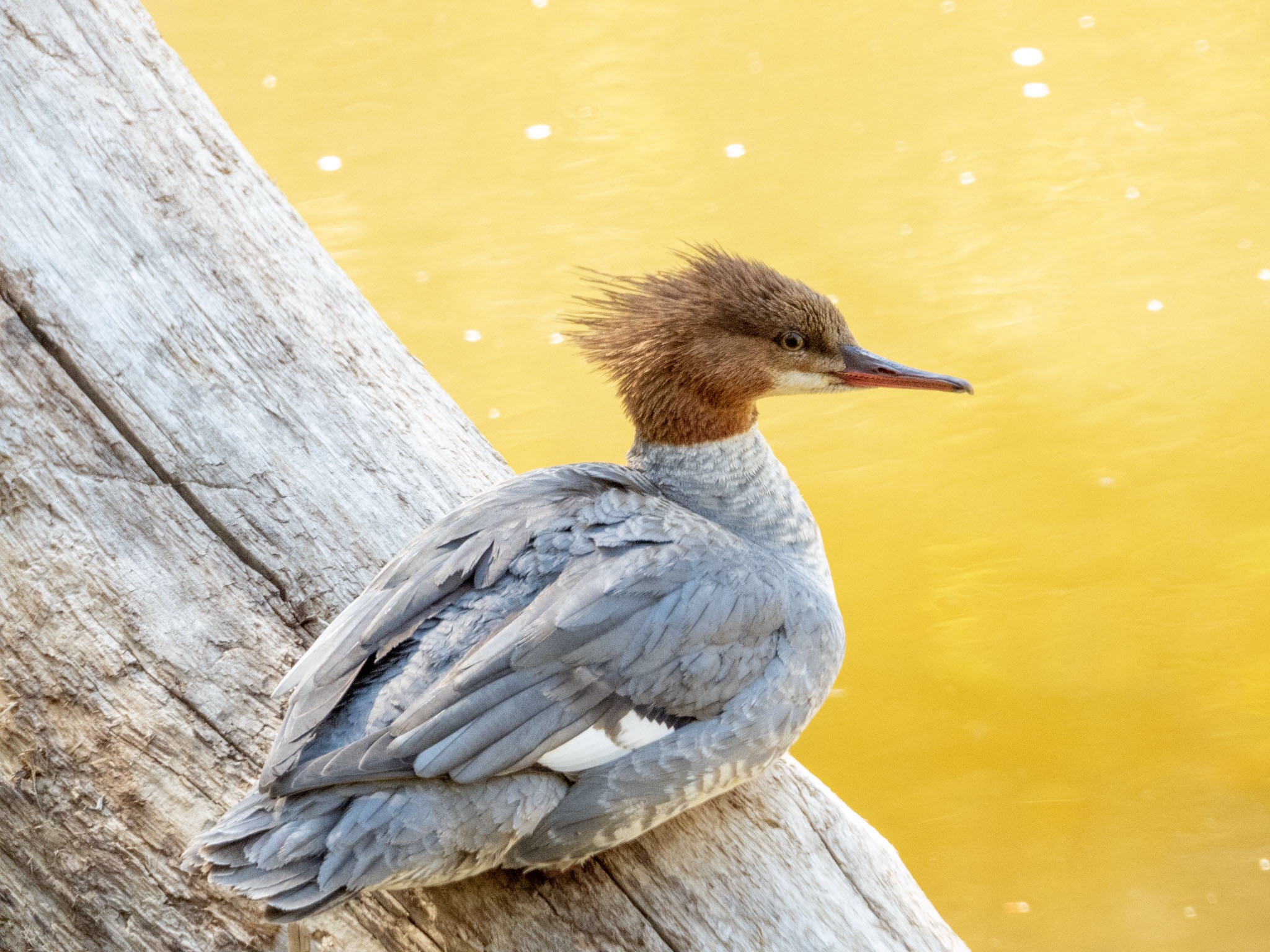
Found this lovely Common Merganser (Mergus merganser) down at the Whitemud Creek yesterday morning. There its was, just chilling on a log with its funky hairdo…, er, “featherdo”? If you look closely at the picture you can see the serrated edge of the bill. Mergansers eat fish so this helps them grip their prey. Sometimes they are referred to as sawbills. The famed naturalist and painter John James Audubon referred to these as Buff-breasted Merganser and Goosander in his 1827 book The Birds of North America. This particular merganser appeared to be alone and is likely either a non-breeding male or a female. Once males reach their breeding age (2 years) their appearance changes a black head and white body. Nonbreeding males and females are tricker to tell apart. None of the information online provided any clues as how to tell them apart. If in doubt, consult your Sibley! According to Sibley, adult nonbreeding males have a white stripe on their wing, which can clearly be seen in this picture. So there you have it folks, it’s a lonesome bachelor. Just a bit downstream there were several merganser couples swimming around romantically in the murky water. I guess this fella either did not get lucky this year or is not ready to commit, not that male merganser commit much as they do not help the female to care for the eggs or young.
Nikon P1000, 868mm @ 35mm, 1/125s, f/5.6, ISO 640.
May the curiosity be with you. This is from “The Birds are Calling” blog (www.thebirdsarecalling.com). Copyright Mario Pineda.
My first flycatcher turned out to be a tricky nut to crack. I spotted it at the top of a dead spruce along the Athabaskan River along the old Ice Fields Parkway in Jasper National Park. Right from the get go I had no idea what I was looking at. I knew that the species was new to me and since I was nit even able to place it in a bird category, e.g. sparrows, finches, black birds, etc, I knew that this was something big. As I had not hope of identifying the bird in the field I focused on getting photographs of it from as many angles as possible. Fortunately it was a sunny day and the bird was perched in full sunlight, so I was able to get some decent pictures of it. Later on after the usual consultations with Merlin and Sibley it appeared that I had a flycatcher at my hands from the genus Empidonax. Flycatchers are small insect eating birds with many species looking similar. Sometimes positive identification is only possible based range, behaviour or vocalizations. My flycatcher is most likely a Hammond’s Flycatcher (Empidonax hammondii, Life: #155, AB Big Year: #106).
Nikon P1000, 806mm @ 35mm, 1/500s, f/5.6, ISO 250.
May the curiosity be with you. This is from “The Birds are Calling” blog (www.thebirdsarecalling.com). Copyright Mario Pineda.
Canada Geese are big birds with an even bigger attitude. There does not seem to be much that faze them. As probably one of the most common birds in these neck of the woods it easy to start ignoring them in favour of more exciting and uncommon birds. This fella, however, was out to make a statement that could not be ignored. Perched on the ridge of the roof of a large house overlooking the the Heritage Wetland Ponds, this Canada Goose was not lacking any self-confidence. I spend quit some time watching it and it seemed quite comfortable hanging out at its lofty and exposed perch. The only predators that could threaten an adult Canada Goose would be non-flying animals such as coyotes, cats (big cat, not your domestic kitty), foxes, dogs and humans. In other words, while this fella may be in an exposed location the biggest threat facing it would be inclement weather. Not on this day though, the sky was blue with not a cloud in sight and this goose was the king (or queen) of this roof.
Nikon P1000, 403mm @ 35mm, 1/200s, f/5, ISO 100. Postprocessed and cropped in Lightroom.
May the curiosity be with you. This is from “The Birds are Calling” blog (www.thebirdsarecalling.com). Copyright Mario Pineda.
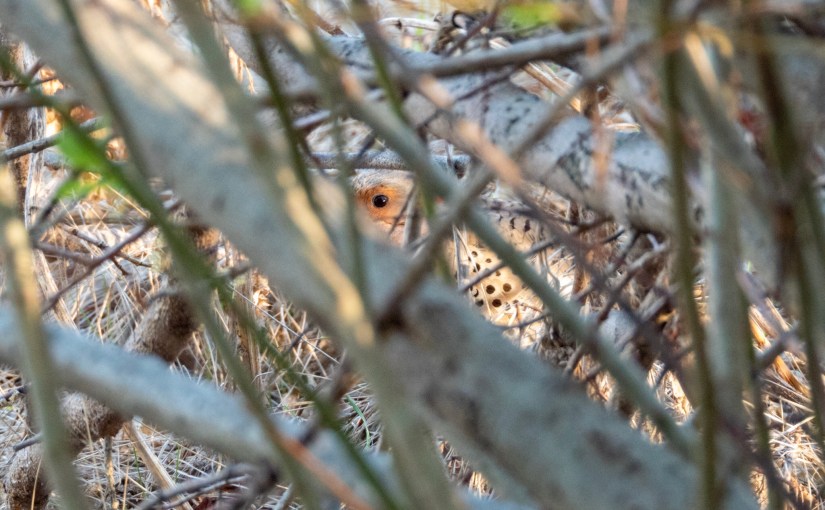
I will be the first one to admit that this picture is a good candidate to post in the Crap Bird Photography group on Facebook (and I will probably share it in that forum). There is more to the story, however, than just a picture of a bird through a jumble of branches. There is a tiny shallow side-pond at the Heritage Wetland Park in Sherwood Park. The pond is surrounded by thick brush and I had never bothered to look at it closely, partly because it is difficult to access through the thick understory and partly because I though it would be too puny for anything interesting to be there. The other day, as I was walking past it, I heard a symphony of croaking from the pond. I have not had much luck with spotting any amphibians to date, but I figure that my luck will never improve if I never try. Said and done. I found what appeared to me as a “weak spot” in the shrubbery and started to slowly make my way through the thick understory. As soon as the pond came within sight the croaking stopped abruptly. This is exactly the same story every time I try to sneak up on frogs. I found a tolerably comfortable spot by the side of the pond. Crouching in the thicket I made myself as comfortable as possible and decided to stay put for a bit so see if the frogs would relax and resume their business. As I was scanning along the water surface, the water’s edge and the shrubbery along the water with my camera I suddenly had to do a double take. In an impenetrable jumble of branches there was an eye looking right at me. I could see bits and pieces of the body of the critter and the pattern was unmistakable, it was a Northern Flicker (Colaptes auratus). It was completely still, not moving a single feather, staring intently at me. So there we were, staring each other down in a human vs bird staring contest. After what appeared like an unreasonable long time I came to my senses and realized that I should probably try to take some pictures, after all the camera had in some miraculous way focused in on the eye of the flicker without getting tricked by all the shrubbery between us. Finding a flicker skulking around on the ground is not uncommon as they are well-known to have a particular fondness for munching on ants.
Nikon P1000, 604mm @ 35mm, 1/60s, f/5, ISO 720. Postprocessed and cropped in Lightroom.
May the curiosity be with you. This is from “The Birds are Calling” blog (www.thebirdsarecalling.com). Copyright Mario Pineda.
It is difficult imagining getting bored of watching birds. With 6 months and 2 days of birding under my belt in three different countries and on two continents every nature walk is like a box of chocolates; you never know what you will see. The diversity in appearance and behaviour seems never ending. Some birds are colourful, some have eccentric behaviours others have impressive physical attributes or perform remarkable physical feats. Then there are those birds that have style. They have brio. They are the Dany and Rusty (as in the Ocean’s film series) of the birding world. Purple Martins (Progne subis) at Heritage Wetlands Park in Sherwood Park definitely belong to this last category. Here they occupy elaborate multi-story bird mansions that balance on tall stakes high above the reeds. When they are not enjoying the vistas from their lofty perches they skip back and forth over the ponds in agile death defying maneuvers.
May the curiosity be with you. This is from “The Birds are Calling” blog (www.thebirdsarecalling.com). Copyright Mario Pineda.
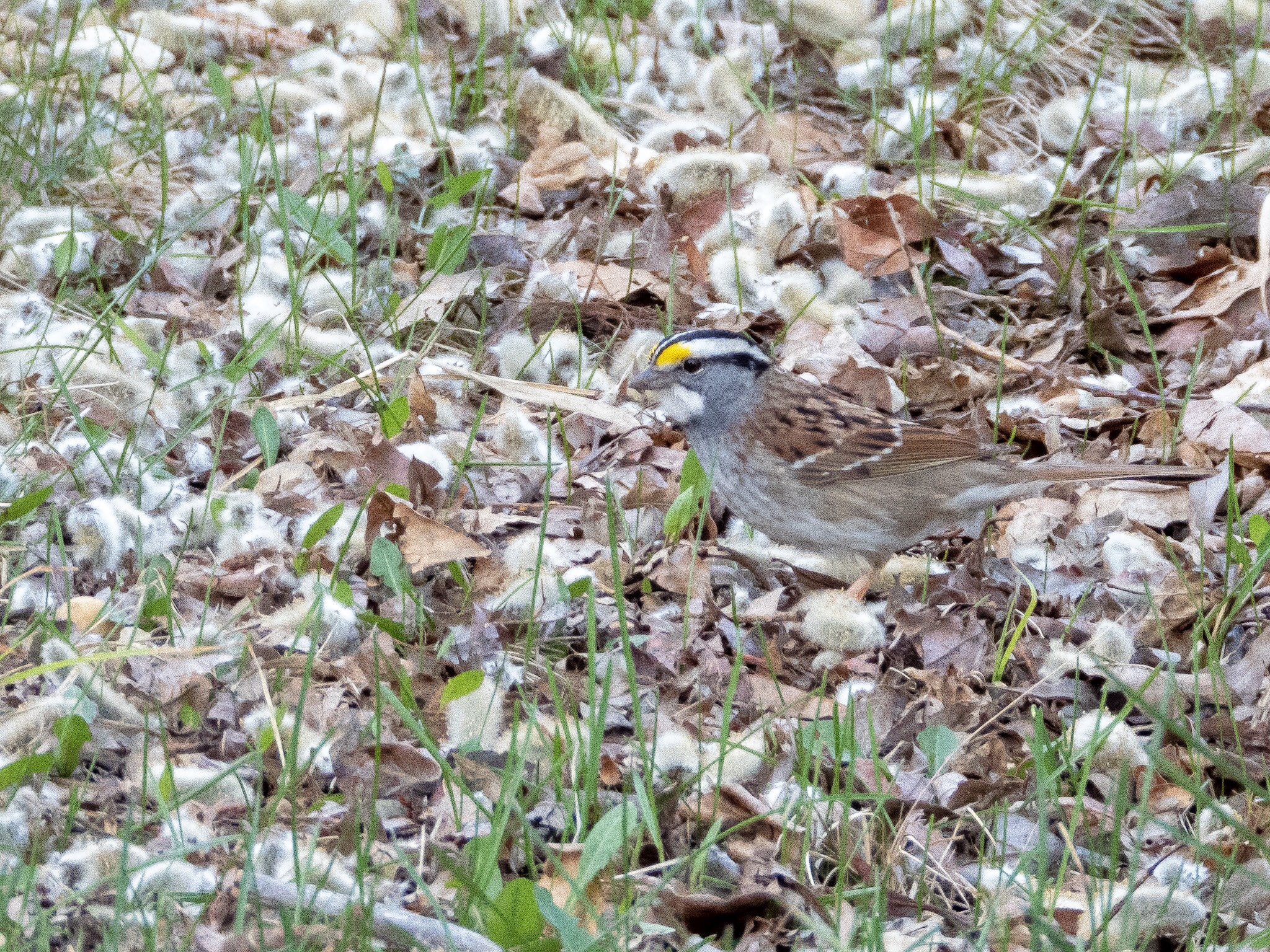
The White-throated Sparrow (Zonotrichia albicollis) has been at the top of my bird wish list ever since I embarked on this journey in December. After signing up for eBird I set up a rare bird email alert. The number of alerts I received throughout the winter were few and far in-between, but there are two particularly notable alerts. The first one was a heron sighting in Hermitage Park in mid-February. Sadly, but not surprisingly, subsequent sightnings suggests that it did not make it though the winter. The second memorable alert actually consisted of a series of intermittent alerts of White-throated Sparrow sighting. Their normal wintering grounds are a few thousand kilometres south-east of here, in the southern and eastern United States along the Atlantic and Gulf of Mexico coast. For some reason, however, every few weeks or so through the winter the odd individual was spotted in or around Edmonton. Sightings like these during the brutal central Alberta winter are extraordinary and rise many questions. Why did they stay behind? Were they lost? Did they make it through the winter? This unassuming sparrow is subtly beautiful with its black and white striped head, yellow lores (the area between the eye and the bill on the side of the head) and a white patch under its bill. It almost looked like a dolled up house sparrow. I spotted this lovely looking fellow (not sure if it a male or female) in the brush along the trail in Heritage Wetland Park in Sherwood Park.
May the curiosity be with you. This is from “The Birds are Calling” blog (www.thebirdsarecalling.com). Copyright Mario Pineda.