Dawn on the Prairie: Returning to the Wainwright Grouse Lek

There’s a magic that stirs in the early prairie light—something ancient, electric, and profoundly alive. For the second time in my life, I found myself bearing witness to it, skulking quietly in a blind somewhere on the grassland outside Wainwright, Alberta, watching the Sharp-tailed Grouse gather and ignite the land with their springtime ritual. The accounts of my first time attending this event are documented in here and here.

The Sharp-tailed Grouse watch is an annual event organized by the Wainwright Wildlife Society—is more than just a birding excursion—it’s an invitation into a world older than memory. Each spring, these prairie dancers return to their ancestral leks where the males perform a spectacle that defies description. To call it a “mating display” feels inadequate. It’s a full-bodied expression of wild instinct and evolution, refined by millennia of selection, played out with whirring wings, staccato foot-stomping, and those impossible, ballooning purple air sacs. This is one dance party where the boys do all the dancing—and the girls remain motionless, watch and judge.

Waiting for the ladies.

This year, I returned with a birding friend—someone equally moved by the subtle drama of sunrise and feather. We arrived in the pre-dawn hush, guided to our blind while the stars still clung to the sky. In the twilight we could already discern the silhouettes and the rustle of the dancing feathered denizens of this grassland. Once we were settled in our hides and rigged up our cameras, the waiting began—the kind that heightens every sense, making you aware of each breath, each rustle. A number of early birds were already present in the field, idling about, perhaps scouting out the best dancing spot or just assessing their chances to get lucky.

Front row seats to the dance performance of the year

And then—they started dancing. At first, they were just shadows moving between the tussocks. But as the light lifted, so did the tempo. Soon the lek exploded into motion: tails fanned, wings held stiff, bodies vibrating with energy. The males faced off and danced with frenetic determination, each movement part performance, part territorial defiance. On this morning there were mainly males, probably 20ish, and only a few females making an appearance. Being mid-May, this was one of the last grouse watch excursion of the year and it’s possible that most of the females had already mated and were in a nesting phase.

While the Sharp-tailed Grouse lek might appear as a chaotic dance party, it is in fact a highly structured arena of sexual selection. Females visit the lek primarily to observe rather than participate, silently watching from the edges as males display in feverish competition. Research has shown that females are incredibly discerning—they typically choose just one male per season, selecting him based on a combination of traits: vigorous and frequent displays, dominance of central territories within the lek, symmetry and size of the combs over the eyes, and the prominence and coordination of air sac inflation and vocalizations. Mating success is heavily skewed—just a few top-performing males are responsible for the majority of copulations. Once a female has mated, she departs alone to nest in dense cover, incubate her eggs, and raise her brood without any help from the male. The entire spectacle, then, is not just a performance—it’s a life-or-death audition for the future of their lineage.

Prairie Bachelor Seeking Spring Fling

Looking for: One fabulous hen to impress with tail fanning, fast-foot stomping, and ridiculous balloon-neck flexing.

About Me: I coo, I strut, I puff. I’ve got fire-red eye combs and a lekking spot that screams “alpha.” No nest, no parenting, all passion. If you’re into commitment-free spring flings with maximum flair, I’m your bird.

Swipe right at dawn—I’ll be shaking it like evolution depends on it.

Watching this unique display again reminded me why I do this. Why I get up at 3:30 in the morning. Why I drive for hours through the dark morning hours while the rest of the world still sleeps. Why I carry back breaking heavy gear into the cold. It’s for these fleeting moments when time slips, and I feel plugged into something wild and real.

As I write this, I can still hear the low drumming of wings, still see the blur of feathers caught in the rising light—prairie grasses glowing gold as the first light spills across these ancestral land. For a fleeting moment, we were not just observes, but a thread in an ancient ritual woven into the fabric of the grasslands. The birds are still calling, and I’m still listening.

A Western Meadowlark looks on with the calm indifference of someone who’s seen it all before.

References

Gibson, R. M., & Bradbury, J. W. (1985). Sexual selection in lekking birds: Are female preferences consistent? The American Naturalist, 126(6), 881–895. https://www.jstor.org/stable/2461497

Montana Fish, Wildlife & Parks. (2017). Sharp-tailed Grouse Reintroduction Plan. Montana State University. https://animalrange.montana.edu/documents/faculty/Sharp-tailed%20grouse%20Reintroduction%20Plan%20Final%20May%202017.pdf

Washington Department of Fish & Wildlife. (1995). Washington state status report for the Sharp-tailed Grouse. https://wdfw.wa.gov/sites/default/files/publications/00389/wdfw00389.pdf

Wikipedia contributors. (2024). Sharp-tailed grouse. Wikipedia. https://en.wikipedia.org/wiki/Sharp-tailed_grouse

May the curiosity be with you. This is from “The Birds are Calling” blog (www.thebirdsarecalling.com). Copyright Mario Pineda.
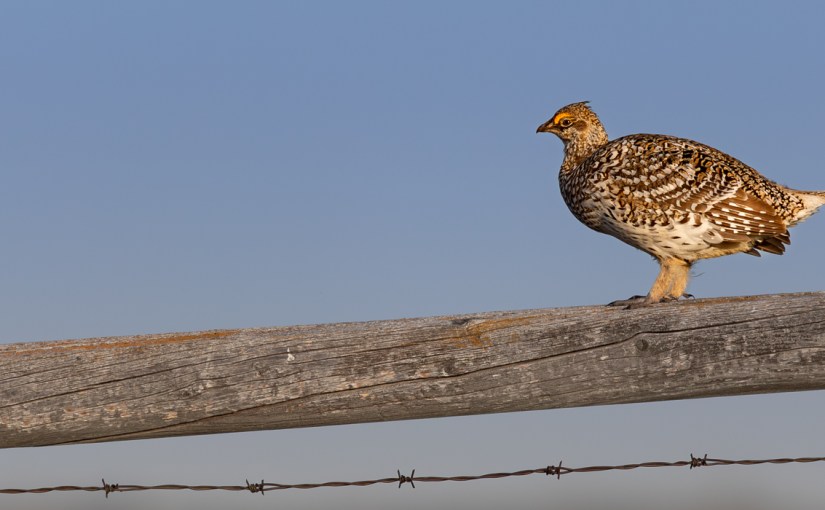
The Birds Are Still Calling

It’s been over three years since I last posted here.

Three years is enough time for a lot to change. Enough time to lose track of something you loved, and then—quietly, slowly, perhaps even serendipitously—find your way back to it.

And that’s what this post is about: I’m back. Back to the birds, back to the writing, back to this little corner of the internet I once treated as a field journal, a creative wellspring, and a place to share the quiet joys of being in nature.

In the time since I last wrote, a few things have happened. I’ve picked up photography much more seriously—especially wildlife and nature photography. With it came the natural side effect of spending more time outdoors: walking the woods before sunrise, crouching quietly near water’s edge, scanning the sky for that telltale flash of movement. Slowly, the birds have returned to my life. With them came the desire to document what I see, experience, and learn along the way.

This blog will be changing a little. It will still be a field journal at heart—but one shaped now by greater focus on photography, documenting travels and adventures, and a deeper commitment to explore and document the far reaches of the wild at the very edge of the world. Expect to find stories from the field, species profiles, reflections on gear and technique, visual essays, and of course, photographs. Lots of them. Not to impress, but to remember. Not to perform, but to witness.

I’m doing this first and foremost for myself—because the act of writing helps me pay attention, and the act of sharing makes it feel real. But if you find yourself here, reading along, welcome. I hope something in these pages gives you a spark of wonder, or a reason to lace up your boots and head out into the wild.

The birds are calling again. And this time, I’m listening with a camera in hand and my eyes wide open.

I am also sharing some of this journey over on Instagram, where the photos often land before the words do. If you’re curious, you can find me there at @mariopinedaphotography.

Let’s begin.

May the curiosity be with you.
– Mario

TL: Common Raven, Jasper National Park. Canon 6D, EF 400mm f/5.6L, 1/320, f/5.6, ISO 100

TR: Bighorn Sheep, Jasper National Park. Canon 6D, EF 400mm f/5.6L, 1/1000, f/5.6, ISO 1000

BL: American Beaver, Whitemud Creek, Edmonton. Canon 6D, EF 400mm f/5.6L, 1/1000, f/5.6, ISO 1000

BR: Northern Shoveler, Lois Hole Provincial Park. Canon 5D Mark IV, EF 400 f/5.6, 1/500, f/6.3, ISO 1250

May the curiosity be with you. This is from “The Birds are Calling” blog (www.thebirdsarecalling.com). Copyright Mario Pineda.

Project 366 – Post No. 304 – A duo of Pileated Woodpeckers

What is Project 366? Read more here.

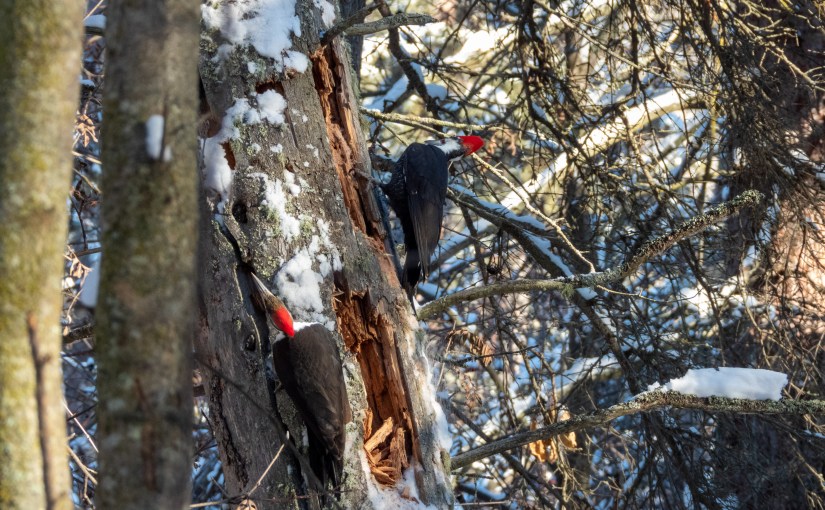
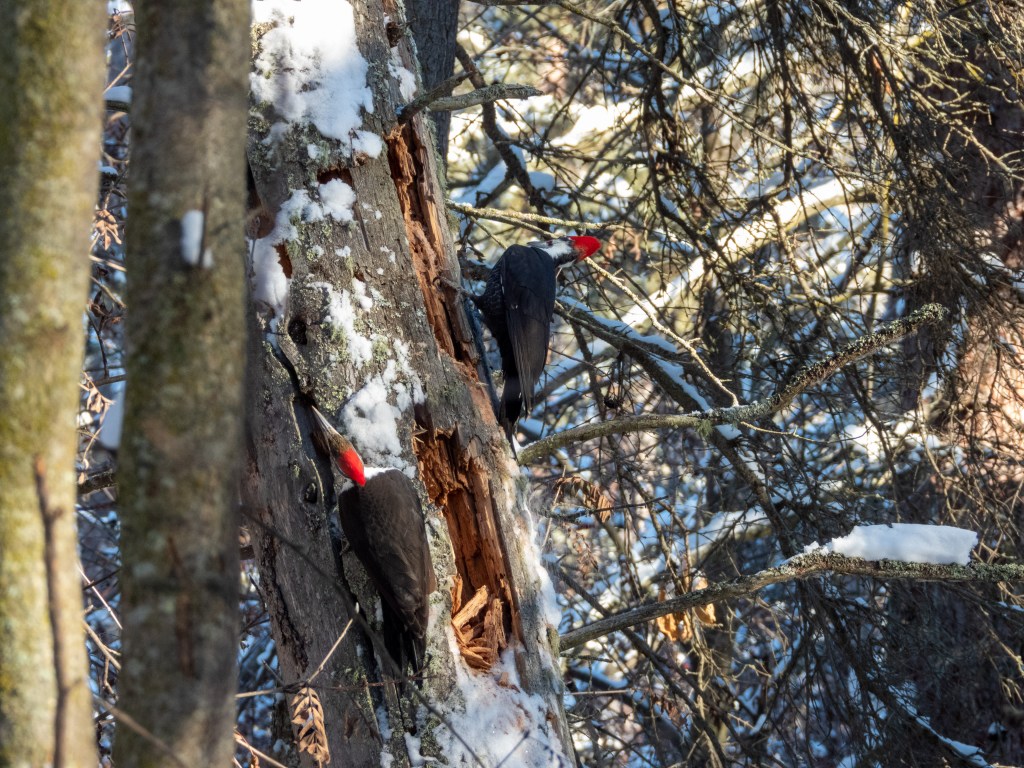
Pileated Woodpeckers hold a special place in my heart. Many years ago, long before I got into birding a friend of mine was sharing stories about his encounters with these magnificent birds. He was not a birder, he just had the fortune of seemingly bumping into Pileated Woodpeckers on a regular basis. I on the other hand, had no such luck. Through his stories and my lack of ability to spot Pileated Woodpeckers these birds became a legend. A seemingly unattainable mythical creature that continuously eluded me. It was only years later that I spotted my first Pileate Woodpecker. How things have changed. These days I not only see them on a regular basis, but I can identify them by sound, whether they are vocalizing or going to town on a tree. The sounds they produce are unmistakable. Spotting a Pileated Woodpecker is always a special treat, spotting two next to each other is an unforgettable experience. The other day two Pileate Woodpeckers were at work on the same tree trunk. Higher up the trunk a Northern Flicker was also busy working away. It must have been a particularly good woodpecker tree.

May the curiosity be with you. This is from “The Birds are Calling” blog (www.thebirdsarecalling.com). Copyright Mario Pineda.

Project 366 – Post No. 303 – Norther Flicker

What is Project 366? Read more here.

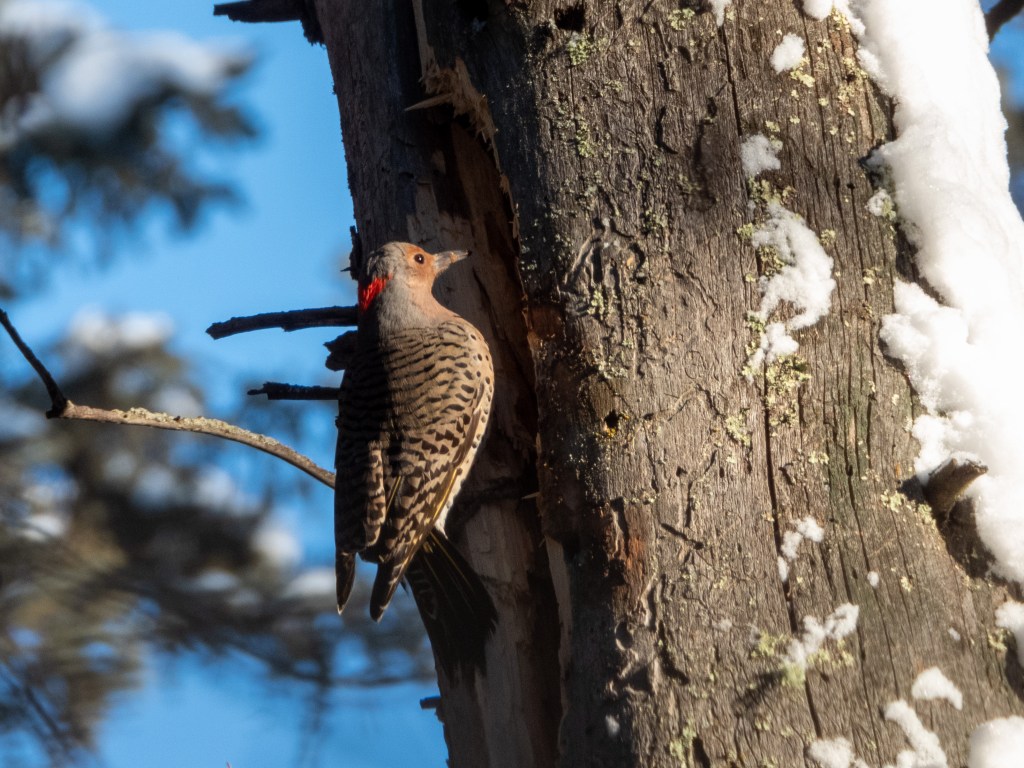
Next to a pair of hardworking Pileated Woodpeckers there was a solitary Northern Flicker working away on the same dead tree. Was it a coincidence that the two woodpecker species were at the same tree? Perhaps this a tree was particularly good for woodpeckers? Or perhaps the flicker was opportunistic and followed the Pileated Woodpeckers along through the forest taking advantage of the large gashes in the trunks the Pileated Woodpeckers leave behind? The Norther Flicker was illuminated by the late afternoon sun which made it particularly splendid against the blue sky. As the Pileated Woodpeckers moved on, so did the Northern Flicker.

May the curiosity be with you. This is from “The Birds are Calling” blog (www.thebirdsarecalling.com). Copyright Mario Pineda.

Project 366 – Post No. 302 – Great Horned Owl basking in the winter sun

What is Project 366? Read more here.

On this sunny mild winters day we came across one of the Whitemud Ravine Great Horned Owls perching in a tree overlooking the creek. It was soaking up the suns rays and seemed fast asleep. I cannot blame it. After the last few weeks of bitterly cold weather the -10 C day must have felt nice and balmy. According to eBird the last time a Great Horned Owl was observed in the ravine was in October last year. Has the owl been there the whole time, but just not seen? Has it been somewhere else and only recently returned to this location? Is it alone, or does it have a mate? The owl we saw was close to a tree where a pair of Great Horned Owls raised a pair of owlets last spring. Is this one of those owls and is it back for another breading season? So many questions and no answers. I will be keeping a close eye on the owls in the ravine and hopefully we will see another season of successful owlets born and raised in our very own backyard ravine.

May the curiosity be with you. This is from “The Birds are Calling” blog (www.thebirdsarecalling.com). Copyright Mario Pineda.
Project 366 – Post No. 301 – Pileated Woodpecker

What is Project 366? Read more here.

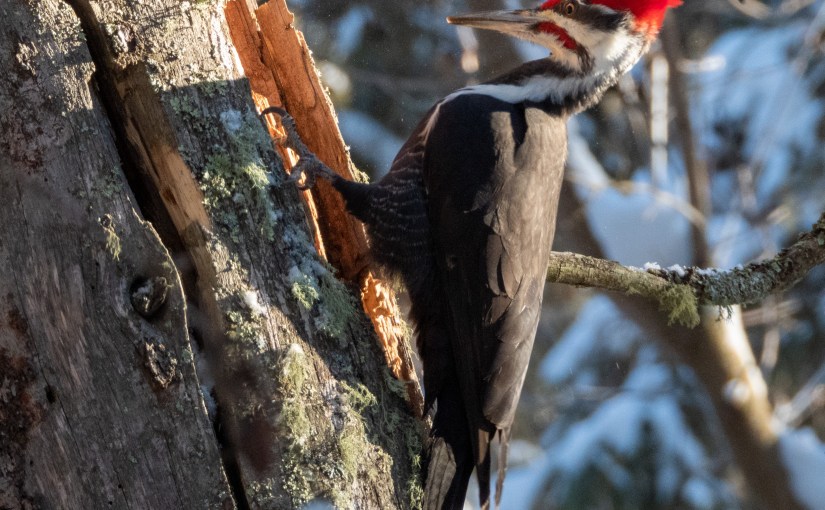
Loud banging noises were coming from the forest. It sounded like someone was hitting a tree trunk as hard as they could with a baseball bat. I knew right away what was making the noise and it certainly was not a human. As incredulous as I was I realized that the only creature capable of making such loud banging noises was a Pileated Woodpecker. I have seen and heard many Pileated Woodpeckers and I know they can be quite energetic when they go to town on a tree. I had never, however, heard one making a noise this loud. It was easy to spot the culprit. There it was, sitting on a decaying tree trunk, illuminated by the sun working on the tree like there was no tomorrow. Large chunks of the tree were flying all around it as it was digging its way into the core of the trunk. The speed at which a Pileated Woodpecker can hammer its way through a tree is truly a sight to behold. There are plenty of dead trees in the Whitmud Ravine with large cavities in them that are the work of Pileated Woodpeckers. Based on the size of some of the cavities it is only natural to come to the conclusion that it must have taken quite some time for a woodpecker to hollow it out. Once you have seen a Pileated Woodpecker in full action one realizes that it would only take a matter of minutes to hollow out one of those cavernous cavities. The efficiency of Pileated Woodpeckers makes them the industrial version of a regular woodpecker. They are truly a force to be reckoned with.

May the curiosity be with you. This is from “The Birds are Calling” blog (www.thebirdsarecalling.com). Copyright Mario Pineda.

Project 366 – Post No. 300 – Hairy woodpecker

What is Project 366? Read more here.

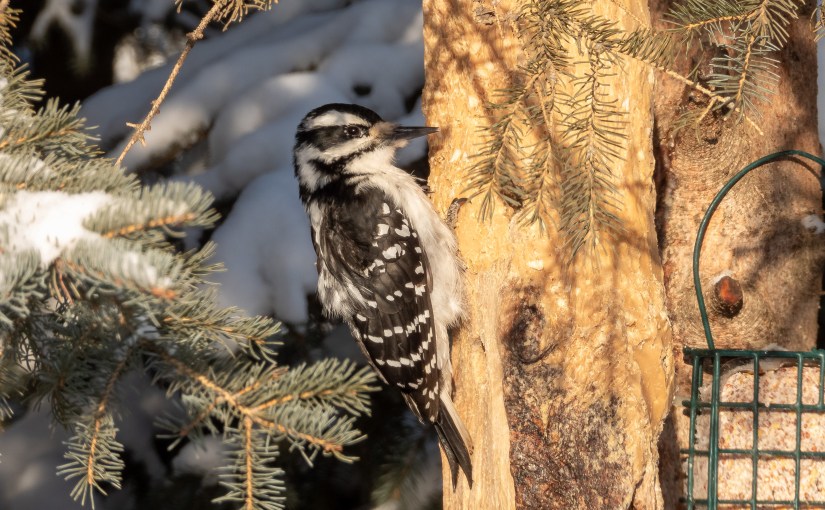
The last two post have featured a Downy Woodpeckers, first a female and then a male. There is, however, another woodpecker in town that looks nearly identical to the Downy Woodpecker. The Hairy Woodpecker is a tad larger than the Downy, with a distinctly longer bill. There are also some even more subtle differences in the black and white markings the the outer tail feathers of the two species. To make things even trickier, the two species can be found in the same habitat and often if one of them is around, the other one is not far away. Today’s picture is of a female Hairy Woodpecker. The telltale sign is the proportionately longer bill relative the head. My rule of thumb is that in Hairy Woodpeckers the length of the bill is more than half of the width of the head while in Downy Woodpeckers the bill is decidedly less than half the width of the head. As with most things in life, the more of the two species you see and compare the better one becomes at telling them apart.

May the curiosity be with you. This is from “The Birds are Calling” blog (www.thebirdsarecalling.com). Copyright Mario Pineda.

Project 366 – Post No. 299 – Male downy woodpecker

What is Project 366? Read more here.

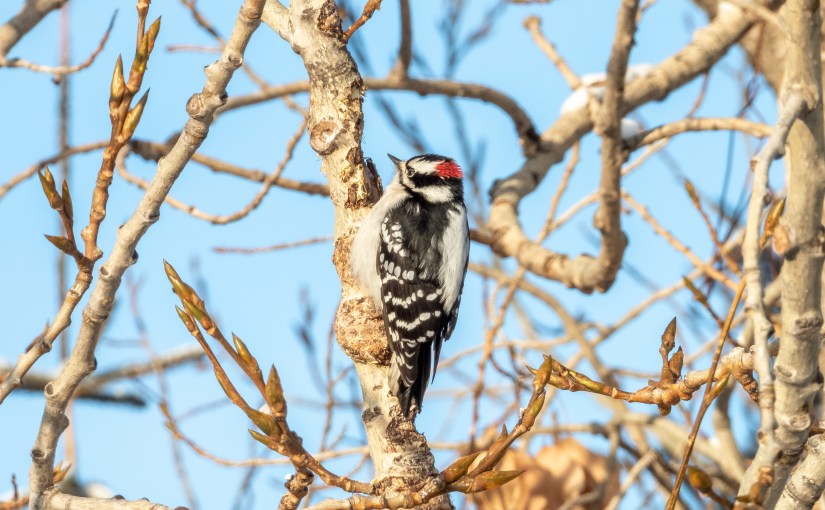
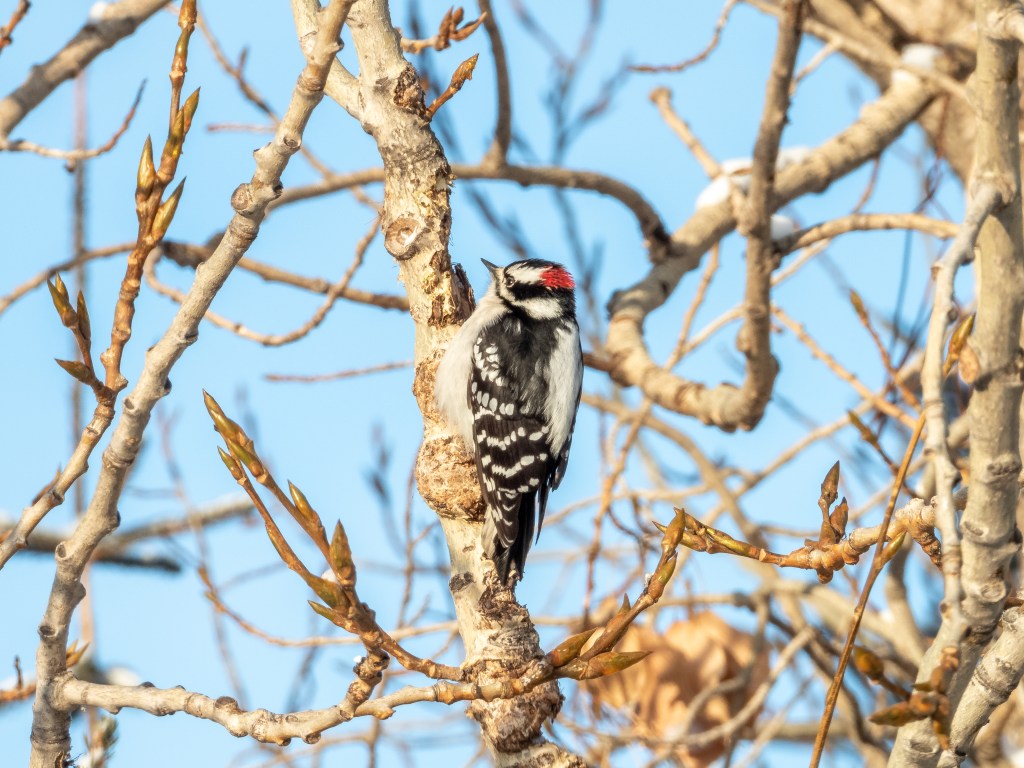
Yesterday’s post featured a female Downy Woodpecker. Today’s post is featuring a male Downy Woodpecker. If it would not be for the red patch on the neck of the male they would be indistinguishable. This male was just a few meters above the feeder where the female was feeding.

May the curiosity be with you. This is from “The Birds are Calling” blog (www.thebirdsarecalling.com). Copyright Mario Pineda.

Project 366 – Post No. 298 – Black, white and red?

What is Project 366? Read more here.

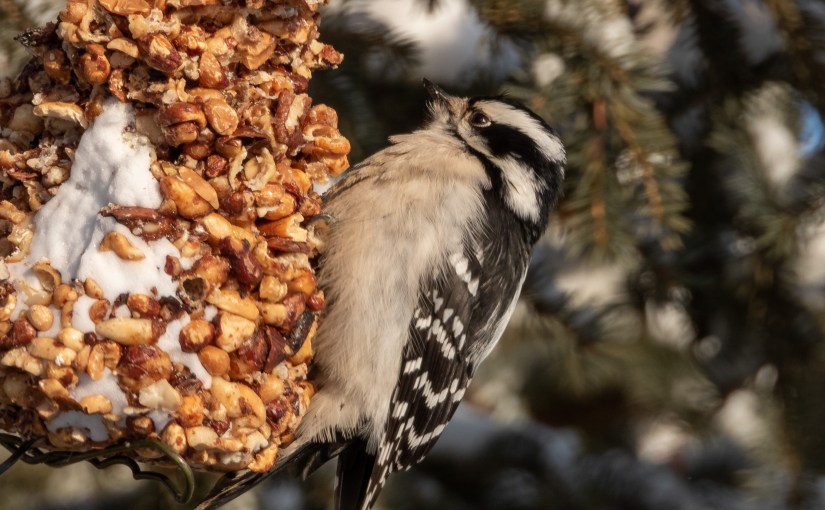
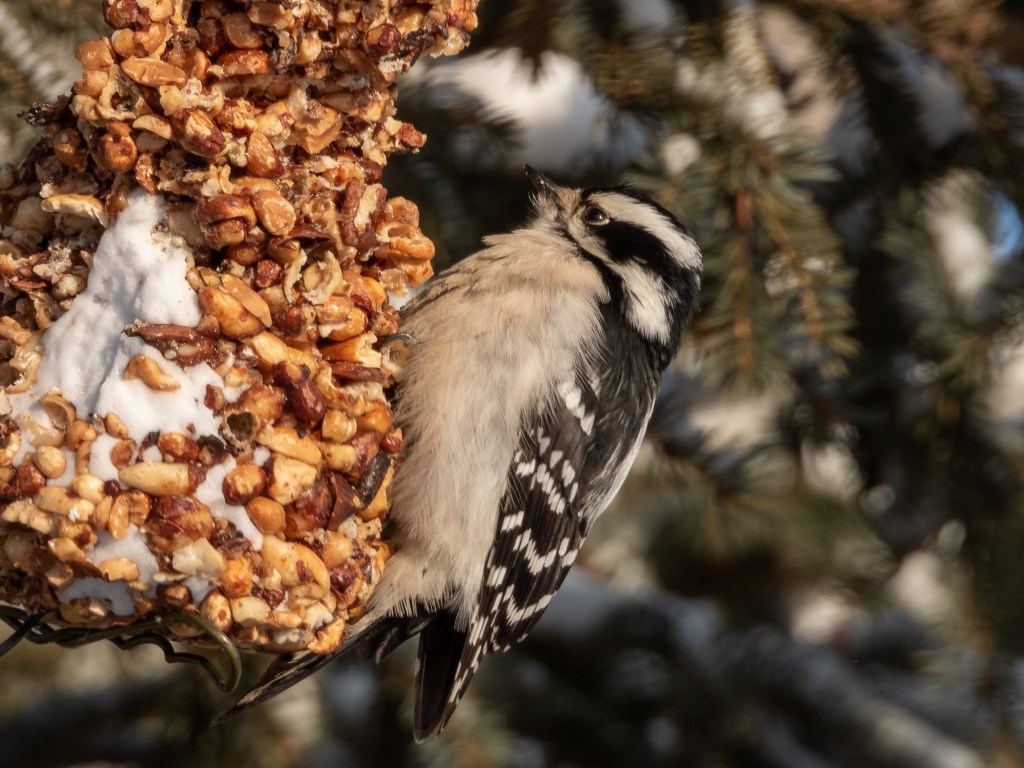
What is black, white, sometimes red and sits on tree trunks? Woodpeckers of course. It is a fascinating fact that many woodpeckers in the world seem to be black and white, with the males having red on their head. Case in point, our very own Downy Woodpecker vs Hairy Woodpecker vs. Pileated Woodpecker are all black and white with the males having red patches on their heads. The Black-backed Woodpecker is black and White, but with the males having yellow at the back of their head. As it turns out, both red and yellow plumage is caused by the same pigment (specifically carotenoids, which also create orange plumage). Northern Flickers also fit this pattern with black and white on their body and brown/orange on their body with red patches on their heads. As you move south through the american continent this color pattern repeats itself among the various woodpecker species one encounters, e.g. Cream-backed Woodpecker, Crimson-bellied Woodpecker, Crimson-crested Woodpecker, Guayaquil Woodpecker, and the Magellanic Woodpecker to mention just a few (but there are many more species fitting this pattern). There are several reasons for this color consistency in woodpeckers. A recent study found that habitat, climate and a shared evolutionary history are strong determinants of woodpecker plumage.

Female Downy Woodpecker going to town at one of the bird feeders in Hermitage Park on a bitterly cold January morning.

May the curiosity be with you. This is from “The Birds are Calling” blog (www.thebirdsarecalling.com). Copyright Mario Pineda.

Project 366 – Post No. 297 – Red-breasted Nuthatch at the bird feeder

What is Project 366? Read more here.

Red-breasted Nuthatches, just like their cousins the White-breasted Nuthatch are common, fleeting and assertive song birds. They know what they want and have no trouble elbowing their way to the food to get their fair share…, only to, moments later, vanish into the shrubbery again. A black stripe across their eyes reminiscent of a bandit mask only makes them appear more like a diminutive feathered vigilante refusing to get intimidated by more boisterous or larger birds.

May the curiosity be with you. This is from “The Birds are Calling” blog (www.thebirdsarecalling.com). Copyright Mario Pineda.