Project 366 – Post No. 078 – Exploring the Mactaggard Sanctuary

What is Project 366? Read more here!

Yesterday I went for a nature walk to a part of the Whitemud Creek that is located south of the 23rd Avenue. I have not been to this location previously and I just happened to run some errands in this neighbourhood so I decided to “kill two birds with one stone” and squeeze in a short nature walk in-between errands. As it turns out this part of the creek flows through the Mactaggard Sanctuary, a 104 hectares nature sanctuary, part of which was donated to the University of Alberta in 1980 by Sandy A. Mactaggard, a developer and philanthropist. The sanctuary has a interesting history, which also explains why it is called a “sanctuary” and not a “park”. There is a video where the late Mr. Mactaggard tells the story behind the sanctuary. In short, the sanctuary used to be located outside of Edmonton when Sandy Mactaggard originally purchased the land for housing development, but only after promising the previous owner of the land that he will preserve it to benefit the citizens of Edmonton. The purpose was not to turn it into another park, but rather keep it pristine and let it remain the way it always had been. That is why it became a sanctuary. The trails along this part of the creek are more untamed and rough with less traffic.

I did not have much time for my nature walk so I had to move quick and as a result did not get much birding done. My main aim was to find a large oxbow lake situated in the sanctuary and do some preliminary scouting to figure out how to access the lake. Oxbow lakes are often enveloped in dense vegetation and can be difficult to find and access. The benefit of this is that many animals use these lakes for raising their young. I did not have any trouble finding the lake as the trail briefly passes right along side of it, but just as I suspected most of the lake is surrounded by dense vegetation. Accessing the more remote parts of the lake (the ones where the trail did not go) proved, however, to be even more difficult than I had anticipated as the entire outside rim of the lake is surrounded by a high and very steep bank (almost like an overgrown cliff) and there was not obvious way of accessing the shoreline. There is a trail, the Mactaggard sanctuary loop trail, that loops around the lake ascending the steep bank. Although this quick exploration gave me some ideas of how one might be able to access some of the more remote parts of the lake, I did not have time to look into the feasibility of any of these possibilites. That will have to be another excursion. On a different note, the mosquitos were voracious and I did not bring any repellent so, this is a reminder to myself not to forget the repellent next time.

Oxbow lake in Mactaggard Sanctuary along Whitemud Creek, Edmonton. June 13, 2019. Nikon P1000, 24mm @ 35mm, 1/800s, f/2.8, ISO 100

May the curiosity be with you. This is from “The Birds are Calling” blog (www.thebirdsarecalling.com). Copyright Mario Pineda.
Project 366 – Post No. 077 – Quantifying a gaggle of geese

What is Project 366? Read more here!

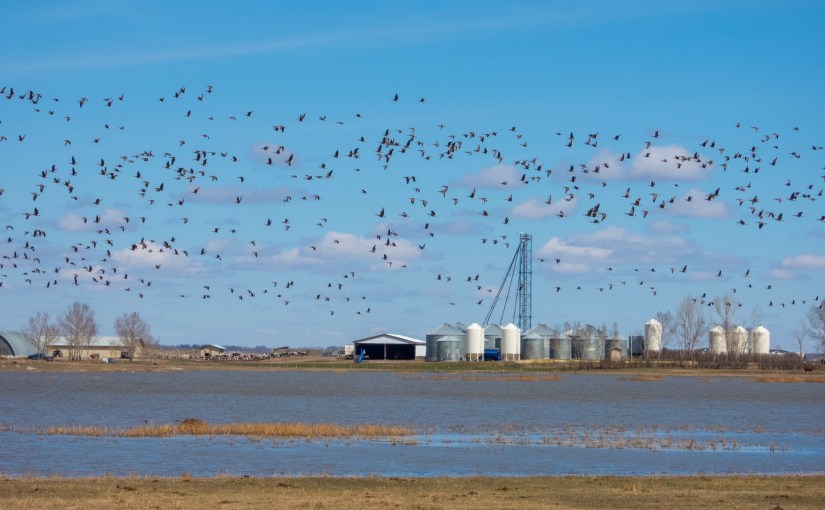
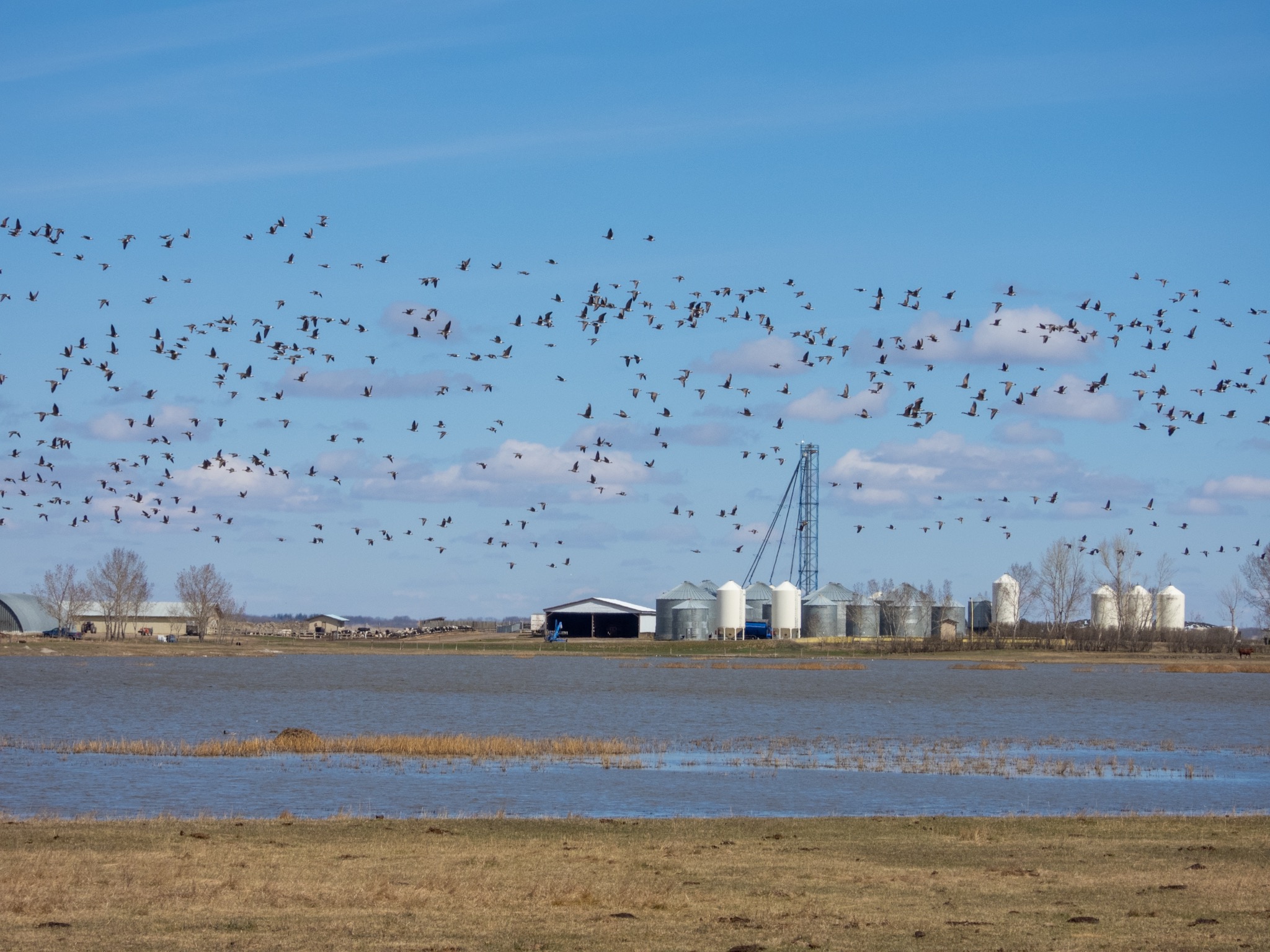
The first time I ran into the conundrum of how to quantify the number of individuals in a large flock of birds was as at the edge of the Pacific Ocean at Boca Budi in southern Chile. On the cliff face overlooking the Pacific Ocean we encountered a colony of nesting Red-legged Cormorants (Phalacrocorax gaimardi). Our best estimated was that the visible portion of their cliff had a minimum of 300 individuals, a number that was likely an underestimate. Here is a link to the eBird checklist. The second time I ran into the same problem, albeit on a different magnitude, was at a small pond outside of Tofield (Alberta) full of snow geese (Anser caerulescens). Our best estimate was that there were 15000 geese on the water and in their air. Here is a link to the eBird checklist. Both times we had no particular estimation strategy, but rather we based our estimates on eyeballing and whatever “common sense” we had (whatever that means in this context). A few weeks ago we encountered a large flock of Canada Geese taking off from a farmer’s field outside of Camrose, this time I decided to go about the estimation more systematically by using one of the photos I took of the fleeing geese.

Nikon P1000, 123mm @ 35mm, 1/1600s, f/4, ISO 100

Once I had the photo on my computer screen I proceeded by according to the following steps:

  1. I started by dividing up the image into a grid (see image below).
  2. I counted each bird in the grid cell with a green outline. There were 23 individuals in this cell.
  3. I used the patter from this cell to estimate the number of individuals in every other cell. The estimates are in yellow and fall into four categories, “looks like 23”, “looks like half of 23, i.e. 12”, “looks less than half, i.e. 5” or “no birds = 0”.
  4. I added up the estimates (the yellow numbers) and got an estimate of 436 geese.
  5. To check how good my estimated was I then counted the actual number of individuals in each grid cell (note the blue dots), indicated in blue numbers, and added it up. There are exactly 422 geese in the picture.

The estimate is not to shabby but obviously begs the question how one would (could) modify this approach to do “live” estimates in the field. I guess doing a “posts-observation” estimate like this is also fine to as long as all the birds are in the picture to start with.

The main issue with this estimate is that the image does not include all the geese. There were plenty more geese both to the right and left of the picture. This estimate was more a proof of concept exercise that still needs to be refined to be useful in the field when you have a gaggle of geese flying by in a matter of seconds.

May the curiosity be with you. This is from “The Birds are Calling” blog (www.thebirdsarecalling.com). Copyright Mario Pineda.

Project 366 – Post No. 076 – Fairy slippers in the mountains

What is Project 366? Read more here!

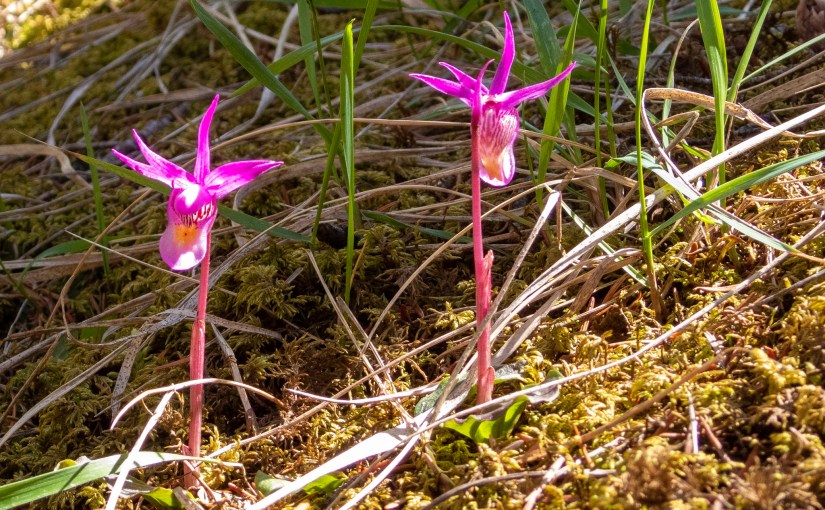
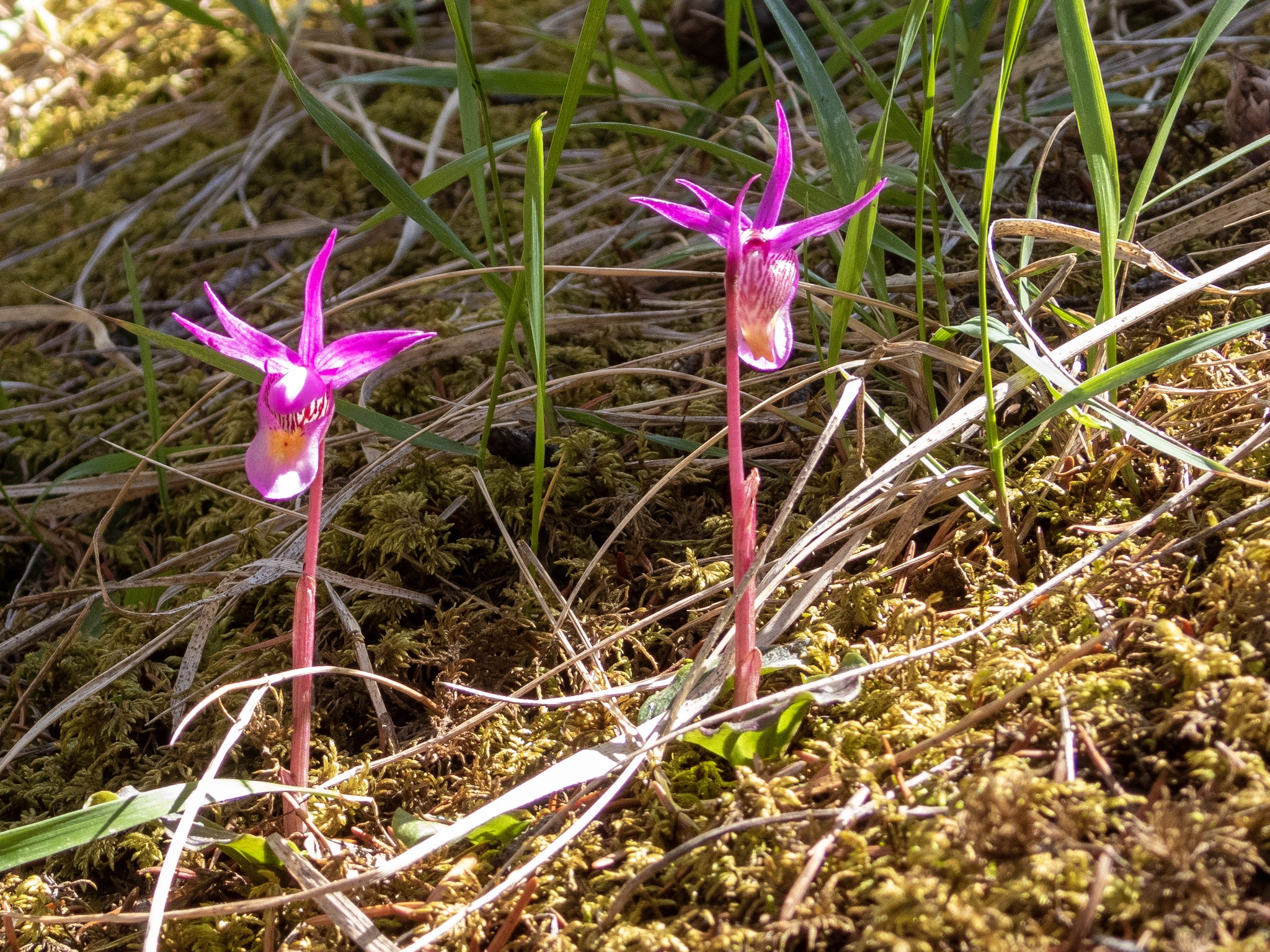
Along a forested section of the trail looping around the First Lake on the Valley of the Five Lakes trail we encountered these small purple flowers poking through the thick moss cover. They had an “orchidy” sort of look to them but at the time I did not know what they were. It turns out they they are indeed orchids known by various names, including, Calypso Orchid, Venus’ Slipper or Fairy Slipper (Calypso bulbosa var. americana). It is a circumpolar perennial orchid found in undisturbed montane forests. They belong to the genus Calypso, which only contains this one species, which takes its name from Greek signifying concealment, as they tend to favour sheltered and undisturbed areas of conifer forest floors. Although it is wide spread globally it is considered threatened or endangered in some part of the world (e.g. several U.S. states and in Sweden and Finland) as it is sensitive to disturbances and has a rather finicky reproductive strategy. It relies on visits by pollinating insects, specifically bumblebees here in Alberta, by deception as it does not produce any nectar to reward its pollinators. As a result insects quickly learn not to visit it again. Talk about burning your bridges reproductively.

Nikon P1000, 62mm @ 35mm, 1/125s, f/4, ISO 100

May the curiosity be with you. This is from “The Birds are Calling” blog (www.thebirdsarecalling.com). Copyright Mario Pineda.
Project 366 – Post No. 075 – Spotted sandpiper

What is Project 366? Read more here!

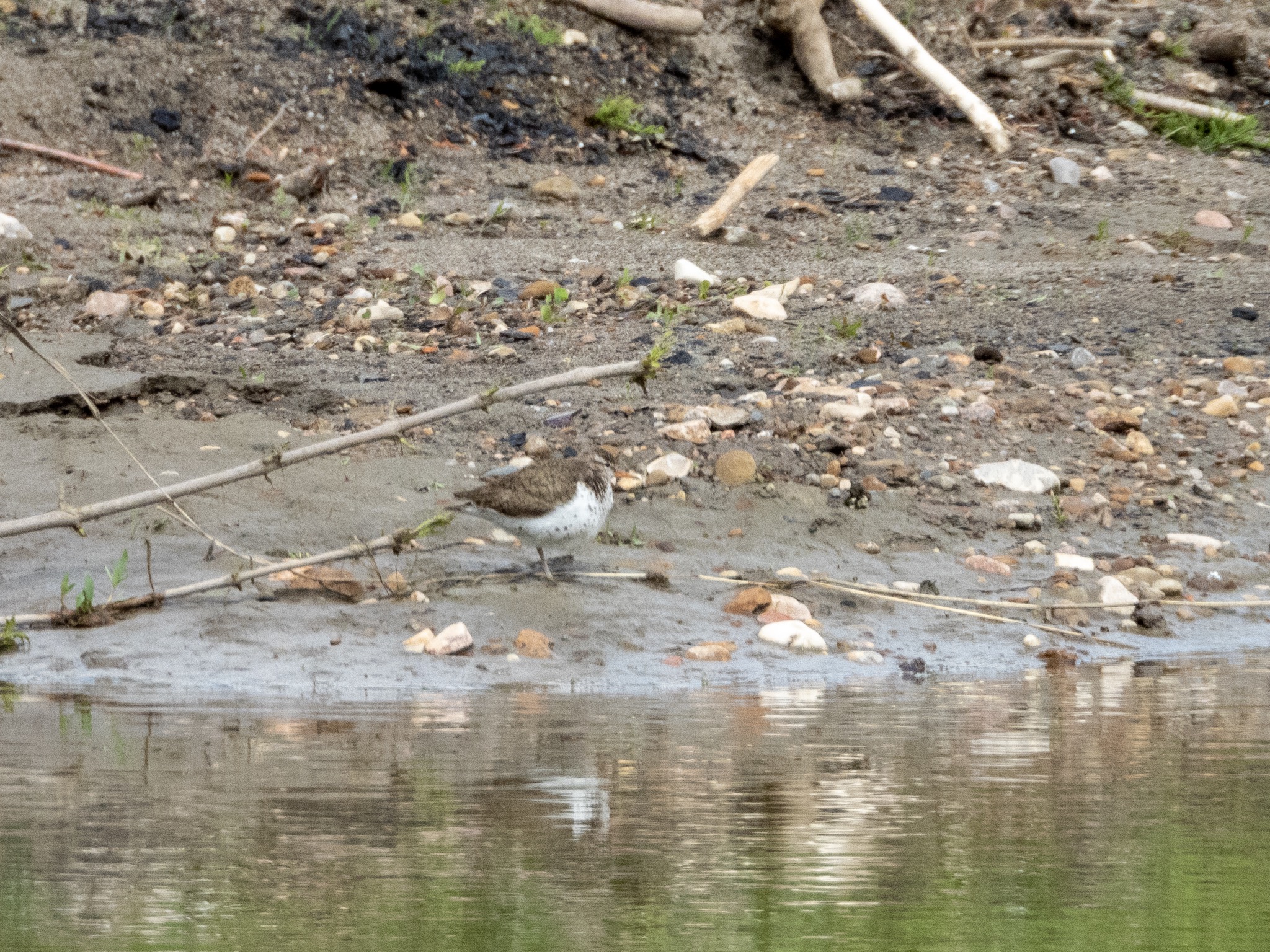
Something was definitely moving along the water’s edge, we just could not immediately focus in on it. It took us a while to adjust our eyes and calibrate our brain to pick up the small stealthy bird scurrying around on the sandy shore on the opposite side of the creek. It was a small shorebird with spotted underparts and sand brown upper parts. If it would not move around it would be nearly impossible to see against the sand and pebbles along the shoreline. I have not seen many shorebirds in my life and this one was definitely a new one. While it was working the shoreline for a morsel to eat its tail was continuously bobbing up and down. Ultimately, this is what gave it away…, it was a Spotted Sandpiper (Actitis macularius, Lifer #162, AB Big Year #114). The Spotted Sandpiper is a true American as it can be found from the Canadian high arctic during the boreal summer down to the shorelines of Chile during the austral summer.

Nikon P1000, 868mm @ 35mm, 1/500s, f/5.6, ISO 280

May the curiosity be with you. This is from “The Birds are Calling” blog (www.thebirdsarecalling.com). Copyright Mario Pineda.
Project 366 – Post No. 074 – Mallard in oxbow

What is Project 366? Read more here!

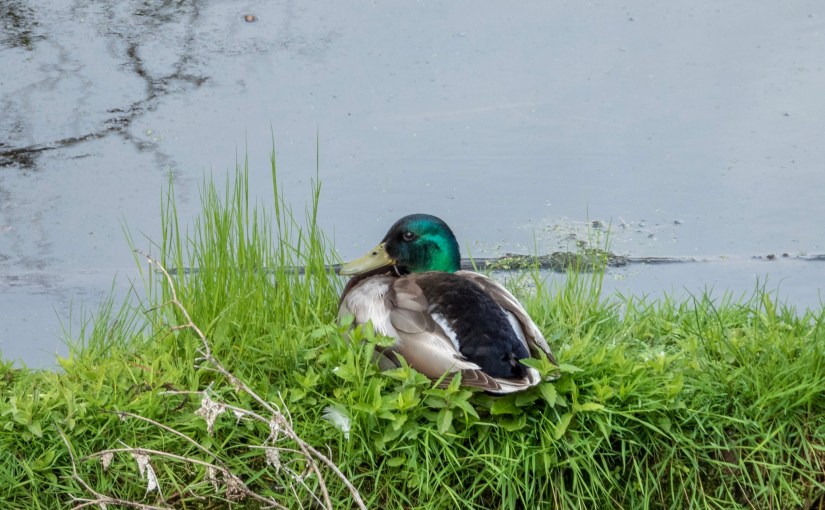
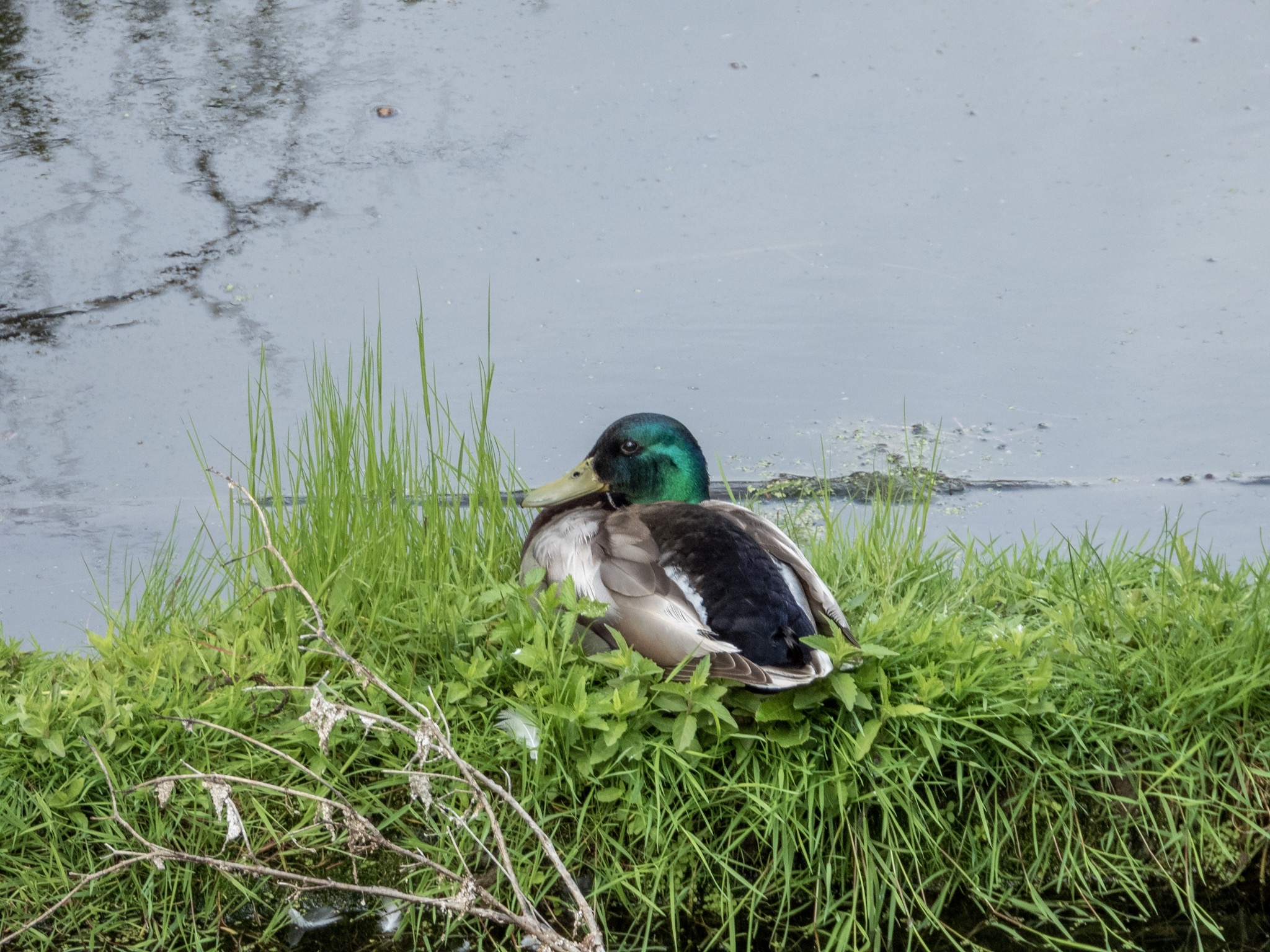
The very first bird we spotted as we arrived at the oxbow pond down at the Whitemud ravine was a male mallard that was snoozing on a log. The log was covered in lush greenery with the mallard cosy like a bug in a rug in the greenery. It was very idyllic and looked quite comfortable. Oxbow ponds are unique habitats where the water is still and stagnant compared to the rushing water in the creek. There are rumours of numerous oxbow ponds along the Whitemud creek. So far I have found two, both almost entirely covered with thick riparian vegetation making them surprisingly difficult to spot although they are only steps away from the trail. This particular oxbow is the largest one I have found so far and is bound by an old beaver dam at the north end and a wall of accreted sediments on the south end. Groundwater and seepage from the west side of the ravine feeds the oxbow, as does spring and surface runoff. Other than seasonal fluctuations in the water level the water is completely still in these pond.

Nikon P1000, 604mm @ 35mm, 1/250s, f/5.0, ISO 180

May the curiosity be with you. This is from “The Birds are Calling” blog (www.thebirdsarecalling.com). Copyright Mario Pineda.

Project 366 – Post No. 073 – Oxbow in the making

What is Project 366? Read more here!

It has been raining over the last few days, but this morning there was a break in the weather so without further ado, we went down to the Whitemud Creek to check out what we could find. On a whim we decided to take the trail along going south along the Whitemud Creek from Snow Valley. Usually we stick to the northern section, but I have been curious for a while now to check out some oxbow ponds in the southern section. Right off the bat we saw a subtle movement along the water’s edge. Something tiny and well-camouflaged was scurrying around on the muddy bank. A closer look revealed that it was a small shore bird that was definitely a lifer. After a bit of studying Merlin and discussions back and forth we reached a unanimous verdict, it was a Spotted Sandpiper (Actitis macularius, Lifer #162, AB Big Year #114). The identification was unmistakable, the spotted under parts, orange bill and bobbing tail as it walked around along the water’s edge. That was a great start to a pleasant morning nature walk. The sandpiper was a welcomed bonus, but the real reason we went to this part of the creek were the oxbows. We did find two oxbow ponds nestled among the vegetation along the trail. We did not have the time to explore them today, but now that I know where they are I am looking forward to coming back and spend some more quality time exploring them. Todays picture shows a wide meander in the Whitemud Creek, this is how oxbow ponds are formed. When a river or creek creates a wide meander like this neck of the meander progressively becomes narrower until it is only a land bridge. Sooner or later the river cuts through the neck, e.g. during high water flow regimes during the spring melt, cutting off the meander and forming an oxbow lake. Oxbow lakes are U-shaped and become free-standing bodies of water with very little or not flow and provide a unique habitat quite different from the habitats along the fast flowing water in the main creek.

Shot with iPhone.

May the curiosity be with you. This is from “The Birds are Calling” blog (www.thebirdsarecalling.com). Copyright Mario Pineda.
Project 366 – Post No. 072 – Fishing at the Ashland Reservoir

What is Project 366? Read more here!

A change of tunes as today’s picture comes from a fishing trip rather than a nature walk. I don’t do many fishing trips as I prefer to watch the animals and let them live to see another day. While I do have personal objections to hurting or killing animals, which is why stick to plant-based foods myself, I also accept and respect that others have different opinions. Here is the snag thought, if you are consuming animal-based foods, then you should also know where it is coming from and what it takes to acquire it and process it. Contrary to some people’s ideas, fish sticks do not grow on trees (there were stories when I went to elementary school many moons ago about the fish stick tree). So this is where the occasional fishing trip comes in. I see this as a learning opportunity for my meat eating son to catch, dispatch, process and cook his own fish. I am ok with him eating meat as long as he understand on a very personal level what it takes to get it to his dinner plate. You can read and watch YouTube videos about where animal-based foods come from until you are blue in your face, but nothing can replace the experience of fishing or hunting for your own food and then going through the entire process all to way to the plate. If you appreciate your fish or meat after experiencing this process first hand, then good on you. Alternatively, you might also start to question whether animal-based foods are right for you…, but that is a different story altogether. Enough of the philosophical discourse.

Today’s fishing excursion took us to the Ashland Reservoir, about 1 hrs drive south west of Edmonton, close by the hamlet Of Warburg (which has an awesome small burger joint if you are into that sort of food). While the boys were fishing (and yes they did catch some trout) I tried my luck with the wildlife watching. The lake is surrounded by lush deciduous forests and agricultural fields. The lake did not have much water fowl in it, and other than a solitary Common Loon, a few Great Blue Herons, the ever-present Mallard, Red-winged Blackbirds and Canada Geese there was not much else to report. My hunch is that the lack of reeds along the shoreline might be a possible reason for the low diversity. That did not stop the muskrats, however, to put on quite a show. They were quite charming as they were swimming to and fro and curiously checking out our fishing attempts. Long live the muskrats.

Nikon P1000, 868mm @ 35mm, 1/500s, f/5.6, ISO 110

May the curiosity be with you. This is from “The Birds are Calling” blog (www.thebirdsarecalling.com). Copyright Mario Pineda.
Project 366 – Post No. 071 – Ring-necked Duck

What is Project 366? Read more here!

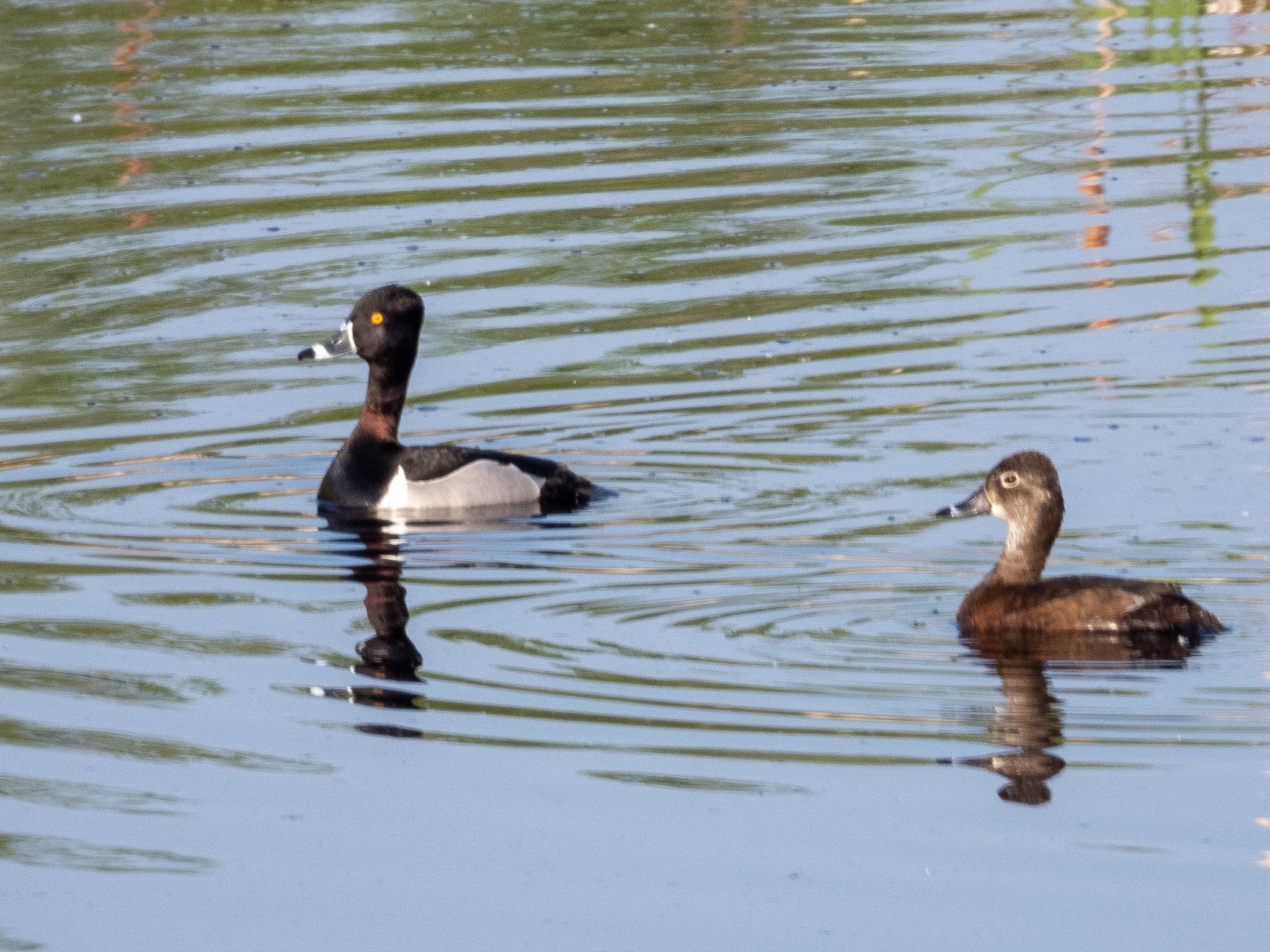
Mingled in with the many Blue-winged Teals and Northern Shovelers there was this pair of unique looking ducks. Clearly a male and a female, I had to look it up in the Merlin App to positively identify these waterfowl. They were very “Scaup-like”, which obviously only makes sense to someone familiar with scaups (another waterfowl). The most obvious difference from a scaup, however, was a white band on the bills of both the male and female + the male had a white band at the base of the bill as well. They were very unique looking so identifying them was a cinch once I consulted Merlin. They are Ring-necked Ducks (Aythya collaris), a species of diving duck common in North America. Looking at reported sightings of Ring-necked Ducks in eBird reveals that while this is definitely a North American species, these ducks get around. There are many reports of vagrants found on tiny isolated islands in both the Atlantic and the Pacific oceans and beyond, such as in Japan and Western Europe. Further online research does provide a bit more context. These ducks are strong flyers and are know to have a tendency to stray far away from their normal range.

Nikon P1000, 1411mm @ 35mm, 1/500s, f/5.6, ISO 180

May the curiosity be with you. This is from “The Birds are Calling” blog (www.thebirdsarecalling.com). Copyright Mario Pineda.
Project 366 – Post No. 070 – Vigilant Mallard

What is Project 366? Read more here!

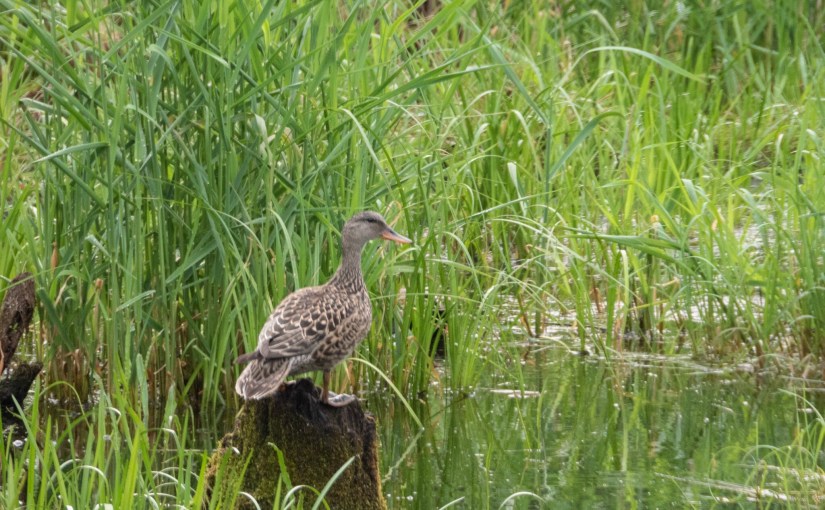
Mallards are one of the most ubiquitous birds in the Northern hemisphere (+ Australia and New Zealand where they have been introduced) and are probably one of the first birds children learn to recognize, although they are more likely to refer to them as ducks, rather than mallard. Technically the name duck is the common name for a large number of species in the waterfowl family Anatidae which includes swans and geese. During a recent morning field trip to Elk Island National Park I found this lone female mallard perching on a tree stump in a shallow pond. She was eyeing me cautiously and seemed quite vigilant yet reluctant to move from her perch. It is possible that she had a nest with either eggs of chicks hidden in the tall grass. It was an overcast day and smoke blown in from forest in northern Alberta lingered over the landscape. The subdued light conditions made it somewhat challenging to take pictures with the Nikon P1000. It all boiled down to balancing the trade off between shutter speed, aperture and ISO to match the subject and light conditions. I took this particular picture at 1008mm (35mm equivalent) at 1/125s shutter speed, f/5.6 aperture and at ISO 560 from the driver’s seat through the open window on the passenger side. Cars make great blinds for wildlife photography. I was only a few meters away from the female and she was clearly aware of my presence. She seemed to tolerate my presence, but I am sure she would take off if I would get out of the vehicle. The long focal length and high ISO (by P1000 standards) did not bode well for a good picture, but I was pleasantly surprised that it turned out quite nice given the constraints.

Nikon P1000, 1008mm @ 35mm, 1/125s, f/5.6, ISO 560

May the curiosity be with you. This is from “The Birds are Calling” blog (www.thebirdsarecalling.com). Copyright Mario Pineda.

Project 366 – Post No. 069 – Spikey the Muskrat

What is Project 366? Read more here!

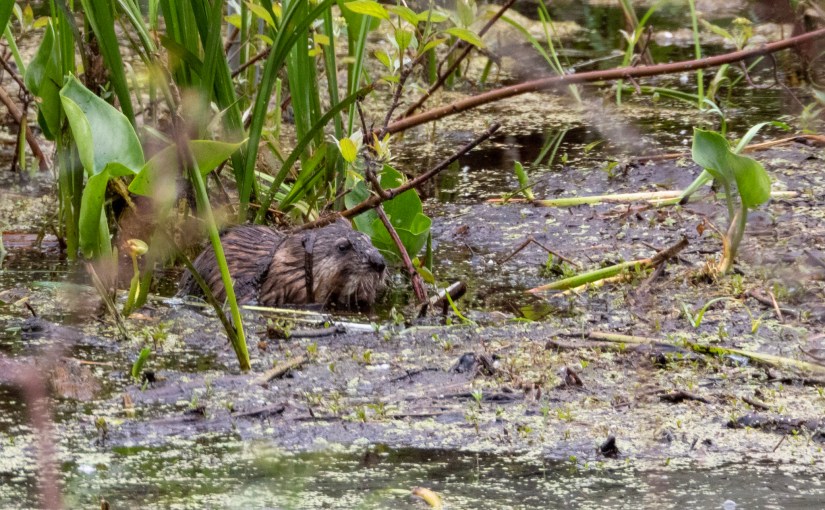
Muskrats are medium-sized rodents, almost like a mini-beaver, but with a rat-like tail instead of the big paddle tail of the beaver. They are basically large field mice adapted to life in water. They have a groovy dental adaptation allowing them to chew with their mouths closed. Their front teeth protrude ahead of the checks and lips allowing them to chew food under water while their mouth technically remains closed. I found this fella in a shallow pond at Elk Island National Park sitting in waist-deep (by muskrat standards) water munching on his breakfast consisting of aquatic plants. He seemed quite hungry as he was really going to town with his veggies and did not seemed bother with my presence, even when I pulled out and assembled my large tripod. Below is a short video clip of his energetic chewing. The video almost looks like it has been sped up, but it’s a regular speed. Let’s call the muskrat Spikey after his spiky and funky hairdo. So, as I was saying, it is not the video that has been sped up, but rather, it is Spikey that is living his (her) life in the fast lane.

Nikon P1000, 756mm @ 35mm, 1/200s, f/5.6, ISO 400

May the curiosity be with you. This is from “The Birds are Calling” blog (www.thebirdsarecalling.com). Copyright Mario Pineda.