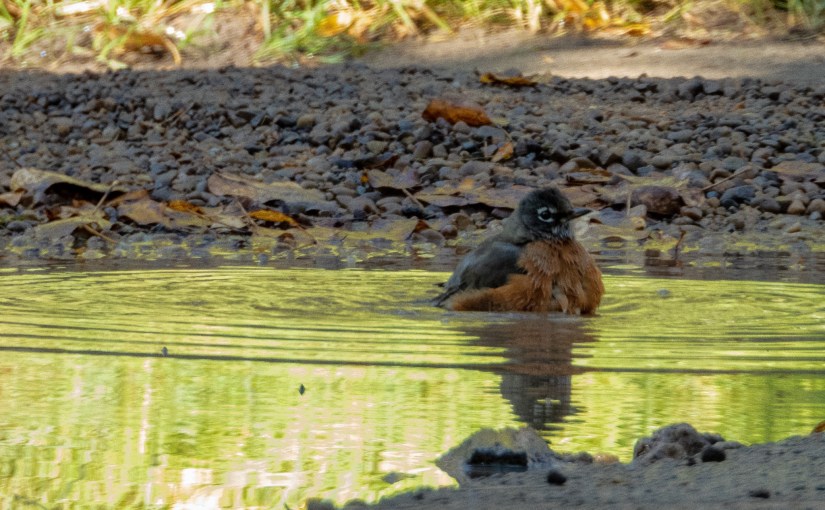
As I was walking down the trail with eyes fixed on the trees there was a splashing sound. At first I though it came from the river, which was just a short distance away on the other side of some shrubbery. The sound seemed closer than the river and more subtle. Not a large splashing sound, but more of a small splashy sound. It did not take long to identify the culprit. In a large puddle along the trail a robin was having its morning bath. It was a very energetic and vigorous bath as it was ruffling up the feathers and shaking around in the brown puddle. My presence did not seem to bother the robin as it continued its bathing routine. It was not until a runner came steaming down the trail that the robin all of a sudden took off and vanished into the shrubbery.
May the curiosity be with you. This is from “The Birds are Calling” blog (www.thebirdsarecalling.com). Copyright Mario Pineda.
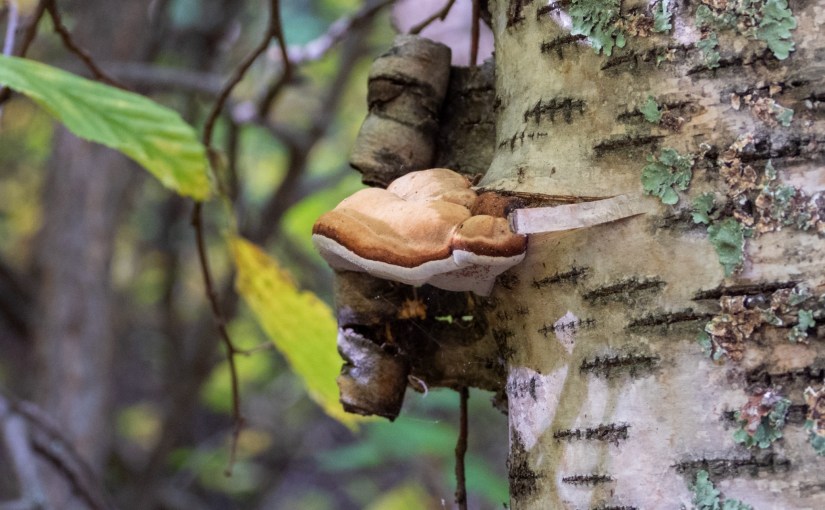
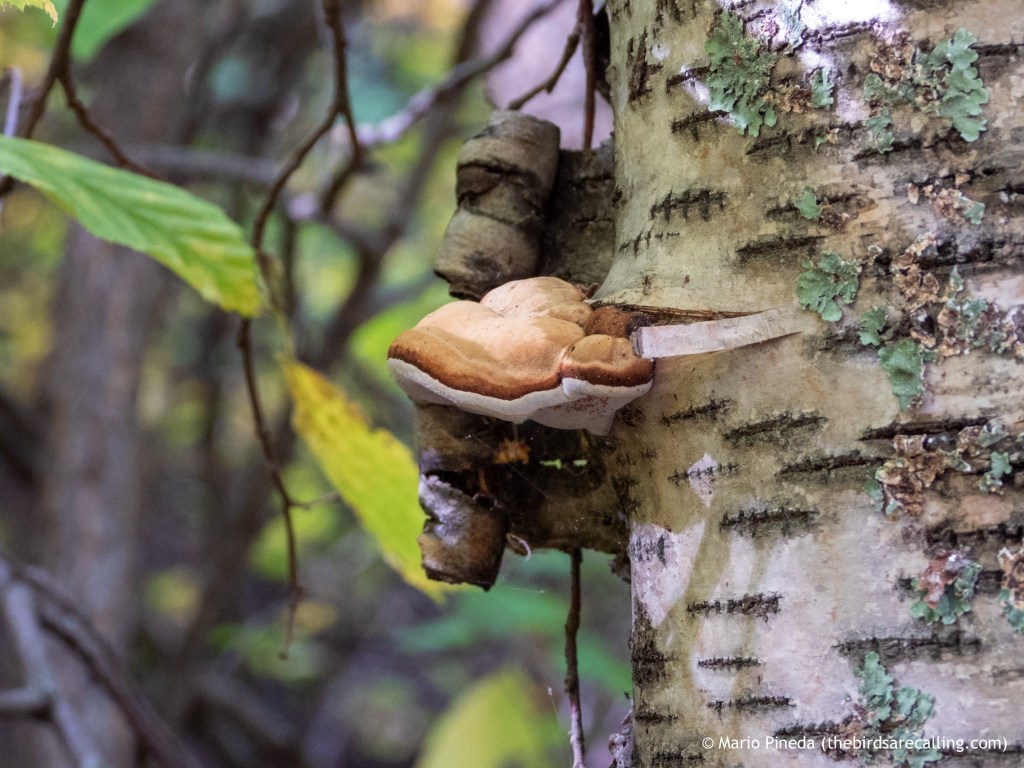
Tree conks are the the fruiting bodies of fungi growing inside tree. They are an ominous signs that the tree is decaying from the inside out. This harbinger of death can be quite pretty though. I came across this stunning conk on a paper birch at the heritage Wetlands park. With a brown gradient on the top, a crisp dark brown line along its waist and a white underside it almost looked like it had been painted with water colors. The decay process is typically slow and conks can grow quite large. The lifestyle of growing on dead or dying organisms called a saprotrophic lifestyle and, while it does not sounds very glamorous, is a important ecological role of many fungi. What dies has to be recycled and fungi and bacteria are key players making this possible.
May the curiosity be with you. This is from “The Birds are Calling” blog (www.thebirdsarecalling.com). Copyright Mario Pineda.
The leaves are long gone and all that remains are clusters of berries. Quite fittingly names these are Snowberries, a deciduous shrub commonly found in backyards as well as along trails. The name of the genus – Symphoricarpos – means “to bear together” in Greek and refers to the distinct closely packed clusters of berries the species produce. While the berries are an important source of food in the winter for birds it is poisonous to humans. While the berries are easy to spot on the leafless branches this will obviously change once the snow arrives.
May the curiosity be with you. This is from “The Birds are Calling” blog (www.thebirdsarecalling.com). Copyright Mario Pineda.
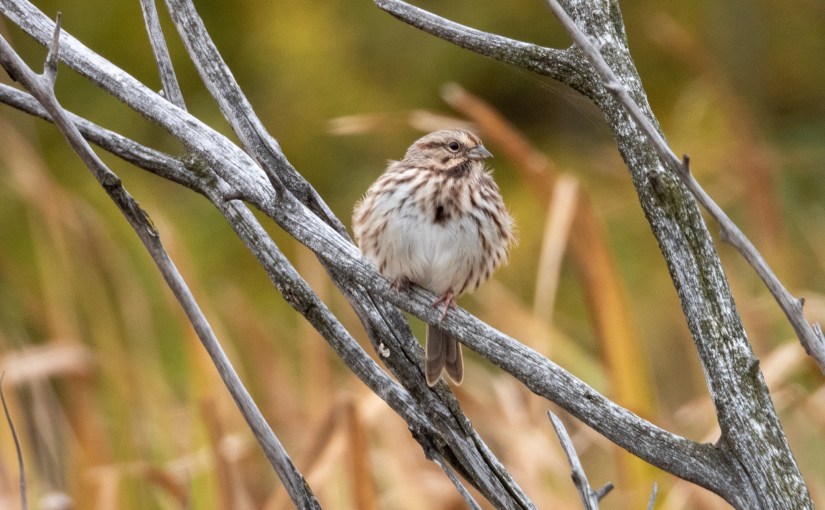
A Song Sparrow hiding among the reed was letting everyone know it was there. Song Sparrows can be found in our city parks until the end of October at which point most of them head south to continental USA. Occasionally, however, the odd one decides to stay behind braving the local winter. True to its name, the Song Sparrow has a colorful repertoire of songs. In one of his journals Henry David Thoreau suggested that the song sounded to him like “Maids! Maids! Maids! Hang up your teakettle-ettle-ettle.” Song sparrows tend to develop local dialects and some people even claim that no two Song Sparrows have the same song. There is a collection of recorded songs here to give you a taste of the diversity of songs. The typical “three short identical notes followed by a longer one” has even been compared to rhythmical pattern of the beginning of Beethoven’s Fifth Symphony. I am not entirely convinced about the Beethoven’s Fifth comparison but I will keep my ears peeled next time I am listening to a Song Sparrow.
Song Sparrow at Heritage Wetlands Park. September 28, 2019. Nikon P1000, 1008mm @ 35mm, 1/320, f/5.6, ISO 400
May the curiosity be with you. This is from “The Birds are Calling” blog (www.thebirdsarecalling.com). Copyright Mario Pineda.
A solitary female mallard was perched on an underwater rock energetically grooming her flight feathers. Perhaps she was getting ready to embark on her journey south. Her speckled fuzzy feathers blended in perfectly with the wilting yellow-brown reeds. It was a cold and crisp morning at the Heritage Wetlands Park. As most birds already have flown south I did not expect to see much. It turnes out that this location is full of surprises. These unassuming wetlands treated me to my first Belted Kingfisher and a Merlin last week. This time both the kingfisher and Merlin were nowhere to be found but instead I ended up seeing (or hearing) 13 species during the hour I was strolling around the ponds. The last time I spotted more species in a single outing was in mid-May and that walk lasted for two and a half hours, so I would say that today was pretty successful. The final breakdown of today’s tally is:
10 Canada Goose 10 Mallard 1 Bufflehead 10 Common Goldeneye 2 Hooded Merganser 4 Red-necked Grebe 2 Ring-billed Gull 1 Pileated Woodpecker 1 Black-billed Magpie 1 American Crow 1 Black-capped Chickadee 5 American Robin 2 Song Sparrow
On a different note. This is post 183 which means it is the half-way mark of Project 366. 183 posts down, 183 posts to go and still going strong.
Solitary female mallard at Heritage Wetlands Park. September 28, 2019. Nikon P1000, 837mm @ 35mm, 1/200, f/5.6, ISO 400
May the curiosity be with you. This is from “The Birds are Calling” blog (www.thebirdsarecalling.com). Copyright Mario Pineda.
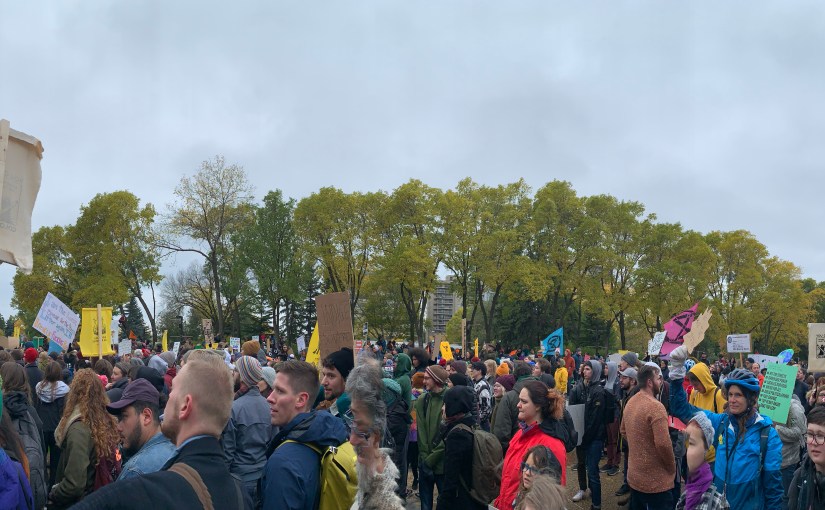
Today was the last day of the Global Week for Future, a series of international strikes and protests demanding that action be taken to address climate change. As today was the last day, the week was wrapped up with a global Earth Strike across the world. An estimated 2 million 7 million (updated) people worldwide participated in today’s strike. Here in Edmonton the strike was scheduled at noon, starting at Churchill square and making its way to the legislature. I was not sure what to expect in terms of number of people – after all this is Alberta, where oil is king and climate change denialism is widespread. The media estimated that there were 4000 participants. The crowd consisted mainly of young adults and teenagers, exactly the demographics that has been the driving force behind this movement. It was a loud and cold event and afterwards we went for some hot chocolate to warm up. I think today’s events show that despite the lackluster efforts from governments and corporations in dealing with climate change there is hope. As the tide is rising (metaphorically and figuratively) it will be increasingly difficult for leaders and decision makers to ignore the growing chorus demanding action. Alberta? Well, we might have a bit more work cut out for us than other places, but I think change is inevitable and the day will come when being tone deaf will no longer be socially acceptable. History tends to repeats itself. One only has to go back a few decades to see many social issues that were debate and resisted and that today have transformed our societies and where opposing views have become socially unacceptable, e.g. women’s suffrage, residential schools, LGBTQ etc.
Edmonton Global Climate Strike for Climate Action
May the curiosity be with you. This is from “The Birds are Calling” blog (www.thebirdsarecalling.com). Copyright Mario Pineda.
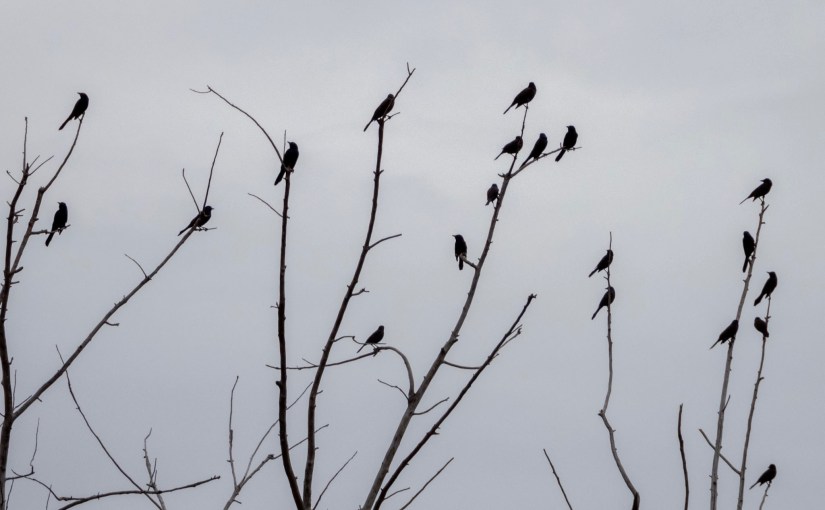
Perched high up in the leafless trees there was a band of American Crows. They seemed wary and worried, looking around like in all directions, carefully watching every movement around them. It did not take long to figure out what had them on the edge. A Merlin was perched in a nearby tree. Suddenly the Merlin took off on what looked like a patrol – sort of just checking things out. But the crows did not take any chances. The whole flock took off simultaneously and started flying back and forth over the tree grove making a lot of noise. Once the Merlin landed in a tree again, the crows settled down and landed as well. One would think that the cows would find safety in their numbers or that they would figure out that they far too large for a Merlin to catch, after all they are about equal in size. But, nope. These fellas were real chickens.
May the curiosity be with you. This is from “The Birds are Calling” blog (www.thebirdsarecalling.com). Copyright Mario Pineda.
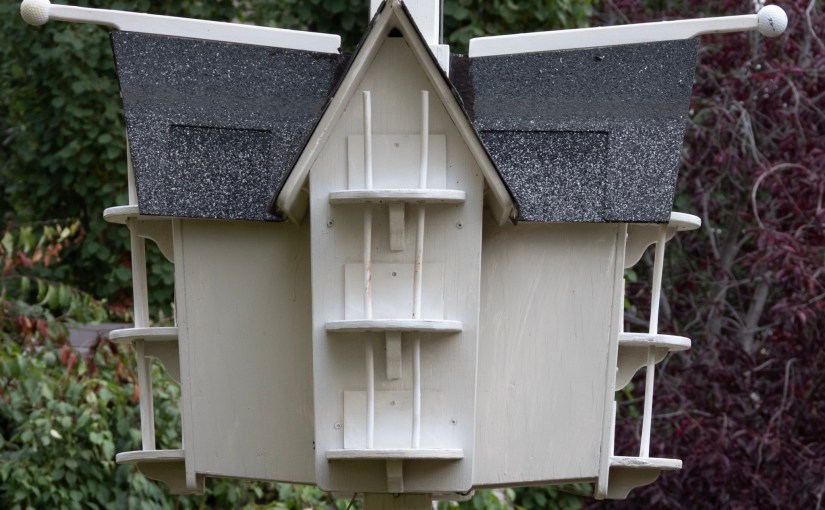
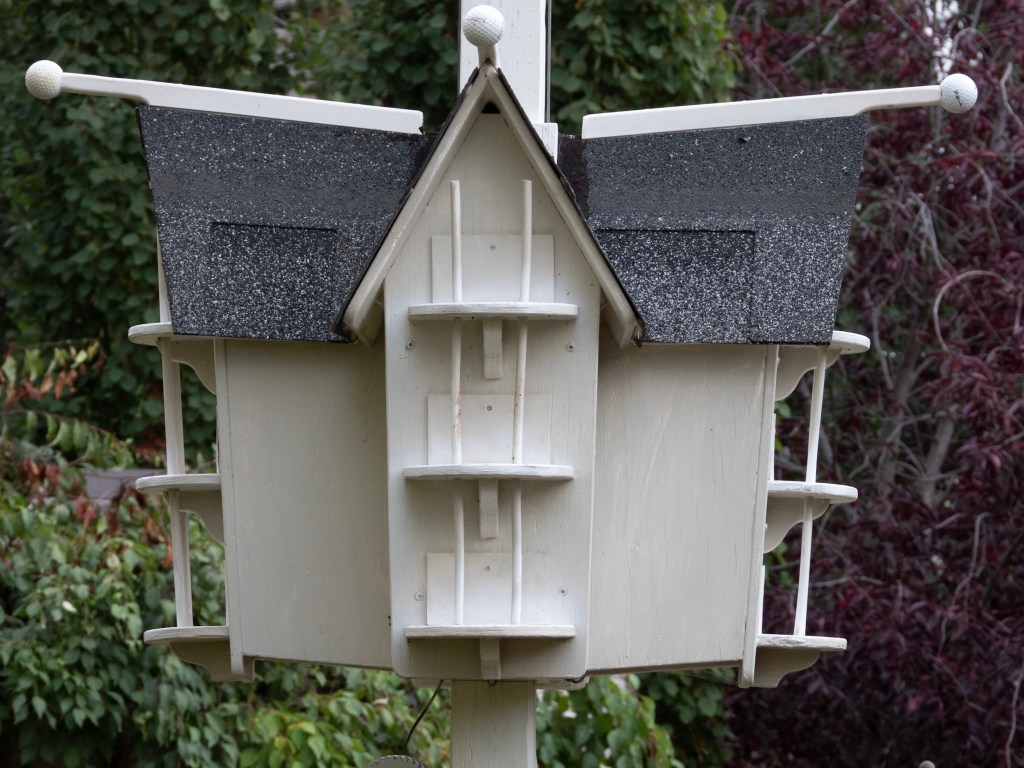
The Purple Martins are long gone and their summer accommodation has been closed for the season. It is reminiscent of a resort that is shut down after a busy summer season with guests flying in from far flung destinations to party it up, find a date, have fun in the hay, have young, raised them, and see them move out – all in the span of about four months. Talk about living life in the fast lane. By now they are on their way or already back at their overwintering rounds around the Gulf of Mexico, in the Caribbean and throughout Central America.
May the curiosity be with you. This is from “The Birds are Calling” blog (www.thebirdsarecalling.com). Copyright Mario Pineda.
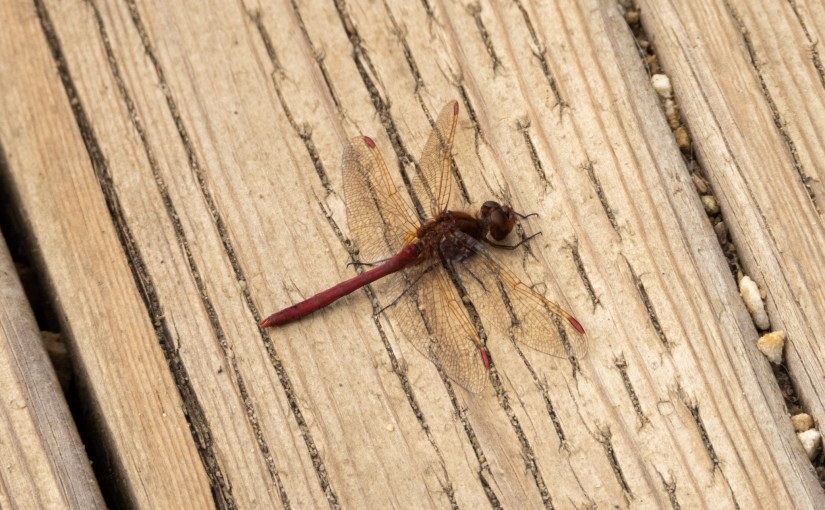
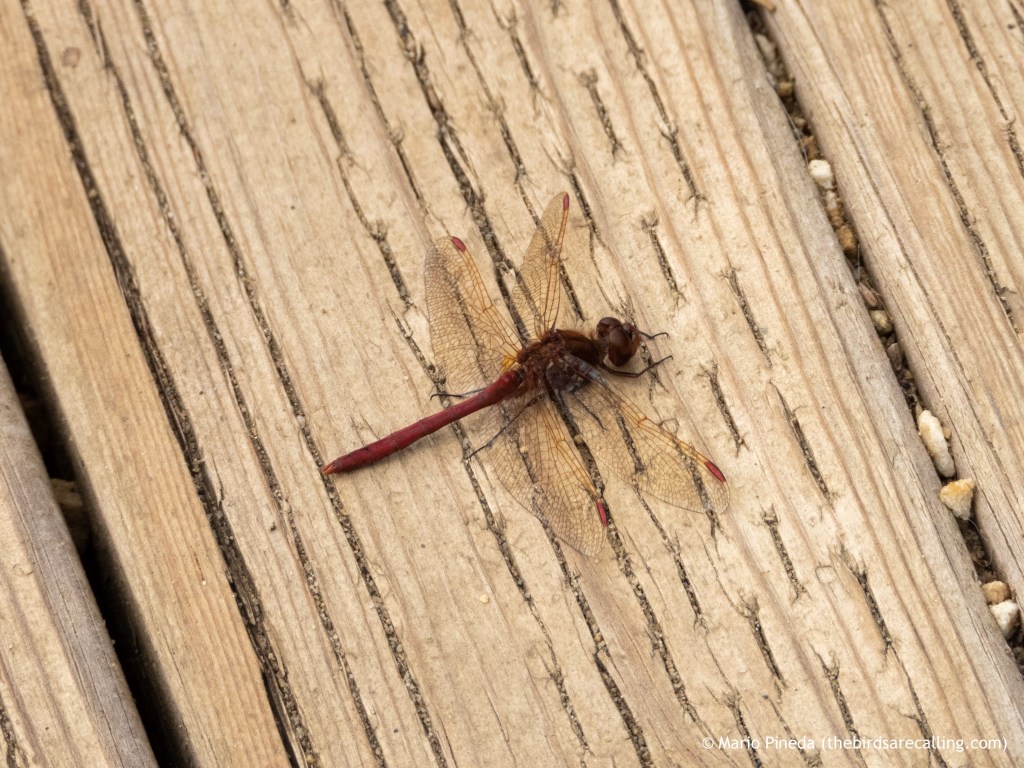
Its name must have been Danger. Meadow “Danger” Hawk. How else could one explain it deciding to land and chill out on the wooden boardwalk that goes around the Heritage Wetland Park. It seemed to be a rather inopportune location for a rest. With kids and dogs running along the boardwalk, cyclists zooming by and the odd birder not paying attention where they step as they scan the skies for exciting finds. This birder did spot the Meadow Hawk, however. I quietly suck up to it to see how close I could get before it got spooked. I was only about a meter right above it snapping pictures when it decided that it had had enough and took off.
Meadow hawk at Heritage Wetlands Park. September 21, 2019. Nikon P1000, 605mm @ 35mm, 1/320, f/5, ISO 100
May the curiosity be with you. This is from “The Birds are Calling” blog (www.thebirdsarecalling.com). Copyright Mario Pineda.
The world is changed; I can feel it in the water, I can feel it in the earth, I can smell it in the air
Lady Galadriel’s prologue in the Fellowship of the Ring
It does not just feel like fall anymore. As of today, the fall is here. As the seasons are changing and nature is readying itself for another winter there are larger and more sinister changes at work. The climate of the entire planet is undergoing massive changes at a scale never seen before. Global emissions are reaching record levels every year and show not sign of relenting. The last four years have been the hottest on record, winter temperatures in the Arctic are rising at an unprecedented rate and extreme weather events are increasingly more extreme and more common. The impacts of climate change are being felt everywhere and are having real consequences on human life. This week the UN Climate Action Summit is taking place and there is a sense of urgency never before seen, particularly among youth that are participating in the summit demanding immediate and forceful action from the leaders of the world. While we all have the possibility to do our share in reducing our impact on the natural world it is easy to feel helpless and insignificant in the large scope of things. What difference will it make if limit my driving when Alberta alone emits close to 300 megatonnes of carbon dioxide annually, the province with the highest greenhouse gas emissions in Canada, and rising? Obviously, in light of this, for the individual person, it is not about making a dent in the emissions, but to take a stand and to show that enough is enough. For anyone to take a stand the requirement is that one has the basic knowledge of the impact humans have on the planet and the role we play in the changing climate. One would think that this would be the easy part, educating people and spreading awareness, but alas it appears that this is the biggest hurdle of them all. Misinformation, denialism and good old stupidity is preventing us to make any headway towards stopping and solving the degradation of our environment. For every little step of progress humanity seems to take two steps back. Just a few local example, we are still talking about building oil pipelines and we are still talking about extracting billion of barrels of oil from the oil sands. It is difficult to watch this rhetoric unfold and turn a blind eye, particularly if you do have a voice. I might not be world leader, an activist or a celebrity but I am a parent and a teacher which means I do have a voice and I do have an opportunity to contribute to educating the next generation of leaders and decision-makers.
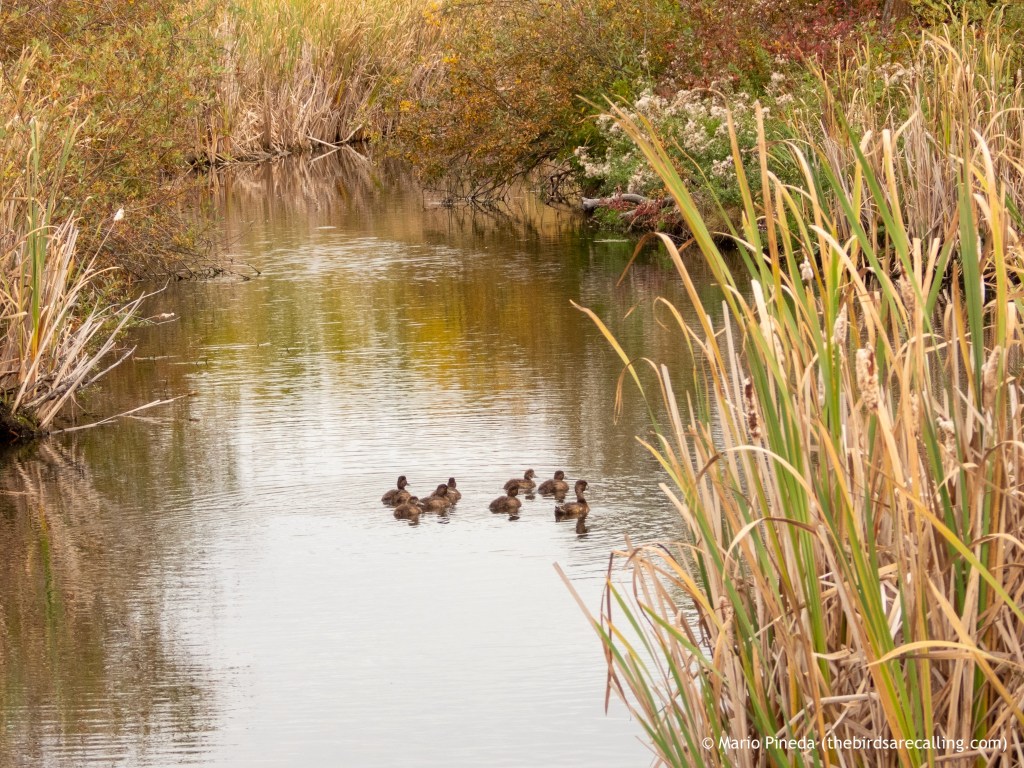
Common Goldeneyes (Bucephalus clangula) at Heritage Wetlands Park. September 21, 2019. Nikon P1000, 134mm @ 35mm, 1/200, f/4, ISO 100
May the curiosity be with you. This is from “The Birds are Calling” blog (www.thebirdsarecalling.com). Copyright Mario Pineda.