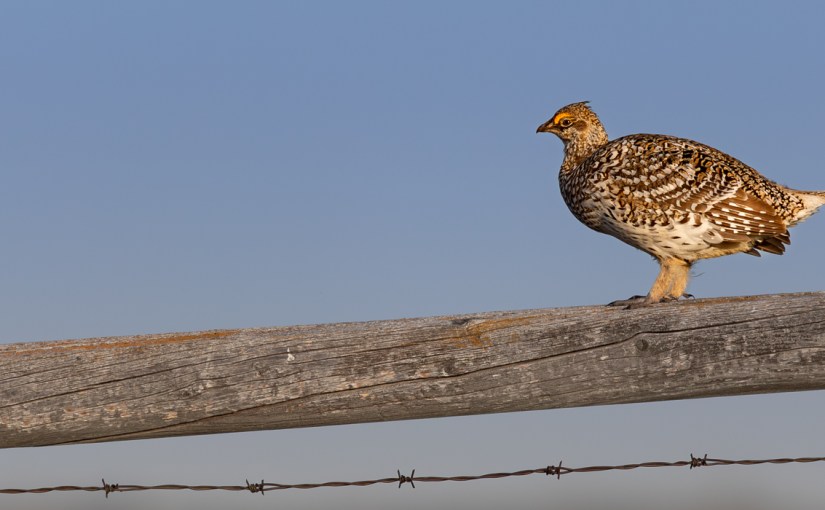
There’s a magic that stirs in the early prairie light—something ancient, electric, and profoundly alive. For the second time in my life, I found myself bearing witness to it, skulking quietly in a blind somewhere on the grassland outside Wainwright, Alberta, watching the Sharp-tailed Grouse gather and ignite the land with their springtime ritual. The accounts of my first time attending this event are documented in here and here.
The Sharp-tailed Grouse watch is an annual event organized by the Wainwright Wildlife Society—is more than just a birding excursion—it’s an invitation into a world older than memory. Each spring, these prairie dancers return to their ancestral leks where the males perform a spectacle that defies description. To call it a “mating display” feels inadequate. It’s a full-bodied expression of wild instinct and evolution, refined by millennia of selection, played out with whirring wings, staccato foot-stomping, and those impossible, ballooning purple air sacs. This is one dance party where the boys do all the dancing—and the girls remain motionless, watch and judge.

This year, I returned with a birding friend—someone equally moved by the subtle drama of sunrise and feather. We arrived in the pre-dawn hush, guided to our blind while the stars still clung to the sky. In the twilight we could already discern the silhouettes and the rustle of the dancing feathered denizens of this grassland. Once we were settled in our hides and rigged up our cameras, the waiting began—the kind that heightens every sense, making you aware of each breath, each rustle. A number of early birds were already present in the field, idling about, perhaps scouting out the best dancing spot or just assessing their chances to get lucky.

And then—they started dancing. At first, they were just shadows moving between the tussocks. But as the light lifted, so did the tempo. Soon the lek exploded into motion: tails fanned, wings held stiff, bodies vibrating with energy. The males faced off and danced with frenetic determination, each movement part performance, part territorial defiance. On this morning there were mainly males, probably 20ish, and only a few females making an appearance. Being mid-May, this was one of the last grouse watch excursion of the year and it’s possible that most of the females had already mated and were in a nesting phase.


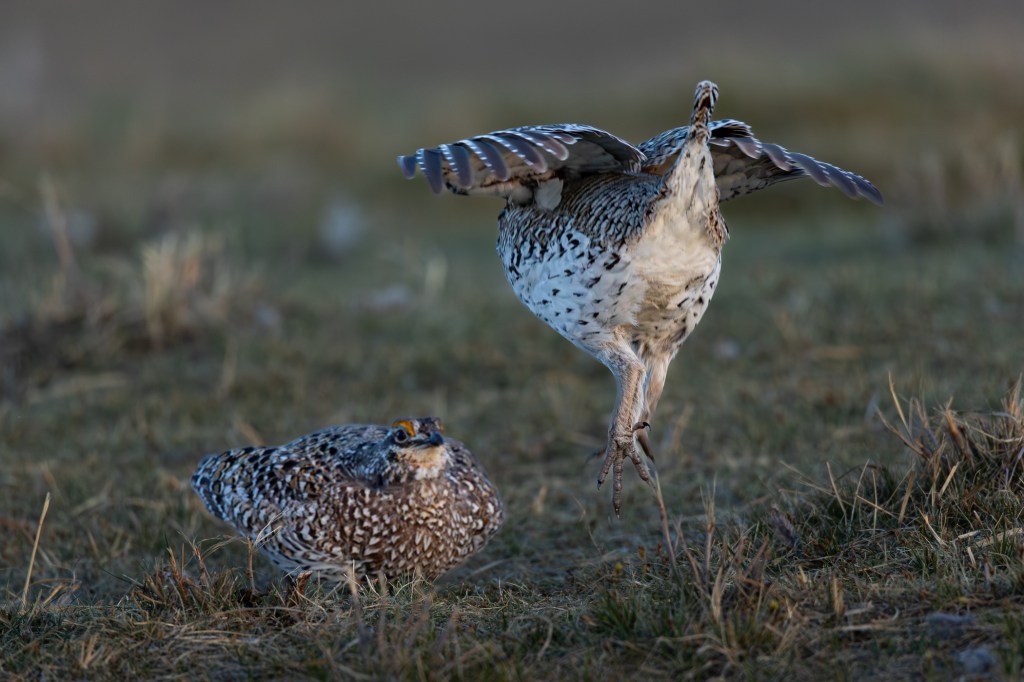

While the Sharp-tailed Grouse lek might appear as a chaotic dance party, it is in fact a highly structured arena of sexual selection. Females visit the lek primarily to observe rather than participate, silently watching from the edges as males display in feverish competition. Research has shown that females are incredibly discerning—they typically choose just one male per season, selecting him based on a combination of traits: vigorous and frequent displays, dominance of central territories within the lek, symmetry and size of the combs over the eyes, and the prominence and coordination of air sac inflation and vocalizations. Mating success is heavily skewed—just a few top-performing males are responsible for the majority of copulations. Once a female has mated, she departs alone to nest in dense cover, incubate her eggs, and raise her brood without any help from the male. The entire spectacle, then, is not just a performance—it’s a life-or-death audition for the future of their lineage.

Looking for: One fabulous hen to impress with tail fanning, fast-foot stomping, and ridiculous balloon-neck flexing.
About Me: I coo, I strut, I puff. I’ve got fire-red eye combs and a lekking spot that screams “alpha.” No nest, no parenting, all passion. If you’re into commitment-free spring flings with maximum flair, I’m your bird.
Swipe right at dawn—I’ll be shaking it like evolution depends on it.
Watching this unique display again reminded me why I do this. Why I get up at 3:30 in the morning. Why I drive for hours through the dark morning hours while the rest of the world still sleeps. Why I carry back breaking heavy gear into the cold. It’s for these fleeting moments when time slips, and I feel plugged into something wild and real.
As I write this, I can still hear the low drumming of wings, still see the blur of feathers caught in the rising light—prairie grasses glowing gold as the first light spills across these ancestral land. For a fleeting moment, we were not just observes, but a thread in an ancient ritual woven into the fabric of the grasslands. The birds are still calling, and I’m still listening.

References
Gibson, R. M., & Bradbury, J. W. (1985). Sexual selection in lekking birds: Are female preferences consistent? The American Naturalist, 126(6), 881–895. https://www.jstor.org/stable/2461497
Montana Fish, Wildlife & Parks. (2017). Sharp-tailed Grouse Reintroduction Plan. Montana State University. https://animalrange.montana.edu/documents/faculty/Sharp-tailed%20grouse%20Reintroduction%20Plan%20Final%20May%202017.pdf
Washington Department of Fish & Wildlife. (1995). Washington state status report for the Sharp-tailed Grouse. https://wdfw.wa.gov/sites/default/files/publications/00389/wdfw00389.pdf
Wikipedia contributors. (2024). Sharp-tailed grouse. Wikipedia. https://en.wikipedia.org/wiki/Sharp-tailed_grouse
May the curiosity be with you. This is from “The Birds are Calling” blog (www.thebirdsarecalling.com). Copyright Mario Pineda.


