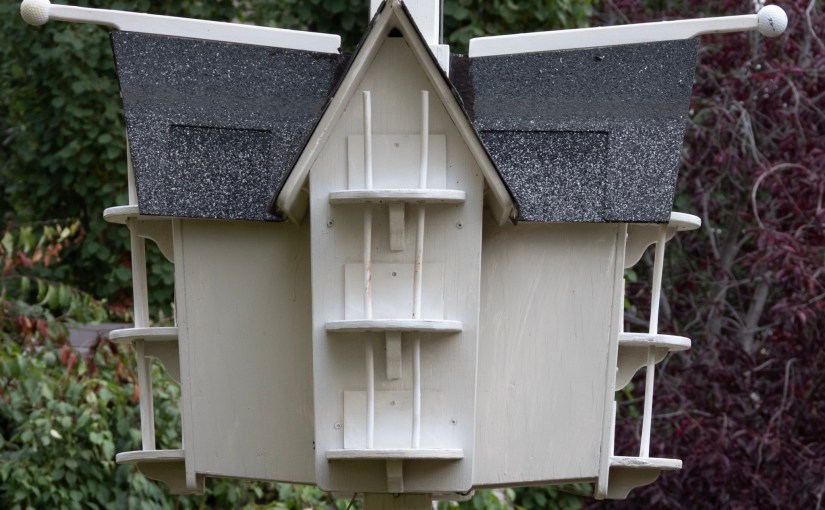
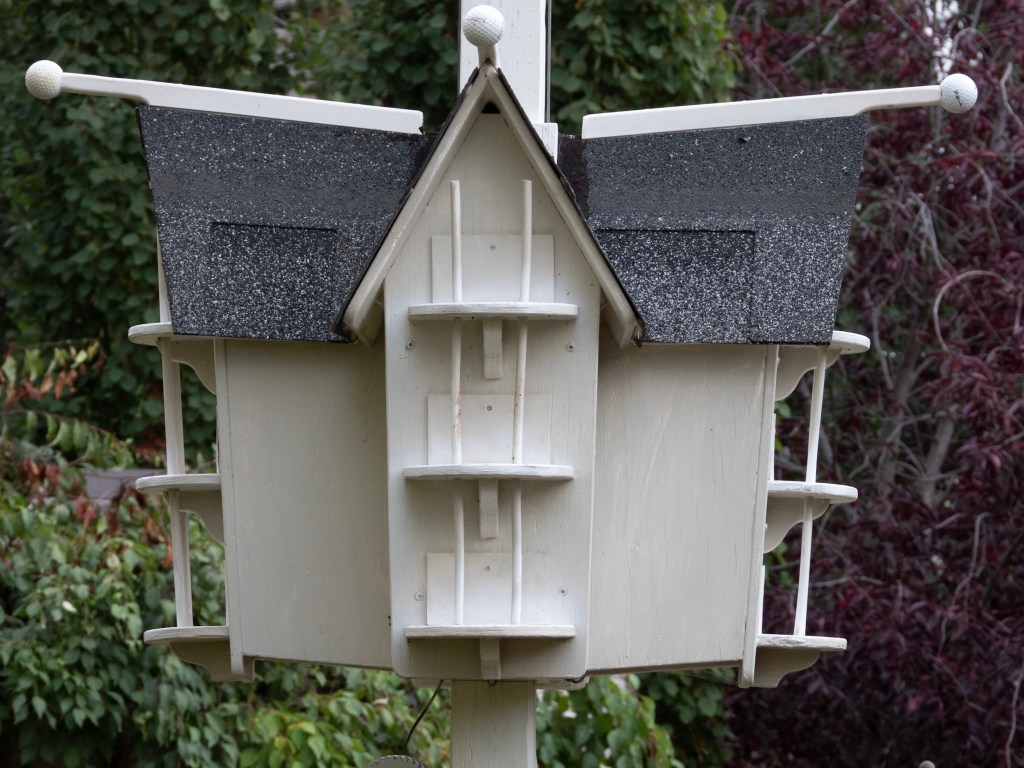
The Purple Martins are long gone and their summer accommodation has been closed for the season. It is reminiscent of a resort that is shut down after a busy summer season with guests flying in from far flung destinations to party it up, find a date, have fun in the hay, have young, raised them, and see them move out – all in the span of about four months. Talk about living life in the fast lane. By now they are on their way or already back at their overwintering rounds around the Gulf of Mexico, in the Caribbean and throughout Central America.
May the curiosity be with you. This is from “The Birds are Calling” blog (www.thebirdsarecalling.com). Copyright Mario Pineda.
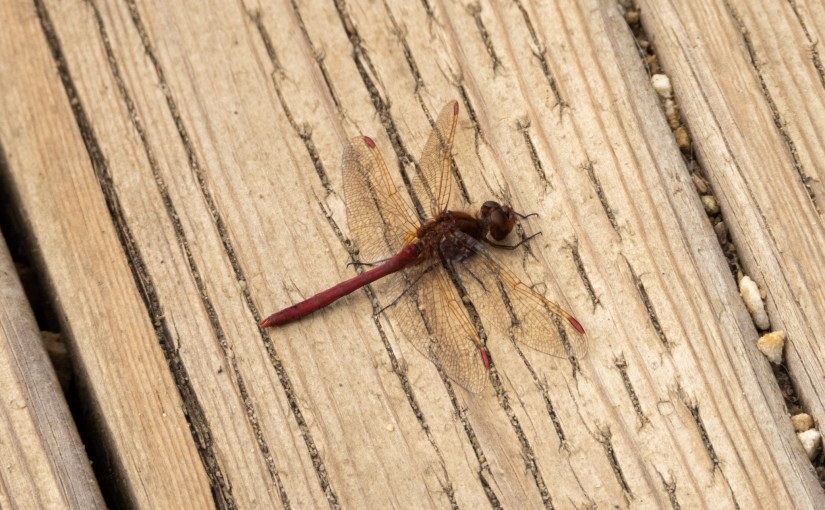
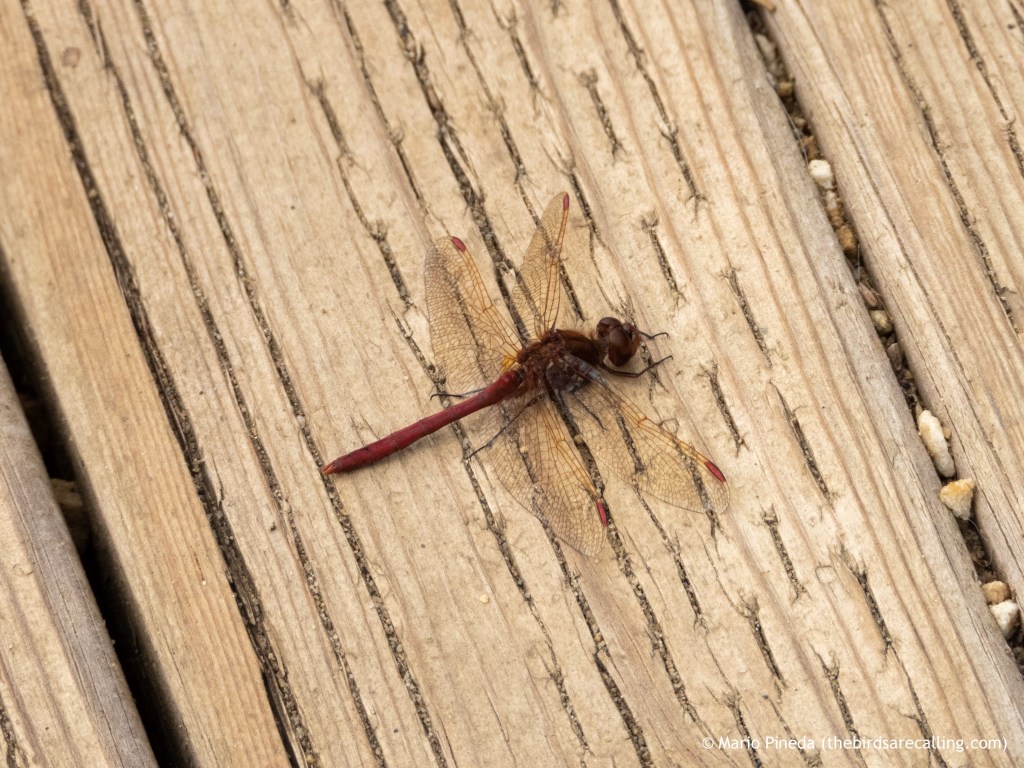
Its name must have been Danger. Meadow “Danger” Hawk. How else could one explain it deciding to land and chill out on the wooden boardwalk that goes around the Heritage Wetland Park. It seemed to be a rather inopportune location for a rest. With kids and dogs running along the boardwalk, cyclists zooming by and the odd birder not paying attention where they step as they scan the skies for exciting finds. This birder did spot the Meadow Hawk, however. I quietly suck up to it to see how close I could get before it got spooked. I was only about a meter right above it snapping pictures when it decided that it had had enough and took off.
Meadow hawk at Heritage Wetlands Park. September 21, 2019. Nikon P1000, 605mm @ 35mm, 1/320, f/5, ISO 100
May the curiosity be with you. This is from “The Birds are Calling” blog (www.thebirdsarecalling.com). Copyright Mario Pineda.
The world is changed; I can feel it in the water, I can feel it in the earth, I can smell it in the air
Lady Galadriel’s prologue in the Fellowship of the Ring
It does not just feel like fall anymore. As of today, the fall is here. As the seasons are changing and nature is readying itself for another winter there are larger and more sinister changes at work. The climate of the entire planet is undergoing massive changes at a scale never seen before. Global emissions are reaching record levels every year and show not sign of relenting. The last four years have been the hottest on record, winter temperatures in the Arctic are rising at an unprecedented rate and extreme weather events are increasingly more extreme and more common. The impacts of climate change are being felt everywhere and are having real consequences on human life. This week the UN Climate Action Summit is taking place and there is a sense of urgency never before seen, particularly among youth that are participating in the summit demanding immediate and forceful action from the leaders of the world. While we all have the possibility to do our share in reducing our impact on the natural world it is easy to feel helpless and insignificant in the large scope of things. What difference will it make if limit my driving when Alberta alone emits close to 300 megatonnes of carbon dioxide annually, the province with the highest greenhouse gas emissions in Canada, and rising? Obviously, in light of this, for the individual person, it is not about making a dent in the emissions, but to take a stand and to show that enough is enough. For anyone to take a stand the requirement is that one has the basic knowledge of the impact humans have on the planet and the role we play in the changing climate. One would think that this would be the easy part, educating people and spreading awareness, but alas it appears that this is the biggest hurdle of them all. Misinformation, denialism and good old stupidity is preventing us to make any headway towards stopping and solving the degradation of our environment. For every little step of progress humanity seems to take two steps back. Just a few local example, we are still talking about building oil pipelines and we are still talking about extracting billion of barrels of oil from the oil sands. It is difficult to watch this rhetoric unfold and turn a blind eye, particularly if you do have a voice. I might not be world leader, an activist or a celebrity but I am a parent and a teacher which means I do have a voice and I do have an opportunity to contribute to educating the next generation of leaders and decision-makers.
Common Goldeneyes (Bucephalus clangula) at Heritage Wetlands Park. September 21, 2019. Nikon P1000, 134mm @ 35mm, 1/200, f/4, ISO 100
May the curiosity be with you. This is from “The Birds are Calling” blog (www.thebirdsarecalling.com). Copyright Mario Pineda.
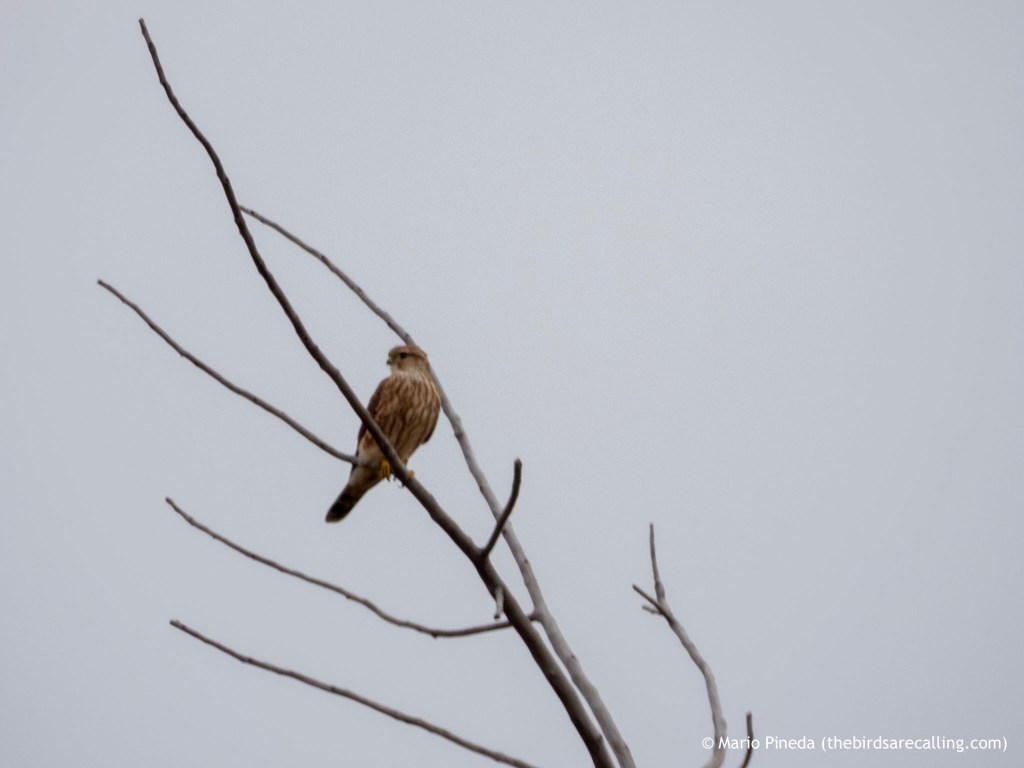
Last time I saw a Merlin was in Camrose during the AB Big Day even on May 4, so when I spotted one perched high up on a dead branch above the Heritage Wetland Park ponds it was a nice treat. It did not stay put for long. After a few minutes it took off, circled the tree tops, scared the bejesus out of a flock of crows and landed high up in another tree. A Pileated Woodpecker caught the Merlin’s attention. It took off again, this time aiming directly for the woodpecker. An adult Pileated Woodpecker is far too big for a Merlin to take down, but I guess it found the woodpecker irritating and scared it into flight. For a few seconds the two were circling each other in the air before each one landed on a new tree. I guess they realized that none of them was really going to scare the other one away so they just accepted each other’s differences. This is the closest I have ever seen a Merlin, but I still had to zoom in all the way to over 1600 mm to get close enough for a positive identification. The picture quality is certainly not stellar but it serves its purpose as far as identification goes. It was not until I came home and was able to cross-reference my picture against field guides that I was 100% sure that it was a Merlin. The Nikon P1000 is a bit of a double edged sword. On one hand, at 1600 mm zoom very few camera setups would be able to get this close, and those that would would be far more unwieldy and expensive. On the other hand, while the 1600 mm is about half of P1000 optical zoom capabilities, the image quality will suffer at this focal length, specially if the camera is hand held.
Merlin (Tamiasciurus hudsonicus) at Whitemud Ravine. September 15, 2019. Nikon P1000, 1613mm @ 35mm, 1/500, f/6.3, ISO 160
May the curiosity be with you. This is from “The Birds are Calling” blog (www.thebirdsarecalling.com). Copyright Mario Pineda.
The Heritage Wetlands is noticeably absent of bird life this time of year as most birds have already left for their southerly overwintering grounds. Today was my lucky day, however. A lonesome Belted Kingfisher was putting in substantial effort looking for its next meal. It was so focused on looking for fish that it did not notice me sneaking up on it as it was perched on the handrail of a wooden boardwalk. Its Lifer #165 and my 116th species on my AB Big Year list. There are 114 species of kingfishers worldwide, but the Belted Kingfisher is the only species found in North America. It is a top predator in both lakes and and along the coast. They can be found in Alberta between April and end of October and spend the winter south of Canada in the United Stated, the Caribbean and throughout Central America. They are funky looking birds with a shaggy crest and a big bill. It was an unexpected find and I spend a long time observing it as it was fishing for its next meal.
May the curiosity be with you. This is from “The Birds are Calling” blog (www.thebirdsarecalling.com). Copyright Mario Pineda.
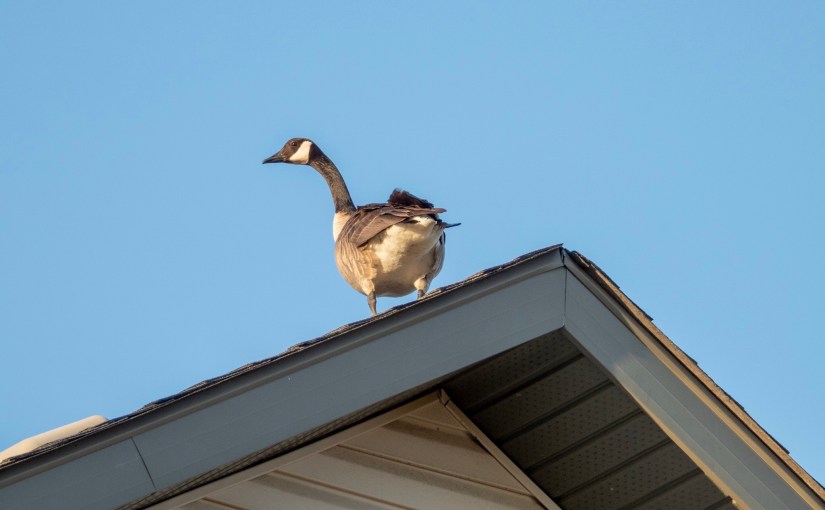
Canada Geese are big birds with an even bigger attitude. There does not seem to be much that faze them. As probably one of the most common birds in these neck of the woods it easy to start ignoring them in favour of more exciting and uncommon birds. This fella, however, was out to make a statement that could not be ignored. Perched on the ridge of the roof of a large house overlooking the the Heritage Wetland Ponds, this Canada Goose was not lacking any self-confidence. I spend quit some time watching it and it seemed quite comfortable hanging out at its lofty and exposed perch. The only predators that could threaten an adult Canada Goose would be non-flying animals such as coyotes, cats (big cat, not your domestic kitty), foxes, dogs and humans. In other words, while this fella may be in an exposed location the biggest threat facing it would be inclement weather. Not on this day though, the sky was blue with not a cloud in sight and this goose was the king (or queen) of this roof.
Nikon P1000, 403mm @ 35mm, 1/200s, f/5, ISO 100. Postprocessed and cropped in Lightroom.
May the curiosity be with you. This is from “The Birds are Calling” blog (www.thebirdsarecalling.com). Copyright Mario Pineda.
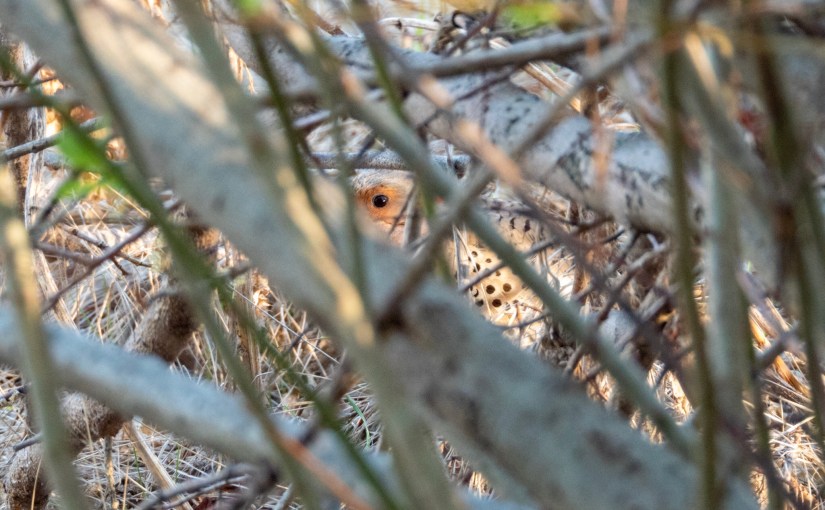
I will be the first one to admit that this picture is a good candidate to post in the Crap Bird Photography group on Facebook (and I will probably share it in that forum). There is more to the story, however, than just a picture of a bird through a jumble of branches. There is a tiny shallow side-pond at the Heritage Wetland Park in Sherwood Park. The pond is surrounded by thick brush and I had never bothered to look at it closely, partly because it is difficult to access through the thick understory and partly because I though it would be too puny for anything interesting to be there. The other day, as I was walking past it, I heard a symphony of croaking from the pond. I have not had much luck with spotting any amphibians to date, but I figure that my luck will never improve if I never try. Said and done. I found what appeared to me as a “weak spot” in the shrubbery and started to slowly make my way through the thick understory. As soon as the pond came within sight the croaking stopped abruptly. This is exactly the same story every time I try to sneak up on frogs. I found a tolerably comfortable spot by the side of the pond. Crouching in the thicket I made myself as comfortable as possible and decided to stay put for a bit so see if the frogs would relax and resume their business. As I was scanning along the water surface, the water’s edge and the shrubbery along the water with my camera I suddenly had to do a double take. In an impenetrable jumble of branches there was an eye looking right at me. I could see bits and pieces of the body of the critter and the pattern was unmistakable, it was a Northern Flicker (Colaptes auratus). It was completely still, not moving a single feather, staring intently at me. So there we were, staring each other down in a human vs bird staring contest. After what appeared like an unreasonable long time I came to my senses and realized that I should probably try to take some pictures, after all the camera had in some miraculous way focused in on the eye of the flicker without getting tricked by all the shrubbery between us. Finding a flicker skulking around on the ground is not uncommon as they are well-known to have a particular fondness for munching on ants.
Nikon P1000, 604mm @ 35mm, 1/60s, f/5, ISO 720. Postprocessed and cropped in Lightroom.
May the curiosity be with you. This is from “The Birds are Calling” blog (www.thebirdsarecalling.com). Copyright Mario Pineda.
It is difficult imagining getting bored of watching birds. With 6 months and 2 days of birding under my belt in three different countries and on two continents every nature walk is like a box of chocolates; you never know what you will see. The diversity in appearance and behaviour seems never ending. Some birds are colourful, some have eccentric behaviours others have impressive physical attributes or perform remarkable physical feats. Then there are those birds that have style. They have brio. They are the Dany and Rusty (as in the Ocean’s film series) of the birding world. Purple Martins (Progne subis) at Heritage Wetlands Park in Sherwood Park definitely belong to this last category. Here they occupy elaborate multi-story bird mansions that balance on tall stakes high above the reeds. When they are not enjoying the vistas from their lofty perches they skip back and forth over the ponds in agile death defying maneuvers.
May the curiosity be with you. This is from “The Birds are Calling” blog (www.thebirdsarecalling.com). Copyright Mario Pineda.
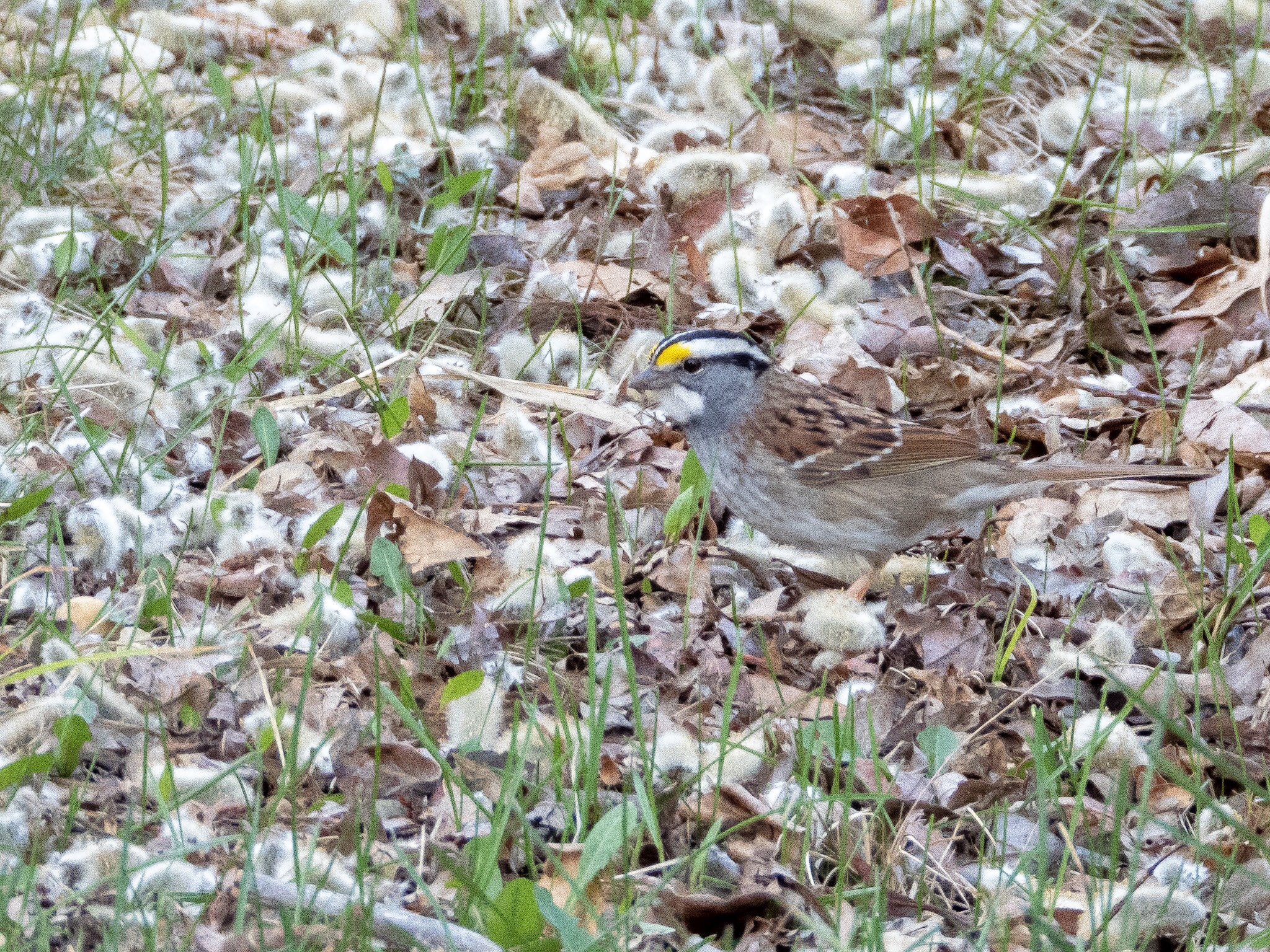
The White-throated Sparrow (Zonotrichia albicollis) has been at the top of my bird wish list ever since I embarked on this journey in December. After signing up for eBird I set up a rare bird email alert. The number of alerts I received throughout the winter were few and far in-between, but there are two particularly notable alerts. The first one was a heron sighting in Hermitage Park in mid-February. Sadly, but not surprisingly, subsequent sightnings suggests that it did not make it though the winter. The second memorable alert actually consisted of a series of intermittent alerts of White-throated Sparrow sighting. Their normal wintering grounds are a few thousand kilometres south-east of here, in the southern and eastern United States along the Atlantic and Gulf of Mexico coast. For some reason, however, every few weeks or so through the winter the odd individual was spotted in or around Edmonton. Sightings like these during the brutal central Alberta winter are extraordinary and rise many questions. Why did they stay behind? Were they lost? Did they make it through the winter? This unassuming sparrow is subtly beautiful with its black and white striped head, yellow lores (the area between the eye and the bill on the side of the head) and a white patch under its bill. It almost looked like a dolled up house sparrow. I spotted this lovely looking fellow (not sure if it a male or female) in the brush along the trail in Heritage Wetland Park in Sherwood Park.
May the curiosity be with you. This is from “The Birds are Calling” blog (www.thebirdsarecalling.com). Copyright Mario Pineda.
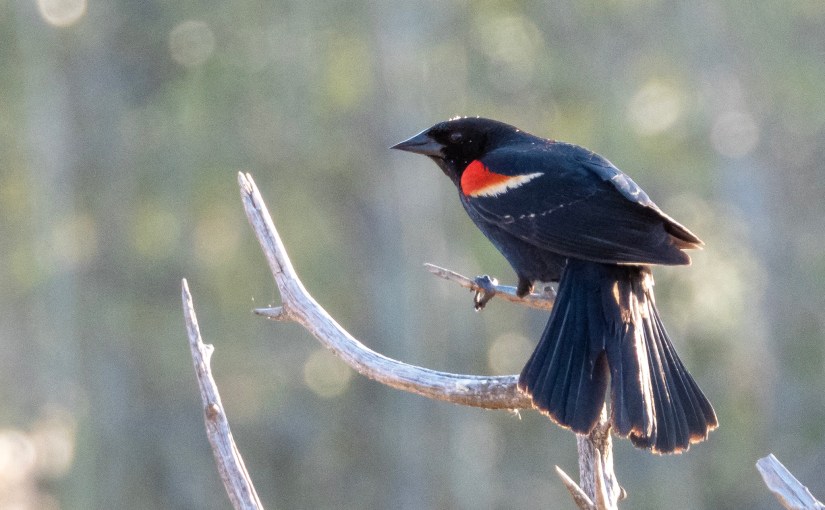
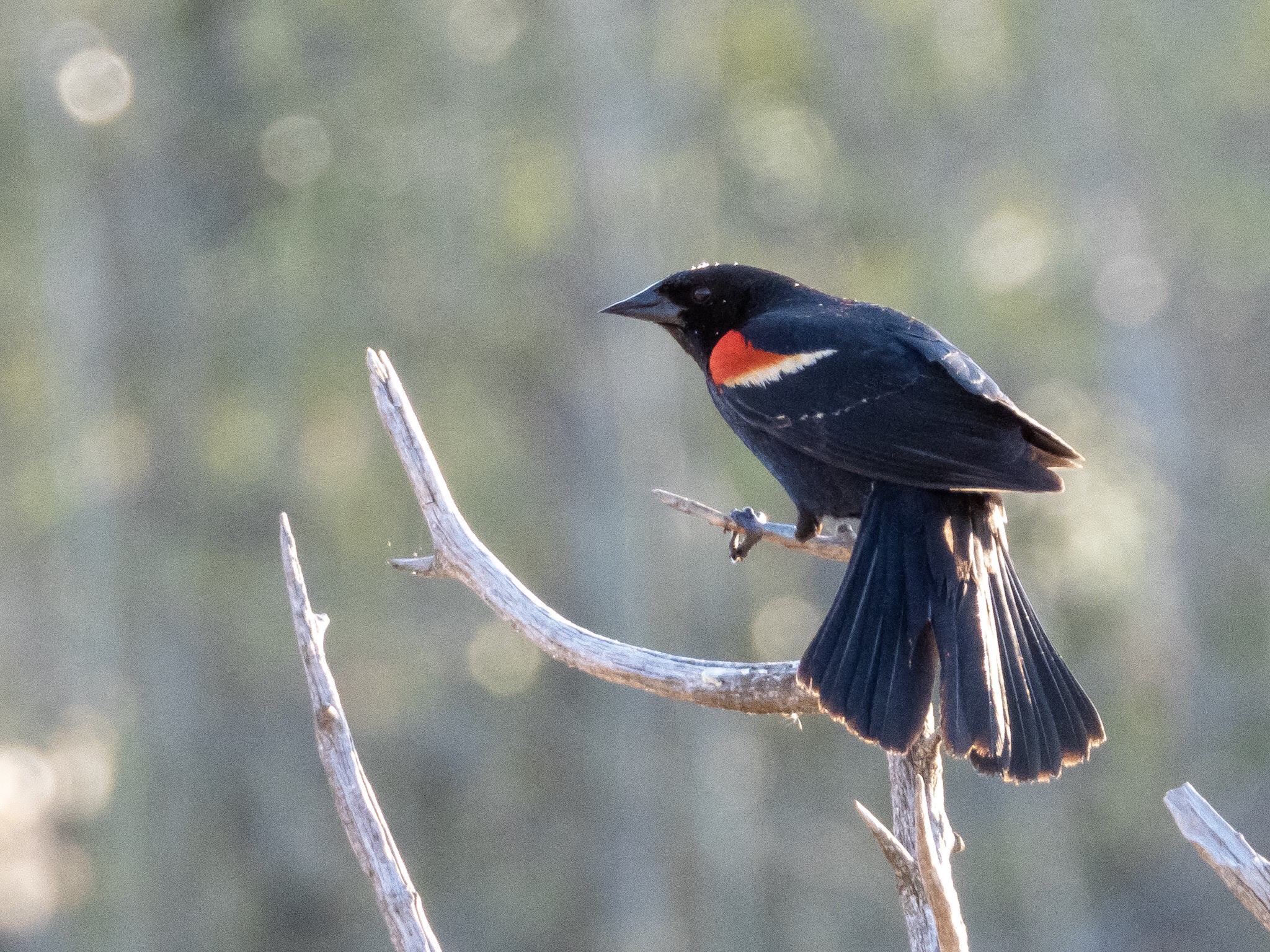
The Red-winged Blackbirds (Agelaius phoeniceus) have been back from their southern wintering grounds for quite some time now, but more and more of them seem to be appearing by the day. During my last visit at the Heritage Wetland Park in Sherwood Park their distinctive metal clanging vocalizations reverberated all over the wetland. I tried to keep a tally of their numbers but I gave up when I reached 30 and instead focused my attention on the other species that were there. While the male blackbirds were very abundant, there was a smaller number of females around as well. This was the first time I have seen female Red-winged Blackbirds. They have the same overall size and shape as the males, but none of the colours. Instead they are brown streaked and almost look like enormous sparrows. Their behaviour differs as well. While the males tend to perch on exposed high locations in the reed or on tree branches vocalizing and showing off, the females only seemed to be hanging out inside the reeds, occasionally coming out into the top level of the reeds. They seemed to check out the situation and then quickly dive back into the cover of the reeds again.
May the curiosity be with you. This is from “The Birds are Calling” blog (www.thebirdsarecalling.com). Copyright Mario Pineda.