Birding Where the Land Ends

There are places on this planet where the map feels strained—where the continent tapers into something thin and improbable, where the very idea of a “human-habitable world” feels like a fragile negotiation between geology and stubborn human will. Chile is one of those places. The Mapuche knew what they were talking about: “Chilli” is often translated as “where the land ends.” Chile is a long, ribbon of earth clinging to the side of a continent, daring you to follow its length. And since I have a particular fondness for walking along the quiet edges of the world in search of all manner of critters, it was too much of a temptation to resist. So last August, I crossed hemispheres—trading Edmonton’s summer for Chile’s winter—and stepped onto a long, narrow blade of earth pressed between the largest ocean and the longest continental mountain range on the planet: a country balanced on a literal and metaphorical knife’s edge.

Chile: a thin red blade stitched to the western edge of South America—one country, nearly every climate. It’s hemmed in on all four sides: the Pacific seals the west; the Andes wall off the east; the Atacama Desert acts as a harsh ecological gatekeeper to the north; and to the south, Patagonia dissolves into fjords and the storm-battered Southern Ocean, where the continent finally breaks apart. No labels needed—its borders are written in water, rock, and wind.

Chile is a biogeographic island perilously lashed to the side of South America, isolated in all four directions by barriers that shape everything from range limits to endemism. To the west lies the Pacific—an ocean so vast it rewires your sense of scale. Standing on the coast in Cachagua, a few hours north of Valparaíso, scanning for Humboldt Penguins with wind-driven salt in my face, it felt like seawatching at the edge of the world: steel-blue, bottomless, and indifferent. From roughly 33°S, the next major landfall due west is Australia—on the order of 12,700 km away—an absurd distance that puts the isolation of this coast into perspective. To the east, the Andes rise as a jagged spine: the longest continental mountain range on Earth, with peaks over 6,000 m and high-elevation deserts and wetlands around 4,500 m, where the air itself becomes a limiting factor. To the north, the Atacama—vast, hyper-arid, and in many places high—functions as a near-insurmountable ecological barrier as real as any ocean, constraining movement and compressing life into rare oasis of water and vegetation. Finally, to the south, Chile tapers into the end of the continent and the violence of the Southern Ocean—Patagonia giving way to the Drake Passage—another boundary that is less a line on a map than a fundamental ecological divide. Chile’s most obvious turnover is the strong latitudinal gradient (north–south), but the revelation in the field was the longitudinal gradient (west–east): here, an afternoon’s drive can feel like a crossing between planets.

The birding began in earnest on the coast in the sleepy village of Cachagua, where the primary target was Humboldt Penguins that often loaf on a tiny rocky island just offshore. Isla Cachagua is close enough to allow one to easily observe its local feathered inhabitants from the mainland, but just far enough to keep people from simply wading over and ruining it.

Watching Humboldt Penguins at Isla Cachagua during the austral winter (August). Hence the toque.
Humboldt Penguin on Isla Cachagua doing what penguins do best: looking cool as a cucumber.

From the coast, the road veered inward, cutting through the matorral—those sun-toughened scrublands that stretch across central Chile like an ancient memory. Narrow valleys carved into the mountains feel like scars: deep, ageless, reminders of tectonic violence and water’s patient insistence. We followed those valleys north, and with each bend the country subtly changed—light sharpening, air drying, slopes steepening—while we kept scanning the hills, the wires, the roadside scrub, the sky.
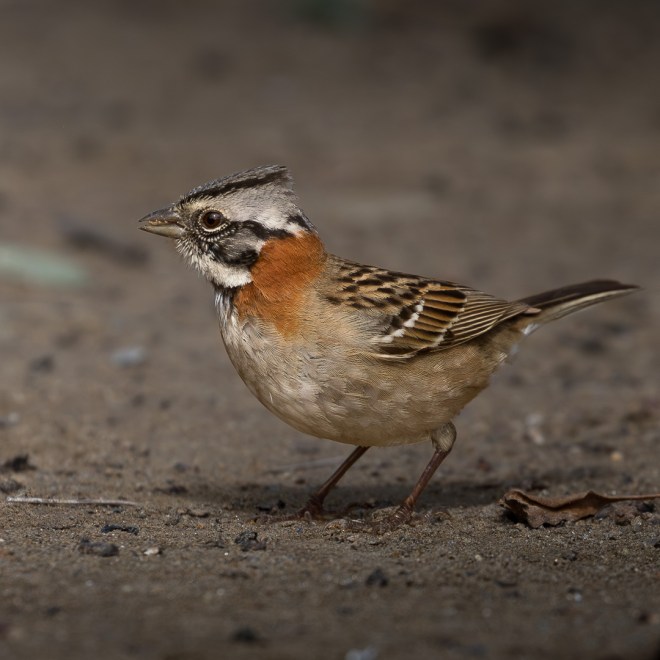
Rufous-collared Sparrow (chincol): the bird that becomes “familiar” fast—bold, musical, and everywhere from city plazas to foothills.
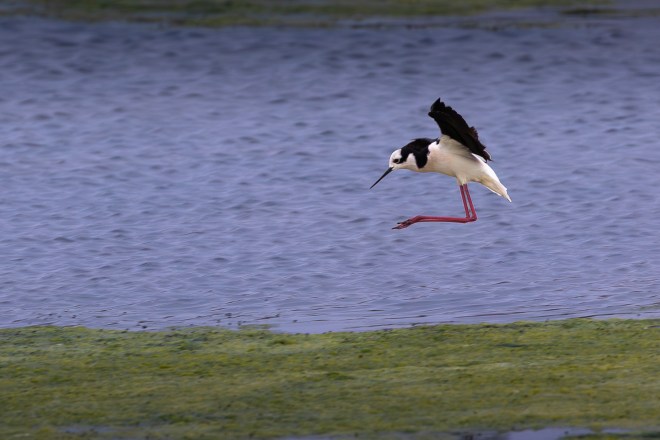
A Black-legged Stilt (Himantopus mexicanus) coming in for a landing at Humedal de Los Choros—known locally as “Perrito” (puppy) for its sharp, yapping calls.

Farther north, the country begins to feel like it is shedding moisture and mercy. The desert doesn’t arrive all at once—it advances in increments, reclaiming greens, simplifying the palette, hardening the light. By the time you reach Parque Nacional Pan de Azúcar (Sugar Loaf National Park)—named for the offshore Isla Pan de Azúcar, whose guano-whitened rock was said in 19th-century accounts to resemble the old “sugar loaves” shipped as white blocks—the Atacama doesn’t so much meet the Pacific as collide with it.

Pan de Azúcar is the embodiment of contradiction: the driest desert on Earth crashing into one of the richest oceans. The cold Humboldt Current drives nutrient-rich upwelling offshore and rolls in fog (locally known as the camanchaca) that looks like mercy but rarely delivers rain—moisture without relief, a thin, silvery lifeline in a landscape that gets almost none. The desert stays severe right to the edge: sun-bleached slopes breaking abruptly into cold, steel-blue depths. Cacti cling to cliffs above seabirds riding the wind, guanacos drift across barren ridgelines, and life persists in the narrowest of margins—aridity fed by fog, abundance hidden beneath hostile surfaces.

Parque Nacional Pan de Azúcar — where the Atacama doesn’t so much “meet” the Pacific as collide with it. One of Earth’s strangest borders: stark desert on land, astonishing abundance at sea, and a razor-narrow strip in between where life survives on mist.

Eventually the shift becomes unmistakable. Green retreats. Sand and stone take over. The light turns whiter, harsher, more honest. We were now properly inside the Atacama: one of the world’s highest and driest deserts.

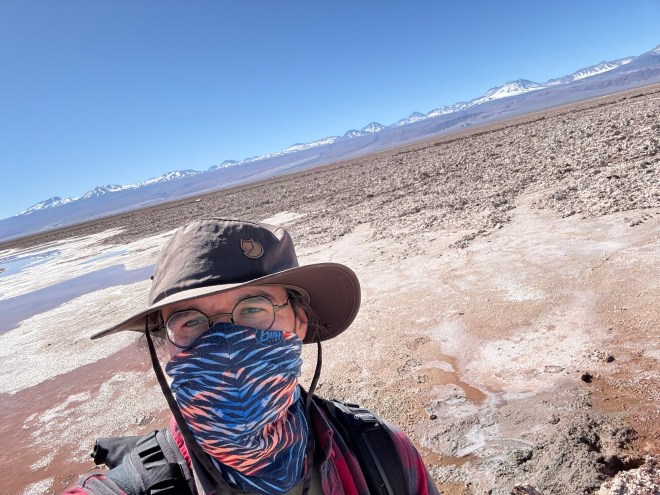
The Atacama itself is a place of hard light, salt-crusted flats, wind-scoured valleys, and volcanoes cut clean against an unnervingly blue sky—where water is so scarce that every trace of life feels earned, and the landscape reads like geology stripped down to its purest sentences. As we traversed the vast expanse, we met only one other car all day. We pulled over for a photo; it passed us, then stopped to ask if we had “extra gas.” That’s the kind of question you only get asked in a place where a bad decision becomes a real problem.
Near San Pedro de Atacama, the landscape flips between bofedales—high-Andean sponge wetlands fed by springs and snowmelt—and salars, salt flats built one evaporated puddle at a time. The pale crust underfoot is what happens when water disappears and minerals refuse to leave. And yes, the face scarf is less “mysterious outlaw” and more “4,000+ metres of bone-dry air and a sun that does not negotiate.”…, although I like the sound of “mysterious outlaw”.
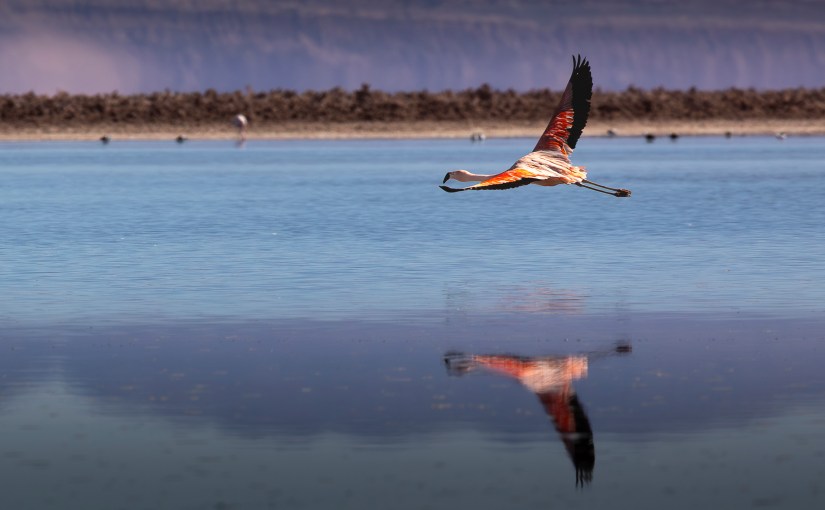
Reserva Nacional Los Flamencos: mineral-rich waters, stark volcanoes, and the kind of habitat that reliably draws waterbirds—especially Chilean, Andean, and James’s flamingos.

There is so much more to explore in this remarkable part of the world, but two specific items we was not able to check off my bucket list this time around were El Desierto Florido—the “flowering desert”—and the elusive Diademed Sandpiper-Plover.

As the matorral transitions to the Atacama, in years when the austral winter rains are unusually strong, dormant seeds burst into life, covering the landscape in carpets of purple, pink, yellow, and white. It’s brief, unpredictable, and spectacular—an explosion of color in a place that is normally defined by silence, salt, and stone. I thought I had timed everything perfectly to bear witness to this phenomenon, but nature does not follow an itinerary. This time around, for reasons unknown, El Desierto Florido was late by about a month and by the time it arrived I was long gone.

The second item we were not able to cross off was the Diademed Sandpiper-Plover (Phegornis mitchellii) aka referred to as the DSP among birding Uber nerds and locally known as Chorlo Cordillerano. After a few thousand kilometers—or maybe it was the thin air—we started calling it El Pollito (the little chicken). El Pollito looks like a diminutive shorebird with its long bill and long legs, except it doesn’t live at the shore. It lives on a razor-thin line between earth and sky—an elusive jewel of the high-Andean bogs, wearing a crown of silver feathers and appearing only to those willing to search where most birds, and most people, never dare to go. It is a rare and coveted find among birders. We certainly put in the miles chasing it. It certainly refused to appear.

At 4,500 m, the Andean bofedal isn’t just “a wetland”—it’s a living sponge stitched into the Altiplano, where icy springs and streamlets spread into a quilt of peat, mosses, and tough grasses that keeps life going above the tree line. This one—Río de Juana / Vega on Ruta B-159, near the Bolivian border—was our Diademed Sandpiper-Plover (DSP) stakeout, the kind of place you scan inch by inch because the rarest birds can vanish into the vegetation. We never did find the DSP, but the bofedal paid us back anyway: vicuñas calmly grazing in the channel, Lesser Rheas striding the margins, Andean Geese and Crested Ducks on the water, and cinclodes, ground-tyrants, and sierra-finches working the turf—so remarkably tame we could simply stand there, wide-eyed, and let the high Andes come to us.
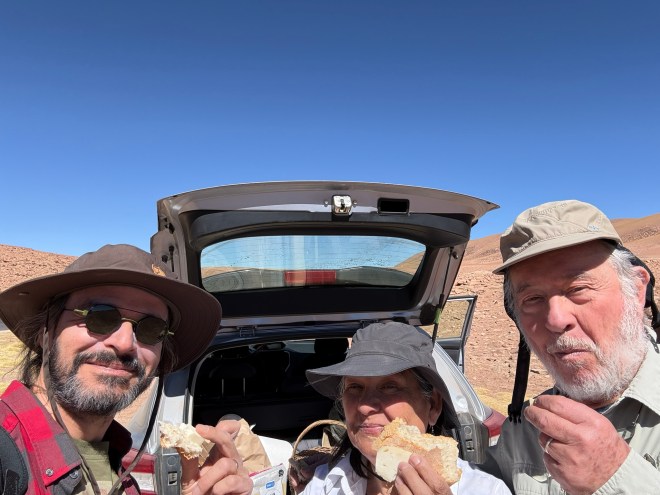
Altiplano picnic, bofedal edition: three humans gathered around the sacred open trunk, aggressively inhaling sandwiches at 4,500 m while the sun tries to cook us like empanadas. We’d spent days scanning these high-Andean “sponges” for the Chorlo Cordillerano, and somewhere along the way it stopped being a rare bird and became a mythic little character we just called El Pollito (the little chicken). No Pollito appeared, but the bofedal still felt like a feast: vicuñas grazing beside the stream like judges, birds everywhere, and us trying to look casual while breathing felt like advanced math.

By the time we turned south again, swinging back toward Santiago and sea level, we had travelled close to 5,000 km—a journey measured not only by distance but by gradients: altitude, light, wind, silence, and, of course, birds. For the full, site-by-site accounting—every checklist, every species, and the exact locations—the complete record is available as an eBird trip report.
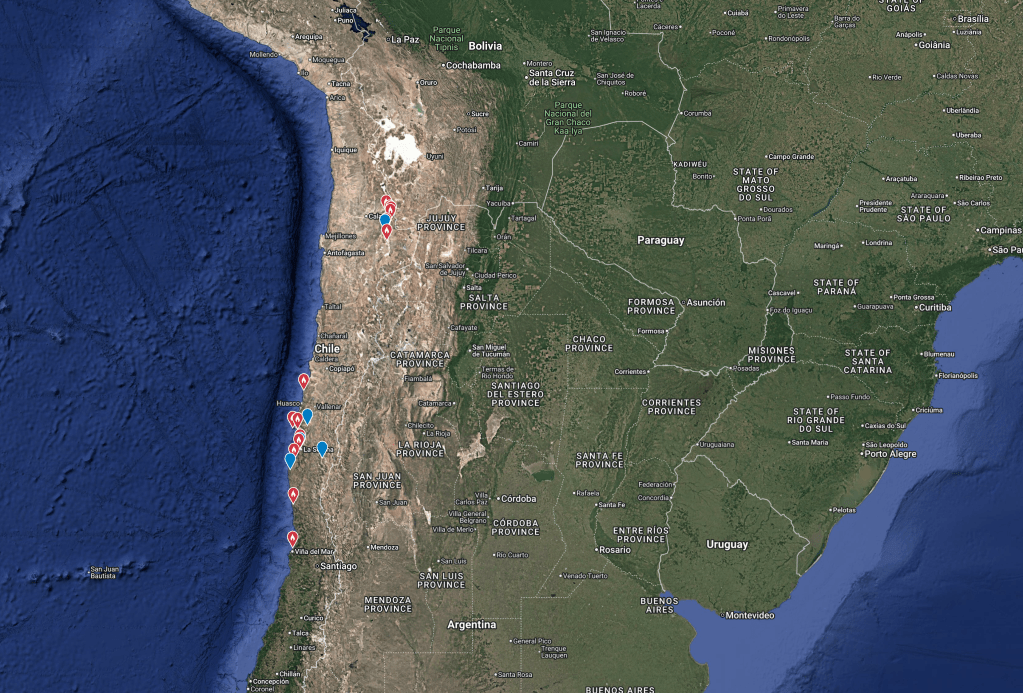
A map of the trip stitches it all together—coastal seawatches and wetlands linked to the high-Andean desert edge—each point a checklist, each pin a moment.

So we never got to see El Desierto Florido or El Pollito. But perhaps leaving a few wants hanging has a silver lining: it gives me two more reasons (not that I need them) to return to this magical country at the edge of the world. In the meantime, I’m back on my home turf, and to borrow the words of Chilean poet Pablo Neruda: ‘I returned from my travels; I sailed on, building joy.’

Regresé de mis viajes, navegué construyendo la alegría
A beam at the entrance of Pablo Neruda’s house, Casa de Isla Negra: “Regresé de mis viajes, navegué construyendo la alegría” (I returned from my travels; I sailed on, building joy).

May the curiosity be with you. This is from “The Birds are Calling” blog (www.thebirdsarecalling.com). Copyright Mario Pineda.
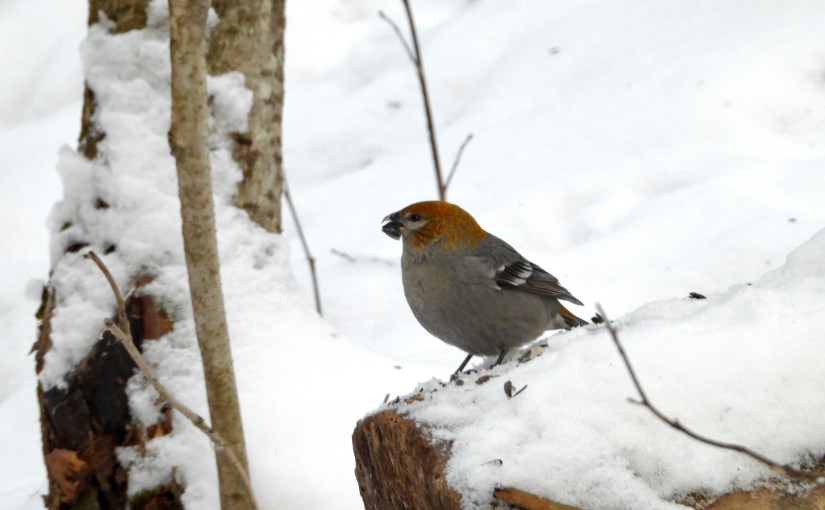
Anniversary Pine Grosbeaks

After a long birding hiatus the indoor isolation of these crazy times finally caught up with me. On a whim, I took a few hours off in the afternoon and headed down to the Whitemud Creek, for the first time in seven months.

3 km leisurely stroll along the Whitemud Creek looking for its winter inhabitants.

The usual suspects greeted me along the trail – Black-capped Chickadees, Nuthatches, Magpies and Red Squirrels. But as luck would have it there was something else in store on this day. Further along the trail, high up in a tree, I was able to discern three plump shadow hoping around on the bare branches. With the bright sky as backdrop it was tricky to make out any identifying characteristics, but it was soon evident that this was a new one. While I was ogling the suspects two other birders arrived. They too were stumped by the unidentified flying objects. I always though it would take more than a wee bit of courage for birders to admit to each other that they have no clue what bird they are looking at. But here we were, the three of us staring at these three plump silhouettes and all we were able to agree on was what it could not be. To small for waxwings or robins, too large and plump to be red polls or any other common finch. After going back and forth one of us managed to find a possible match using Merlin…, Pine Grosbeaks. It immediately dawn on me – here I am birding for the first time in seven months and I spot a lifer. More specifically #167. Later on as I was looking at my stats in eBird I realized that the previous lifer was on December 15 (one year and one day ago) at the same spot, along Whitemud Creek (a Black-backed Woodpecker).

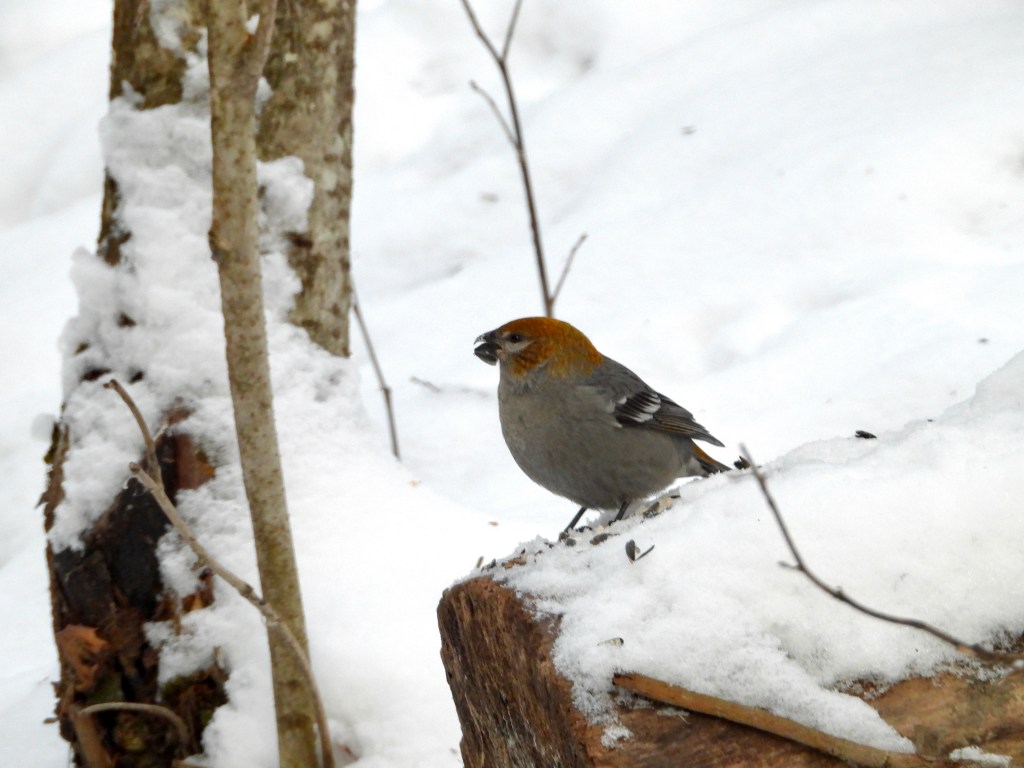
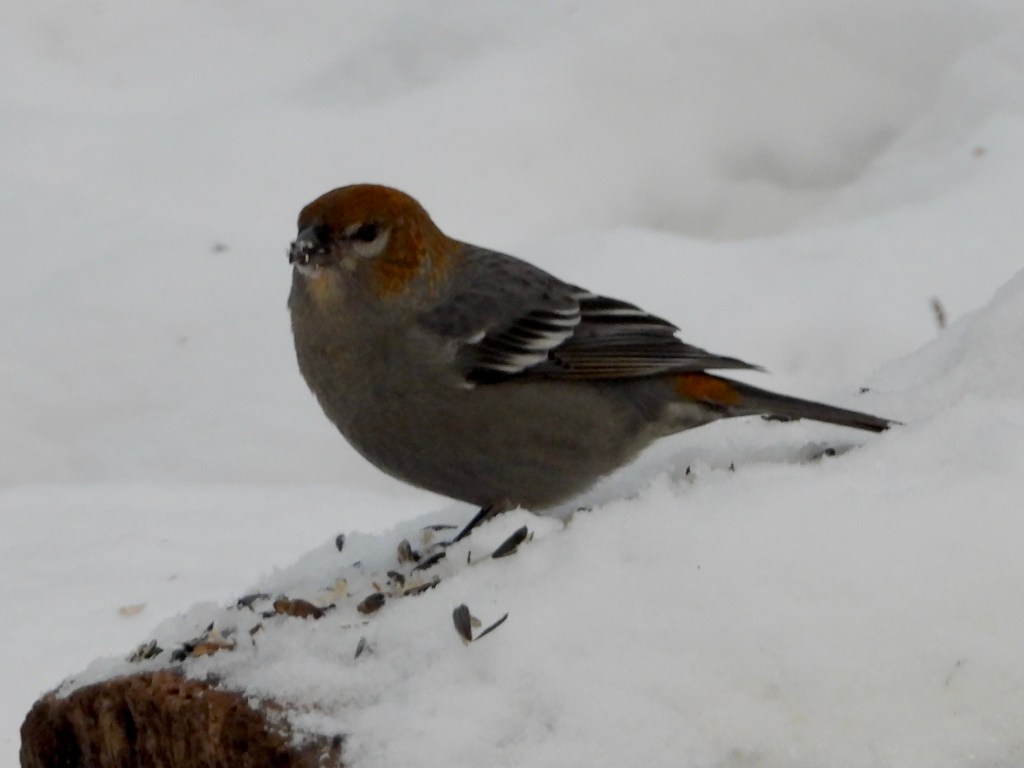
Pine Grosbeak munching on sunflower seeds along the trail.

Perhaps by coincident or perhaps through some sort of subconscious decision today, December 16, also turned out to be the two year anniversary of me starting birding. Exactly two years ago I brought my newly acquired Nikon Monarchs to my first birdingouting to the Beaver Hills Bird Observatory. It was a snowy and cold day, just like today. That was 185 checklists and 167 species ago. That day I racked up my first eight lifers.

Was the Pine Grosbeak’s auspicious timing a sign that it is time to pickup the binocular and camera again and head back into the green? Is it a sign that the time is ripe to get back to this blog. Maybe. The world has changed in the past seven months. I used to always looked forward to and plan grand trips to far-off destination, binoculars and camera in hand, hunting for new birds. These days, working from home and limiting even local outing, travel is out of the question and all these plans and dreams seem out of reach. The first big trip I did as a birder was to Chile and Argentina. The birds of southern South America blew me away (and this part of the continent is not even know for its bird diversity) and before I even returned to Canadian soil, the next trip to South America was already confirmed. We would have arrived in Chile this week…, of-course none of that happened and who knows when we can dare to dream about trips like that again.

I leave you with a snapshot from a rainy and grey day in Southern Chile. Its the day we managed to finally track down the glorious Torrent Duck. Yes, it was rainy, grey, one of us was suffering from Montezuma’s Revenge and the Torrent Ducks were tiny specks in the far distance…, yet it was one of the birding highlights of the trip. I can wait returning to the land of the Torrent Duck.

Spotting Torrent Ducks in the distance on December 29, 2018 on an overpass on the local highway in the Araucania Region in Southern Chile

Project 366 – Post No. 290 – Black-necked Swan

What is Project 366? Read more here.

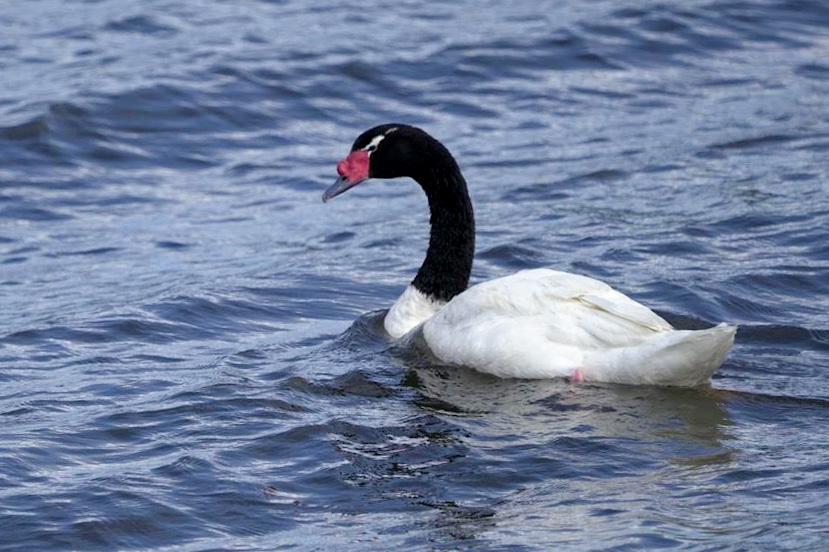
As the temperatures continue to be bitterly cold (sitting at a crispy -31 °C as we speak) one can only dream of past warmer birding outings. About a year ago I was road tripping along dusty country roads in Chile and came across a Black-necked Swan bobbing on a salt water lake in Boca Budi. The Black-necked Swan is unmistakable and is just what the name says: a swan with a black neck. Although it is the smallest member in its genus it is the largest waterfowl native to South America.

May the curiosity be with you. This is from “The Birds are Calling” blog (www.thebirdsarecalling.com). Copyright Mario Pineda.
Project 366 – Post No. 286 – A splash of summer in the middle of the winter

What is Project 366? Read more here.

Exactly one year ago I returned from a trip to Chile. Of course, Chile being in the Southern Hemisphere meant that December and January was the middle of the summer. So, on this day when the mercury is is at -26 °C here in Edmonton a splash of summer seems quite appropriate. I came across, what looked like, Daisies on a meadow in the province of Araucania, about 1000 km south of Santiago on Christmas Day.

May the curiosity be with you. This is from “The Birds are Calling” blog (www.thebirdsarecalling.com). Copyright Mario Pineda.
Project 366 – Post No. 276 – New Year’s jackrabbit

What is Project 366? Read more here.

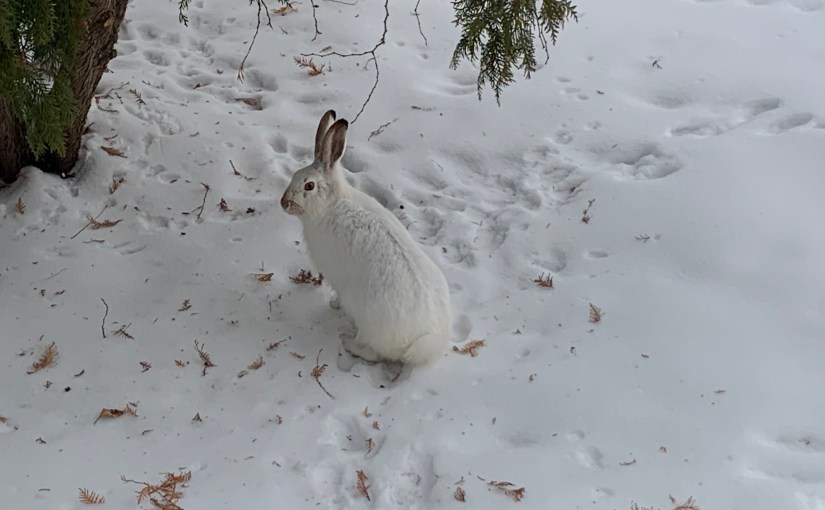
2019 is coming to an end tonight and so is my Alberta Big Year. It seems appropriate to reflect back on the year that has past and some of the accomplishments and memorable moments. But first, let me introduce the New Year’s jackrabbit. This not so little fella was a complete surprise. It was hiding under a juniper bush right outside my front door. I already knew that someone liked to hang out under the bush as there are always fresh tracks in the snow. This is the first time, however, I caught the culprit. What ensued was a bit of a stare-down contest. The jackrabbit was just sitting there starting at me and did not seem to want to budge. Eventually it leisurely hopped away, crossing the street without even checking for any cars.

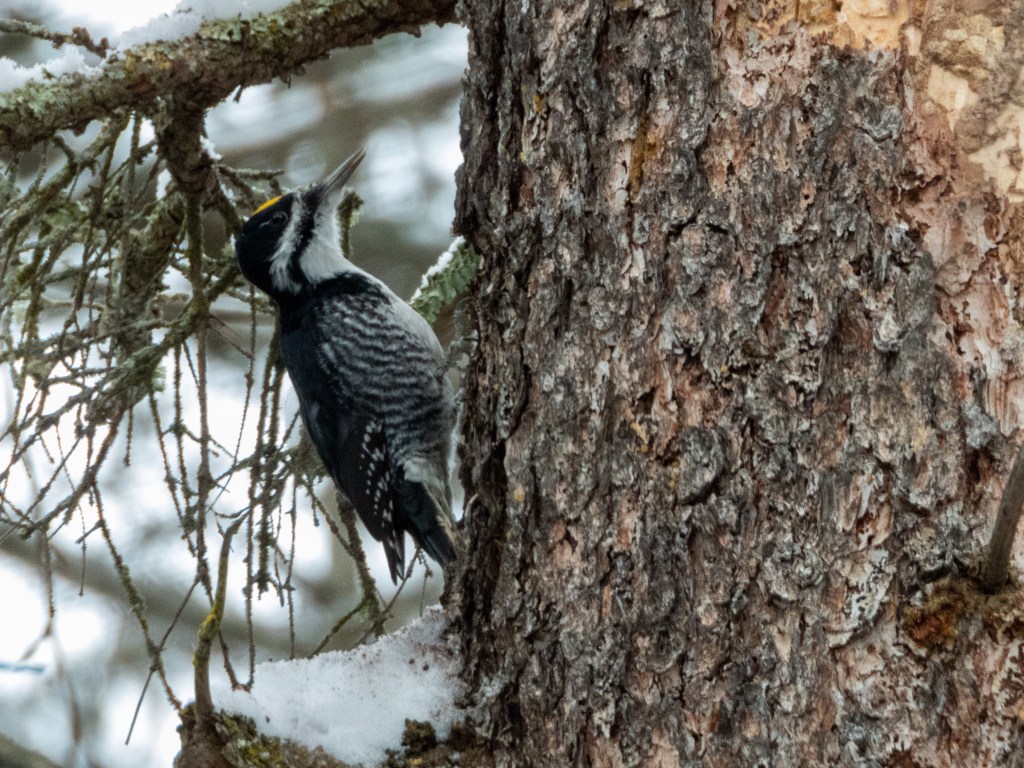
As my 2019 AB Big Year is coming to an end my final tally is 117 species, starting with a Downy Woodpecker on January 13 at Beaverhill Bird Observatory and ending with a Black-backed Woodpecker on December 15 in the Whitemud Ravine. I was hoping to reach a higher number but technical difficulties with our vehicle effectively eliminated all out-of town excursions about half way through the year (the number of checklist submissions drops in June due to this). Because of this, most of my birding excursions over the last 6 months have been to locations within the city limits, with the most common location being the Whitemud Ravine.

Last lifer of the year, a Black-backed Woodpecker in the Whitemud Ravine on December 15.

Globally I saw a total of 145 species in three different countries (Canada, Chile and Argentina). The first bird of the year was a Yellow-billed Pintail (Anas georgica) in the Ancapuli Humedal (wetland) in Araucania, Chile. The highlight of my birding year was definitely my trip to Chile and Argentina where I scored 53 lifers.

I am looking forward to the new year and the birding and nature adventures it will bring. With this being post 176 there are 90 posts left of Project 366. I feel like I am on a roll and the post have become a daily ritual. As Project 366 wraps up, however, I will likely take my birding and nature walks in different directions.

The unforgettable rainy moment when we spotted a male and female Torrent Duck (Merganetta armata) doing their thing in the raging rapids in Río Allipén , Araucania, Chile.

May the curiosity be with you. This is from “The Birds are Calling” blog (www.thebirdsarecalling.com). Copyright Mario Pineda.

Project 366 – Post No. 273 – Cormorant colony

What is Project 366? Read more here.

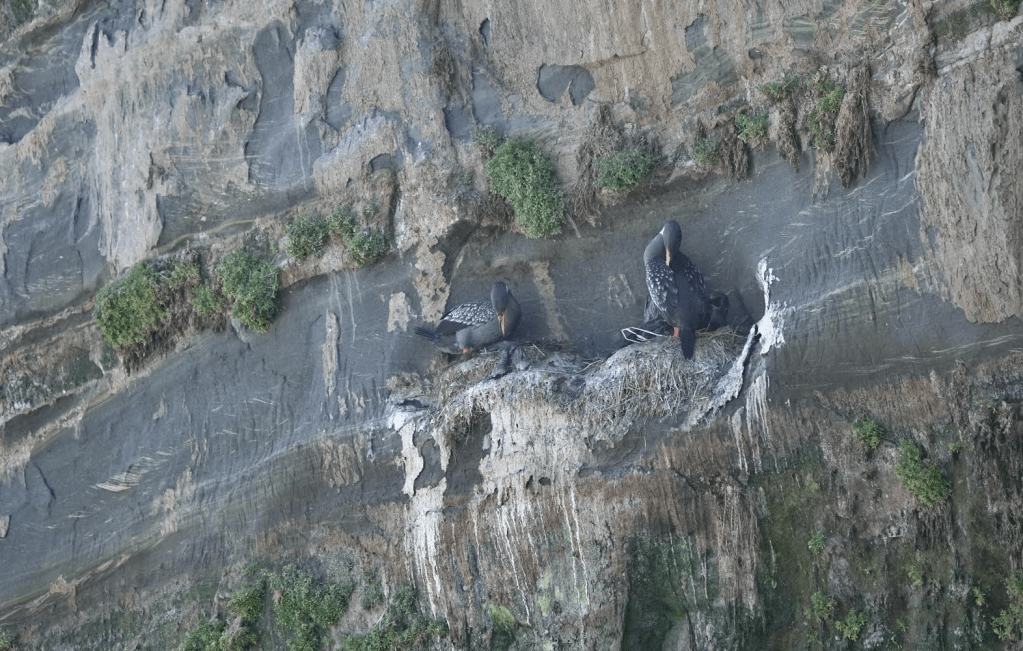
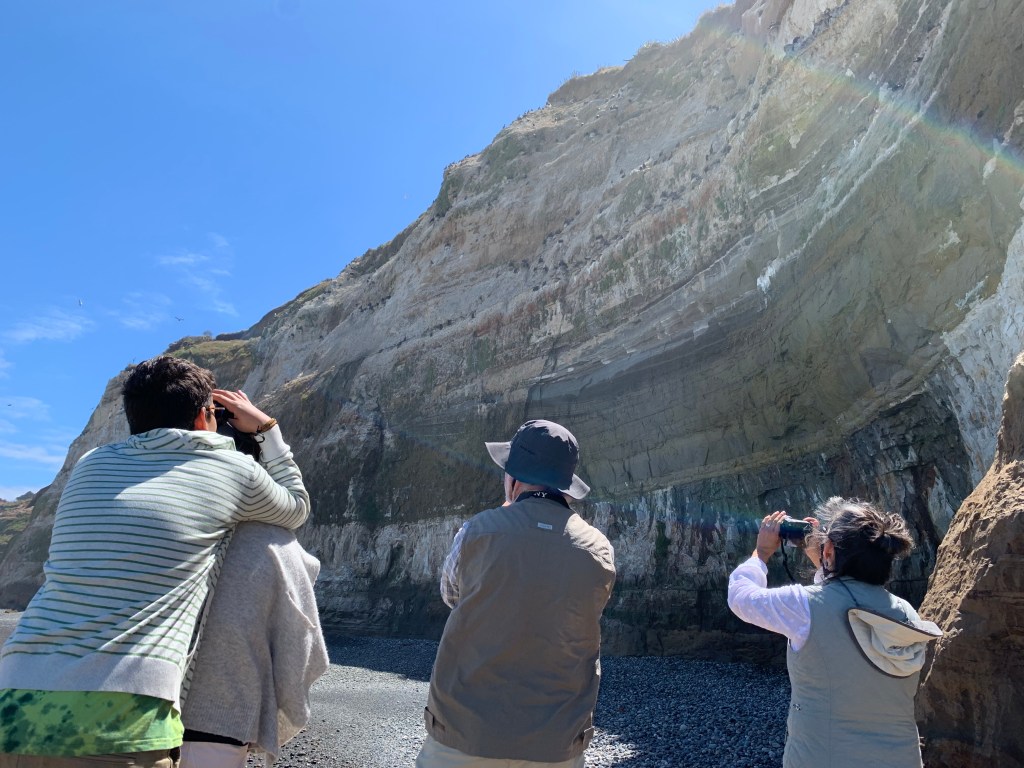
On this day a year ago I was in the southern hemisphere at the edge of the Pacific Ocean in a small seaside village called Puerto Saavedra around 38th southern parallel. As we were walking along the ocean, Red-legged Cormorants were skimming along the tips of the breaking waves on their way out towards the sea or on their way back towards the shore. The inbound cormorants disappeared behind a cliff face jutting out across the beach. We made our way towards the cliff and as we emerged on the other side of the bend the cliff face continued into the distance. The cliff face closes to us was covered in Red-legged cormorants both sitting in pairs on tiny ledges. It was a spectacular sight and completely unexpected as there did not seem to be a report that there was a cormorant colony located here. While there were a few reports Red-legged Cormorants in this area on eBird, no report had been submitted from this exact location and with this many birds. The largest reported number of individuals was 88 birds from a location several hundred meters south of our colony while the rest of the handful of reports only counted a few individuals. There must have been several hundred birds visible on the cliff and quite likely there were many more past the next bend a few hundred meters away. The Red-legged Cormorants, locally referred to as Lile, are handsome looking and quite distinct from other cormorants I have seen. They are predominantly smoky grey colored with a white patch on their neck and red feet. Wikipedia reports that it is a non-colonial seabird living in pairs or small groups while eBird reports it as “scattered individuals”. Our observation would suggest that they do indeed live in colonies (at least on occasion). It is worth mentioning that Jaramillo’s field guide to The Birds of Chile states that the Red-legged Cormorant “breeds in loose colonies on cliffs”. I am with Jaramillo on this one!

Since this was during my pre-camera days the following pictures were taken by our fellow photographing birders on this day (Thanks Patricia and Francisco).

Red-legged Cormorant coming in for landing at the edge of the cliff. Photo courtesy of Patricia and Francisco.
A couple of cormorants barely hanging on to the cliff which at this location was past vertical. Photo courtesy of Patricia and Francisco.
Counting cormorants.

Our eBird report for the day went as follows:

 Boca Budi, Araucanía, CL
Dec 27, 2018 11:41 AM - 1:28 PM
Protocol: Traveling
1.531 kilometer(s)
4 species
Kelp Gull (Larus dominicanus)  4
Red-legged Cormorant (Phalacrocorax gaimardi)  300     Nesting colony on cliff face. 100 m north along the beach from Boca Budi restaurant (38*49’17’’S 73*23’57’’). Adults collecting seaweed for nest building. Many nests with visible chick and adult feeding behaviour. Estimated minimum 300 individuals on cliff gave from photo. More individuals were seen flying in and out bound beyond far cliff strongly suggesting that 300 is an underestimate. All observed individuals exhibited characteristics identification marks of the species (whitish patch on neck sides, grey upper and underparts, bright yellow bill and red legs)
Turkey Vulture (Cathartes aura)  2
Chimango Caracara (Milvago chimango)  2 

After spending a long time admiring the cormorants it had become lunch time, so we for a bite to eat to the restaurant mentioned in the report. Recently I found out that the restaurant, which used to be perched perilously at the very edge of the sea, was claimed by the sea during the Chilean winter. I wonder what has happened to the cormorant colony. While most of the nests were well out of reach of the waves, it was evident that the pounding action of the waves was “eating away” at the base of the cliff and that the cliff was likely not very stable.

May the curiosity be with you. This is from “The Birds are Calling” blog (www.thebirdsarecalling.com). Copyright Mario Pineda.

Project 366 – Post No. 268 – Birding in Araucanía lacustre

What is Project 366? Read more here.

On this day last year – December 23, 2018 – I landed in Araucanía lacustre, Chile. It was my first trip abroad as a birder and I was super excited about many things, but in particular the prospects of birding in the Southern Hemisphere. It was my first visit in Chile, the first time back in South America in about 40 years and the first time back in the Southern Hemisphere in about two decades. I was travelling light carrying only a single carry-on bag. These were pre-camera days, so in terms of birding gear all I had was my Nikon Monarchs and Alvaro Jaramillo’s Birds of Chile. After a layover in Cancun and an overnight layover in Santiago the last leg of my journey took me to Araucanía lacustre, about 800 km south of Santiago known for its lakes and volcanoes. My final destination was the country side close to the small town Villarica situated at the foot of a snow-covered and smoking volcano.

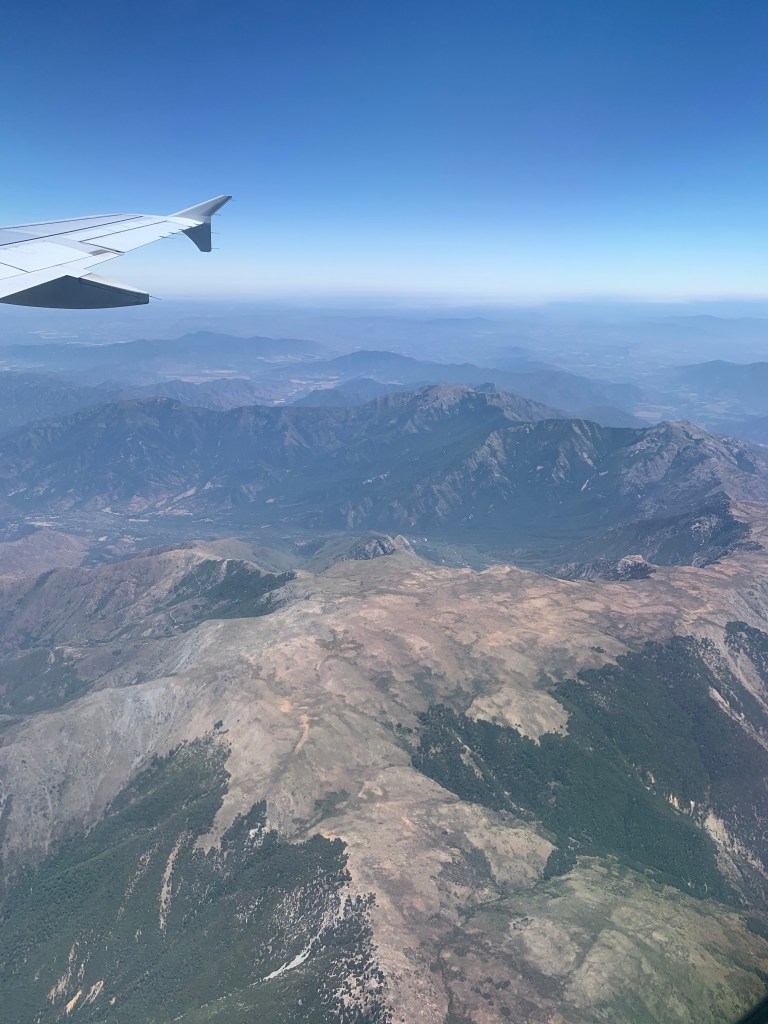
A view of the Andes between Santiago and Araucanía lacustre.

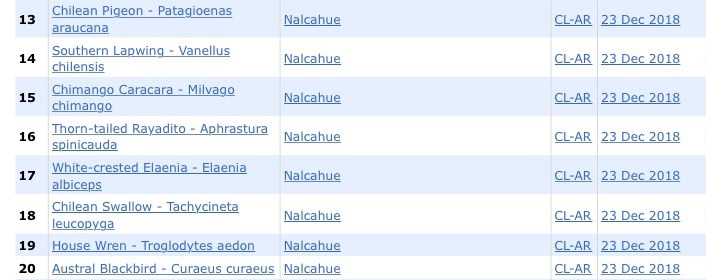
On my first day in and around Villarica I saw eight new species. Over the next three weeks in the Austral summer I would see a total of 53 species of birds in an unforgettable adventure.

The tally from the first day in Araucanía lacustre.

May the curiosity be with you. This is from “The Birds are Calling” blog (www.thebirdsarecalling.com). Copyright Mario Pineda.
Project 366 – Post No. 035 – Tree Swallow

What is Project 366? Read more here!

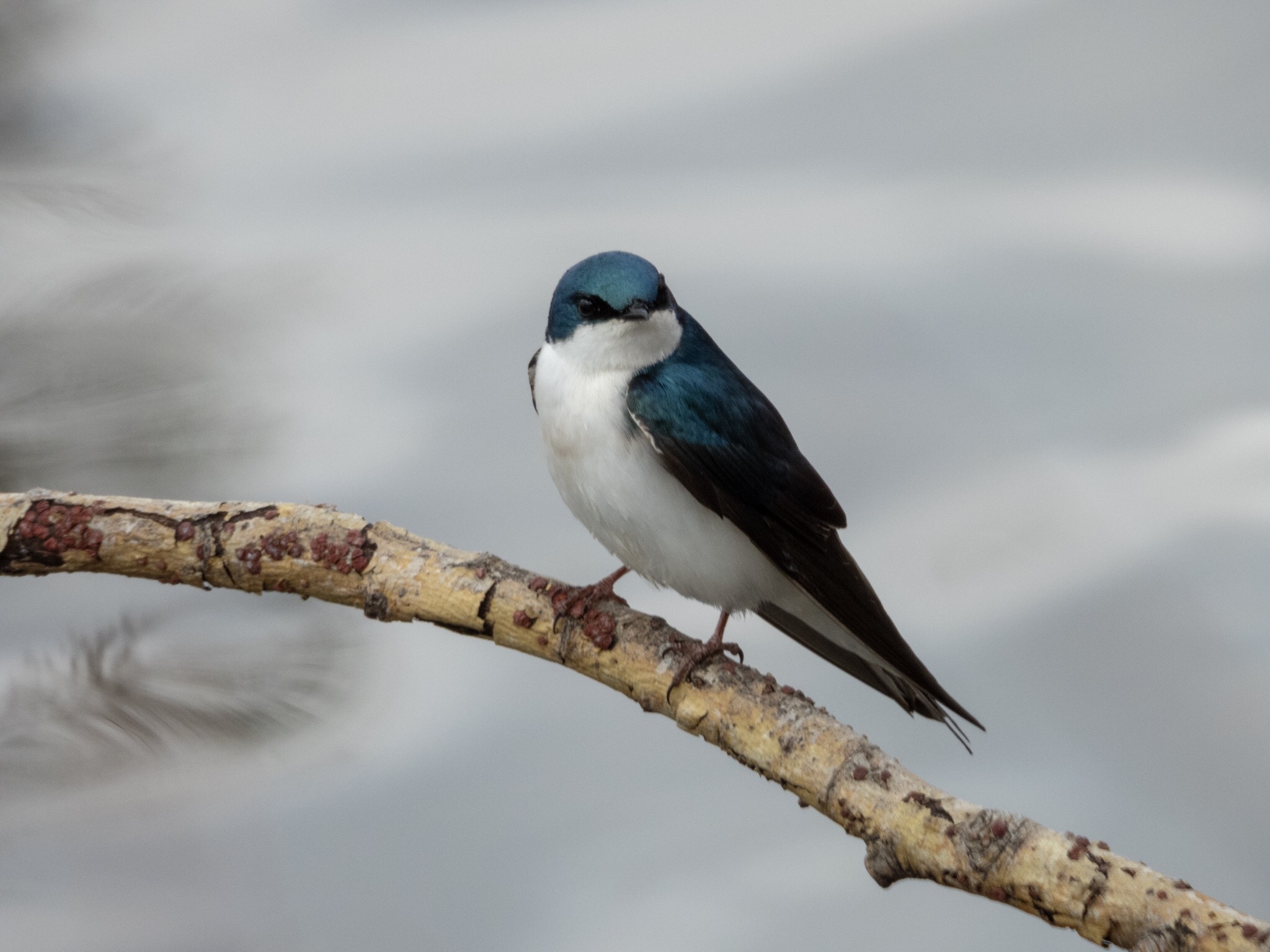
Swallows can be tricky to id and photograph. They are small, always seem to be airborne, skipping back and forth at breakneck speeds, never stopping and seemingly never landing. During a field trip in southern Chile in December I found these swallows flying around above a pasture. Despite visiting the same field almost every day over the next few weeks I never managed to catch one perching. As a result I never got a good look at one and, needless to say, I was not able to id or photograph them. Using the process of elimination all I was able to do was to narrow it down to two possible species, either the Chilean Swallow (Tachycineta leucopyga) or the Blue-and-white Swallow (Pygochelidon cyanoleuca). Of course, this left me very dissatisfied but they were simply too small, too fast and the morphological differences between the two species were too subtle for me to be able to pinpoint the species. Fast forward 5 months and I spot my first swallow of the year at Heritage Wetland Park in Sherwood Park. As it turns out, Canadian swallows behave the same way as Chilean swallows. Skipping back and forth at breakneck speeds, never stopping, never perching and never sitting still. Even with a new camera and more birding and photography experience there was just no way for me to catch up with them. As I was standing at the edge of the pond pondering my conundrum I suddenly spotted a lonesome swallow sitting on a dead branch that was jutting out over the water surface. It only sat there for a few seconds before taking flight again. Now I had a lead, I immediately trained my camera on that branch; pre-focusing and adjusting all the settings. I waited and I waited. I lost my concentration and focus several times but after what appeared to be an eternity, there it was, a very pretty Tree Swallow (Tachycineta bicolor, Lifer: #107, AB Big Year: #56). It landed at the exactly same spot as last time. I don’t know if it the same individual or a different one that just happened to land on the same place. I did not care, it was the closes look I have ever got of a swallow. The wait was worth it.

Nikon P1000, 1310mm equivalent, 1/500s, f/5.6, ISO 160

May the curiosity be with you. This is from “The Birds are Calling” blog (www.thebirdsarecalling.com). Copyright Mario Pineda.