Project 366 – Post No. 277 – Landslide

What is Project 366? Read more here.

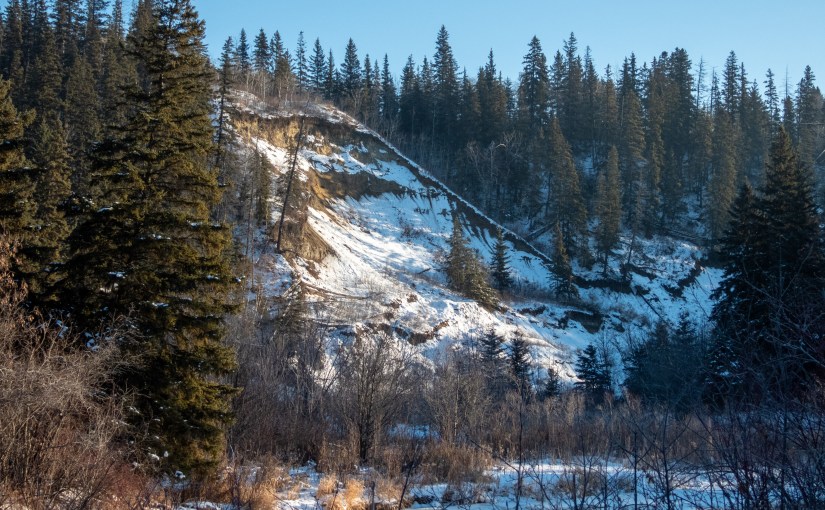
A walk along the Whitemud Ravine and the North Saskatchewan River is a walk through time. The creek and the river are like time machines revealing past history by carving themselves slowly through earth revealing. The ancestral North Saskatchewan River flowed across the prairies for millions of years within a broad shallow-sloped valley named the Beverly Valley. Parts of that ancestral valley underlie the central part of Edmonton. About 27000 years ago a major glacier from the Canadian Shield advanced over the Edmonton region and ended up depositing thick sediment, completely burying Beverly Valley. The part of the river valley that is presently exposed in the City of Edmonton is only about 12000 years old. It was formed by the re-establishment of the regional drainage following the retreat and melting of the glaciers. This time, however, along a different path that the original Beverly Valley. Over the past 12000 years the North Saskatchewan River has carved down through the sediments deposited by the glacier creating today’s river valley. These days more than 60 million years of time are exposed in the geological records along the banks of the North Saskatchewan River, spanning the age of the dinosaurs to the arrival of man in North America. The signs of the ongoing erosion are everywhere along the Whitemud Ravine and while it may appear to be a slow process there are also signs that occasionally changes can happen in a matter of seconds. Several of the steepest banks along the creek show clear signs of landslides. Judging by the lack of vegetation on the slopes these landslides must have happened recently. Living along the upper edge of the ravine can be perilous as a 1999 landslides took several houses with it down.

May the curiosity be with you. This is from “The Birds are Calling” blog (www.thebirdsarecalling.com). Copyright Mario Pineda.
Project 366 – Post No. 276 – New Year’s jackrabbit

What is Project 366? Read more here.

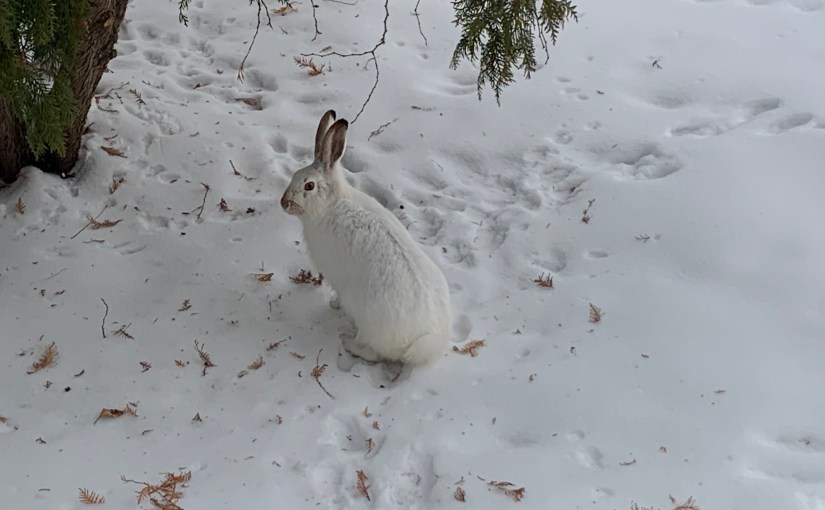
2019 is coming to an end tonight and so is my Alberta Big Year. It seems appropriate to reflect back on the year that has past and some of the accomplishments and memorable moments. But first, let me introduce the New Year’s jackrabbit. This not so little fella was a complete surprise. It was hiding under a juniper bush right outside my front door. I already knew that someone liked to hang out under the bush as there are always fresh tracks in the snow. This is the first time, however, I caught the culprit. What ensued was a bit of a stare-down contest. The jackrabbit was just sitting there starting at me and did not seem to want to budge. Eventually it leisurely hopped away, crossing the street without even checking for any cars.

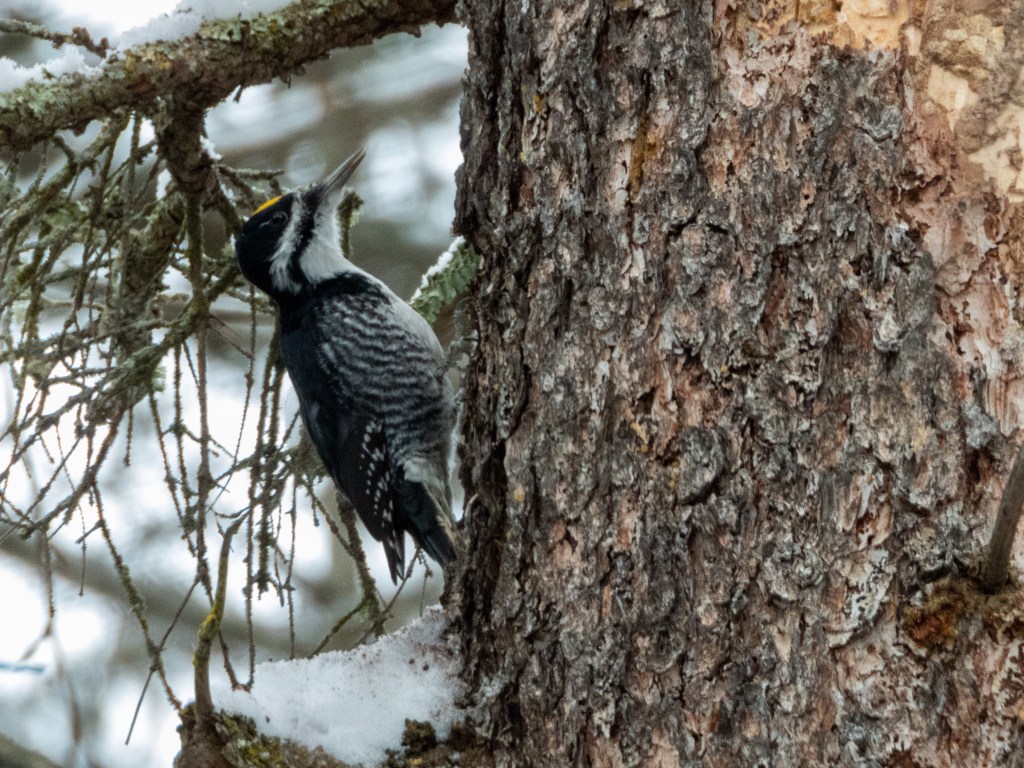
As my 2019 AB Big Year is coming to an end my final tally is 117 species, starting with a Downy Woodpecker on January 13 at Beaverhill Bird Observatory and ending with a Black-backed Woodpecker on December 15 in the Whitemud Ravine. I was hoping to reach a higher number but technical difficulties with our vehicle effectively eliminated all out-of town excursions about half way through the year (the number of checklist submissions drops in June due to this). Because of this, most of my birding excursions over the last 6 months have been to locations within the city limits, with the most common location being the Whitemud Ravine.

Last lifer of the year, a Black-backed Woodpecker in the Whitemud Ravine on December 15.

Globally I saw a total of 145 species in three different countries (Canada, Chile and Argentina). The first bird of the year was a Yellow-billed Pintail (Anas georgica) in the Ancapuli Humedal (wetland) in Araucania, Chile. The highlight of my birding year was definitely my trip to Chile and Argentina where I scored 53 lifers.

I am looking forward to the new year and the birding and nature adventures it will bring. With this being post 176 there are 90 posts left of Project 366. I feel like I am on a roll and the post have become a daily ritual. As Project 366 wraps up, however, I will likely take my birding and nature walks in different directions.

The unforgettable rainy moment when we spotted a male and female Torrent Duck (Merganetta armata) doing their thing in the raging rapids in Río Allipén , Araucania, Chile.

May the curiosity be with you. This is from “The Birds are Calling” blog (www.thebirdsarecalling.com). Copyright Mario Pineda.
Project 366 – Post No. 272 – A walk on the creek

What is Project 366? Read more here.

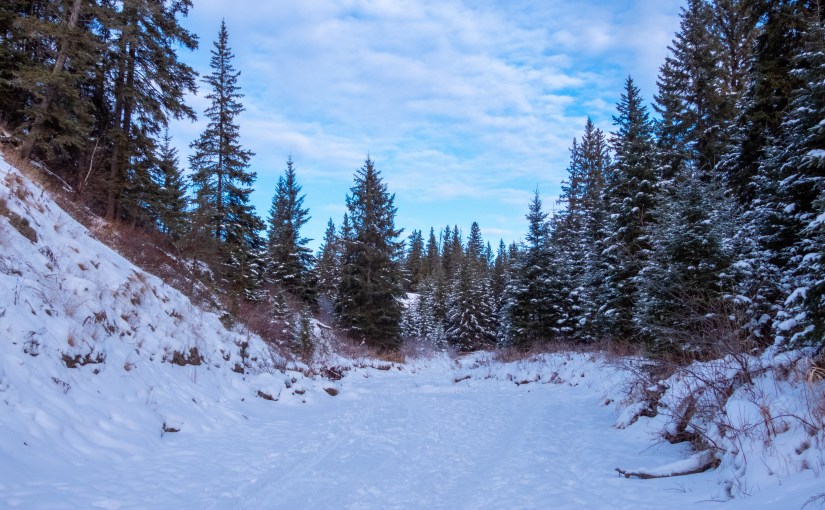
So finally I was able to take a walk on the creek. The temperature has been consistently well below the freezing point for over a month now and the Whitemud Creek is covered by a thick layer of ice. Well-traveled trails on the ice provided enough reassurance that it would be safe now to walk on the ice. Going for a walk on the creek is a different experience. First of all, since it is flat it is an easy way of travelling through the forest. No ups and downs and as a result the risk of tripping or slipping is virtually eliminated, which is a bit of an oxymoron as you are walking on ice. The trick is obviously that the ice is snow covered so one does have quite a bit of traction. Secondly, the view of the ravine is quite different from the creek than from the trails above the creek and one is able to access parts of the ravine that are difficult to access by land.

May the curiosity be with you. This is from “The Birds are Calling” blog (www.thebirdsarecalling.com). Copyright Mario Pineda.

Project 366 – Post No. 271 – Rivulet of water

What is Project 366? Read more here.

Although the winter officially begun less than a week ago (on winter Solstice on December 21) we have been in the grips of subzero temperatures for several months by now with both the Whitemud Creek and the North Saskatchewan River solidly frozen for quite some time now. On Christmas Day we took the kids sledding at the hill at the north end of the ravine. It was a beautiful sunny day with a balmy -10 °C. I decided to go up a small icy trail off the main trail. It looked like the trail had been flooded at some point in time as it now was covered in a thick expansive sheet of ice. At the end of the icy section it became apparent where the water came from…, well sort of. There was a black rivulet of water flowing down the slope our of the forest and as it made its way down the slope it dovetailed with sheet of ice covering the trail. It was a very peculiar sight to see water flowing when all other bodies of water have been frozen solid for months. The snow had melted where the rivulet came down and judging from the thickness and extent of the ice sheet the rivulet must have been there for quite some time. For the water to remain in a liquid state while it was coming down the slope can only mean that it must be quite warm at the source. The obvious question is, however, where is the water coming from? Is it discharge from a human-made source higher up in the forest? Is it a warm spring? Unlikely, but possible. I did not have time to follow the rivulet upstream this time around. Perhaps next time.

May the curiosity be with you. This is from “The Birds are Calling” blog (www.thebirdsarecalling.com). Copyright Mario Pineda.

Project 366 – Post No. 270 – Holiday Downy Woodpecker

What is Project 366? Read more here.

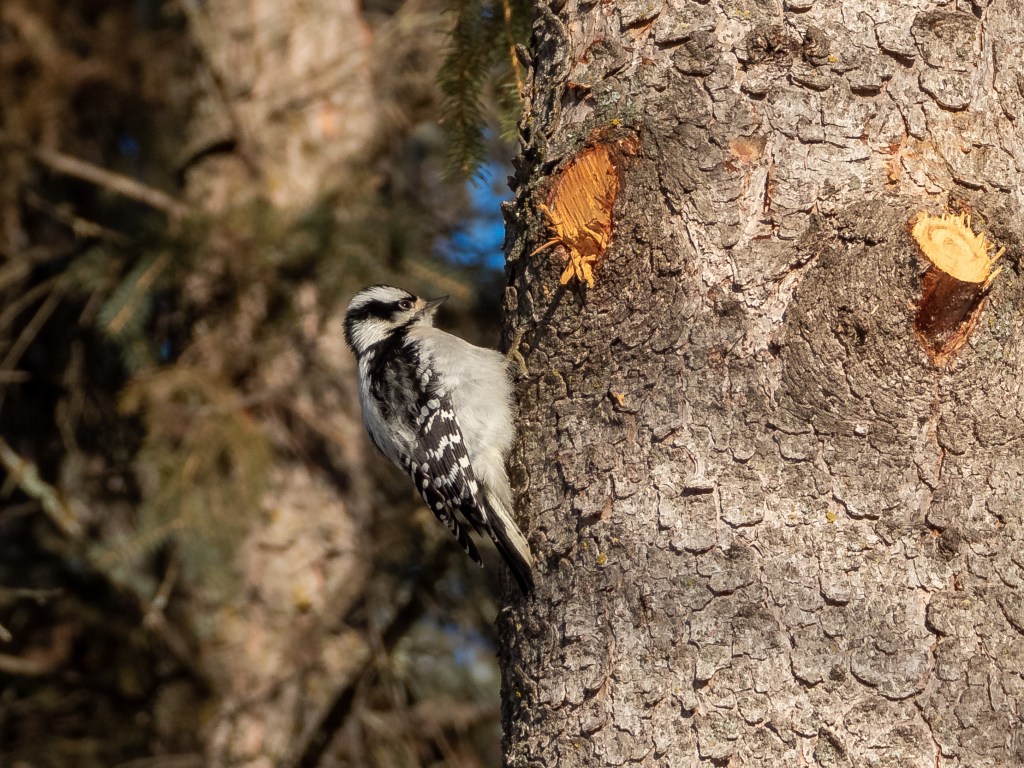
What would be more fitting on Christmas Day than a cute little Downy Woodpecker that was enjoying the sunshine today down in Whitemud Ravine. Downy woodpeckers are the smallest of North America’s woodpeckers and other than being smaller are virtually identical to the Hairy Woodpecker. Despite their similarities the two species are actually not very closely related and belong to two different genus. While the reasons for their nearly identical plumage is not fully understood, studies have shown that their similar appearance is an example of convergent evolution.

May the curiosity be with you. This is from “The Birds are Calling” blog (www.thebirdsarecalling.com). Copyright Mario Pineda.
Project 366 – Post No. 269 – Frozen stubble fields

What is Project 366? Read more here.

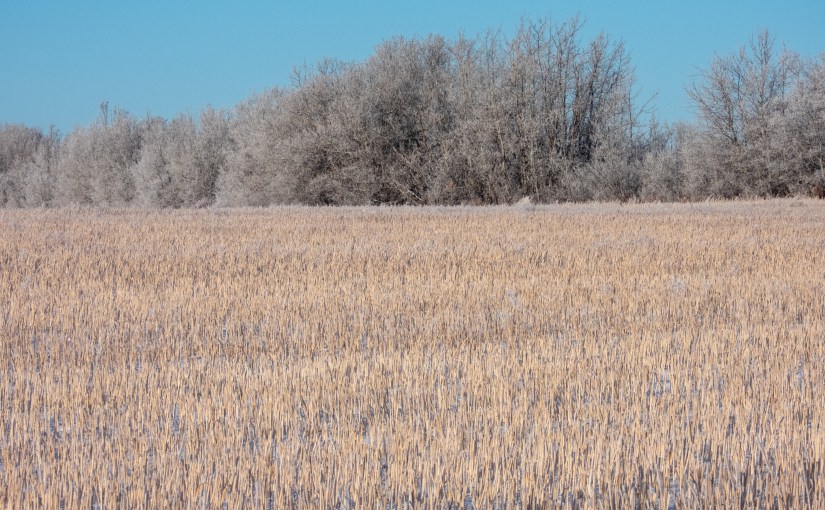
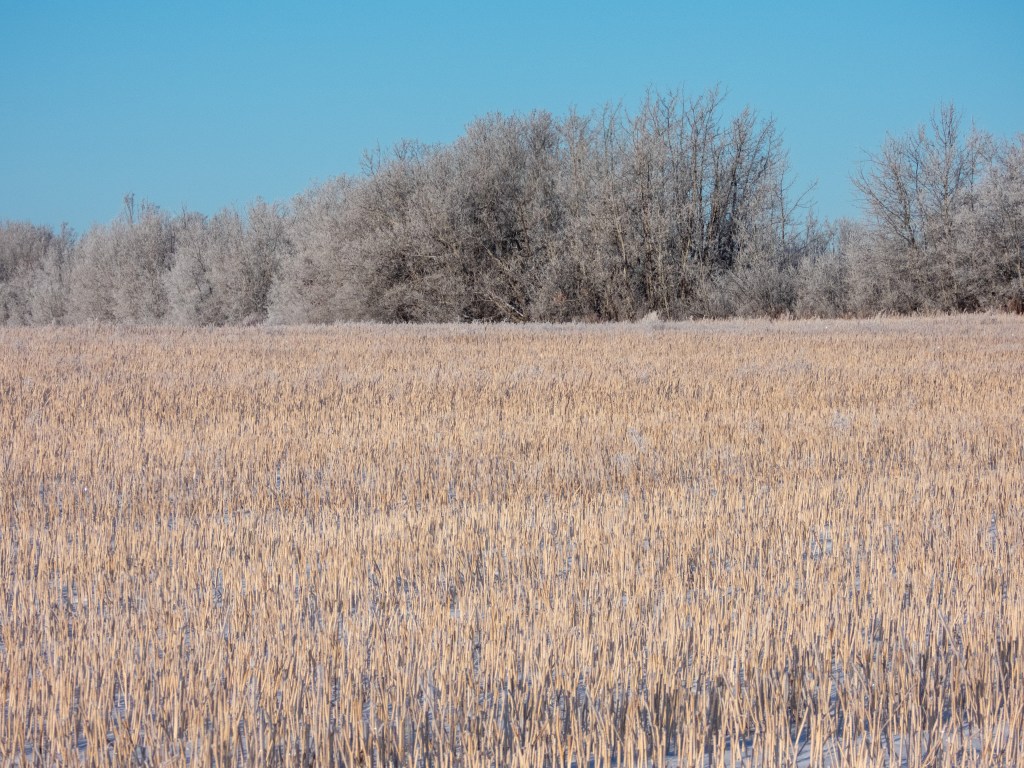
A stubble field is a type of agricultural crop residue consisting of the cut stems after the crop has been harvested. Usually the stems are ploughed directly in to the ground in springtime. Stubble fields serve many functions, including nutrients recycling as the stems compost and fertilize the field as well as providing erosion control due to wind and water. Wildlife also benefit from stubble fields as the fields provide shelter and food to various animals, including birds.

May the curiosity be with you. This is from “The Birds are Calling” blog (www.thebirdsarecalling.com). Copyright Mario Pineda.

Project 366 – Post No. 267 – Hoarfrost

What is Project 366? Read more here.

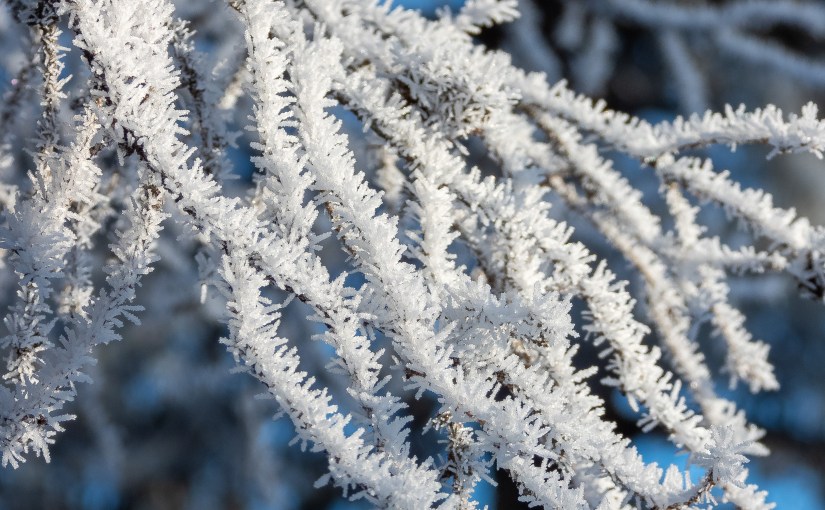
It was the first hunt of the year for the Snowy Owls of the Ray Gibbon Drive in St. Albert. It was a beautiful winter’s day with the sun beaming down from a clear blue sky and the temperature in the single digits below freezing point. As we were scanning the fields and wood lots at the outskirts of St. Albert I noticed that the stubble fields and the branches of trees and shrubs seemed whiter than usual and were glistening and sparkling as the rays of the sun hit them. A closer inspection revealed that they were covered in a delicate layer of ice crystals, ever so fragile and ephemeral. Only later did I learn that when ice crystals are formed on exposed objects, such as wires, branches or leaves it is called hoarfrost. The conditions under which hoarfrost is formed are rather specific. Hoarfrost ice crystals are formed on exposed objects by condensation of water vapor to ice at temperatures below freezing and occurs when air is brought to its frost point by cooling. Hoarfrost is formed by a process analogous to that by which dew is formed on similar objects, except that, in the case of dew, the saturation point of the air mass is above freezing. The occurrence of temperatures below 0° C is not enough to guarantee the formation of hoarfrost. Additionally, the air must be initially damp enough so that when cooled it reaches saturation, and any additional cooling will cause condensation to occur. In the end, we never found any Snowy Owls today, but the beautiful weather and the unique hoarfrost created a winter wonderland fitting for the coming holiday season.

May the curiosity be with you. This is from “The Birds are Calling” blog (www.thebirdsarecalling.com). Copyright Mario Pineda.

Project 366 – Post No. 266 – Winter Solstice

What is Project 366? Read more here.

Today is the first day of winter and it is also Winter Solstice with the shortest amount of day light hours and longest night of the year. Tomorrow the tables will have turned and we would have gained a whopping whole second of day light, from today’s 7:27:42 hours between sunrise and sunset to 7:27:43. It is interesting to realize, however, that the the time of the sunrise will continue to happen later until the end of the month. The reason the days are getting longer is because the sunset is happening later every day starting tomorrow. Today is also post 266 in my Project 366 which means that I have 100 posts left and tomorrow the two digit countdown starts towards the finishing line. One could say that today represents a turning point in terms of seasons and in terms of my blog postings. It is also a time to start thinking about what will come after I complete this project. I am exploring several ideas for possible future projects. More will be said and written about this in the next hundred days.

May the curiosity be with you. This is from “The Birds are Calling” blog (www.thebirdsarecalling.com). Copyright Mario Pineda.

Project 366 – Post No. 265 – Brown Creeper

What is Project 366? Read more here.

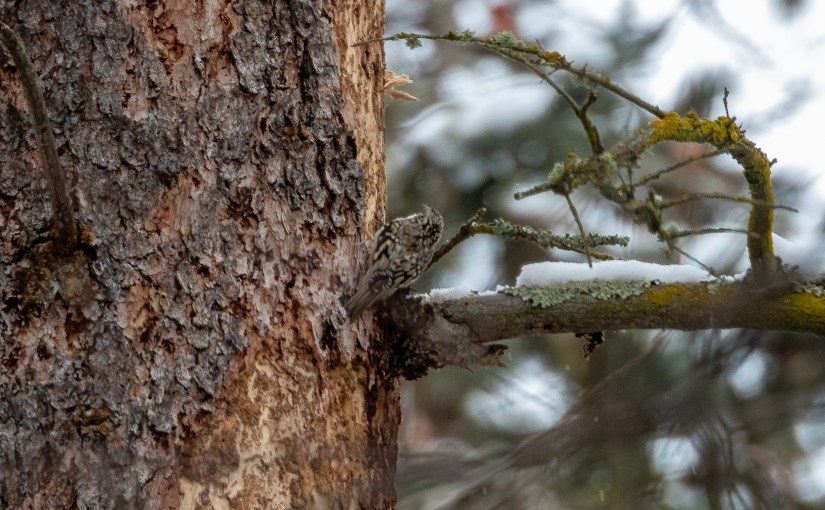
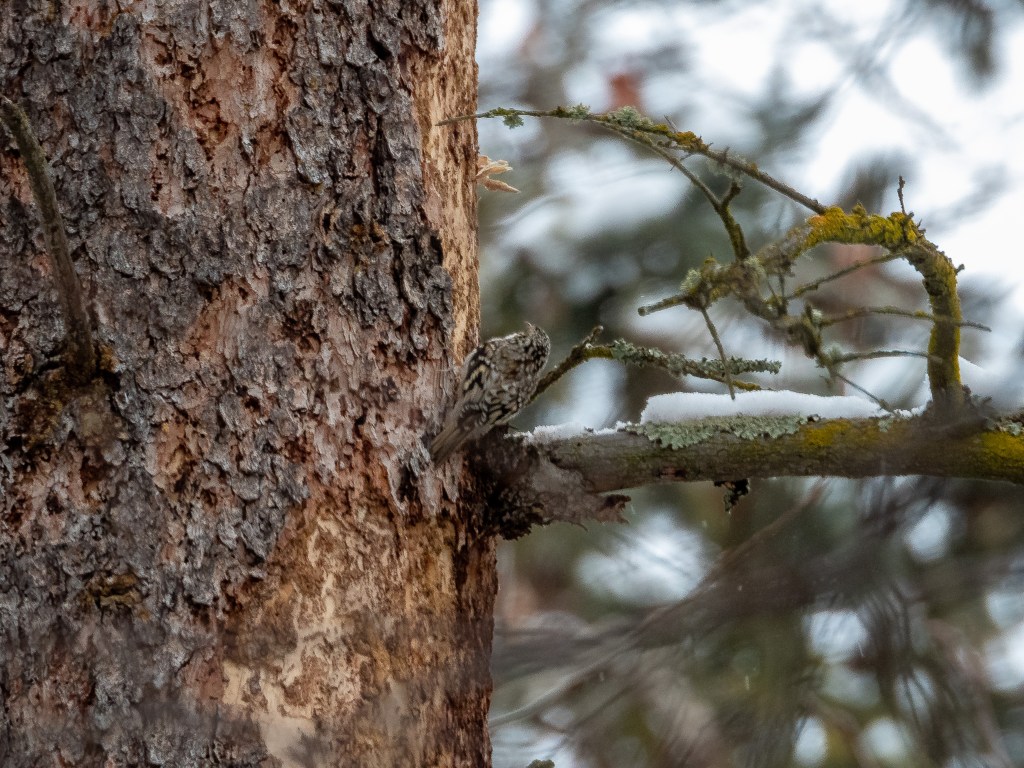
As I was focusing on trying to get a good photo of the Black-backed Woodpecker – after all it was a lifer for me – all of a sudden something else appeared in the view finder. Something grey/brown scurried across the trunk. I knew immediately what it was. It was a Brown Creeper, an small, cryptic and elusive bird. I have seen it twice before but never even tried to take a picture of it. It just seems to small, hard to spot and fast moving to even try to photograph. The Nikon P1000 is rather sluggish and it seems like a long shot trying to photograph this bird. This time, this Brown Creeper literally photo bombed my picture of the Black-backed Woodpecker, so I too the opportunity to snap a few pictures of it. It all happened fast, before I knew it, it was gone. I had managed to snap a handful of pictures of it, none very good. It’s a first and any future photos of it can only get better I guess.

May the curiosity be with you. This is from “The Birds are Calling” blog (www.thebirdsarecalling.com). Copyright Mario Pineda.

Project 366 – Post No. 264 – Frozen catkins

What is Project 366? Read more here.

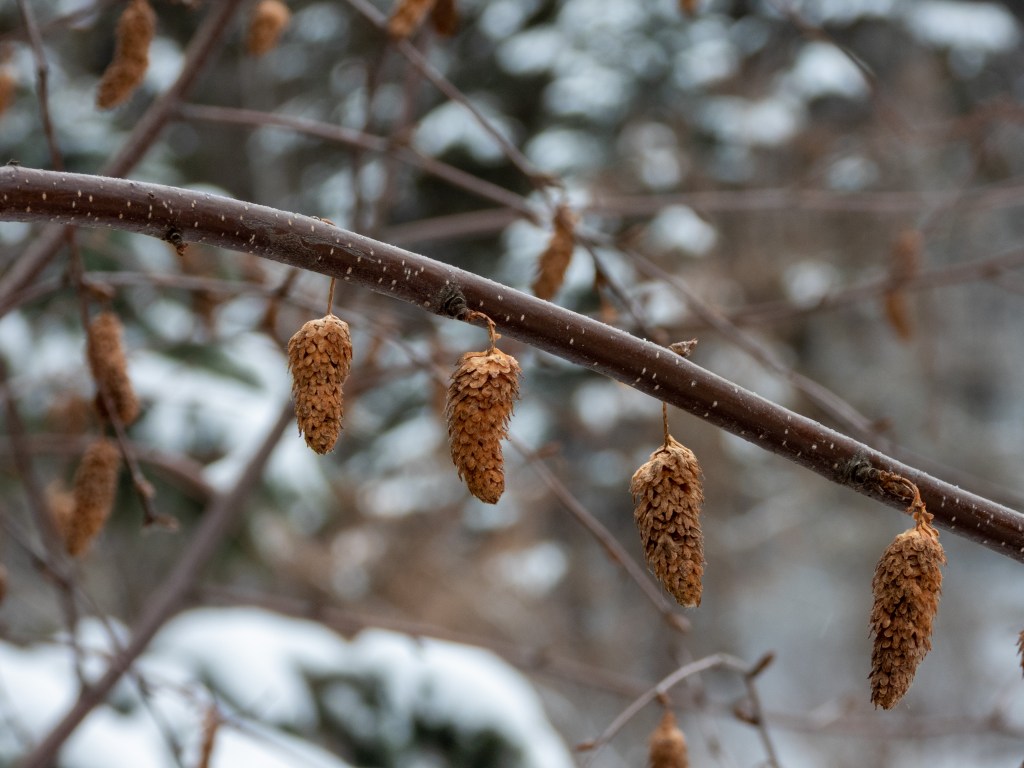
A single branch was reaching out over the frozen creek. The branch was bare except a handful of dry and frozen catkins that were still attached to it, frozen in time. Many trees and shrubs have catkins. The most well-known in these neck of the woods are probably birch and willows.

May the curiosity be with you. This is from “The Birds are Calling” blog (www.thebirdsarecalling.com). Copyright Mario Pineda.