Dawn on the Prairie: Returning to the Wainwright Grouse Lek

There’s a magic that stirs in the early prairie light—something ancient, electric, and profoundly alive. For the second time in my life, I found myself bearing witness to it, skulking quietly in a blind somewhere on the grassland outside Wainwright, Alberta, watching the Sharp-tailed Grouse gather and ignite the land with their springtime ritual. The accounts of my first time attending this event are documented in here and here.

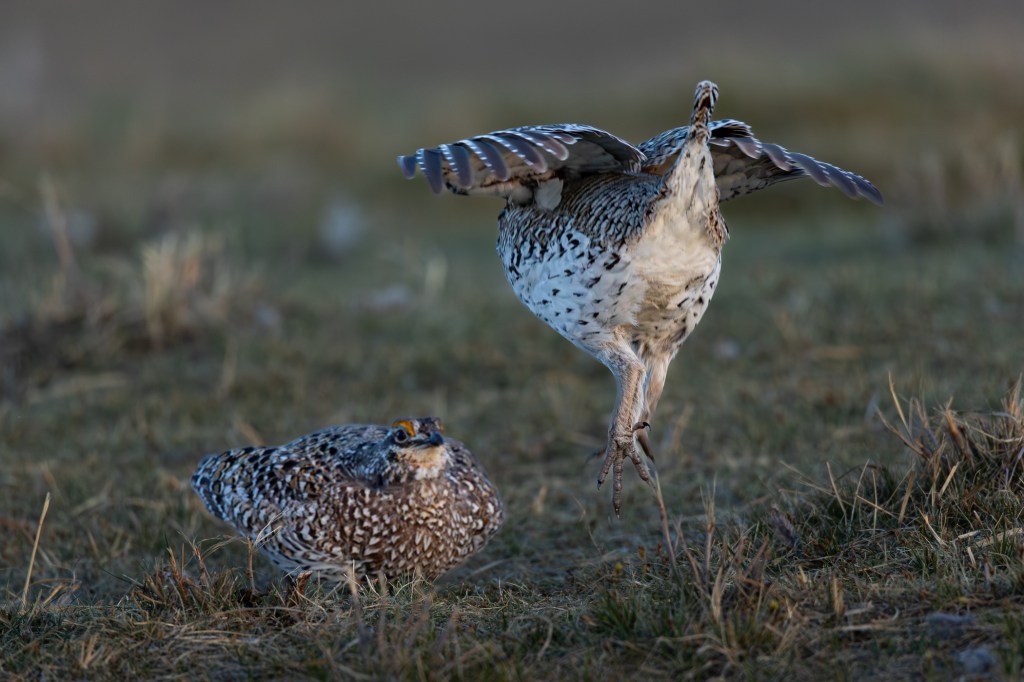
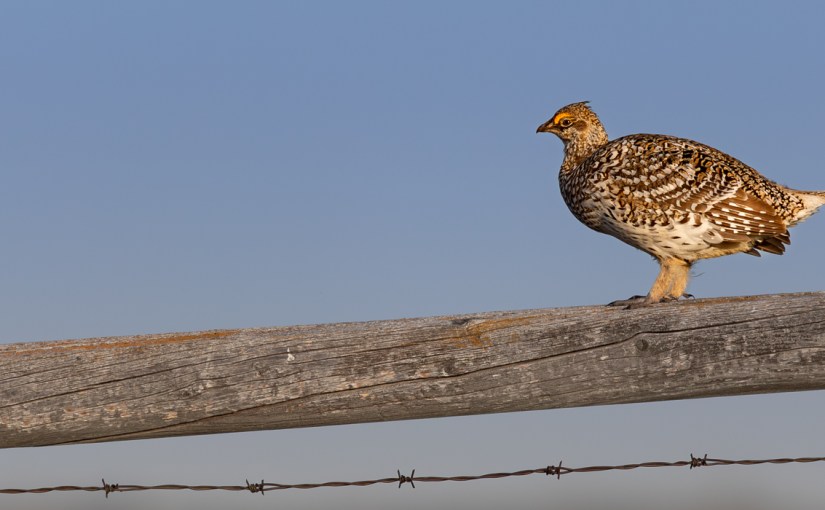
The Sharp-tailed Grouse watch is an annual event organized by the Wainwright Wildlife Society—is more than just a birding excursion—it’s an invitation into a world older than memory. Each spring, these prairie dancers return to their ancestral leks where the males perform a spectacle that defies description. To call it a “mating display” feels inadequate. It’s a full-bodied expression of wild instinct and evolution, refined by millennia of selection, played out with whirring wings, staccato foot-stomping, and those impossible, ballooning purple air sacs. This is one dance party where the boys do all the dancing—and the girls remain motionless, watch and judge.

Waiting for the ladies.

This year, I returned with a birding friend—someone equally moved by the subtle drama of sunrise and feather. We arrived in the pre-dawn hush, guided to our blind while the stars still clung to the sky. In the twilight we could already discern the silhouettes and the rustle of the dancing feathered denizens of this grassland. Once we were settled in our hides and rigged up our cameras, the waiting began—the kind that heightens every sense, making you aware of each breath, each rustle. A number of early birds were already present in the field, idling about, perhaps scouting out the best dancing spot or just assessing their chances to get lucky.

Front row seats to the dance performance of the year

And then—they started dancing. At first, they were just shadows moving between the tussocks. But as the light lifted, so did the tempo. Soon the lek exploded into motion: tails fanned, wings held stiff, bodies vibrating with energy. The males faced off and danced with frenetic determination, each movement part performance, part territorial defiance. On this morning there were mainly males, probably 20ish, and only a few females making an appearance. Being mid-May, this was one of the last grouse watch excursion of the year and it’s possible that most of the females had already mated and were in a nesting phase.

While the Sharp-tailed Grouse lek might appear as a chaotic dance party, it is in fact a highly structured arena of sexual selection. Females visit the lek primarily to observe rather than participate, silently watching from the edges as males display in feverish competition. Research has shown that females are incredibly discerning—they typically choose just one male per season, selecting him based on a combination of traits: vigorous and frequent displays, dominance of central territories within the lek, symmetry and size of the combs over the eyes, and the prominence and coordination of air sac inflation and vocalizations. Mating success is heavily skewed—just a few top-performing males are responsible for the majority of copulations. Once a female has mated, she departs alone to nest in dense cover, incubate her eggs, and raise her brood without any help from the male. The entire spectacle, then, is not just a performance—it’s a life-or-death audition for the future of their lineage.

Prairie Bachelor Seeking Spring Fling

Looking for: One fabulous hen to impress with tail fanning, fast-foot stomping, and ridiculous balloon-neck flexing.

About Me: I coo, I strut, I puff. I’ve got fire-red eye combs and a lekking spot that screams “alpha.” No nest, no parenting, all passion. If you’re into commitment-free spring flings with maximum flair, I’m your bird.

Swipe right at dawn—I’ll be shaking it like evolution depends on it.

Watching this unique display again reminded me why I do this. Why I get up at 3:30 in the morning. Why I drive for hours through the dark morning hours while the rest of the world still sleeps. Why I carry back breaking heavy gear into the cold. It’s for these fleeting moments when time slips, and I feel plugged into something wild and real.

As I write this, I can still hear the low drumming of wings, still see the blur of feathers caught in the rising light—prairie grasses glowing gold as the first light spills across these ancestral land. For a fleeting moment, we were not just observes, but a thread in an ancient ritual woven into the fabric of the grasslands. The birds are still calling, and I’m still listening.

A Western Meadowlark looks on with the calm indifference of someone who’s seen it all before.

References

Gibson, R. M., & Bradbury, J. W. (1985). Sexual selection in lekking birds: Are female preferences consistent? The American Naturalist, 126(6), 881–895. https://www.jstor.org/stable/2461497

Montana Fish, Wildlife & Parks. (2017). Sharp-tailed Grouse Reintroduction Plan. Montana State University. https://animalrange.montana.edu/documents/faculty/Sharp-tailed%20grouse%20Reintroduction%20Plan%20Final%20May%202017.pdf

Washington Department of Fish & Wildlife. (1995). Washington state status report for the Sharp-tailed Grouse. https://wdfw.wa.gov/sites/default/files/publications/00389/wdfw00389.pdf

Wikipedia contributors. (2024). Sharp-tailed grouse. Wikipedia. https://en.wikipedia.org/wiki/Sharp-tailed_grouse

May the curiosity be with you. This is from “The Birds are Calling” blog (www.thebirdsarecalling.com). Copyright Mario Pineda.

The Birds Are Still Calling

It’s been over three years since I last posted here.

Three years is enough time for a lot to change. Enough time to lose track of something you loved, and then—quietly, slowly, perhaps even serendipitously—find your way back to it.

And that’s what this post is about: I’m back. Back to the birds, back to the writing, back to this little corner of the internet I once treated as a field journal, a creative wellspring, and a place to share the quiet joys of being in nature.

In the time since I last wrote, a few things have happened. I’ve picked up photography much more seriously—especially wildlife and nature photography. With it came the natural side effect of spending more time outdoors: walking the woods before sunrise, crouching quietly near water’s edge, scanning the sky for that telltale flash of movement. Slowly, the birds have returned to my life. With them came the desire to document what I see, experience, and learn along the way.

This blog will be changing a little. It will still be a field journal at heart—but one shaped now by greater focus on photography, documenting travels and adventures, and a deeper commitment to explore and document the far reaches of the wild at the very edge of the world. Expect to find stories from the field, species profiles, reflections on gear and technique, visual essays, and of course, photographs. Lots of them. Not to impress, but to remember. Not to perform, but to witness.

I’m doing this first and foremost for myself—because the act of writing helps me pay attention, and the act of sharing makes it feel real. But if you find yourself here, reading along, welcome. I hope something in these pages gives you a spark of wonder, or a reason to lace up your boots and head out into the wild.

The birds are calling again. And this time, I’m listening with a camera in hand and my eyes wide open.

I am also sharing some of this journey over on Instagram, where the photos often land before the words do. If you’re curious, you can find me there at @mariopinedaphotography.

Let’s begin.

May the curiosity be with you.
– Mario

TL: Common Raven, Jasper National Park. Canon 6D, EF 400mm f/5.6L, 1/320, f/5.6, ISO 100

TR: Bighorn Sheep, Jasper National Park. Canon 6D, EF 400mm f/5.6L, 1/1000, f/5.6, ISO 1000

BL: American Beaver, Whitemud Creek, Edmonton. Canon 6D, EF 400mm f/5.6L, 1/1000, f/5.6, ISO 1000

BR: Northern Shoveler, Lois Hole Provincial Park. Canon 5D Mark IV, EF 400 f/5.6, 1/500, f/6.3, ISO 1250

May the curiosity be with you. This is from “The Birds are Calling” blog (www.thebirdsarecalling.com). Copyright Mario Pineda.

Project 366 – Post No. 366 – So long and thanks for all the birds

What is Project 366? Read more here.

Its seems surreal that I actually have reached post 366, that it has been a whole year and that this project has now been completed. So much has happened during this year, I am one year older, my teen is different person altogether and the world has changed profoundly. I was anticipating and expecting some of these changes, others I could not have imagined in even my wildest dreams. All of this in a blink of eye. This post comes in an age of upheaval and pain with an uncertain future where the world is changing at an unprecedented rate and in unpredictable directions. The last year’s development shows the limitations of foresight we humans are capable of. So much for trying to be well-informed and staying ahead of the curve.

I will be scaling back my blogging and quite likely the nature of the posts will change as well. Stay tuned for my reappearance here or somewhere else on the interwebs. I have plans that are forming, but not yet ready to see the light of day. Rest assure, however, that my focus will be creating something beautiful and timeless like a sliver of light dispelling the darkness, even if only momentarily, that has enveloped the world.

So long and thanks for all the birds.

May the curiosity be with you. This is from “The Birds are Calling” blog (www.thebirdsarecalling.com). Copyright Mario Pineda.

Project 366 – Post No. 365 – A burglar at the bird feeder

What is Project 366? Read more here.

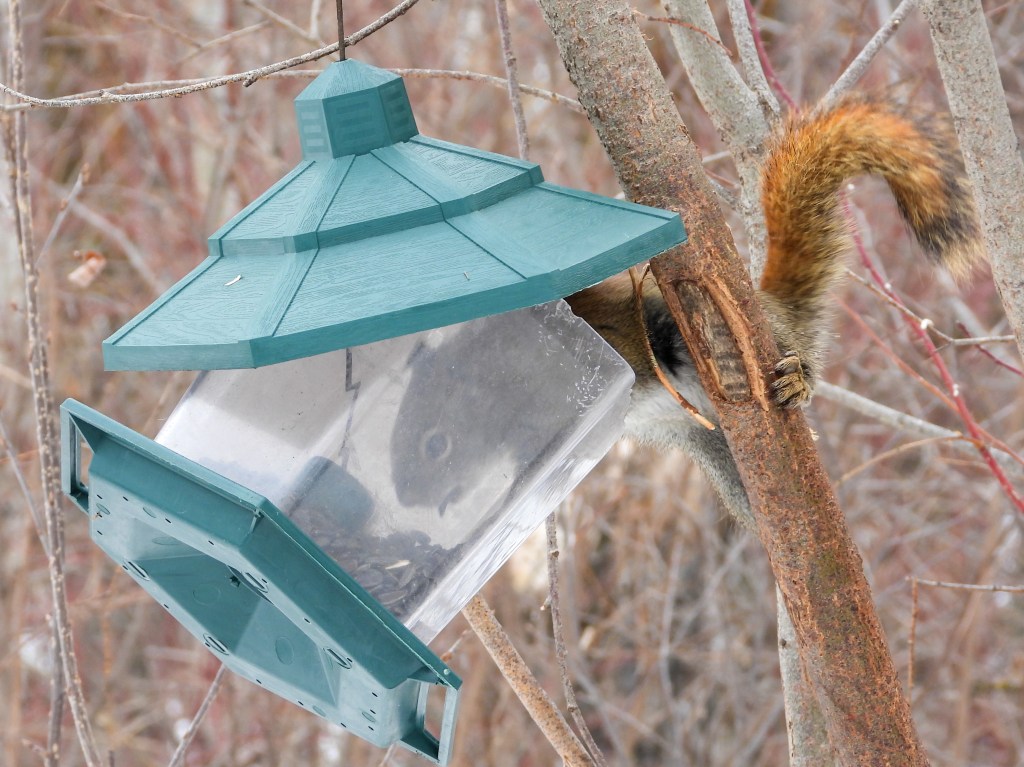
Along a long straight stretch of the trail I noticed a squirrel run across the trail in the distance. Of course a squirrel crossing the trail is not anything particularly remarkable in these neck of the woods, so I did not pay much attention to it. I kept on walking. A few minutes later, the squirrel crossed the trail in the opposite direction (I assumed it was the same squirrel). I kept on walking getting closer to the spot where it had crossed,… when it ran across the trail again. I was almost upon it when it,… crossed again. Once I arrived at the location along the trail where the squirrel had been crossing it the reason for its behavior became abundantly clear. I a bush, right of the trail there was a single bird feeder that had had its roof knocked off, leaving it wide open for anyone to help themselves to the sunflower seeds. As I was watching the odd chickadee and nuthatch swoop in for a seed the squirrel came back. It quickly climbed the bush and without hesitating dove right into the feeder to grab a mouthful of sunflowers. Like a smooth and stealthy burglar it was gone it a flash, crossing the trail and disappearing into the forest, presumably to its secret lair to stay its loot. Two minutes later it came back, scampering through the forest, crossing the trail, climbing up to the bird feeder and back in it went.Its industriousness was quite impressive. It had clearly found the mother lode of the day and was hellbent on hoarding as much as possible before any competitor would discover the gold mine.

May the curiosity be with you. This is from “The Birds are Calling” blog (www.thebirdsarecalling.com). Copyright Mario Pineda.

Project 366 – Post No. 364 – Downy Woodpecker

What is Project 366? Read more here.

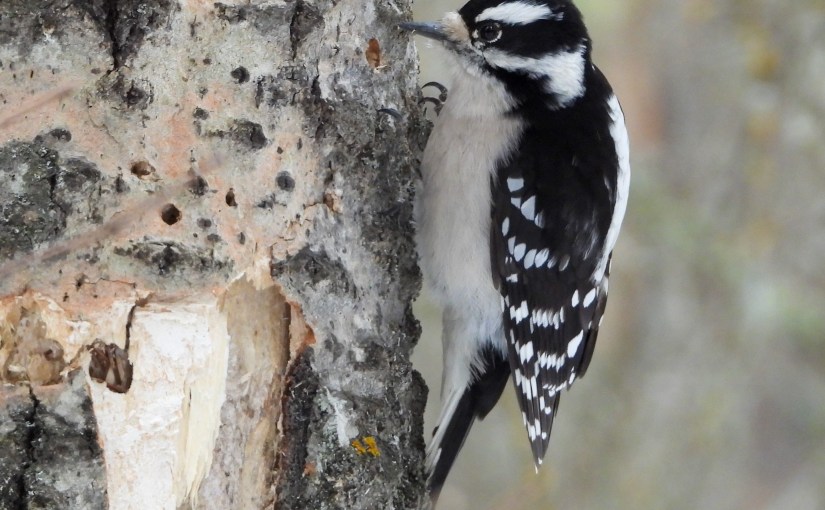
The female Downy Woodpecker had made a pencil sized hole through the bark and was intent on thoroughly investigating what lied inside. I wonder how she decided to make the hole where she did it. Experience? Can she sense that there is something hiding under the bark? Or perhaps it’s was a random spot.

May the curiosity be with you. This is from “The Birds are Calling” blog (www.thebirdsarecalling.com). Copyright Mario Pineda.

Project 366 – Post No. 363 – Red-breasted Nuthatch striking a pose

What is Project 366? Read more here.

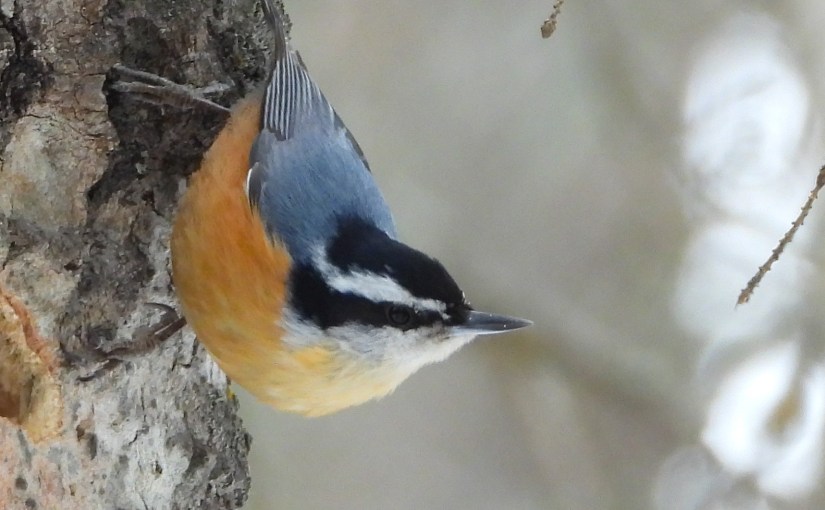
Today’s picture captures the iconic pose of the Red-breasted Nuthatch – clinging to a tree trunk, upside down and with its head cocked checking out its surrounding. Nuthatches are curious yet cautious. Yesterday, as we were walking along the Whitemud Ravine south of the Snow valley trail head looking for a reported Black-backed Woodpecker, all of a sudden a scrawny-looking Red-breasted Nuthatch landed on a branch right in front of my face, no more than two feet away. It was almost as if it was demanding an offering before it would let me pass b. A nuthatch hold up. Except I did not have any food with me. I hesitantly reaches out towards it, fully expecting it to take off. Instead it eagerly jumped onto my hand and started hopping around looking for something to eat. It started to energetically pecking at my thumb. All of a sudden, out of nowhere, another Red-breasted Nuthatch swooped it, tackles the scrawny nuthatch on my hand and took its place. Once it had determined that I did not have anything edible, it took off. I was quite perplexed by the behaviour of these nuthatches. I have had plenty of chickadees eagerly landing and pecking on my hand hoping for a hand out, but this was the first time nuthatches had shown this behaviour. I am not sure if these two individuals were just more habituated to humans and from getting handouts, or if they were just more desperate to find food. The first nuthatch did look quick scrawny and skinny. In the end we never found the Black-backed Woodpecker, but thanks to these two nuthatches we nevertheless were left with an unforgettable experience.

May the curiosity be with you. This is from “The Birds are Calling” blog (www.thebirdsarecalling.com). Copyright Mario Pineda.

Project 366 – Post No. 362 – American Three-toed Woodpecker

What is Project 366? Read more here.

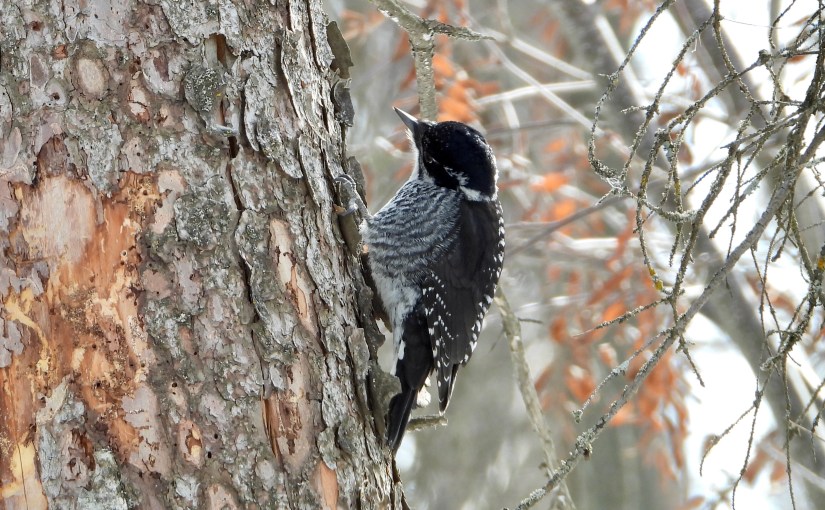
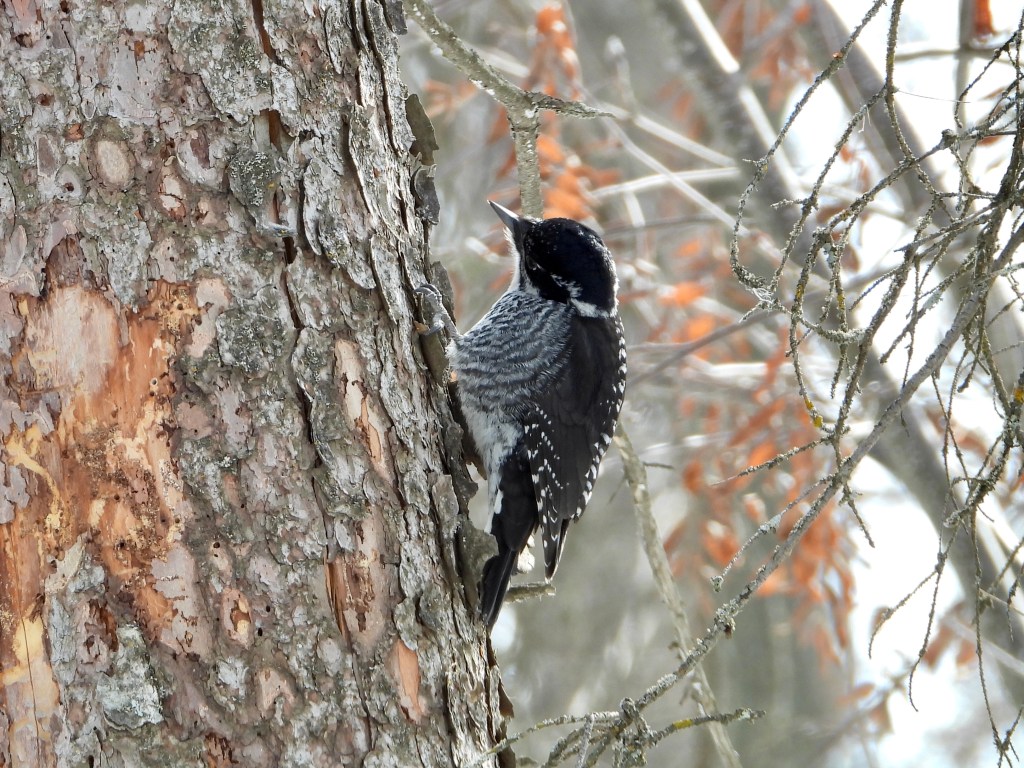
In a clearing at the Grey Nuns Spruce Woodlot a lone American Three-toed Woodpecker was busy working away looking for a meal on a spruce tree trunk. It is only the second American Tree-toed Woodpecker I have seen, the first one was last winter at the Whitemud Ravine. No wonder this one threw me for a bit of a loop. With too much black in its back to be a Downy Woodpecker and too little black on its back to be a Black-backed Woodpecker it had me scratching my head for a minute. This one had a black back with messy white barring and white spots in the wings. The underparts were white with fine blackish barring on the flanks. The face was black with a white line behind the eye and a thin white line below the cheek. The characteristic yellow head patch that males have was missing suggesting that this was a female.

May the curiosity be with you. This is from “The Birds are Calling” blog (www.thebirdsarecalling.com). Copyright Mario Pineda.

Project 366 – Post No. 361 – Colorful bird real estate

What is Project 366? Read more here.

There is a spot in the Grey Nuns Spruce Woodlot, an opening in the forest where the trail takes a turn, where there is a bird feeder. Someone has scrawled “Feed Us” on the side of the feeder…, and fed they get. The other day when we visited someone had hanged several colourful bird houses in the surrounding trees. All freshly painted this prime real estate is just waiting for someone to move in.

May the curiosity be with you. This is from “The Birds are Calling” blog (www.thebirdsarecalling.com). Copyright Mario Pineda.
Project 366 – Post No. 360 – Black-capped Chickadee on birch

What is Project 366? Read more here.

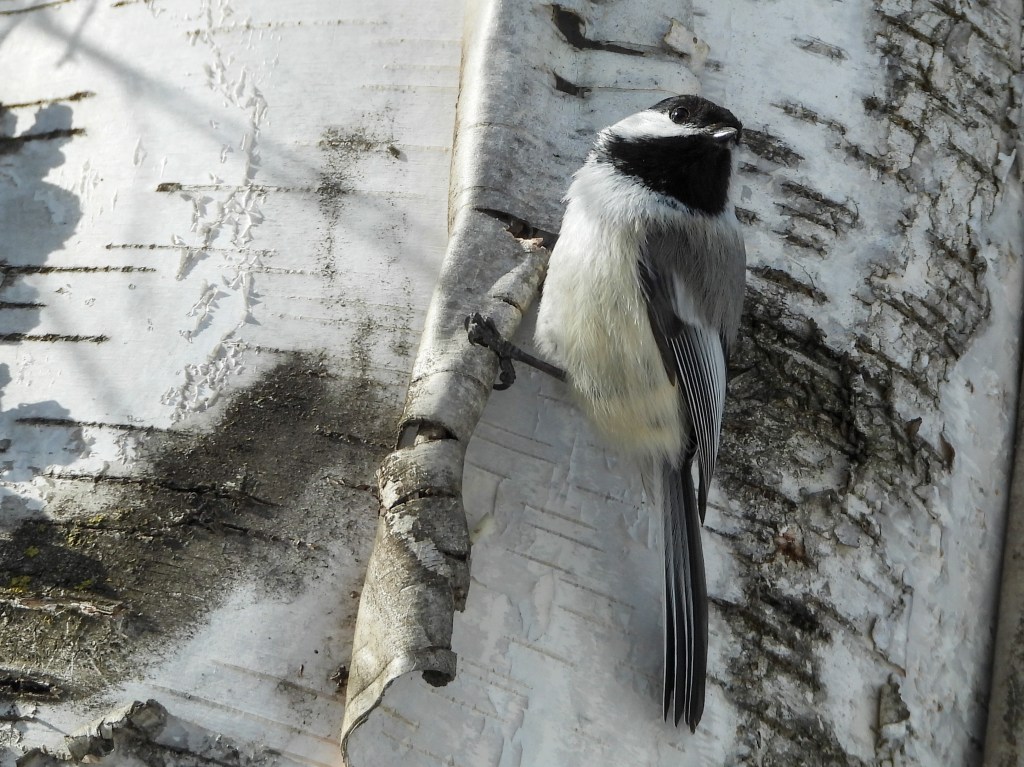
At the Grey Nuns Spruce Woodlot we came across this paper birch tree that the Black-capped Chickadees seemed to take a particular fondness to. A handful of chickadees were busy clinging to the bark and working away with their beaks on the bark. It looked like they were looking for something on the bark and in the cervices. Occasionally a chickadee would tap at the bark like a woodpecker. I assume they were looking for food. Chickadees are known to store, or “cache,” food such as seeds. Perhaps this tree was their cache location. Either way, it was an entertaining sight.

May the curiosity be with you. This is from “The Birds are Calling” blog (www.thebirdsarecalling.com). Copyright Mario Pineda.
Project 366 – Post No. 359 – Common Raven on pipeline

What is Project 366? Read more here.

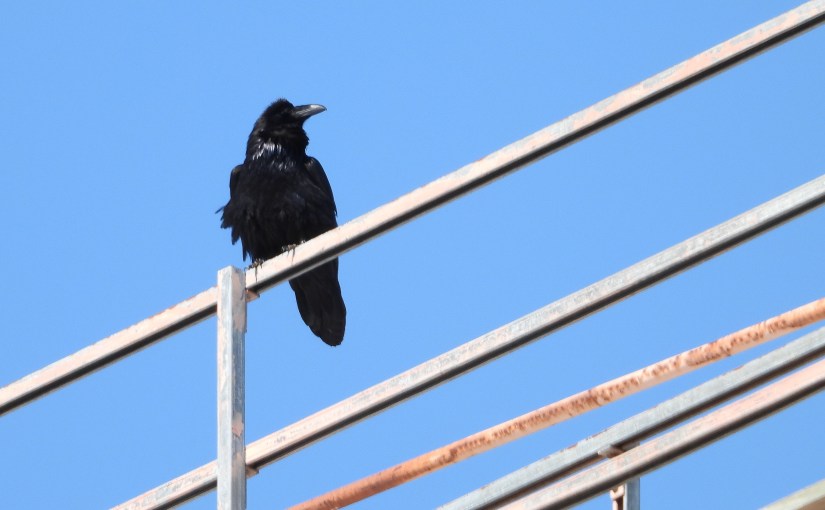
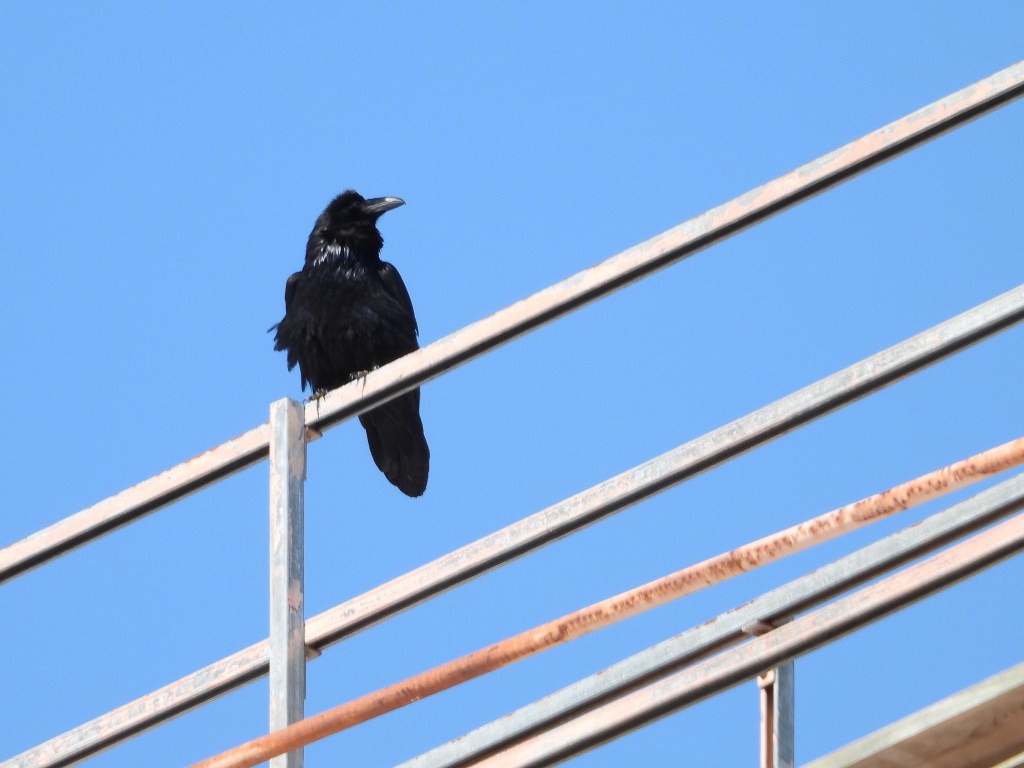
In the Whitemud Ravine one often comes across ravens around the orange pipeline that crosses the creek close to the Snow Valley end. Last spring the several raven couples even tried to build stick nests on the pipeline. None of them seemed to be successful, however. The other day I caught a raven sitting on the catwalk railing above the pipeline. Is it staking a territory? Is its choice of vantage point just a matter of a good view? Who knows why the ravens enjoy the pipeline.

May the curiosity be with you. This is from “The Birds are Calling” blog (www.thebirdsarecalling.com). Copyright Mario Pineda.