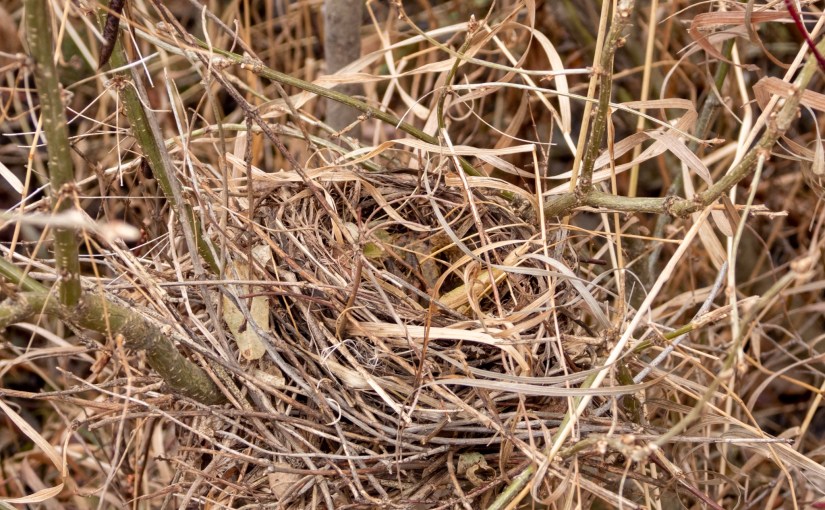
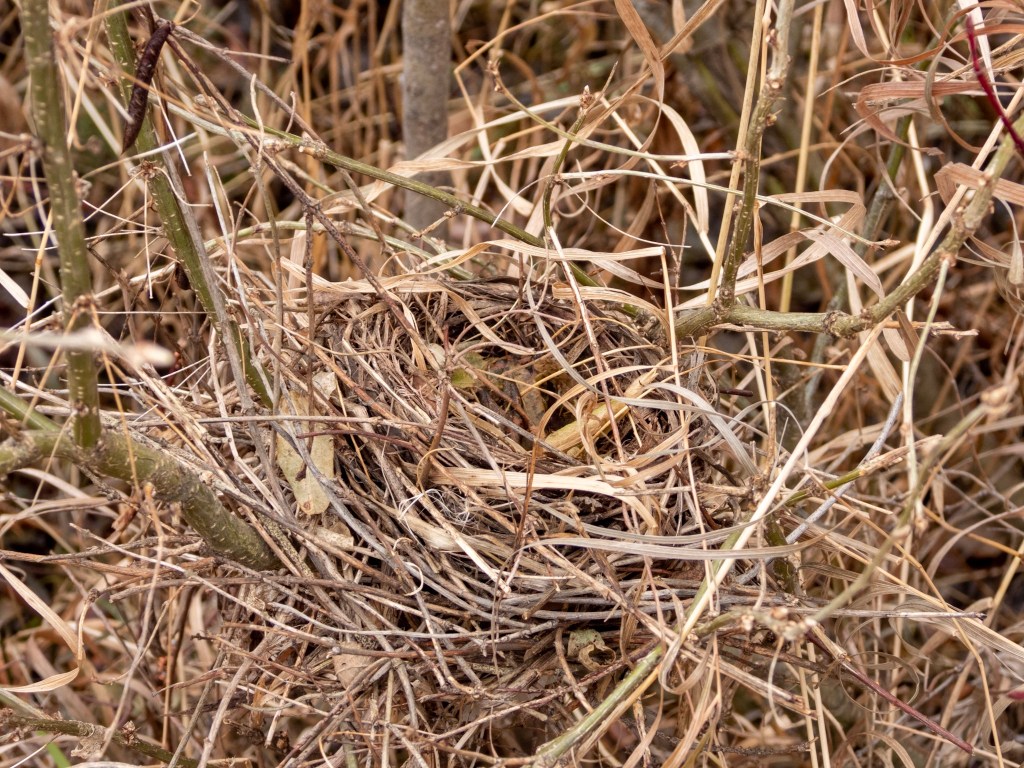
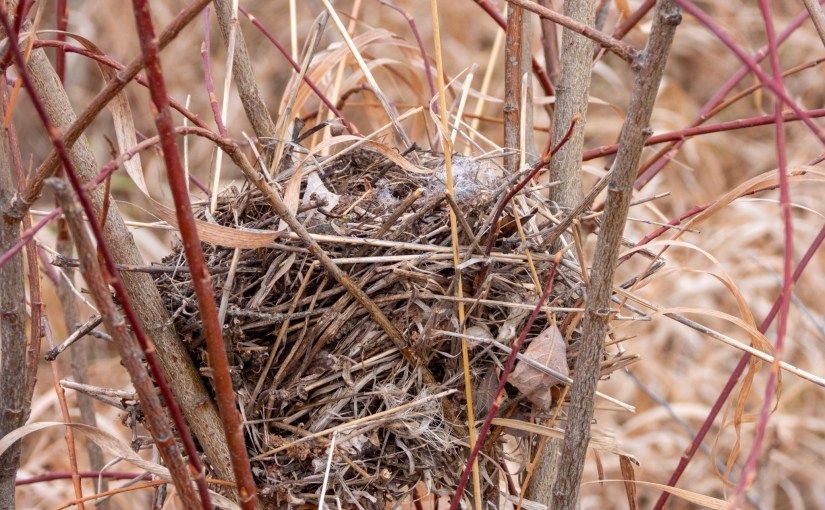
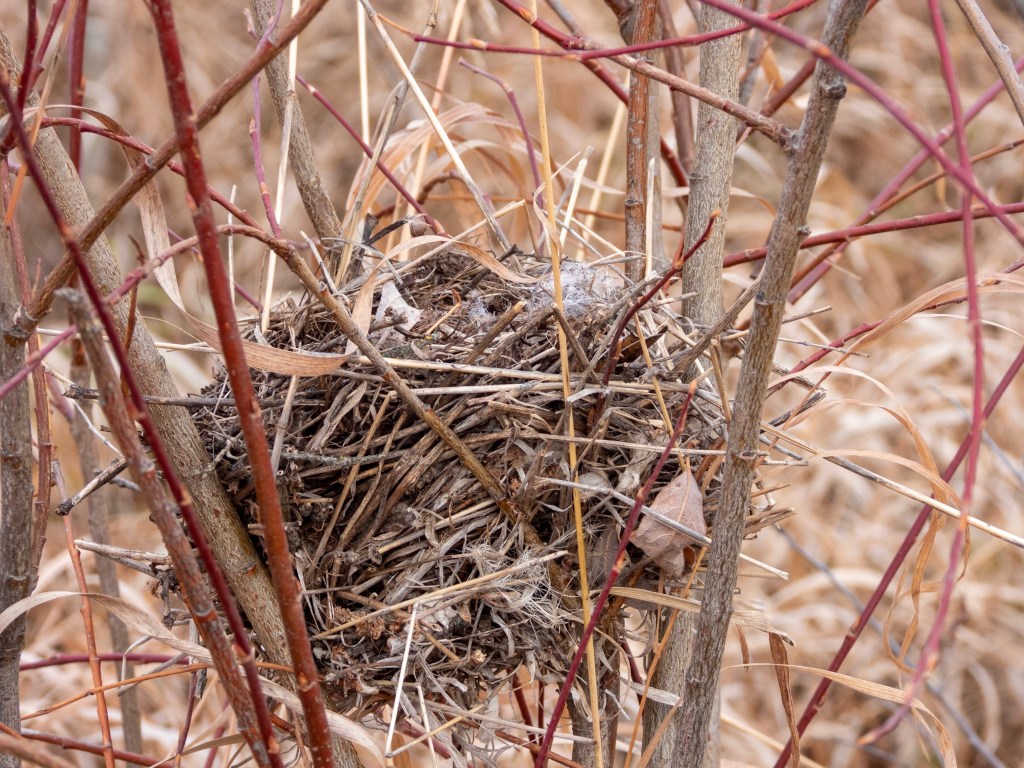
A ghillie suit a type of camouflage clothing designed to resemble the background environment such as foliage, snow or sand enabling the wearer to “disappear” into the background. Whoever build this nest achieved the same effect as a ghillie suit. The untidy straws of grass protesting around the best almost eliminates the outline of the best making it blend in with the surroundings. Some people might say that the best is messy. I like to think that the design of the nest was intentional and a highly effective camouflage trick.
May the curiosity be with you. This is from “The Birds are Calling” blog (www.thebirdsarecalling.com). Copyright Mario Pineda.
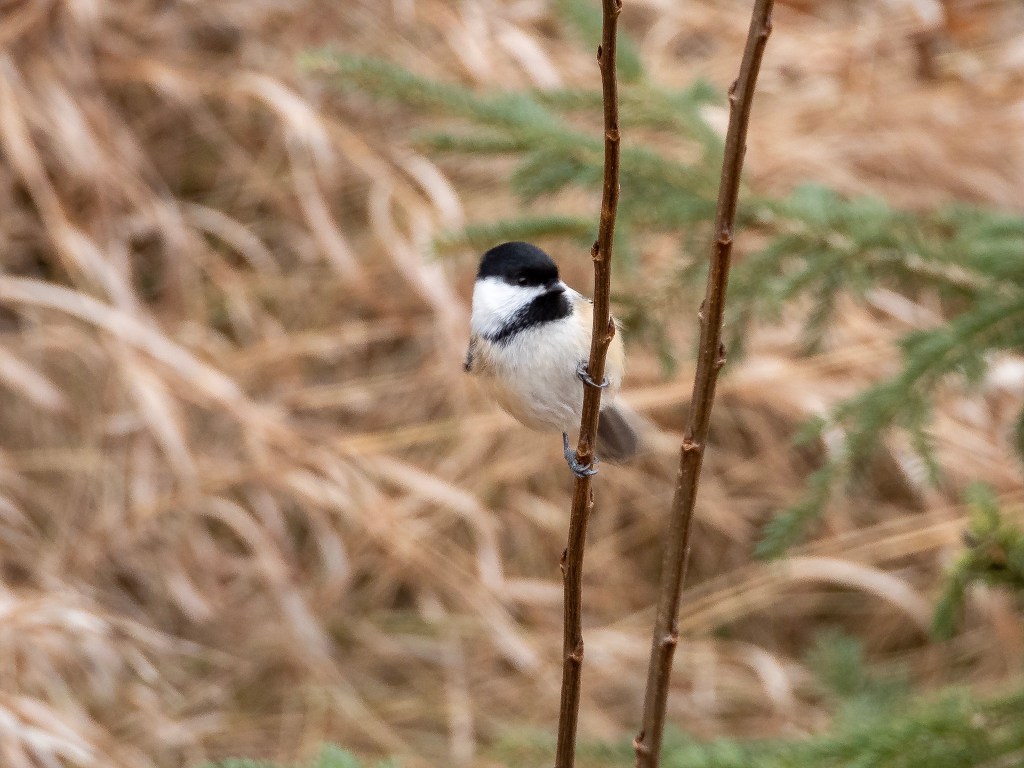
Chickadees might be tiny but they sure know what they want and make sure you know what it is. They regularly follow one along as you go for walks in the forest. They flutter around, chirp and it is pretty clear that they are hoping for a treat. They might be common and in your face, but they are que painful difficult to photograph as they never seem to sit still. They are always moving and on the go. This fella sat still long enough for me to quickly take a picture, but before I knew what had happened it was off and on to a different branch.
May the curiosity be with you. This is from “The Birds are Calling” blog (www.thebirdsarecalling.com). Copyright Mario Pineda.
Abandoned and left to the elements these nest – two cup shaped nests right next to each other – are rapidly succumbing to rain, snow and wind. Without the protection of the leaves or the upkeep of their tenants it is clear that they will not make it through the winter unscathed. With one of the nests essentially disintegrating and the other hanging on by a strand of grass I doubt there will be anything left in the spring.
May the curiosity be with you. This is from “The Birds are Calling” blog (www.thebirdsarecalling.com). Copyright Mario Pineda.
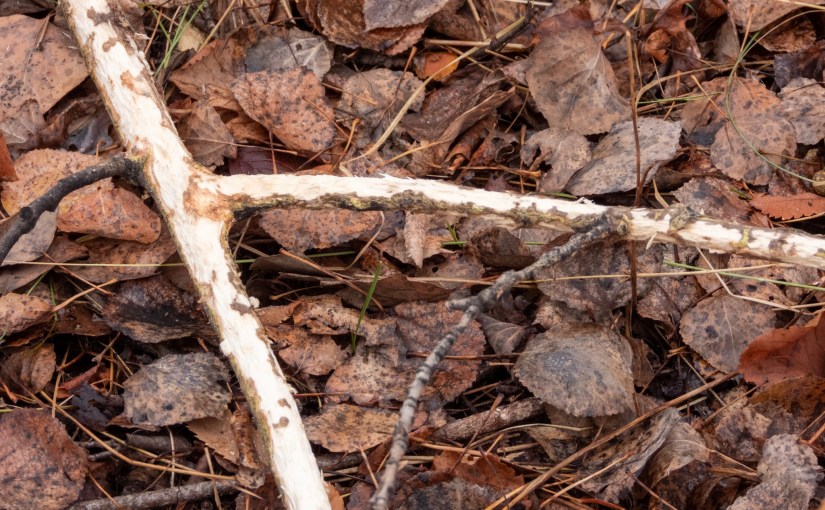
Beavers are not the only ones that like to consume bark as part of their diet. Last week in the forest by the Heritage Wetland Ponds I came across a large number of branches that had been debarked. To my best knowledge there are no beavers at this location and the branches were not by the water, so the question is what other animals would debark branches in this way? bit of research reveals that squirrels, voles and porcupines also chew bark for food. based on the amount of branches that had been chewed my guess would be that it was likely porcupines that chewed the bark off these branches. Just like beavers, porcupines chew through the outer layer of the bark and consume the inner bark, also known as phloem.
May the curiosity be with you. This is from “The Birds are Calling” blog (www.thebirdsarecalling.com). Copyright Mario Pineda.
With the leaves gone, the branches are exposed revealing nests that were occupied just a few months ago. Meticulously constructed using twigs, grass and lined with feathers these were the domiciles where baby birds were hatched, reared and before moving out and moving on in life. Of course, when the nests were inhabited they were well-concealed by foliage. Will the same inhabitants return next year? Will new tenants move in? Are these disposable nests used only one season? What shape will the nest be after the winter?
May the curiosity be with you. This is from “The Birds are Calling” blog (www.thebirdsarecalling.com). Copyright Mario Pineda.
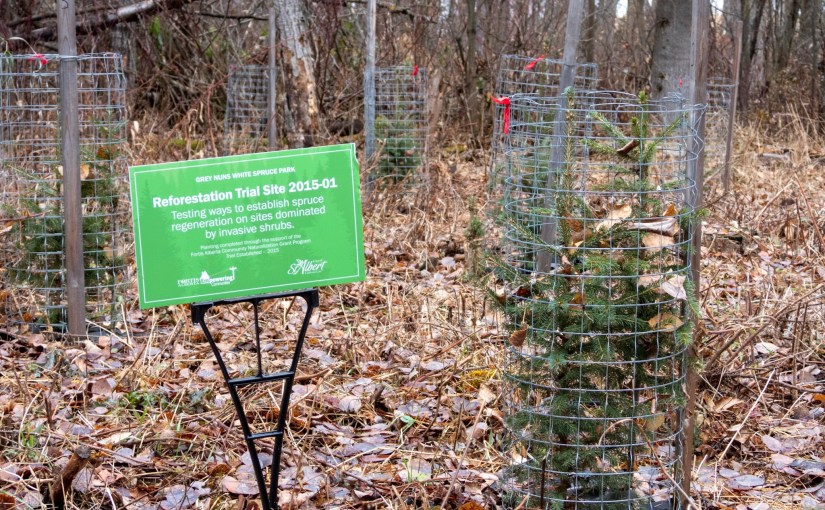
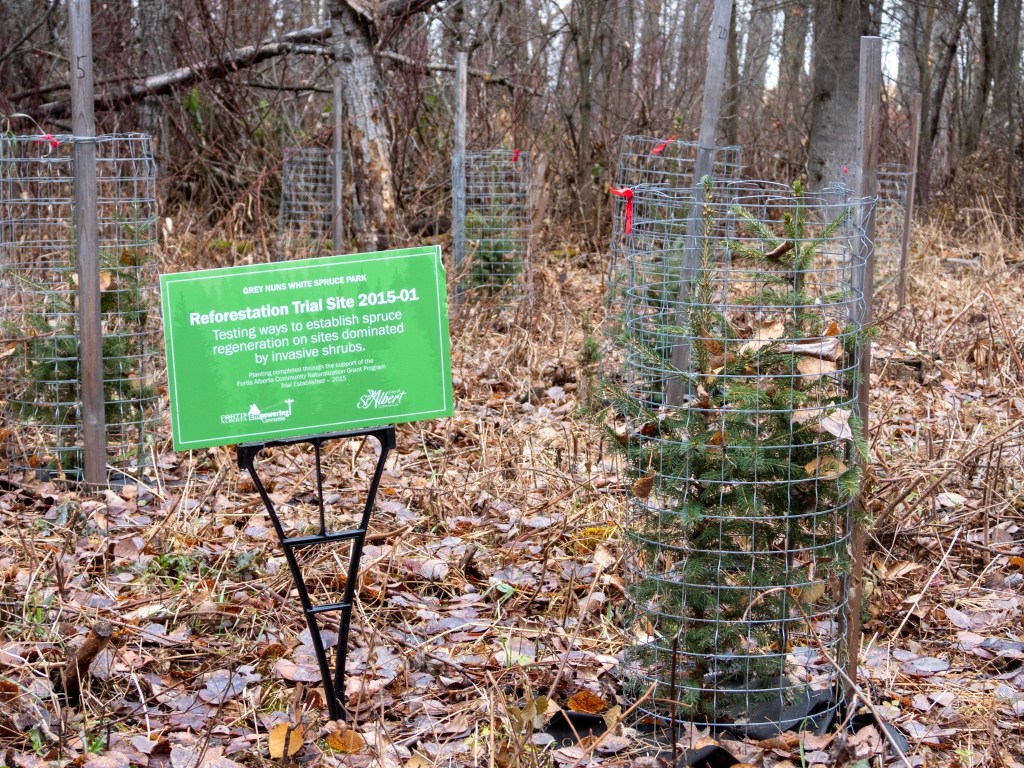
Throughout the city parks and forests one encounters locations that are undergoing reforestation. Typically these are locations that were invasive species have been removed followed by an attempt to reintroduce native species. I say “attempt” because most invasive species are very aggressive and once established they can me almost impossible to eliminate. Today’s picture was taken at the Grey Nun’s Spruce Woodlot where baby spruce trees have been planted wrapped in metal mesh to protect them from hungry deer and rabbits.
May the curiosity be with you. This is from “The Birds are Calling” blog (www.thebirdsarecalling.com). Copyright Mario Pineda.
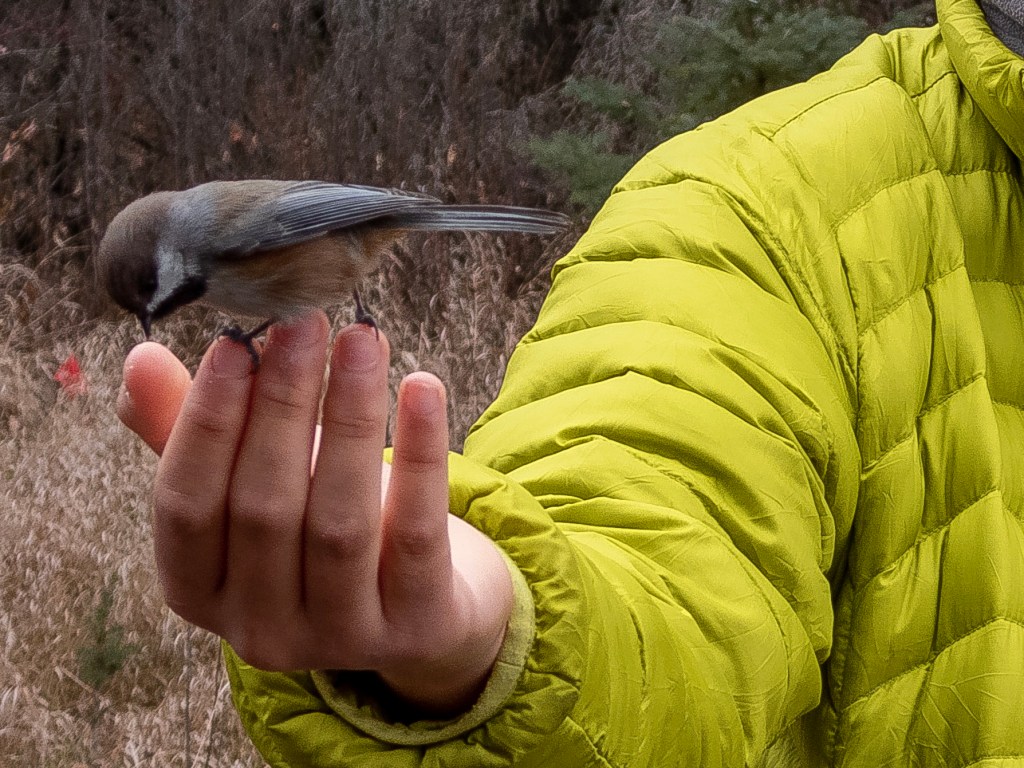
As I was saying in yesterday’s post, the chickadees at the Grey Nuns Spruce Woodlot were out in full force. Accosting us as soon as we arrived. If you stretched out your hand, a chickadee would immediately land on it and start to look for treats, pecking your fingers with its tiny bill. As soon as it realized that there were no treats to be had it would take off, only to immediately be replace by another one. It was a whirlwind of chickadees and, as usual, I identified them all as Black-capped Chickadees.., that was, until I was going through the pictures the next day. I realized that one of the chickadees did not look like the others. Instead of a black capped head it had a brown head with more brown throughout its body. In the freeze frame picture it is easy to see (if you pay attention) that this is a Boreal Chickadee. Boreal Chickadees are typically solidly outnumbered by the Black-capped Chickadees and I a rarely lucky enough to spot one. This is the first picture I have taken of a Boreal Chickadee. It’s a bit ironic that I did not realize what I had taken a picture of until the next day.
May the curiosity be with you. This is from “The Birds are Calling” blog (www.thebirdsarecalling.com). Copyright Mario Pineda.
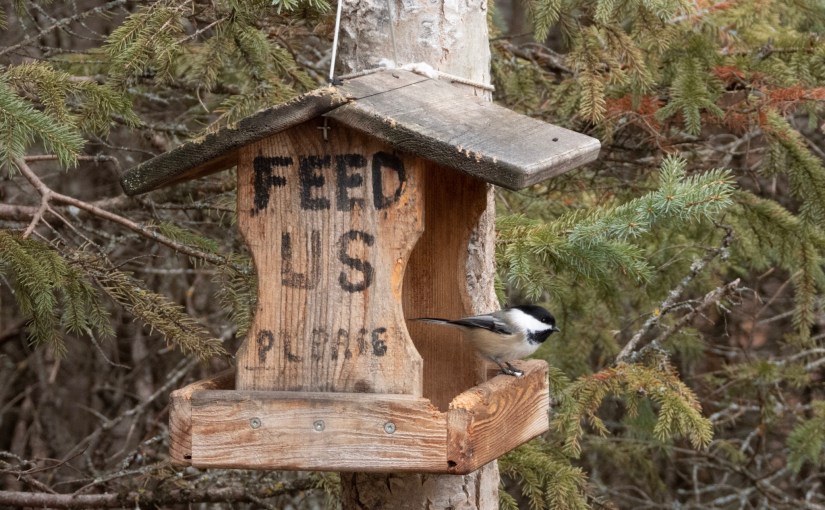
We went to the Grey Nuns Spruce Woodlot today. This patch of forest is a remnant of a much larger forest that existed at the time of settlement of the St. Albert area over 170 years ago. It is an old-growth forest that is squeezed in between the busy Ray Gibbon Drive, the Joy Centre and sprawling sub-division developments. The forest is just over 40 hectares in size and contains a diversity of tree covered, shrub and grassland areas. Among birders the area is perhaps best known for its large number of Snowy Owls during the winter. It was here that I spotted my first Snowy Owl last winter. During our visit today we went on the narrow trails winding through the forest. As soon as we arrived we were accosted by a band of energetic and chubby Black-capped Chickadees that required us to appease them with food. They simply did not take a no for an answer and continued to follow us through the forest. I suspect that they probably are used to being fed by humans, which was further corroborated when we came across an old dilapidated feeder hanging just off the trail where the chickadees had spray-pained “FEED US PLEASE”. We did not bring any food for the feathered denizens of the forest this time, but clearly next time we will have to make up for this.
May the curiosity be with you. This is from “The Birds are Calling” blog (www.thebirdsarecalling.com). Copyright Mario Pineda.
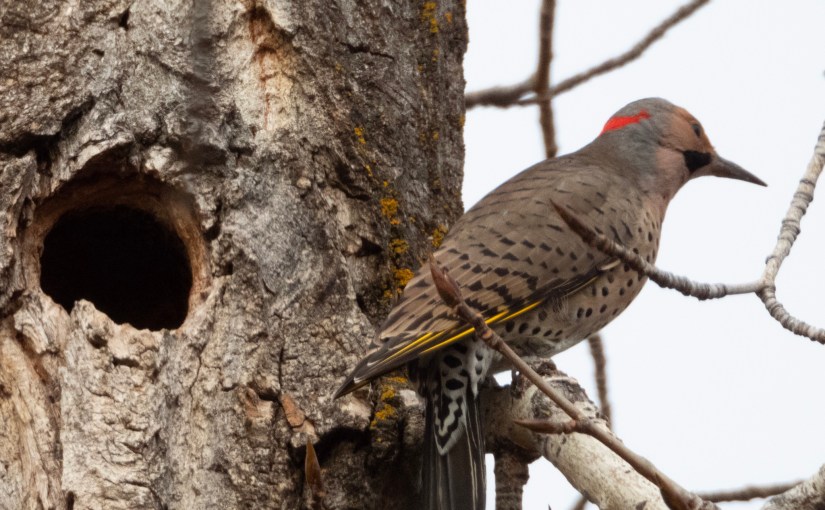
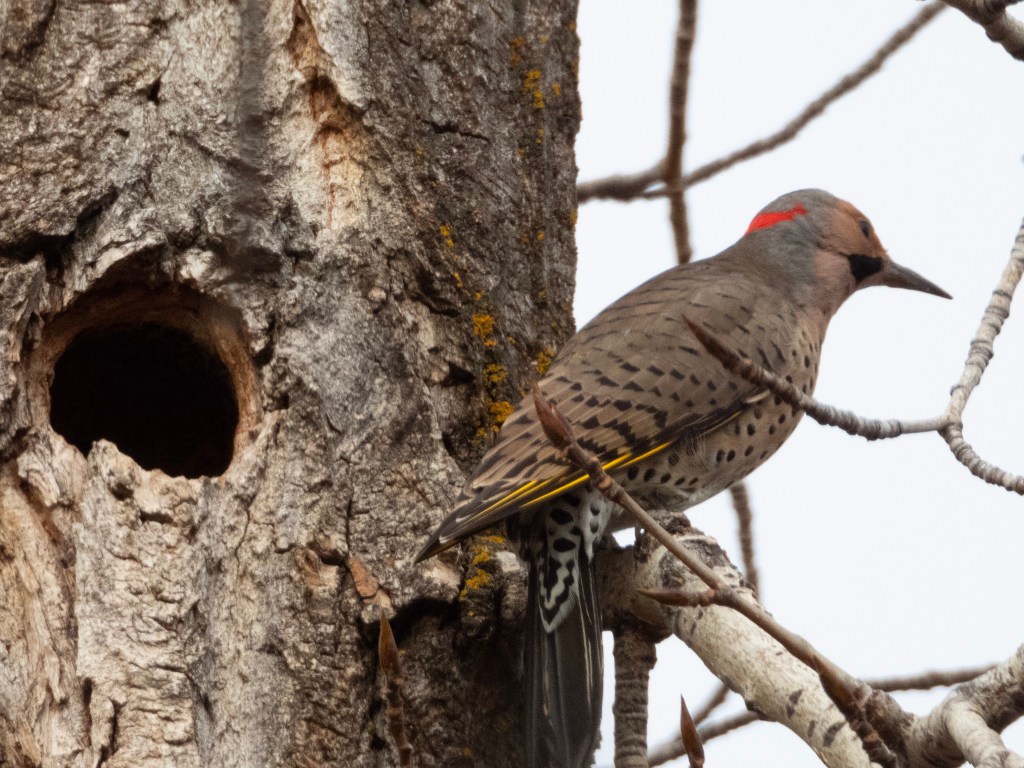
I came across a Northern Flicker today sitting on a trunk working on its nest. Earlier during the summer I saw a flicker at the same cavity, so I assume it could be the same individual. There are two quite different-looking forms of the species, the Yellow-shafted Flicker in the east and north, and Red-shafted Flicker in the west. This particular individual had the red crescent on its nape distinct of the Yellow-shafted Northern Flicker. The dark “mustache stripe” by the beak indicates that it is a male.
May the curiosity be with you. This is from “The Birds are Calling” blog (www.thebirdsarecalling.com). Copyright Mario Pineda.
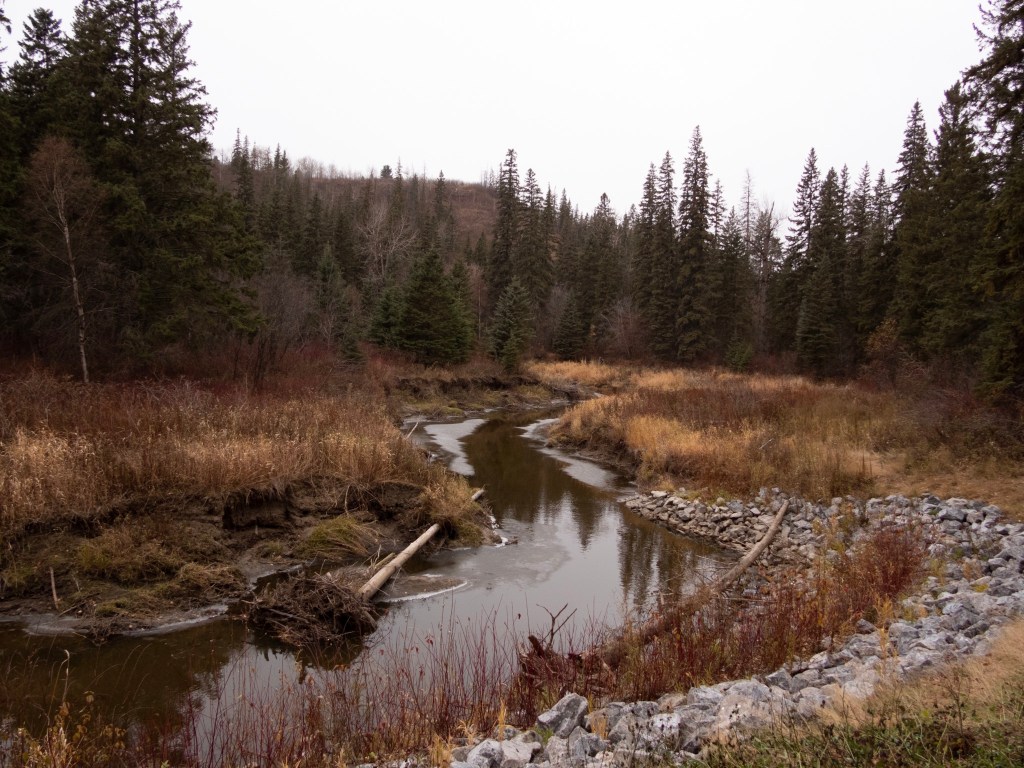
A meandering creek (or river) is a a creek characterized by a series of regular sinuous curves, bends, loops, turns or windings in the watercourse. A meander is produced by the river as it erodes the sediments of an outer (or concave) bank and deposits this and other sediments downstream on an inner (or convex) bank. The concave side of a meander is often referred to as a cut bank and the convex side as a point bank. Over time the result is the formation of a meandering course as the channel migrates back and fort across the direction of the floodplain. There is a whole lot of physics and math behind the formation, dynamics, size and shape of the meanders. The Whitemud Creek is meandering its way through the Whitemud Ravine and the erosion that takes place during this process is very noticeable on a seasonal basis. Particularly the cut banks seem to be advancing at a very fast pace with lots of trees succumbing and falling into the river as sections of the bank collapse into the creek. I am sure the busy work of beavers – i.e. removing trees – accelerates this erosion process. We humans are not, however, idle. In an effort to control the erosion and the ever-shifting course of the creek large swats of cut banks are covered in rocks, mesh and planted with fast growing plants. In today’s picture you can see a cut bank covered in sizable rocks in an effort to reduce the erosion and stabilize the bank. It seems, however, that most of these efforts only postpone the inevitable and it seems to be a loosing battle. The combined force of the beavers and the flow of the water is mighty.
May the curiosity be with you. This is from “The Birds are Calling” blog (www.thebirdsarecalling.com). Copyright Mario Pineda.